


The Seawind 1170 is a perfect example of how this Australian catamaran brand is bringing its performance-led designs to Europe
Seawind 1170 review: Nimble Aussie catamaran comes to Europe

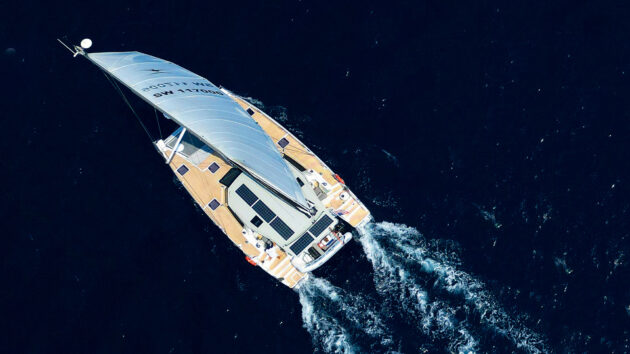
Nearly 800 Seawind catamarans have launched since the brand’s creation in 1983. These were at first all from Australia, before founder Richard Ward took over the Corsair Trimaran factory and moved production to Vietnam in 2008.
Seawind designs have much going for them, and have never sacrificed performance while gaining in comfort over the years. However, with cargo transport costs to Europe at around £45,000, most have headed for Australia and the United States.
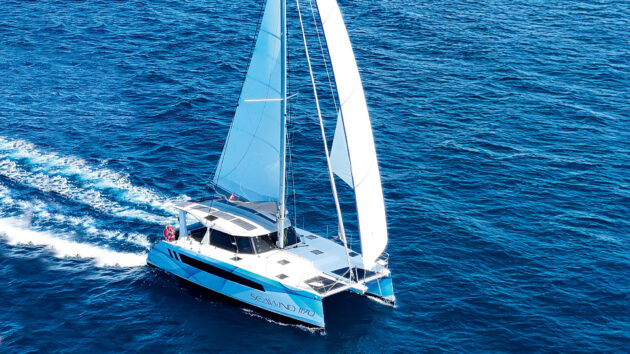
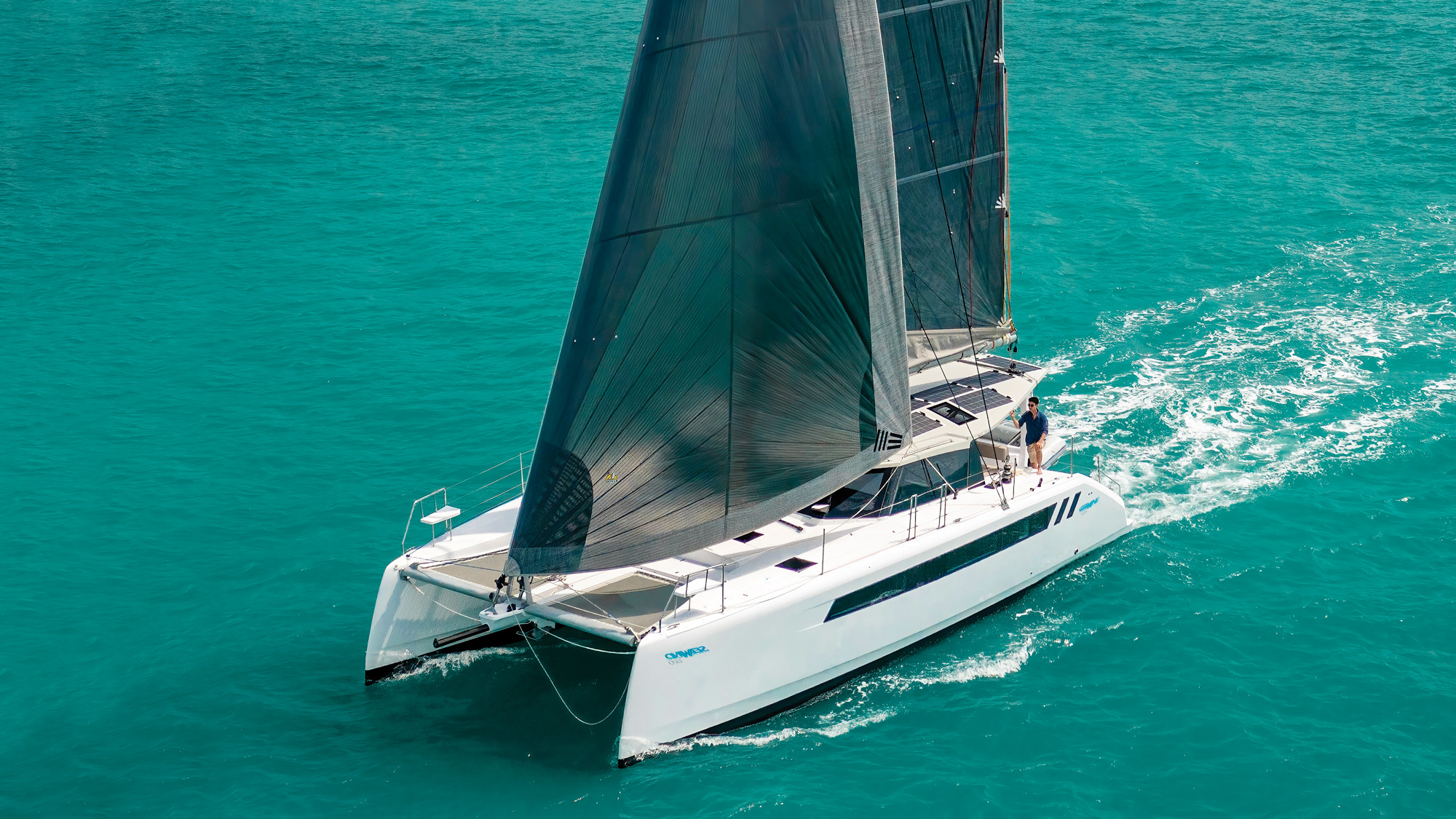
Photo: Seawind Catamarans
This new Seawind 1170 could change that. Although the first two models were built in Vietnam, the moulds were then shipped to Türkiye where a Seawind factory opened in Menemen in 2023 in the Izmir free zone.
The catamarans are built using PVC foam sandwich and Vinylester resin infusion, resulting in a light displacement of 9,000kg for the 1170. This equates to a performance/comfort compromise similar to that of Excess, Nautitech and even an Outremer (but without daggerboards).
Having sailed from the Aegean Sea, hull No5 of the Seawind 1170 was waiting for us in La Grande Motte, southern France, where the International Multihull Show is held every year. If good multihulls reveal themselves in light winds, then we’d find out what the Seawind 1170 is capable of, because the breeze was extremely light.
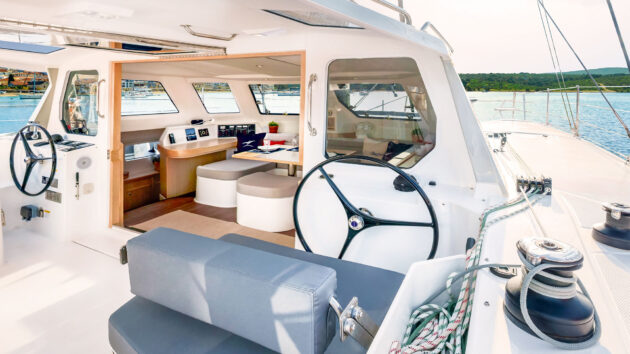
Hinged helm seat backrest allows seating facing forward or aft. Photo: Seawind Catamarans
The Seawind 1170 is nifty and nimble
First impressions were positive: this ‘small’ catamaran pivots lengthwise, nimbly extricating itself from the corner of the port where it was confined, aided by its two 29hp Yanmar engines. We powered away from the coast, the engines at cruising speed, noting 6 knots on the log.
From the port helm station, if you’re alone, or behind it if you are a crewmember, you get an ideal view of the mainsail as it’s hoisted. The same goes for unfurling the Code 0, which is essential in very light winds.
This position of the twin helm stations, on either side of the cockpit and covered by the bimini, offers the helmsman particularly good protection, while the winches and clutches are within easy reach.
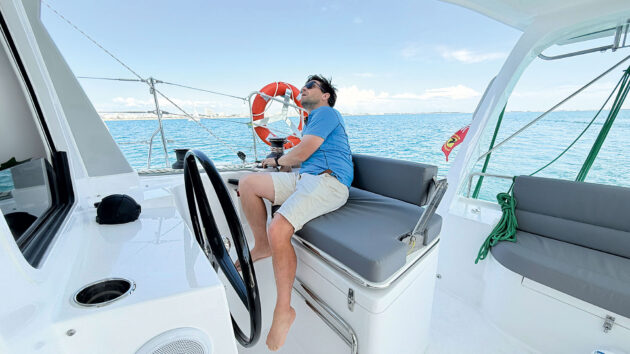
There’s good views from the helms outboard or though the window. Photo: François Tregouet/MULTImedia
You have the electronics in front of you, while the VHF is located inside, but you can reach it because the bulkhead windows slide down into the bulkhead, like a car’s electric windows.
As for the view from this position, it is a little confusing at first because, unless you stick your head out to the side, you are looking through this bulkhead window and the coachroof windows beyond. But you get used to it pretty quickly because the view is almost 360°, with good visibility even under the headsails.
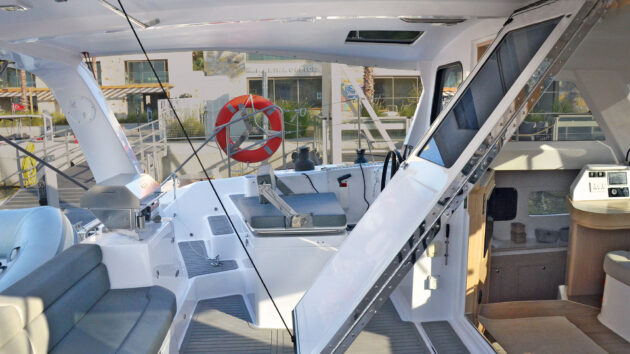
Seawind’s ‘magic door’ folds up to be secured against the bimini roof to completely open up the space between the saloon and the cockpit. Photo: Seawind Catamarans
Aussie nature
For the past 20 years Seawinds have had a ‘magic door’ that removes the boundary between the saloon and the cockpit. Divided into three panels that fold into the centre, the whole thing can then be raised up under the bimini with a few turns of the winch.
Once locked in the horizontal position by a sturdy stainless steel bar, the cockpit and saloon become one (provided you don’t forget the door threshold!). It’s a prime chance to really appreciate this large cockpit, fully protected from the sun.With the essential barbecue and large, opening portlights on the front of the deckhouse promoting natural ventilation, we have three strong markers of a catamaran with ‘Aussie’ genes.
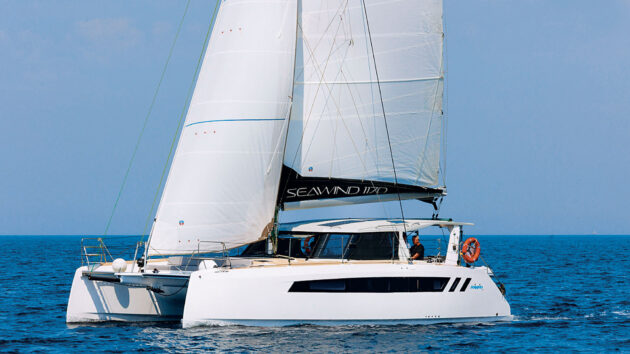
The Seawind 1170 has pedigree breeding and packs plenty in for a 39ft cruising cat. Highlights include fine entry hulls aiding perfomance, good layout and space, and a well protected cockpit. Photo: Seawind Catamarans
Although the 1170 only offers only one three-cabin layout, this is optimised with the port hull entirely dedicated to the owner.
The aft section is occupied by a long bathroom worthy of a much larger boat. In the centre, the passageway provides plenty of stowage space and could almost be described as a dressing room, as the owner’s cabin is located just ahead. The transverse bed is quite high up in the nacelle, but it is accessible from both sides, and the sea view through the long hull portlight is well worth the three steps to climb.
On the starboard side, the guest cabin has its own bathroom forward, while aft there is an extra cabin that can be used for a weekend or for children.
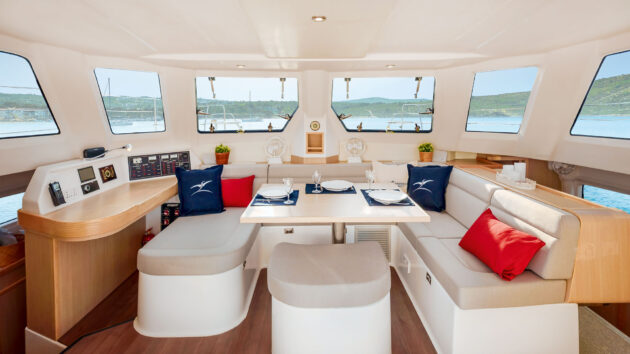
Fixed benches around a table that pivots and lowers. Photo: Seawind Catamarans
The location of the galley in the passageway is a very sensible choice for a yacht of this size. It frees up space in the nacelle, which offers a spacious saloon and a proper chart table on the port side.
The galley is not isolated, however, as it remains open at the top to the saloon. It has attractive worktops and plenty of stowage space for a 39-footer. The inclusion of an induction hob, used in combination with an optional lithium battery pack, follows a global trend away from gas and its associated risks and constraints.
Article continues below…
Seawind 1370 first look: New spacious performance multihull
The market for comfortable and spacious performance multihulls continues to grow. Seawind is perhaps less well known in Europe than…
Excess 13 review: A great ride and much more
We may think we want that performance multihull, a 50ft+ daggerboard catamaran with the legs to average double figures and…
£404,354.00
Light breeze progress
We make good progress under Code 0, despite the light breeze. Admittedly, in these calm conditions the helm feels a little stiff, but we appreciated the very discreet wake left by the Richard Ward-designed hulls.
On our test sail sales director Mike Rees trimmed the mainsail with precision. Its track is offset on the hard bimini, out of harm’s way, adjusted via an endless line on an Antal notched pulley, which works to the inch while being very secure. Further forward, the self-tacking Solent benefits from a curved traveller, but we prefer to stick with Code 0 so that we’re among the few on the water moving almost as fast as the wind.
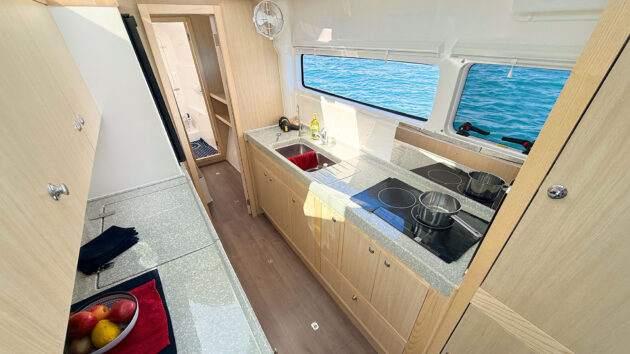
Large linear galley is in starboard ama passageway but still open and connected to the saloon. Photo: François Tregouet/MULTImedia
In this fleeting breeze, the autopilot sometimes steers better than we do, or at least for longer. That gave the opportunity to test the large forward bench seat that spans the entire width of the trampoline, with its luxurious upholstery and backrests. And there are so many places to spend a quiet moment, as a couple or with friends – from the pulpit seats to the wide transom scoops that will be very pleasant at anchor.
The helm seats in particular work well, by using reclining backrests that allow you to sit facing in either direction. The Seawind provides so much space and comfort for its size, it makes me question if we really are on board a 39-footer.
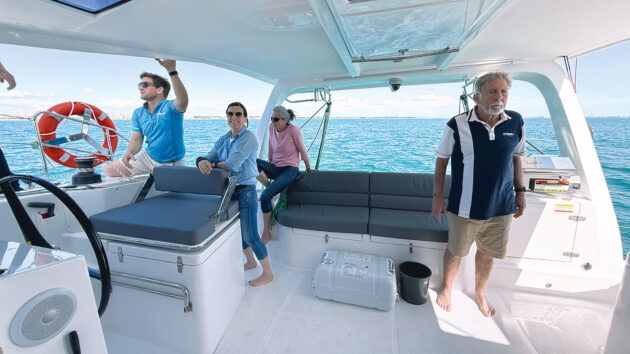
Saloon/cockpit door folded into three; then secured into the roof. Photo: François Tregouet/MULTImedia
When the mainsail falls into its lazy bag, we take a closer look at the fittings. They are clearly high quality, with a Seldén mast and genoa furler, Lewmar winches and sturdy blocks.
A few perceived quality flaws did not escape scrutiny, however. Presumably, toe-rails weren’t included in the mould for the boat so to meet the required CE standard Seawind has placed a cable spanning the bases of the guardrail stanchions to meet the standard – which I felt not very practical. However, the whole boat is CE certified and for this third hull produced in Türkiye the standard is well within European norms.
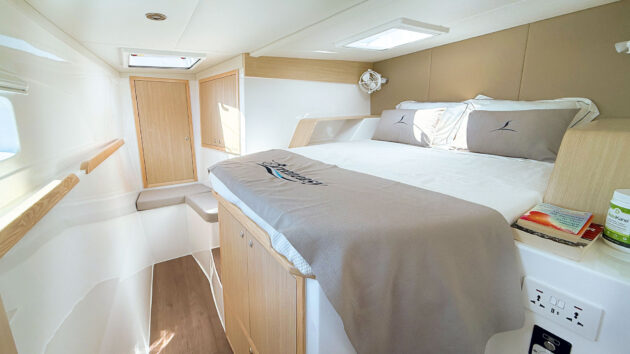
A climb up into the main cabin’s double bed – good stowage beneath. Photo: François Tregouet/MULTImedia
By positioning the production of the 1170 at the gateway of Europe, Seawind is, of course, gaining in competitiveness, but also in visibility. And it shows the brand understands current demand. The light wood chosen for this model, for example, confirms that this boat was designed with the European market in mind.
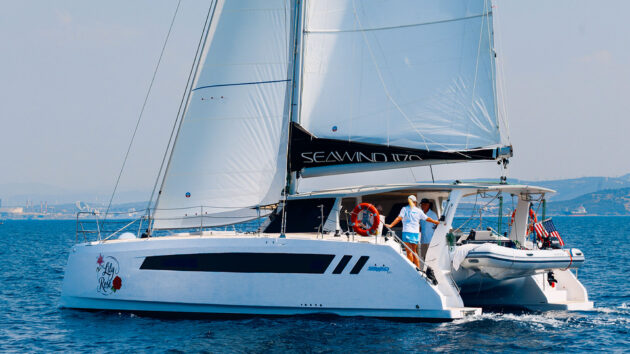
Model: Hull No3, Turkish built, with main options including lithium batteries, B&G electronics package, watermaker, electric winches, Code 0 on furling system. Photo: Seawind Catamarans
 If you enjoyed this….
Yachting World is the world’s leading magazine for bluewater cruisers and offshore sailors. Every month we have inspirational adventures and practical features to help you realise your sailing dreams.Build your knowledge with a subscription delivered to your door. See our latest offers and save at least 30% off the cover price.
Note: We may earn a commission when you buy through links on our site, at no extra cost to you. This doesn’t affect our editorial independence.
Verdict
The Seawind’s Australian roots bring some fresh thinking to the European market, while making it an ideal candidate for the Mediterranean, with its helm positions protected from the sun. But it’s also a versatile and capable cruiser that can tackle the Atlantic and longer offshore voyages. An original and accomplished 39ft catamaran, the 1170 offers everything you need for enjoyable sailing and memorable cruises in a compact and intelligent format. For those who’d like to discover the world of catamarans or downsize to save effort and reduce costs, the Seawind 1170 is an interesting prospect. It can be handled well solo, short-handed or in the company of less experienced crewmembers. And it targets a wide audience, appealing with its versatility, careful construction and a more accessible price thanks to its new production base close to the old continent.
Details
LOA:11.90m 39ft 0in
Beam:6.50m 21ft 3in
Draught:1.20m 3ft 11in
Displacement:9,200kg 19,841lb
Engine:2 x 29hp Yanmar
Fresh water tank:500lt 110gal
Diesel tank:2 x 260lt 2 x 57gal
Height under platform:0.70m 2ft 3in
Air draught :18.80m 61ft 8in
Mainsail:57m2 613ft2
Solent:27.5m2 296ft2
Code 0 (optional):51m² 549ft2
Spinnaker (optional):111m² 1,195ft2