


A bold decision to use different designers helps give the Excess 13 identity and makes a telling difference under sail. Has this lively, modern brand finally come of age?
Excess 13 review: A great ride and much more

We may think we want that performance multihull, a 50ft+ daggerboard catamaran with the legs to average double figures and outrun weather systems. But for cruising and family sailing do we really need all that space, complexity and exorbitant cost that comes with it?
In reality, more multihull cruisers who enjoy fast sailing and active helming will settle for a compromise between the pace and price of an Outremer or Balance-type daggerboard cat, with the all-out volume offered in a shorter length package by major production yards such as Lagoon, Leopard and Fountaine-Pajot.
Positioned in the area between these two ends of the scale, therefore, are a few increasingly popular brands offering fast family cruisers such as Nautitech and Seawind (see page 68). And, having experienced one of the most memorable sails of the season on this Excess 13 – during an autumn when I tested over 20 new production yachts – I’d argue that Excess can now confidently occupy this best-of-both-worlds area too.
Excess evolution
I have liked what Excess set out to do from the outset. Indeed, when it was first heralded as this cool new startup to appeal to a funky new foiling generation of water lovers, it held real appeal. However, I admit to being a little underwhelmed by their first generation products, launched in 2019.
The logic of such a large boatbuilder (Beneteau Group) leaning upon their existing Lagoon range is understandable, but arguably these first Excesses (12 & 15) were too similar looking and were always going to be pushing wide Lagoon hulls through the water. Although Excess soon amassed its own popular following and operating model, it’s arguably only now – with this change of designers for its mid-range fifth model – that it achieves a fresh approach and identity.
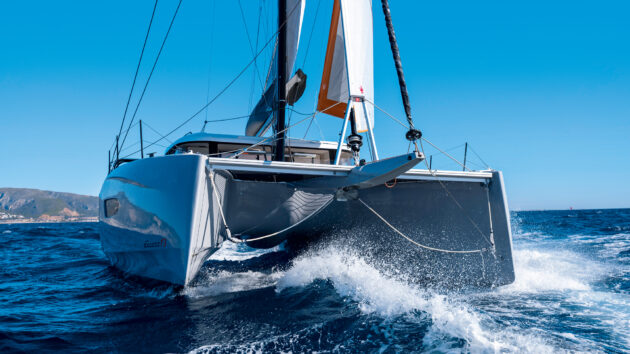
Lombard’s design includes fine entries and narrow waterline beams below the full length hard chines – while maintaining large volumes above. Photo: Andreas Lindlahr/EYOTY
There is no escaping the fact that the other main production cat brand that builds aft helm cats is Nautitech, who use Marc Lombard design, including for its recent award-winning 44 and 48 models. So it’s a brave yet sensible move from Excess to employ the same design firm. On top of that, Excess knew it also had to engineer and build the 13 lighter than its past models, and strictly to the designed weight to ensure telling performance results.
Equally, the designers had to respect the look and feel on which the brand has already established itself. Therefore this is still a big cat, with high-sided voluminous hulls, so how would it behave at sea?
Worth the wait
Although we previewed and toured the 13 at its spring 2025 premiere at the International Multihull Show, we didn’t get a chance to sail it before October. Nevertheless, good things can come to those who wait, and in our case, it was a Force 5 and a hearty swell off the Catalonian coast – conditions which could really expose a catamaran, but ones that helped highlight the opposite.
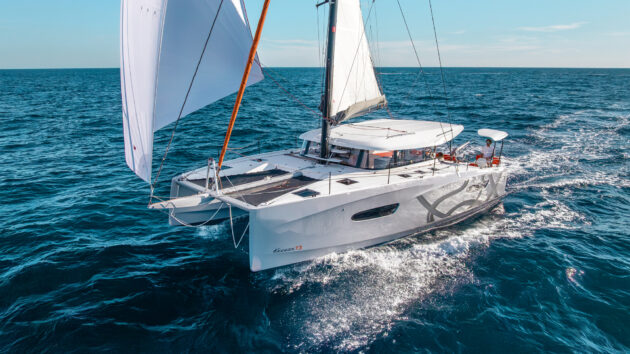
Sculpted sides and graphics help disguise high freeboard, while the coachroof and boom are kept low. Photo: Andreas Lindlahr/EYOTY
Punching out from Port Ginesta into 18-20 knots of true wind, or 25 knots apparent, and a large swell with short wave formation, I knew we were in for some proper testing conditions. It quickly became evident this Excess offers enjoyable, direct steering and a balanced feel, giving that communicative weather helm monohull sailors appreciate.
Beating into what were typically awkward conditions for a cat, the overriding take-home was the motion of the Excess. It consistently maintained high average speeds in the late 7-8 knots at 40° to the apparent wind, through waves which would have stalled other designs.
Granted, we were sailing the more powerful Pulse line version, which adds 9m2 upwind sail area, and was equipped with upgraded sails. Powering along upwind, clocking over 8.5 knots when freed a couple of degrees to 45° apparent, we were on the limit of needing a first reef.
To put these figures into perspective, we were sailing faster and higher upwind than a new 50ft cruising monohull. There was some spray over the deck, and a good amount of water and wind noise at the helm, yet it was engaging, fun sailing upwind (rare for a production cruising cat). Such qualities come from a mix of design and weight management, combined with the ease with which it can be managed, steered and trimmed.
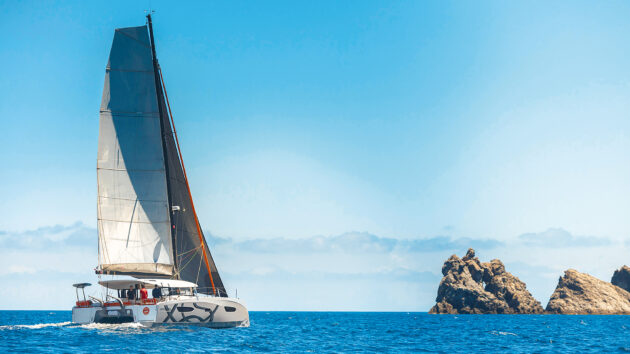
A powerful sailplan on the Pulse Line version. Photo: Thibault Desplats
The mast is brought aft, so the low boom overhangs the coachroof, and the mainsheet is led straight onto the long traveller on the aft beam. The traveller really helps optimise the angle of attack and manages twist, while aiding control of that powerful square-top mainsail.
The layout of the winches and control systems is also well considered for easy handling when short-handed, including this traveller. Its controls lead to a winch (optionally powered) within reach of the starboard helm, from where the rest of the sail controls are also managed. There’s even a locker here for the battery switches and winch breakers.
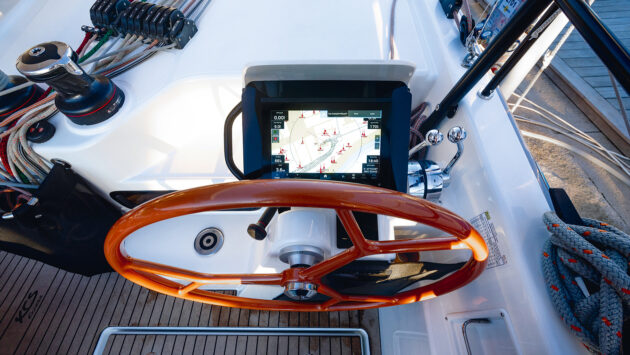
Running rigging leads to winches and a large clutch bank by the starboard wheel. Photo: Andreas Lindlahr/EYOTY
Secrets to success
We now had 26 knots over the deck while sailing upwind into 2+m waves, and I wanted to see how this felt from inside the cabins. Production multihulls can often creak, twist and groan in such conditions, yet the Excess remained comparatively quiet and stiff, with no excessive slamming. Its asymmetric hulls have fine beams below the waterline to slice through waves, yet still swell out from sculpted chines to allow for generous living areas in the hulls above. Lombard’s Eric Levet confirms that their goal was to ensure pleasurable, easy sailing while still maintaining this voluminous accommodation.
As you move through the boat, you also start to appreciate Excess’s attention to weight saving. In engineering terms, the most impressive example is the main bulkhead dividing the cockpit and saloon; it also forms the bulkheads for the aft cabins, creating a single, beam-wide frame that saves weight over separate cabin bulkheads.
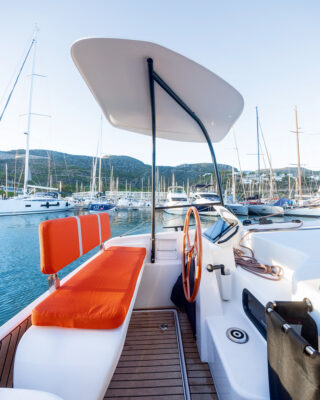
Comfortable helm seat raises for swim platform and engine access. Photo: Andreas Lindlahr/EYOTY
These ringframe sections in the aft cabins are 35mm-thick PET foam sandwich structures, which help create vast openings aft to the berths. As well as infused balsa-cored sandwich hulls, Excess uses a new process it calls ‘infujection’ for the deck – a mixture of infusion and injection technologies designed to keep the sandwich deck as light as possible.
Elsewhere, the internal doors have dual functions, so each cabin door also acts as a locker/closet door, which saves both weight and space and the damage typically done when doors bang into each other.
So it’s less is more. Even the large forepeak sail lockers are left bare, with gel coat only applied if a crew cabin is chosen here. In short, this all helps ensure a lightweight displacement of 10.8 tonnes (2 tonnes less than the 14). And that difference is felt when sailing. Lighter hulls equate to more helm sensitivity, more enjoyment and more time sailing.
The deck design which ensures the yacht is easily managed is also commendable. Floating thimbles lead the genoa sheets aft, providing a tight sheeting angle without requiring heavy fixed tracks. The running rigging is kept uncovered and easy to access, and although this involves some friction routing it around the squared coachroof, it’s a practical system which brings lines to a bank of clutches and two winches by the starboard helm.
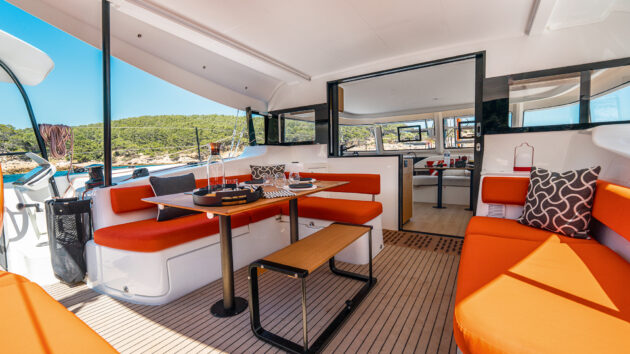
Plenty of downtime space on long, wide benches and lightweight furniture. Photo: Yann Riou/polaRYSE
The side-decks are particularly wide, which you really notice from the low helms as it makes for a field of white glassfibre. But they are clean, free of tripping hazards, and incorporate a good toerail and bulwark. There are also long handrails inboard on the coachroof. Steps by the mast base help provide easy access to the composite roof, which can be left bare, covered in solar, or integrated with ‘skylounge’ seating or a convertible fabric bimini section. The coachroof also has wells for harvesting rainwater.
Elsewhere, stowage on deck is generous, particularly forward in the bridgedeck lockers and sail lockers in each forepeak.
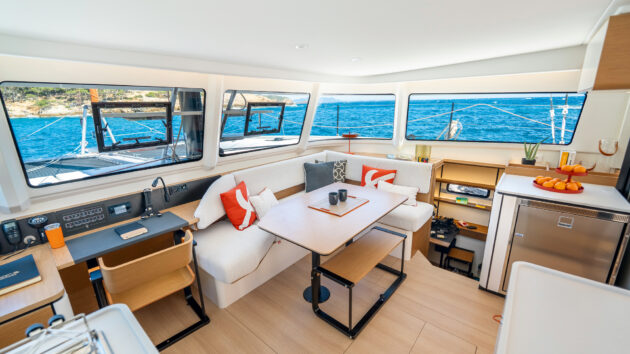
Smart features include the U-shape alcove between cockpit and galley, the forwardfacing navstation, and opening portlights. Photo: Yann Riou/polaRYSE
The case for aft helms
It was time for the real fun, to turn off the breeze, unleash the Code 0 and start averaging double figures with ease. For all-out speed, a gennaker would have allowed us to run deeper with the wind and waves and surf more, yet the Code sail still enabled us to reach across and then turn onto some waves for short surfs. This was properly engaging early evening sailing, clocking surfing speeds of 13-14 knots.
Lombard’s signature reverse sheer helps maintain clear views from the wheel to the bows, where the spray fizzed hypnotically off the leeward stemhead. It looks good and feels good. And while I was revelling in the sailing, I was conscious of the arguments for the generic drawbacks of an aft helm cat.
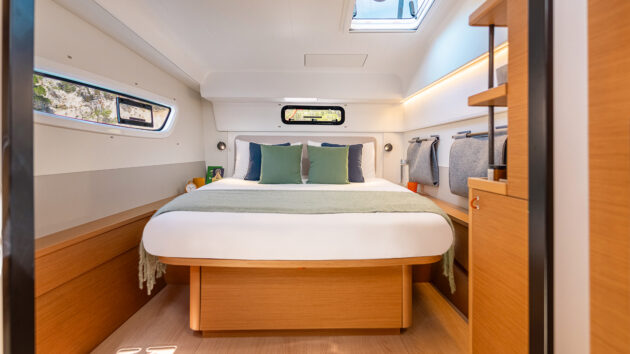
Spacious owners’ suite. Photo:Yann Riou/polaRYSE
These usually boil down to impaired visibility forward and a lack of protection for the helmsman. The Excess offers good visibility from the helms through the notably clear, straight windows (watch our video for confirmation). If you do want to make the near 20ft traverse to the other helm, to check telltales or see what’s to leeward, it’s also balanced enough to give you time to do this without needing to engage autopilot.
Excess’s new folding platform transoms helps make it feel more secure while helming. These form swim platforms in their lowered state and make it easier to step aboard from a dock or from the dinghy. Yet when raised, they seal off the transom scoop area properly (having once witnessed my young daughter walk straight off a cat’s transom, I remain wary of relying on a guardwire or two to keep small crew/pets in). The bench seat, easily wide enough for two, also lowers down to help the helmsman feel contained in the boat.
The helm biminis provide sun protection and have been improved over earlier models. However, one aspect I was less prepared for was the noise from back here at the wheels. Above the hearty apparent wind roared the noise of the wake. Despite Excess’s efforts to reduce weight, these are still voluminous hulls that create drag, and when you’re steering from so close to that wake, it’s loud – until you start planing of course…
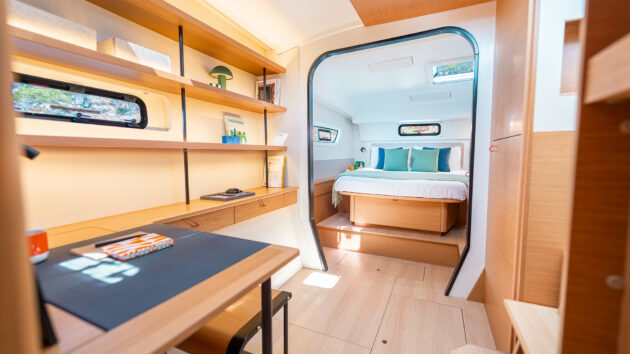
The Owners’ suite features a desk for home working, a walk-in closet and a generous en suite. Photo: Yann Riou/polaRYSE
… Which happens at around the 10-knot speeds we were now averaging with the wind. Even when just two-sail reaching in 16-20 knot winds in the fading light, we could still encourage the hulls to release. It was harder to manage this or surf without the larger Code/headsail but the Excess continued to offer enjoyable and easy fast reaching across the waves. It was the type of sailing you didn’t want the fading light to put a stop to.
Getting comfortable
The modern, bright style of an Excess, combined with its focus on reducing weight for this model, results in an airy and minimalist look. It’s not Spartan, but it’s more Ibis than Hilton, more colourful French wipe-clean decor than heavy traditional joinerwork. The fiddle-less tables and lightweight bench seats are quite basic, for example.
That said, Jean-Marc Piaton has added some flair and classy touches. His brief was to keep it light, make it look light, while improving perceived quality. Non-slip cork in the bases of lockers and stowage units and carbon fibre rods to lighten furniture and shelves are examples.
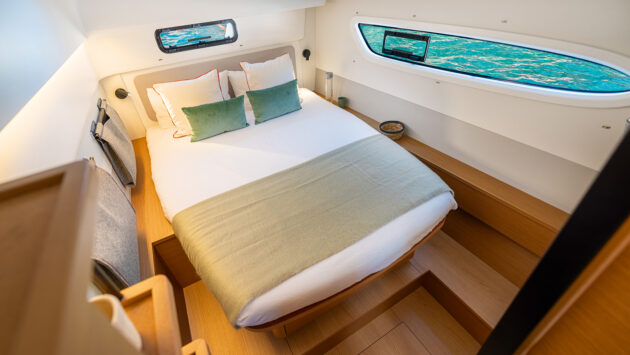
There’s a good size berth in the second main cabin, too. Photo: Yann Riou/polaRYSE
Galleys on cats can typically link the cockpit and saloon, but Excess has managed it well by creating a worksurface you can use from standing outside or in. This is thanks to U-shape section forward of the cockpit table – with the bulkhead doors open, you can stand here and work at the sink and countertop, and stow crockery in a locker with drying rack outboard. It eases circulation. There’s also extra refrigeration space available opposite. Deep double bins are located in the most practical position, as they pull out from beneath the inboard countertop, accessible from the passageway between cockpit and saloon.
Another prime feature is the forward-facing navstation. It provides an ideal protected position to passage plan and potentially even sit a watch, as forward visibility is unhindered. Meanwhile, two large forward-facing sections of the coachroof windows open for valuable natural ventilation here.
In terms of accommodation, it’s the norm, with three or four cabins offered. We had the former, which has a hull dedicated to owner space to starboard. The first thing you’ll gawp at down here is the beam and sheer space it provides for long term periods of living aboard. The hulls are wide enough aft to offer cutaways each side of the berth. This master cabin also features a forward-facing desk for home working, a proper walk-in closet and a generous, light and bright en suite, including twin sinks and a separate shower compartment.
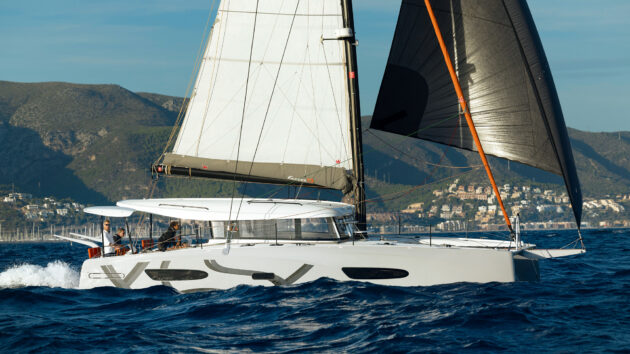
Toby enjoying some direct steering and fast reaching with the Code 0 through the swell. Photo: Andreas Lindlahr/EYOTY
It’s a similar situation to port, where the forward cabin is particularly large for a yacht with performance nods, and includes the same size berth as on the Excess 14. Both port cabins have their own heads, which are linked by and share a large central shower compartment, although the forward heads can be swapped for a laundry area.
Excess 13 specifications
LOA: 12.99m 42ft 7in
Beam: 7.25m 23ft 9in
Draught: 1.48m 4ft 10in
Light displacement: 10,800kg 23,810lb
Upwind sail area: 115m2 1,238ft2
Upwind Pulse line: 124m2 1,335ft2
Engines: 2x Yanmar 40hp saildrives
Fuel: 2x200lt 88gal
Water: 300lt 66gal (+ optional 300lt/66gal)
Design: Marc Lombard & Piaton Yacht Design
Price as tested: €628,00
Contact: excess-catamarans.com
 If you enjoyed this….

Yachting World is the world’s leading magazine for bluewater cruisers and offshore sailors. Every month we have inspirational adventures and practical features to help you realise your sailing dreams.Build your knowledge with a subscription delivered to your door. See our latest offers and save at least 30% off the cover price.
Note: We may earn a commission when you buy through links on our site, at no extra cost to you. This doesn’t affect our editorial independence.
Verdict
The conditions we experienced really helped showcase what this Excess 13 can do and how the attention to its weight management has paid off with the motion and agility it offers – it’s a winning combination of ease, sportiness and manageability. The Excess is an ideal size for family cruising, with a great layout for short-handed sailing. Aft helm layouts will always divide opinion and, as always, I advise you try them before forming that opinion. Personally, I found they help encourage you to keep sailing, hands-on. The Excess also offers more accommodation volume than any other yachts in its category. The airy decor and lighter weight fittings will more suit warm weather sailing, which it has been well set up for with its natural ventilation, convertible roof option and/or solar space. Its beamy hulls and high freeboard won’t help it win a beauty prize. And you’ll need the Pulse line taller mast to extract the best out of it. But with this 13, Excess now offers spirited sailing, combined with a luxury of space and comfort that could make you exceedingly popular with family and friends.