



From Jules Verne trophies to solar-powered exploration, Matt Sheehan explores how the world's toughest boats refuse to head for the scrap

From crushing it to make garden furniture, to sending it through a complicated process to strip the resin from the fibre, or turning it into an energy source, there’s no shortage of ideas about what to do with your boat once you and everyone else who has owned it have finished with it.
In a world focused on sustainability, the marine world has been considering for some time how to squeeze the most out of the planet’s resources.
There are plenty of good examples, not least by the French who have established a mandatory recycling system. Manufacturers pay a levy on new boats and annual taxes fund the Association pour la Plaisance Eco-Responsable to dismantle them. Boats from 2.5-24m are taken to one of the 37 authorised centres across France. For boat owners the service is free.
And yet the irony is that, in the racing scene at least, France seems to squeeze the most out of their machines already. In fact, you could argue that a recycling system for the IMOCA fleet is currently irrelevant as none of the boats seem to have reached the end of their lives – they keep bouncing back to complete yet another Vendée Globe.
It’s true of their big machines too with the latest being remarkable for the staggering new record it has set 25 years after it was first launched. As solo French sailor Guirec Soudée crossed the finishing line after around 40,000 miles around the world this spring he didn’t just better an existing record – he obliterated it, taking almost 28 days off the previous best. And he did what no one else has managed to do by taking a giant 32m Ultim trimaran non-stop, the wrong way around the world.
Article continues below…
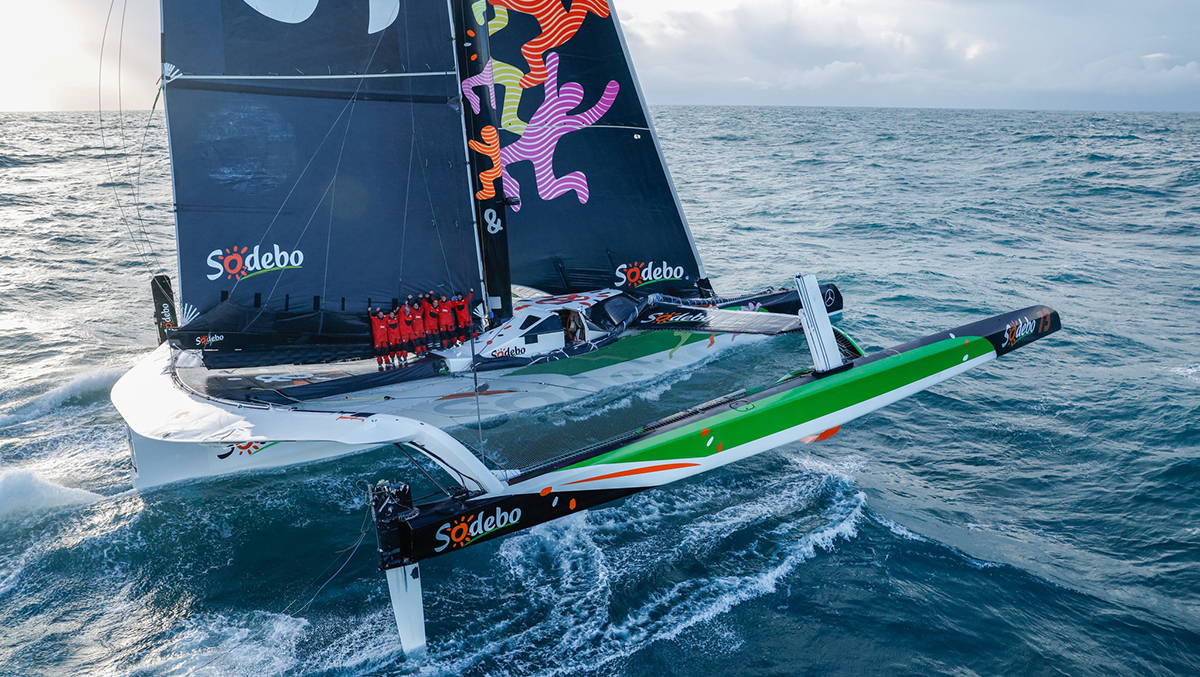
Around the world record broken: Sodebo takes Jules Verne Trophy in 40d 10h 45m
Thomas Coville’s Sodebo team crossed the virtual finish line between Ushant and Lizard Point this morning at 0746 (French time),…
His boat MACSF was originally launched in 2001 for Olivier de Kersauson and named Geronimo. She was 34m overall back then, designed and built to set new trans-ocean and around the world records. In 2004 de Kersauson and his crew took the Jules Verne Trophy, lapping the planet the right way in just over 63½ days. From there she set several other records, including the Trans-Pacific and the Challenge Round Australia.
In 2013 she was bought by Sodebo to be heavily modified with the aim of winning the 2014 Route du Rhum with Thomas Coville at the helm. The design side of the refit fell to VPLP who created what was to become the precursor to the Ultim class. The work was extensive, with the central hull replaced and extended by 3m. The beams were reinforced so foils and rudders could be added to the floats, which were also rebuilt. A new mast completed a machine that was now 6 tonnes lighter.
After a tricky start to her career that began with a collision with a freighter in the Route du Rhum, Sodebo went on to break records again including a new solo round the world time, and a transatlantic record.
Sold in 2021 she became Actual for Yves le Bleve and then Mieux for Arthur le Vaillant. She was renamed MACSF when Guirec Soudée bought her last year and now has another record on her CV. And there are plenty of other French racing machines not yet ready for the scrap heap despite many thousands of miles under their hulls.
Take the 28m cat ENZA. Famous for setting the Jules Verne in 1994, today this boat is still lapping the planet, albeit at a slower pace. It started life as the 80ft Formula TAG in 1983 before becoming ENZA in 1994. Designed by Nigel Irens she was the first ocean racing cat to be built almost exclusively of carbon fibre and the first boat to break 500 miles in 24 hours. In 1994 she set a round the world fully crewed record of 74 days.
In 1997 she was bought by Tracey Edwards and renamed Royal & SunAlliance. Despite dismasting in their Jules Verne attempt in 1998 she broke seven world records.
Tony Bullimore had her next, renamed Team Legato and lengthened to 100ft for The Race in 2000. But 2010 almost spelled the end of her career after she capsized off Cape Finisterre in just 15 knots of wind. Too old, too tired and too damaged, was this the end? No. In 2015 she was converted to sport two wingmasts, acres of solar panels and more accommodation to take on a new life as a fully green, sustainable exploration vessel. Since then Energy Observer has clocked up almost 70,000 miles.
So if ever there were cases to prove how a sport that may seems excessive and wasteful could be quite the opposite, these examples prove there’s plenty of life left in race boats and that you should look elsewhere for garden furniture raw materials.
 If you enjoyed this….
Yachting World is the world’s leading magazine for bluewater cruisers and offshore sailors. Every month we have inspirational adventures and practical features to help you realise your sailing dreams.Build your knowledge with a subscription delivered to your door. See our latest offers and save at least 30% off the cover price.
Note: We may earn a commission when you buy through links on our site, at no extra cost to you. This doesn’t affect our editorial independence.