



What is the ideal yacht? Janneke Kuysters gets real-life answers from experienced cruisers on how to choose the perfect boat for you
Is there such a thing as the perfect cruising yacht? Most long-distance cruisers will answer ‘yes’ – and point at their own vessel. But the differences between all these ‘perfect’ boats are huge, as are the compromises every cruiser inevitably has to make.
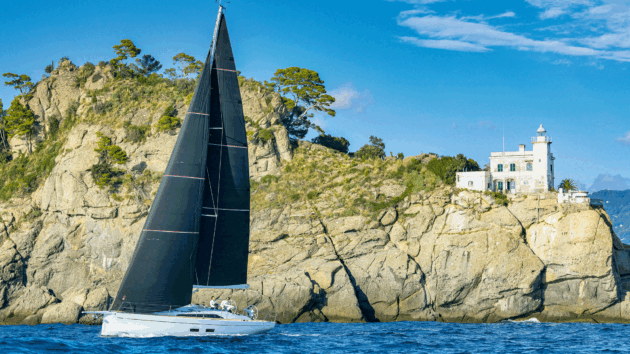
A current production yacht, such as this Jeanneau SO415, may suit those seeking light, spacious living quarters, and a modern hull shape. Buying new can also open up more finance options. Photo: QAPTUR
Which yacht is right for you will depend on a lot of variables. Your experience, your itinerary, the crew on board, the ease of handling and level of redundancy you require, the level of luxury needed to keep everyone happy while spending years voyaging. There are lots of factors to think about. Your perfect cruising yacht is one you feel good about and more than a list of tick-boxes. But there are some variables you need to consider:
- Budget: the bigger the boat, the higher the budget for maintenance and insurance you’ll need. Do you want to leave with a boat that is ready, or do you plan to continue making upgrades underway?
- Itinerary: for high latitude cruising, shelter and a strong hull is essential. However, if you’re planning on sailing in the tropics, you’ll want to prioritise outdoor space and lots of hatches.
- Crew experience: will the boat be forgiving of an inexperienced crew’s learning curve, or do you have the experience to sail a more sensitive yacht? How much expertise do you have among the crew when it comes to maintenance and equipment?
- Number of crew: a solo sailor or a large family have very different demands for space, cabins and ease of handling.
- Sailing style: does the boat fit your ambitions when it comes to seakindliness versus speed/miles covered?
- Full-time or part-time: if you sail year-round, the boat is your home and, inevitably, you have more stuff onboard. Lighter boats can be more weight sensitive, so you have to take that into consideration.
- Equipment: how high-spec do you want to get? Do you have the skills to solve tech problems when they arise? Are you prepared to wait in port for spare parts to arrive, or do you prefer to follow the ‘what you don’t have, won’t break’ philosophy?
Taking all these factors into account, we asked experienced cruisers to explain their choices for their perfect yacht – and what they’d recommend to others.
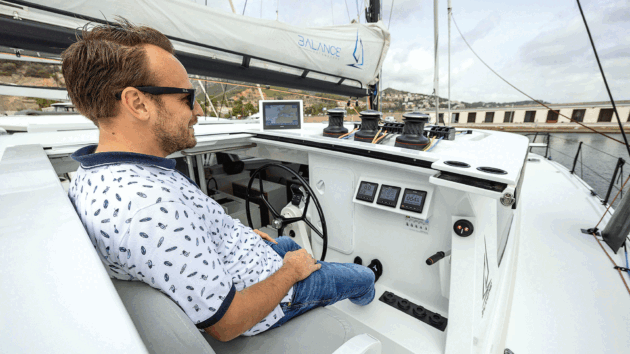
Boat shows are a chance to try different cockpit and living space layouts, such as the adjustable helm station on this Balance 482. Photo: Andreas Lindlahr/EYOTY
Long keel liveaboard – Island Packet 465, Seminole Wind
British cruisers Terry and Alan Ryall enjoyed sailing their previous Vancouver 38 pilothouse for many years, exploring European coastal waters. After retiring they were looking for a larger boat for longer-term offshore cruising and living on board.
“We would have loved a larger Vancouver, but they were not being built. By chance we had the opportunity to buy an Island Packet 465 (49ft), which has all the features we were looking for: sturdiness, centre cockpit, cutter rig, long keel and easy handling,” Alan explains. “Before our Atlantic crossing, we added a generator, watermaker, wind generator, and solar panels.”
Terry adds: “The Island Packet has a long keel, but only a 1.6m draught. This was perfect for our cruising area.”
The couple cruised for six years in the east Caribbean, the Florida Keys and the east coast of the US. Then they spent six years exploring the west Caribbean, where a shallow draught is needed to get into the hurricane holes like Rio Dulce. “The conservative rig with only a 63ft mast made it possible for us to weave in and out of the Intracoastal Waterway,” says Alan.
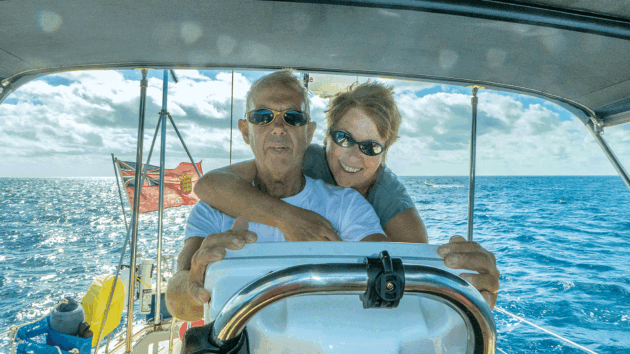
Terry and Alan Ryall. Photo: Alan Ryall
A lightning strike in the Florida Keys was a disaster at first, but proved an opportunity: by replacing the equipment, they could install upgrades that matched their experience with offshore cruising.
Seminole Wind’s downwind performance is very good, but the Ryalls had to compromise on upwind performance. “We didn’t buy this boat for round-the-cans racing, but with a bit of tweaking we are relatively fast upwind. Our angle is between that of a deeper fin keel and a catamaran. The traditional design means we have a relatively short waterline. We reach hull speed easily.”
Alan has learned to love Seminole Wind’s bow thruster. “It makes it so much easier to get into tight spots, because backing a large yacht with a long keel is not easy. Without it, we’d need a lot more space to turn.”
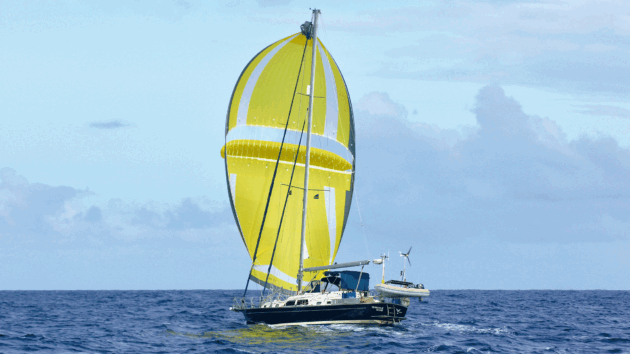
The Ryalls’ 2011 Island Packet 465 allowed them to cruise shallow waters and the Intracoastal Waterway. Photo: Alan Ryall
Custom cutter – Jarrett 50, Steel Sapphire
Scottish-Australian couple Peter and Jennifer Bernard left Sydney in 2018 on their Jarrett 50 Steel Sapphire and sailed halfway around the world to the UK. Currently, they are finishing a refit in Ipswich, before taking off again. Steel Sapphire is a custom 50ft steel cutter ketch by Bill Dixon, launched in 1994.
Peter says: “To be honest, we fell in love with her at first sight: her classic lines, teak decks and serious bluewater pedigree. Originally, we were looking for a Bermudan sloop of 42-46ft, so because she was that bit bigger at 50ft, the ketch rig appealed as it kept each sail size smaller making it more manageable for just the two of us.
“Steel Sapphire is designed with bluewater cruising and thus redundancy in mind. Twin engines, twin masts, twin headsails, two autopilots, two solar arrays, power generation from solar, wind, genset and engine alternators, two heads. While systems failure and breakdown are somewhat inevitable with bluewater cruising, we are never anxious about it given the levels of redundancy Steel Sapphire has.
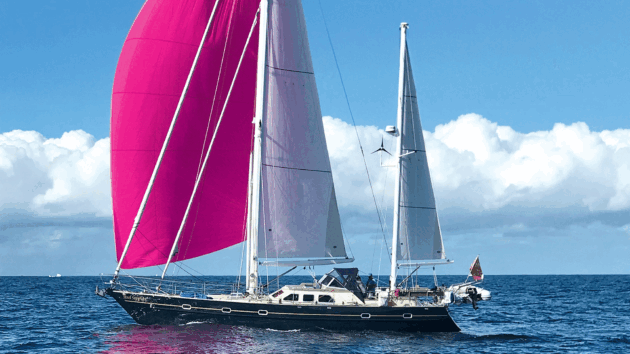
Opting for a cutter-rigged ketch allowed the Bernards to handle a larger yacht sailing two-up. Photo: Peter and Jen Bernard
“The interior layout fits our lifestyle,” Peter continues. “The deck saloon, nav station, lower dinette, forward cabins and our huge aft cabin are all separate ‘zones’ – connected, but slightly separate from each other, making it easy to have friends and family on board for extended periods without feeling too cramped.
Despite the yacht’s size, Jennifer says she is simple to handle. “Sailing Steel Sapphire is easy and surprisingly fast for a 32-tonne ketch, because of in-mast furling and all lines managed from the cockpit. Even in the wildest weather all sail changes can be managed single-handed, which allows the off-watch person to sleep uninterrupted.
“The cockpit hardtop and enclosure allow us to feel safe, protected and out of the elements when we want. We routinely sail in 30-40 knots in shorts and a T-shirt, and arrive in port feeling much more rested than friends with more exposed cockpits on the same passage. And with a tankage of 1,200lt of water and 1,000lt of diesel we’re quite independent from shore facilities.”
But there are compromises. “The biggest is sightlines due to the deck saloon – sitting down on the cockpit benches or behind the wheel you have no forward visibility,” explains Jennifer. “The two engines side by side means she carries her beam well below the waterline. This does slightly negatively affect performance as her underwater shape is not quite so slippery. We estimate we lose about half a knot from our hull speed as a result.”
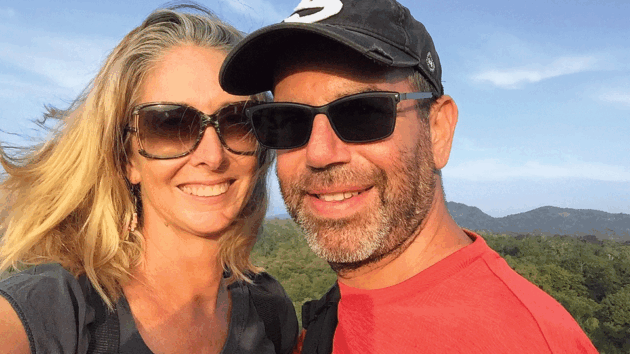
Peter and Jen Bernard. Photo: Peter and Jen Bernard
“Having a steel boat means more maintenance: you have to stay on top of the integrity of your paint system,” points out Peter.
Jen adds: “Although Steel Sapphire has two inches of insulation throughout, her navy blue hull and steel decks carry a heat penalty: in the tropics the inside temperature was about two degrees higher than on GRP boats.
“To achieve what we wanted in our budget meant going with an older boat (now 32 years old). With that comes more maintenance, and many of the systems are now of an age where spare parts availability can be an issue. Upgrading equipment is a continuous process, in which we learn what works for us and what doesn’t.”
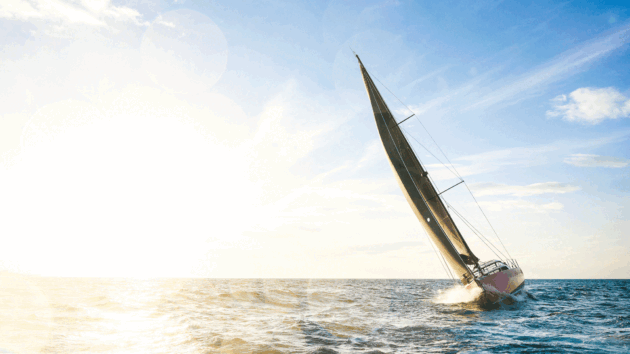
‘Upgrading equipment is a continuous process: you have to learn what works for you’. Photo: Samo Vidic/Pegasus Yachts
Production option
Bavaria Cruiser 42, Seabiscuit
British couple Vicki and Robert Bennett began their cruising voyage in an unusual location: Dubai. They sailed across the Indian Ocean and around the Cape of Good Hope to the Caribbean. After a few seasons there, Robert continued solo to Nova Scotia and returned south along the east coast of the USA. Recently, they sailed to the UK in their 2004 Bavaria Cruiser 42, Seabiscuit.
“Choosing Seabiscuit was very easy, no lengthy discussions of its pros and cons, it was simply the only boat available at the time while living in Dubai,” says Robert.
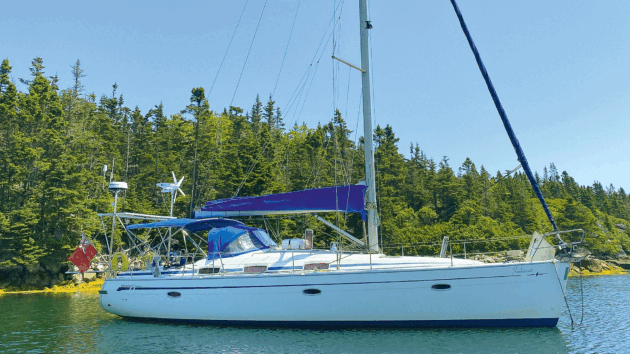
The Bennetts have sailed around the Cape of Good Hope in their Bavaria 42. Photo: Vicki and Robert Bennett
“Initially we used her for local club racing, only later embarking on more adventurous trips away.
“Seabiscuit sails effortlessly on calm waters with lots of comfort in the spacious cockpit and dual helm, but does suffer with slamming when upwind on a steep sea. This is when we appreciate the many handles and fiddles on Seabiscuit. On modern mass-produced yachts you’ll find fewer of these useful details. The diesel tank is perhaps on the small side for ocean passages, having just 210lt When required, we simply carried fuel on deck.
“Perhaps her biggest downfall is also her major strong point: the 2.1m keel. We struggled quite a bit in the Bahamas where a shallower draught counts for everything, but we reap the rewards of the deeper keel almost everywhere else.”
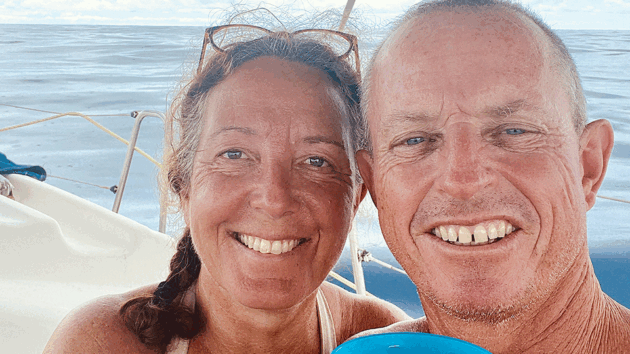
Vicki and Robert Bennett. Photo: Vicki and Robert Bennett
Solo adventurer
Contest 50CS, Steppingstone
Dutch/Norwegian cruising couple Harald Hart and Marion Hobbelink enjoyed years of cruising in their previous Nicholson 35 and Contest 45, from Gibraltar to the north of Norway. Marion explains: “I don’t really fancy long passages, so we have developed a system that fits us: Harald sails the longer distances solo and once he has arrived, I join him for coastal exploration.”
Harald adds: “After a lot of research, we bought our first Contest because of the quality of the hull, systems and finish. In my opinion, Contest manages to build very sturdy boats that handle very well, especially for me as a solo sailor most of the time. The step to the 50CS was an easy one: I wanted to sail further afield in higher latitudes, so I needed a strong hull and the same ease of handling that I loved in the 45. On top of that, she’s a very fast boat. Although I’m not looking for speed as such, it’s nice to get somewhere fast, comfortably and safely.”
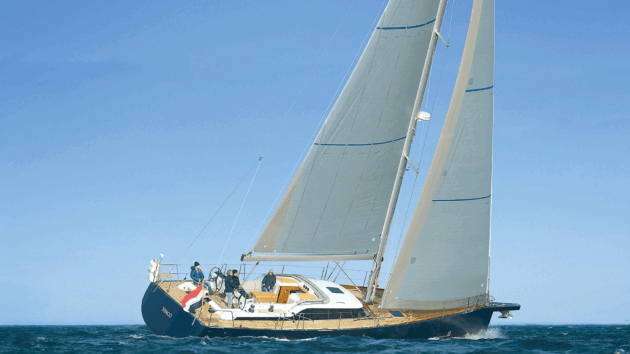
A centre-cockpit Contest 50CS, here on sea trials in the Netherlands. Photo: Sander van der Borch/Contest Yachts
Harald sailed solo straight from the Netherlands to Greenland, where Marion joined him. “A dream come true, cruising around in the wilderness,” Harald explains.
The couple didn’t change much to the specs when commissioning Steppingstone: “Only later, with the high latitude sailing in mind, I added a furling cutter sail and the matching running backstays. I’ve also added solar panels to generate power for the basic equipment in case my generator fails, and Starlink for weather information and to keep in touch with Marion.”
The cutter sail is handled with an electronic winch; the controls of the mainsail and jib are hydraulic. The two systems add redundancy, and Harald never has to leave the cockpit: all the controls are within reach. “I wasn’t very skilled in all things technical around boats. So, by buying a new boat, I bought time to get to know the systems. While sailing, I was reading the manuals and familiarising myself with the equipment. It has worked perfectly.”
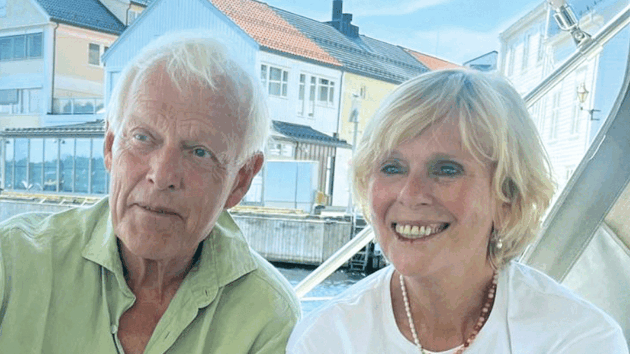
Harald Hart and Marion Hobbelink. Photo: Harald Hart
He didn’t feel like he had to compromise in any way: “The only thing that I sometimes struggle with is the accessibility of the equipment. But that is part of owning a boat anyway. In general, I am the compromise, because I’m still growing in my knowledge of how this boat works.”
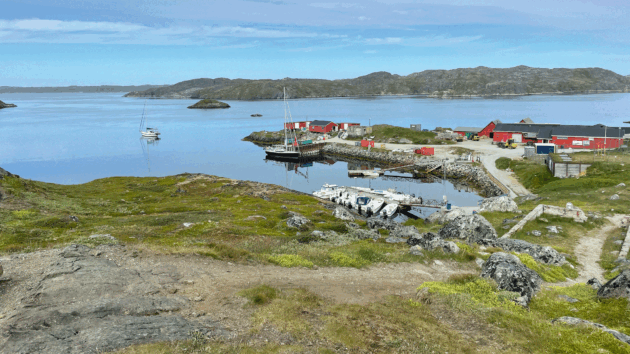
Harald Hart has sailed Steppingstone solo across the North Sea to the Faroe Islands, Iceland, and Norway. Photo: Harald Hart
Adaptable cat
Lagoon 440+, Impi
South African/French couple Ana Hill and Brent Grimbeek set off on their first circumnavigation in 2011 on Impi, a then two-year-old Lagoon 440+. They’re now on their second lap around the globe. Brent says: “Before we owned a Catana 471: a great boat. But in preparing for our long-distance sailing plans, we needed to consider not only how we wanted to sail, but how we wanted to live. Our dream was a comfortable ocean home for years.
“Safety is our highest priority: a solidly built catamaran, capable of handling heavy weather and carrying long-term cruising equipment. Unlike many yachts, Impi maintains her sailing ability and handling characteristics at cruising displacement. She performs well on all points of sail, pointing remarkably well to windward. Now, on our second circumnavigation, we know we made the right choice.”
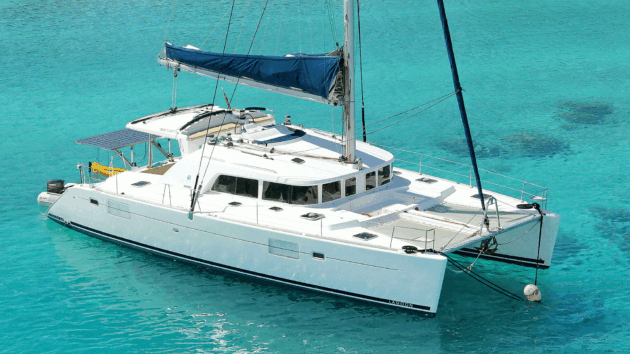
The Lagoon 440 Impi has had many upgrades over two circumnavigations. Photo: Brent Grimbeek
Ana says: “One of the best features is the cockpit: it feels like a monohull cockpit turned sideways. In heavy following seas, it keeps green water outside, where it belongs.” She also cites the catamaran’s separate living areas – including a forward seating area, cockpit and flybridge – for giving flexible use of space.
As with any boat, there were compromises. “Like most production catamarans, the Lagoon 440 was designed with the charter market in mind,” says Brent. “We viewed her as an excellent platform and reinforced structural areas while she was still new.”
Brent and Ana keep upgrading Impi. “Impi has evolved continuously,” notes Ana. “We’ve added sugar scoop extensions to improve performance; watertight bulkheads, engine-room bilge pumps with alarms and a crash bulkhead to increase safety.
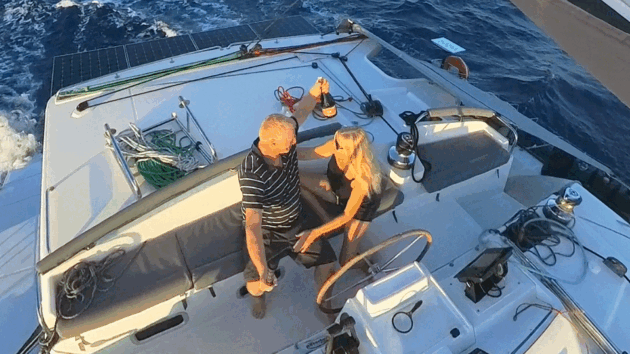
Photo: Brent Grimbeek
“We redesigned durable Hydranet sails for power performance, prioritising reliable drive and longevity over pure light-air efficiency. We increased the mast height and installed Cyclops load sensors.”
On their decision, Ana says: “A catamaran is, in our opinion, the best choice for long-term cruising. But you have to be aware that a catamaran requires a different heavy-weather tactic compared to a monohull.”
Article continues below…
Choosing a used double-handed yacht – Our top tips
Everyone is shorter on time than ever. For sailors with families, jobs and competing demands, the case for a smaller,…

Second hand boats: Buying a yacht to upgrade
Among brokerage listings it’s rare to see a yacht openly advertised as ‘work needed’. After an initial conversation, the potential…
Aluminium explorer
Boréal 47, Zephyros
American sailing family Jon, Megan, Ronan and Daxton Schwartz are true high latitude cruising veterans with their Boréal 47 Zephyros, which they built new, launching in 2017. Their cruising waters of choice include the Arctic, Antarctic and everything in between.
“When we started trying to find a boat to take our family cruising in 2016, we had a 3-5 year concept which included time in the Mediterranean Sea and Patagonia,” says Jon. “Our initial requirement was a strong hull that did not require lots of maintenance. We also wanted a lifting keel or centreboard to allow shallow water access, a pilot house for watch standing, and three staterooms.
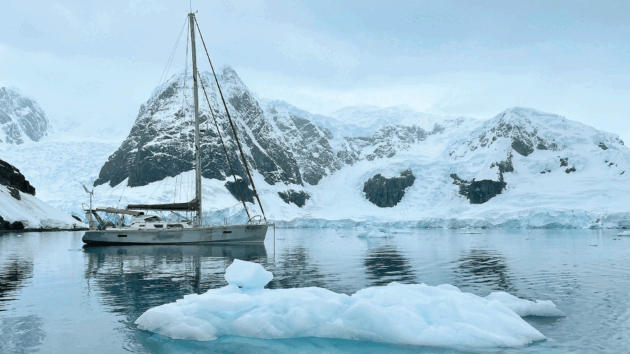
Doing just what she was built for; the aluminium Zephyros cruising amidst the ice. Photo: The Schwartz family
“We quickly settled on aluminium for the hull and realised that we were looking for either a custom boat or a semi-custom design, likely from France or the Netherlands. We had trouble finding a used hull that met our needs for significantly less than we could build a boat at the time (before the price of aluminium increased significantly).”
Megan adds: “Zephyros’s best features are her pilot house, lifting centreboard, protected single rudder, daggerboards and robust build. The secure cockpit with a large, single wheel means that we have given up cockpit lounging space, but it’s a compromise that we don’t mind too much in the higher latitudes. She is also very well insulated, which is great in the colder climates, but we struggle in the warmer climates to keep cool.
“For the initial build, we also begrudgingly accepted a few compromises including a top-entry refrigerator and no dedicated shower stall.”
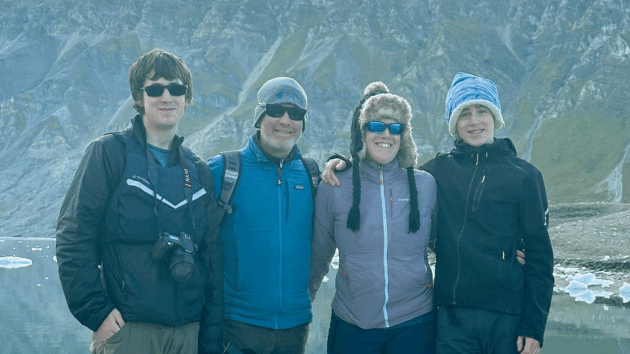
The family have been sailing for nine years on their Boréal 47. Photo: The Schwartz family
“After cruising for almost four years and reaching our initial sailing goals, we realised that no one wanted to stop sailing as there was still much of the world to see,” says Jon.
“We began making upgrades, based on how we use the boat and to make life more comfortable as we continued living aboard.
“With Covid, we also realised we might have to do extended passages to depart southern Chile, so we installed a watermaker. We had originally plumbed the boat for a future install but skipped it in the build.
“The connectivity landscape changed, along with the age of our children. High school academics benefit significantly from digital connectivity, so we have added cellular antennas for local SIM cards and Starlink.”
Megan adds: “We learned that we always needed either shade or rain/snow shelter when standing at the helm. And devices for four – along with satcomms, watermaker, etc – all required significantly more energy than when we started. So, we added a permanent bimini structure that holds over 1kW of solar panels. We also changed out our old batteries for a larger LFE battery system along with a new electrical backbone.”
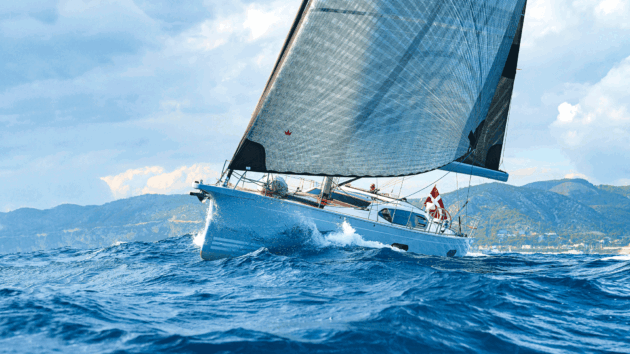
Try to test-sail potential yachts in a wide range of conditions. Photo: Ludovic Fruchaud/EYOTY
Swedish comfort
Hallberg-Rassy 46, Cadenza
British couple Fiona and Matt Davey have sailed the UK coast extensively on different boats, before starting offshore voyages on their 2000 Hallberg-Rassy 46 Cadenza. Matt says: “Our cruising plans for higher latitudes as well as lower latitudes meant that we wanted a boat with good sailing performance and a seaworthy hull.
“We ranked potential boats by comfort ratio, as we wanted a comfortable ride. With a CR of 39.0 she hasn’t disappointed: she never slams into waves and we always feel safe. Cadenza doesn’t sail as fast as current HR models, but as the wind and waves increase, she keeps her speed through the water and will sail past more modern hull designs.”
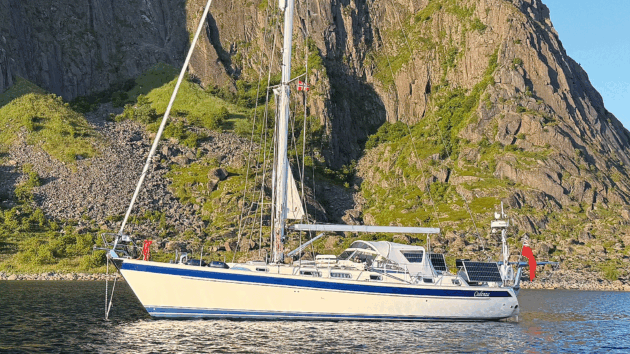
The Daveys have made several upgrades to Cadenza over time. Photo: Fiona and Matt Davey
Fiona adds: “We really like her deep, secure centre cockpit; it is very safe and the glass windscreen gives great protection and visibility. We would often sail with the cockpit enclosure up on chilly wet days in Norway. With hydraulic sail controls and electric winches, it’s easy to operate everything from the helm position. The downside is that she’s not the best boat to host a cockpit party.”
The distinctive Hallberg-Rassy style was part of the appeal for Matt. “The build quality and finish is first class and we love the cosy all-wood interior. There’s plenty of stowage and all lockers are lined. And the armchairs! We wouldn’t have specified them, but now we wouldn’t be without them.
“In addition to that, the huge tanks for water (920lt) and diesel (960lt) mean we can cruise independently for a long time and give a range of over 1,200 miles.”
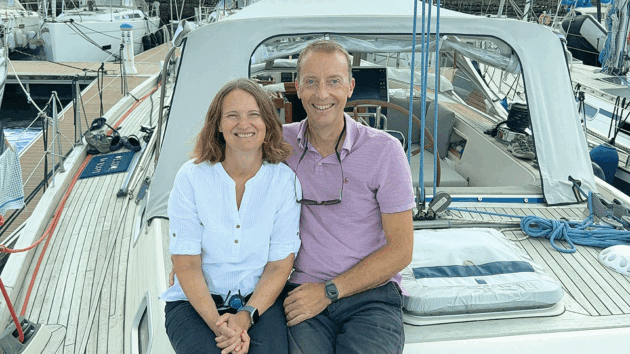
Fiona and Matt Davey on their yacht. Photo: Fiona and Matt Davey
There were inevitably compromises. “We would have preferred a centreline double berth in the aft cabin, but our 2-plus-1 arrangement means we can choose the lower side berth on passage,” says Matt.
“The galley is a very secure space at sea, but when in harbour, we are sometimes envious of newer boats with a linear galley design,” agrees Fiona.
Before and during their voyages they have upgraded Cadenza extensively. Matt says: “A big one was installing lithium batteries with a Victron system and a high output alternator. We like being at anchor, so we’ve added davits and upgraded our anchor, chain, windlass and bow roller arrangement. On our shakedown sail to Oslo, we made a stop at the Hallberg-Rassy yard in Sweden and replaced several items. Their spare parts team is fantastic.”
Half a world away
Outremer 51, Traverse
Solo ocean racer Mike Golding chose an Outremer 51 for cruising halfway around the world with his wife and family. “I was certainly looking for a catamaran, and Outremer was always going to be a strong contender for me. I did consider a 1997 Gunboat 48 – there were only seven built – and I viewed two. However, we didn’t want a project, and both required significant work,” he recalls.
“Our Outremer was built in 2022 and had been sailed from France to New Zealand as part of the Outremer World Rally by an American couple who had looked after her extremely well. She was basically ready to sail, which suited our needs perfectly. We wanted to get started on the adventure.
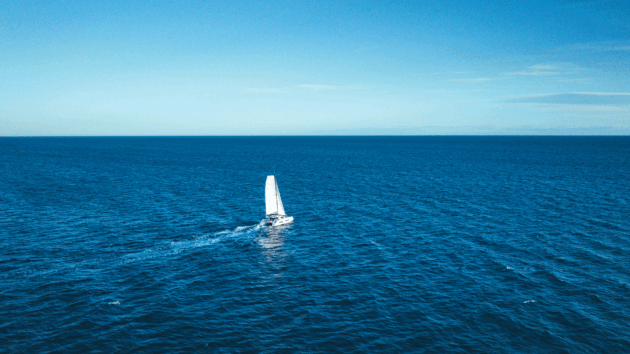
Golding’s advice for anyone considering buying a boat to cruise the world: seize the moment and do it! Photo: Robin Christol/GLY
“For us, I felt a catamaran offered the speed to extend our range or shorten our passages – ultimately giving us more time to spend in new places. The living space, both at sea and at anchor, is unrivalled by a monohull. The protected cockpit was particularly important to us; we ate outside for every single meal during our passage. Cats sail without excessive heel, and they don’t roll around at anchor. To me, it’s just a no-brainer.
“We could have designed our family adventure around wherever we happened to buy the boat, so I was pretty open-minded about location. It is true that larger cats will generally be cheaper in more distant markets and more expensive when based in Europe. Our thinking was to buy at a New Zealand price, sail across the world, and hopefully sell at an EU price at the end of the adventure.
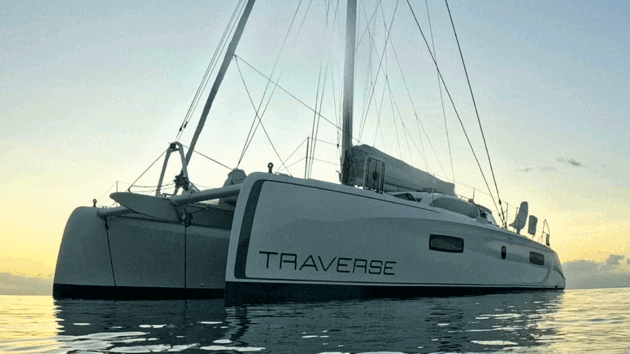
Mike Golding bought an Outremer 51 in New Zealand, and sailed it back to Europe. Photo: Mike Golding
“My goal was to use the boat every single day we had her – that’s how you extract the value from the purchase. A boat sitting on a mooring is just as expensive, and none of the fun! For us, the strategy worked.”
Mike didn’t see the choice as a compromise. “There are plusher, roomier catamarans out there for the same or less money but for us the Outremer 51 struck the right balance. Although my wife, Andrea, might disagree, the only compromise I can think of is that perhaps I would have liked a bigger, faster boat. But that’s just me…!
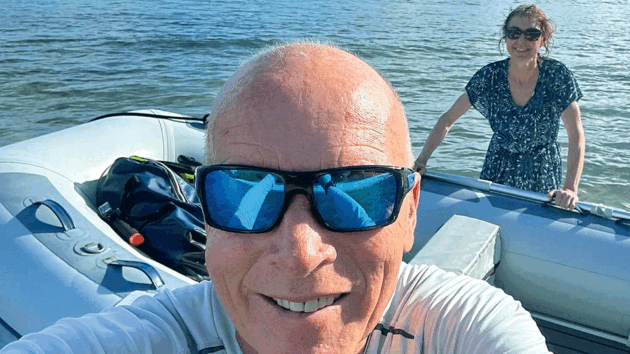
Mike Golding. Photo: Mike Golding
“I think it is nearly always worthwhile getting the safest, biggest, fastest and most comfortable yacht that fits within your budget. You won’t regret it.
“My advice has always been simple: if you’re thinking about it, do it. Life is too short, too unpredictable to miss out on experiences like this.”
 If you enjoyed this….
Yachting World is the world’s leading magazine for bluewater cruisers and offshore sailors. Every month we have inspirational adventures and practical features to help you realise your sailing dreams.Build your knowledge with a subscription delivered to your door. See our latest offers and save at least 30% off the cover price.
Note: We may earn a commission when you buy through links on our site, at no extra cost to you. This doesn’t affect our editorial independence.