


The new ORC 52.2 aims to appeal to fans of pure performance, but by no longer sacrificing levels of comfort. Does it succeed? François Trégoüet reports
ORC 52.2 review: Performance and thrills in spades

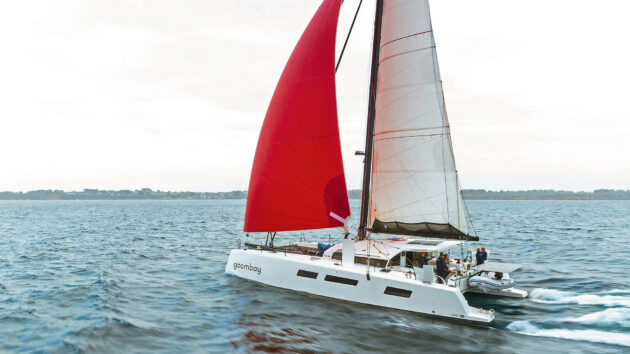
There’s only one Francis Joyon, the original client for a boat that was then called the TS50. The TS designation stood for ‘Très Simple’ (very simple) a clear statement of concept.
For a racer like Joyon, a stripped-out interior that can be cleaned with a pressure washer might feel like home. But you rarely sail alone on a 50ft catamaran – and in 20 years since the first TS50 a lot has changed on the market.
After being acquired by the Grand Large Yachting group, the shipyard – now known as ORC Catamarans – had to evolve its offerings.
Did the original over-engineered TSs lead to a few disasters when pushed to their limits in offshore races for which they weren’t designed? Now, masts will no longer be extended beyond what was initially calculated by architects Christophe Barreau and Frédéric Neuman.
And did the original interior layout put too many people off? Again, the interior has been redesigned so everyone feels more comfortable on board.
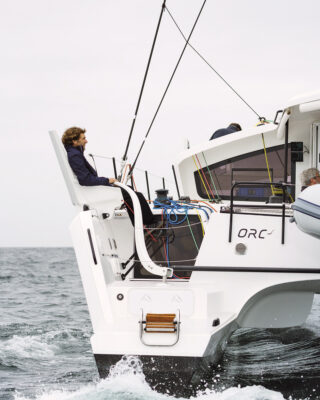
Ergonomic seat is an invitation to helm for hours on end. Photo: François Treguoet/MULTImedia
But since ORC’s promise is to deliver exceptional performance and thrills, there’s no question of turning its multihulls into floating hotels. In the specifications provided to the Darnet Design firm, the first and most strictly enforced requirement was the weight allowance for the new interior: 200kg and not a single gram more! Furniture, upholstery, panelling, materials, portholes, lighting, everything was weighed and kept within the limit.
Offshore epicentre
I travelled to Lorient, the epicentre of top-level French offshore racing, where the ORCs are built. The submarine base constructed by the Germans during World War II is home to ORC Catamarans. The shipyard couldn’t have found a better host city for its catamarans, which are among the highest performing on the market.
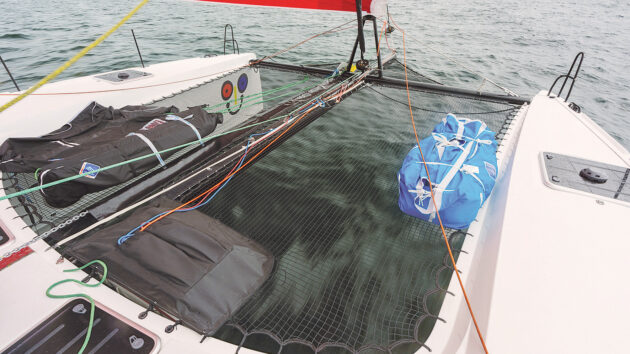
Large forward trampoline. Photo: François Treguoet/MULTImedia
The atmosphere at the dock at ‘La Base’, where the ORC 52.2 sits sandwiched between the brand-new Ultim Gitana 18 and the IMOCA Initiatives Cœur, is immersive. It’s hard to think about anything other than sailing speed and performance in such a hot-bed of French ocean racing.
While the major changes to this MkII model are certainly on the interior, an ORC is designed first and foremost for sailing, so we’re off for a ride (ORC stands for Ocean Rider Catamarans) between Lorient and Groix.
The mainsail is hoisted from the base of the mast using the boat’s only electric winch. The low roof takes just two steps forward of the windows to reach, and the boom only comes up to just below my knees, which makes it convenient for opening, stowing, or closing the lazy bag.
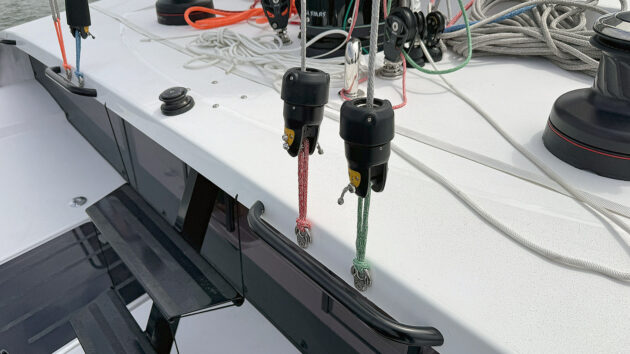
Returning to the cockpit, the precision of the deck layout and the quality of the hardware is admirable: Karver furlers and winches, Harken blocks, Antal pulleys. We then unfurl the genoa, and even as it’s barely set the surge of speed is immediate – you can physically feel it, as if on a Hobie Cat.
Roof is an easy two steps up from the cockpit. Photo: François Treguoet/MULTImedia
Despite the light chop, typical for this stretch of water, the upwind angle and speed are impressive. In 12-15 knots of wind, the speedometer fluctuates between 8 and 10 knots, close hauled at less than 40° to the apparent wind.
How could you resist an invitation to sit in one of the two bucket helm seats? The way they extend beyond the platform’s maximum width is slightly disconcerting, but it’s reassuring to know they tilt to fit within the boat if necessary. Once you adjust the small pulley system for the footrest to perfectly suit your height, it feels just like being on a Figaro, but with added power and weight (albeit still just 10,500kg displacement).
So, I grip the tiller firmly and fall into a regatta routine, eyes shifting from the telltales to the water in front. To leeward, the helmsman has to keep an eye out through the deckhouse windows, or, if the headsail really blocks the view, ask a crewmember to watch for traffic. One thing is certain, however: I don’t feel inclined to engage the autopilot, and it’s only the meal break (incorrigible Frenchmen!) that makes me let go of the tiller.
With the now-standard mast height the ORC remains a high-performance boat, yet you always feel in control.
In the harshest conditions it’s still possible to keep the mainsheet in hand for a quick ease if needed, including from the helm seats. When sailing under autopilot, whether solo or with a small crew, an anti-capsize system will provide added peace of mind (which might be recommended on any performance catamaran).
Headboard panelling, big windows and plenty of lighting ensures continuity between the interior and exterior. Photo: Guillaume Gatefait/ORC
With a press of the windlass remote control at the base of the mast, the anchor drops off the beach of Les Grands Sables, south-east of Groix island. But as the sun returns, the breeze threatens to die down, so we waste no time hauling up the anchor and setting off on a few speed runs.
The gennaker is hoisted at the end of the bowsprit and unfurled immediately. From then on, the only goal for those taking turns at the helm is to break the day’s speed record and exceed the 14 knot true wind speed.
Unfortunately, all good things must come to an end, and to head back to the mainland we have to bear away several degrees. The asymmetric spinnaker is soon hoisted, and we lose a few knots, but still hovering around double-figure speeds. Above all, the sense of joy at the helm is as strong as ever, and the smiles on everyone’s faces speak volumes about the satisfaction levels of both designers and testers.
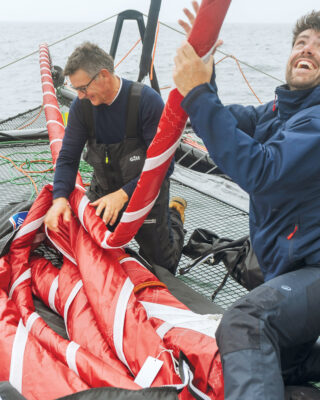
Huge trampoline keeps weight off and is a good working area, encouraging sail changes for optimum performance. Photo: Guillaume Gatefait/ORC
What’s more, manoeuvring this 17m x 8.20m yacht back to the dock proves a stress-free affair. Thanks to its low draught, featherweight build, and efficient centreboards, its two 40hp engines are more than sufficient.
Secrets of light
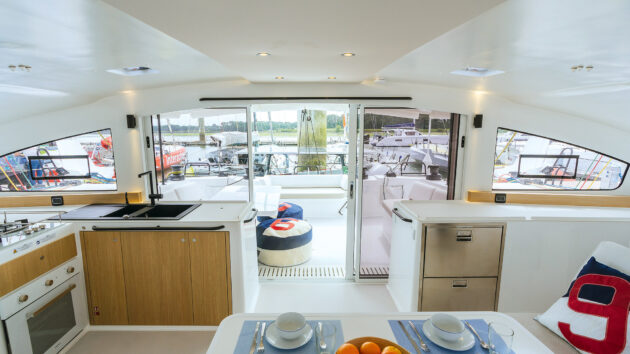
We take advantage of the long channel run to start exploring the interior with Antoine Gicquel, who is in charge of the ORC 52.2 project at Darnet Design. He’s here to evaluate, at sea, the effectiveness of all the design choices made. And the first thing he points out to me is the new level of interior brightness. This is evident in the hulls, where the side portholes have been enlarged.
It’s even more striking in the saloon, which appears more spacious thanks to new skylights integrated into the forward corners of the roof. The night-time lighting has also been carefully designed to enhance the space and create a warm atmosphere.
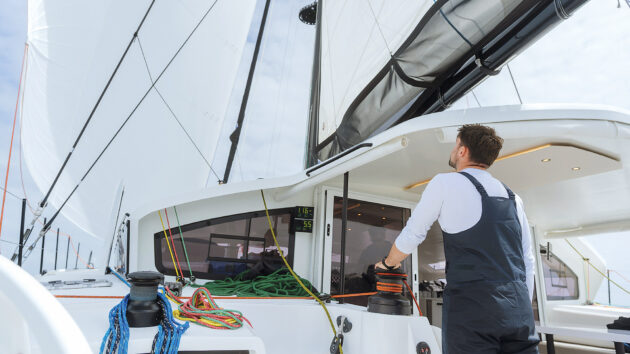
Cockpit winches are at just the right height for working. Photo: Guillaume Gatefait/ORC
“Light is the lightest material,” points out Gicquel, always keeping weight constraints in mind. He regrets that the owner did not opt for the darker shade suggested for the drop ceiling connecting the saloon to the cockpit – which would have diverted attention from the numerous bolts associated with the deck plan that are otherwise too difficult to conceal.
The new seating design, however, was faithfully implemented, with the soft curves suggesting genuine comfort. Both in the saloon and the cockpit, comfort has improved significantly without adding a single gram.
I’m shown how the steps leading down to the hulls now offer much better ergonomics. On the port side of the hull, they also make it easier to access the central single berth.
Everywhere you look, you notice the new rounded contours of the furnishings. A spacious saloon table, a galley extending the full length of the roof aft bulkhead, a large chart table and a watch berth on the starboard side, the good ideas are all still there, and that’s just as it should be. But every choice of colour, material and shape now contributes to a sense of softness and welcoming warmth.
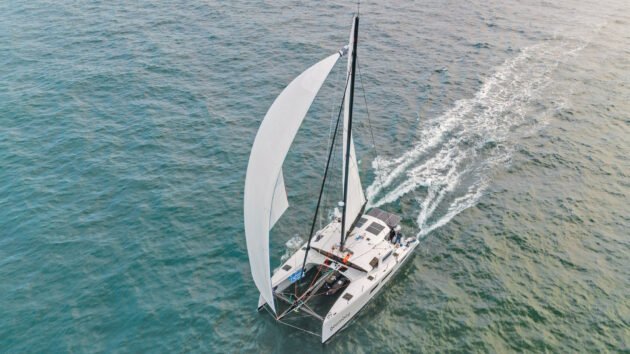
‘The surge of speed is immediate’. Photo: Guillaume Gatefait/ORC
Practicality hasn’t been overlooked either. For example, there’s more stowage in the galley, and the linen closets in the cabins are as elegant as they are well-crafted. The aesthetic evolution is equally striking in the hulls. Structural reinforcements and furnishings align perfectly, allowing the eye to glide seamlessly over the surface. In the starboard owner’s cabin, at the foot of the large transverse double berth, a stylish bench runs along the hull.
Between the daggerboard box and the forward sail locker, the heads compartment has been significantly upgraded. With the simple addition of a mirrored vanity and a black shower column against a backlit wooden panel, the space transforms from an impersonal motel room into a Pullman suite.
While the aft cabins are identical on both sides, the heads occupies the central space on port, this time with shower stall and toilet in separate compartments. This allows for more flexible use for up to five guests in the port hull. A final double cabin, this time running fore-to-aft, occupies the forward section, extending all the way to the sail locker, which is also accessible from the deck.
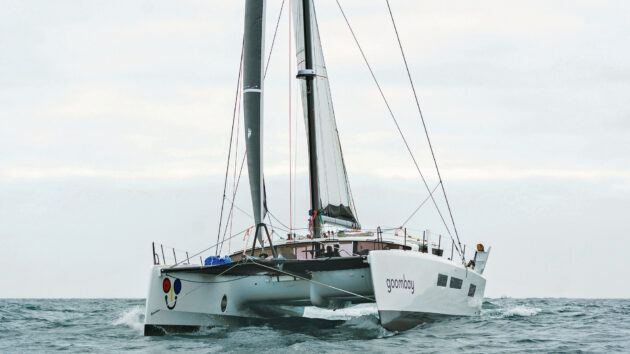
A great view forward from helm seats canted slightly outboard. Photo: Guillaume Gatefait/ORC
Smart, stiff build
After disembarking, which is made all the easier by the 60cm taller sugarscoop, I turn to admire the dynamic lines, accentuated by that attractive chamfer at the stern.
But it must be said that the ORC 52.2 is all about smart design, as opposed to flash, and maintains a highly traditional construction process. The ORC 52.2 is built using Vinylester resin infusion, glassfibre, and PVC foam. The expertise lies in the implementation and optimisation of the foam panels in the sandwich construction, which are pre-machined. This reduces their volume and the amount of resin required for the lay-up.
Carbon fibre is used for several structural elements, such as the mast bulkhead and the aft bulkhead, when weight savings are deemed truly significant while maintaining stiffness and strength.
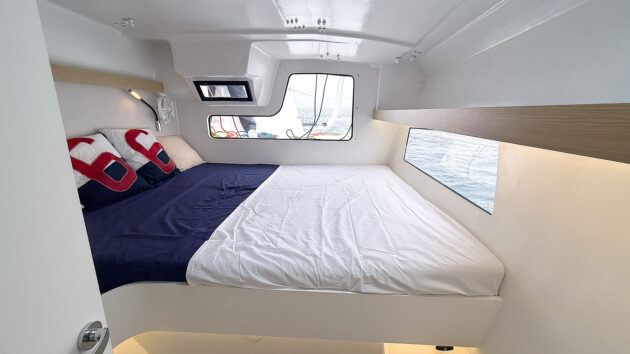
A bright master ensuite cabin with meticulous attention to detail in the fittings. Photo: François Trégoüet/MULTImedia
Of course, a tempting list of options is there to indulge in if needed. You could probably resist the carbon roof, though it would be harder to pass up the carbon centreboards; and you’d likely give in to the carbon mast, even if, at nearly €180,000, it adds over 10% to the price.
Inside, all the furniture is still laminated directly to the hull, a time-consuming process no longer found on any mass-produced multihulls. Admittedly, this choice prevents the boat from offering ‘island-style’ berths, for example, but the fittings form a rigid, non-deformable framework. This has the advantage of ensuring both the platform’s rigidity and its lightness, as there’s no need to add material to ensure the structure’s integrity.
This construction process allows ORC to deliver on the shipyard’s promise at a reasonable price: to delight enthusiasts of sailing thrills, right down to the most discerning racers who thought they’d forever remain loyal to monohulls and lead keels.
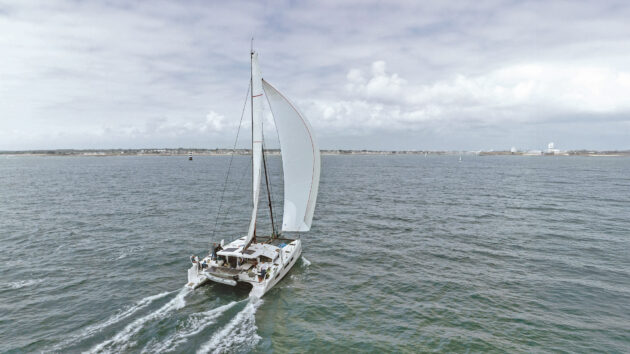
Under an asymmetric spinnaker. Narrow wake and high-riding bows speak volumes about the light weight and sleekness of the ORC 52.2’s hulls. Photo: Guillaume Gatefait/ORC
ORC 52.2 specifications
Hull length: 15.84m/52ft 0in
LOA with bowsprit: 17.08m/56ft 0in
Beam: 8.20m/26ft 11in
Displacement (light): 10,500kg/113,021lb
Upwind sail area: 145.7m²/1,568ft²
Mast height: 22.20m/72ft 10in
Engine: 2×40hp
Base price: €1.32m ex VAT; boat tested €1.8m
Design: Barreau-Neuman/Darnet Design
 If you enjoyed this….

Yachting World is the world’s leading magazine for bluewater cruisers and offshore sailors. Every month we have inspirational adventures and practical features to help you realise your sailing dreams.Build your knowledge with a subscription delivered to your door. See our latest offers and save at least 30% off the cover price.
Note: We may earn a commission when you buy through links on our site, at no extra cost to you. This doesn’t affect our editorial independence.
Verdict
Positioned between its two sister brands within the Grand Large Yachting group, ORC is lighter and more powerful than Outremer, yet without the stratospheric prices that Gunboat’s mix of high-tech construction and luxury brings. The ORC 52.2 carries on the brand’s DNA by embracing a certain radicalism, with high average speeds made possible by slender hulls and a dedication to lightness.Given the performance and the thrill it delivers, the listed price of €1.32 million seems almost reasonable. But the onboard living experience, historically perceived as Spartan, has undergone a major overhaul. It’s no longer likely to deter but rather to appeal instead to a broader audience. This evolution is a success, as it brings real improvements in both perceived quality and actual comfort, without compromising the ORC 52.2’s spirited character. It should be capable of welcoming everyone on board for truly memorable cruises at a particularly rapid pace.