



The Transat Café L’Or last Autumn was a dramatic race featuring unexpected finishes, capsized boats, and speedy IMOCAs. Andi Robertson reports
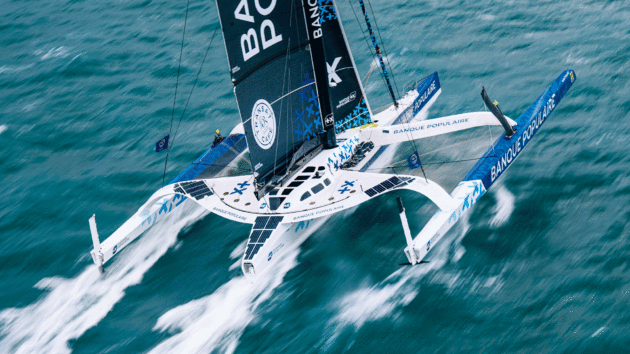
Shortly after 10.30 in the evening on Saturday, 25 October, French team mates Erwan Le Draoulec and Tanguy Le Turquais found themselves upside down in a capsized trimaran in 30-knot winds with the waters of the English Channel rising inside their boat.
Though Le Turquais says there was no panic on board, fear did momentarily take hold as air inside their smashed Ocean Fifty became scarce, and the pair realised the aft hatch was blocked by bags.
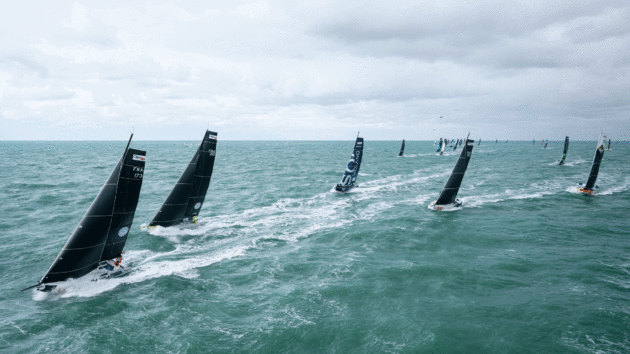
Class 40s stream out from the Le Havre start. Photo: Vincent Curutchet/Alea
“It lasted five or 10 seconds maybe, but they felt like hours,” recounted a shocked Le Turquais. “I was thinking: we’re going to drown here like a couple of idiots.”
Fortunately, both were rescued safely, along with four more competitors, in a hectic few hours of incidents.
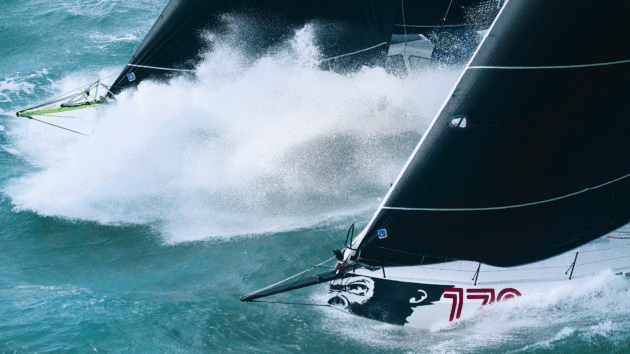
‘A mean low pressure system was approaching Biscay’. Photo: Vincent Curutchet/Alea
Transat Café L’Or: The coffee route
If it’s an odd-numbered year, the nights are drawing in and there are dramatic mid-Atlantic rescues of multihull sailors hitting the headlines, it must mean the race across the Atlantic which follows the ‘coffee route’ is underway.
For its 17th edition the double-handed offshore classic switched its name from the Transat Jacques Vabre to become the Transat Café L’Or, thanks to the French coffee giant which supports the race from Normandy, northern France, to Martinique in the Caribbean.
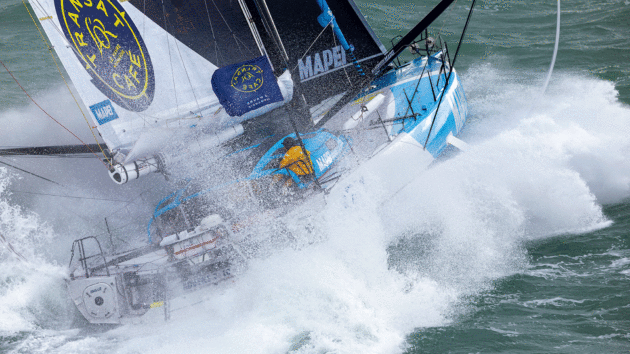
Conditions on the Class 40 Engie mid-race. Photo: Team Engie
Otherwise the blend has changed little. The docks in Le Havre welcomed four divisions: four Ultims; a record fleet of 10 Ocean Fifty trimarans; 18 IMOCAs (the reduced numbers reflecting the post-Vendée Globe season); and 42 Class 40s of all vintages.
The race organisers’ plan was to try and ensure the winners of all four fleets finished within hours rather than days. So the Ultims raced around the Saint Peter and Saint Paul Archipelago, 600 miles north-east of Brazil, the IMOCA course took them to the Canaries, the Ocean Fiftys turned right at the Cape Verdes, while the Class 40 fleet had to be halted in La Coruña to sit out a storm for three days, before passing south of a mark off the Azores.
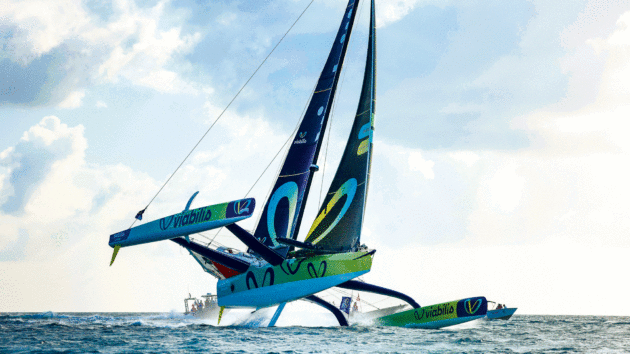
Skippers Baptiste Hulin and Thomas Rouxel took a last-gasp victory in the Ocean Fifty trimarans with Viabilis Océans. Photo: Jean-Marie Liot/Alea
Mouth-watering prospect
The line up in each division was fascinating. Sadly the launch of the highly anticipated Gitana 18 was delayed, but in the big Ultim fleet 2023 winners Armel Le Cléac’h and Seb Josse were out to defend their titles with Banque Populaire XI, reported to be flying earlier and more smoothly with new foils.
Franck Cammas joined as co-skipper to Tom Laperche on SVR Lazartigue. Thomas Coville hand-picked Benjamin Schwartz as a powerful ally and his co-skipper on the re-optimised Sodebo Ultim 3. And ex-Figaro ace Anthony Marchand has upgraded to a new boat with Actual Ultim 4, formerly Gitana 17.
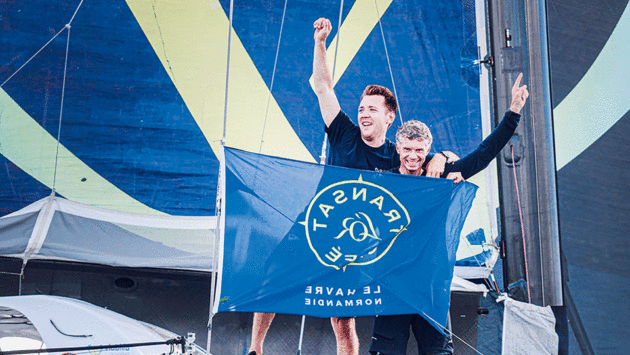
Skippers Baptiste Hulin and Thomas Rouxe. Photo: Jean-Marie Liot/Alea
The Class 40 fleet ranged from five new 2025 launches, to a couple of 10- to 15-year-old boats raced by Corinthian teams. There were a clutch of international skippers, including Irish-US/French pairing Pamela Lee and Jay Thompson on #EmpowHer, pro Italian and French teams, enthusiastic amateurs, and super-experienced hands, not least ocean racing legends Michel Desjoyeaux and Vincent Riou, to make for a wide-open competition.
In the IMOCA class Britain’s Sam Goodchild had been thrust into the media spotlight having just been announced as the skipper of the new Macif Santé Provence being built for the next Vendée Globe, following Charlie Dalin’s cancer diagnosis.
For the Transat Café L’Or Goodchild and his co-skipper Lois Berrehaar had been tipped as favourites, along with Yoann Richomme and Corentin Horeau on Paprec Arkéa, while Jérémie Beyou seized the availability of two-times race winner Morgan Lagravière to join him on Charal.
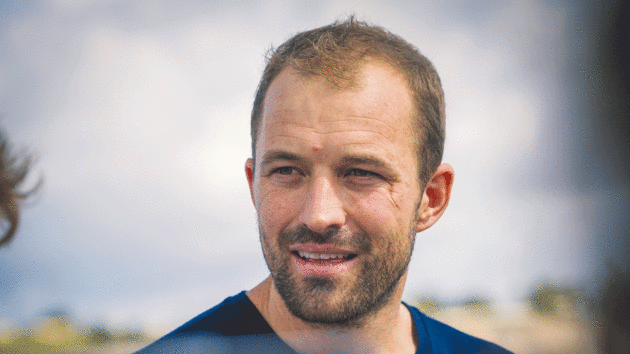
Sam Goodchild was one of the favourites, having taken the helm of Macif for the next IMOCA cycle. Photo: Jean-Marie Liot/Alea
In the end the race organisers’ ambitions to finish the four fleets together were thoroughly thwarted by the weather – SVR Lazartigue won the Ultim class on
5 November, while the winning Class 40 pairing (Guillaume Pirouelle and Cedric Château on Seafrigo-Sogestran) came in 12 days later.
But within each fleet there was plenty of close competition – just 22 minutes separating the top two 40s, while the Ocean Fifty fleet was even closer.
Minutes in it
This year’s race saw the Ocean Fifty class come of age with 10 boats racing. The circuit is tightly controlled in terms of budgets and technology: there are a maximum of 11 boats allowed in the class, the boats have one-design C-foils and sail programmes have discrete limits. The newest launch this year was Edenred 5 of Emanuel Le Roch and Basile Bourgnon, which went into the water in July and started winning races straight off the bat.
Late on the Friday afternoon, before the Sunday 26 October scheduled start, the Ocean Fifty class came to the race management team with a plea to start the following day, Saturday.
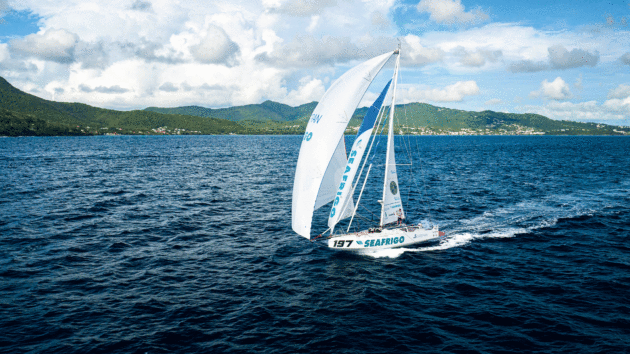
Seafrigo-Sogestran was the winning Class 40, skippered by Guillaume Pirouelle and Cédric Chateau. Photo: Georgia Schofield/TCO25
With a mean low pressure system approaching Biscay in the early part of the week, the trimaran sailors wanted to have the best chance of being in front of it. Eventually the go-ahead was given and the Ocean Fifty fleet was set off from a low key start, with no spectator boat flotilla or live television coverage.
They needn’t have worried about their media profile. In gusts of up to 40 knots with big seas three Ocean Fifty trimarans capsized within a matter of hours. All three pairs were successively helicopter lifted off their stricken boats but the images and stories made headline news – even in Britain, after class stalwart Erwan Le Roux’s Koesio upturned on a beach in Guernsey (see panel, right).
But after that first night the Ocean Fifty fleet had a thrilling race. Victory seemed destined to go the way of Edenred. Basile Bourgnon, the youngest skipper in the race and son of the late Laurent (a past double winner), sailed an accomplished race with Le Roch. Two days from the finish they had a 30-mile lead, until their gennaker pole collapsed, damaging the rudder link bar. There was no way of matching their rivals’ speed after that and Edenred dropped to fifth.
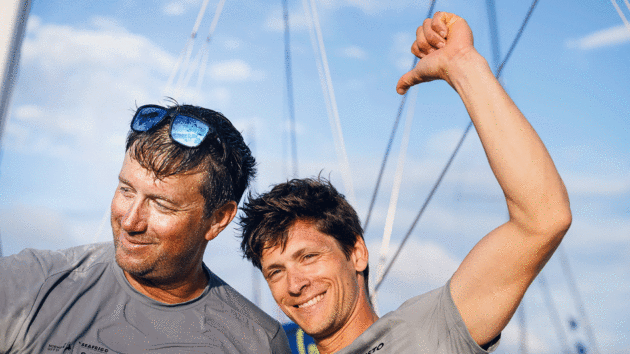
Guillaume Pirouelle and Cédric Chateau. Photo: Jean-Louis Carli/Alea
The fairytale dream of a family double was lost, as Basile’s cousin Mathis won the Mini Transat the same week, 30 years after his own father.
After 12 days and 5 hours of racing the class win was decided by just 18 minutes. Underdogs Baptiste Hulin and Thomas Rouxel on Viablis Océans, an older 2017 VPLP design, made a better approach from the south to pass Figaro talents Pierre Quiroga and Gaston Morvan on WeWise at the very south-eastern corner of Martinque with less than 90 minutes to sail.
Just 10 minutes later Luke Berry and Antoine Joubert clinched 3rd on Le Rire Médécin Lamotte, their best ever placing. Australian-born Berry lived in Macclesfield until he moved to Saint Malo with his family at 10, then studied at Southampton University. For him this result exorcised the ghosts of the 2023 race, when he and Joubert were capsized and dismasted.
“Getting on the podium on a race like this, when there’s never been as many Ocean Fiftys, with the oldest boat from 2009 – we are very, very happy,” Berry said.
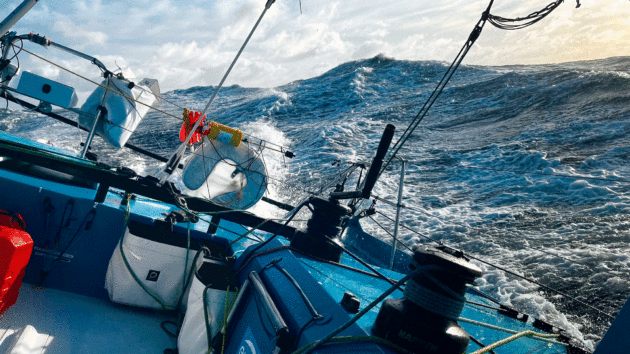
Conditions on the Class 40 Engie mid-race. Photo: Team Engie
“We’ve always known that this boat’s been quite fast downwind – at least as fast as you’d ever want. I would put [the result] down to putting the boat at the right speed at the right time. At the beginning we accepted to be a bit slower and to be a bit behind to play the safety, knowing that potentially we’d be able to catch up around the Canary Islands. Then after [it was] just trying to do our thing and make the right choices.
“At the beginning we were quite affected [by all the capsizes], especially having broken our boat in two in the last race, but we really did our own thing.”
Article continues below…
Three 50ft trimarans capsize in first night of Transat race: all skippers rescued
The Transat Café L’Or – formerly known as the Transat Jacques Vabre – has got off to a dramatic start…

Peter Burling goes offshore: America’s Cup helmsman will race on foiling Ultim trimaran
When it was announced that three-times Kiwi America’s Cup helmsman Peter Burling had not re-signed with Emirates Team New Zealand,…
International surprise
In the IMOCAs Beyou and Lagravière outgunned their rivals in the tradewinds with Charal. At times the powerful Sam Manuard design was more than 3 knots faster than its nearest chasing rivals.
Lagravière is a former 49er racer who at one time had his own IMOCA programme with Safran, and brought experience and ideas from Thomas Ruyant’s team, with whom he sailed for two previous Transat wins. He is known for an ability to keep the boat sailing fast for hours, while Charal had also gained from technical improvements.
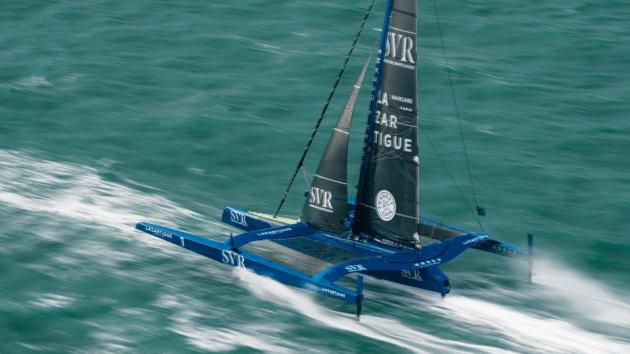
Franck Cammas and Tom Laperche took first place in the Ultim category of the Transat Café L’Or with SVR Lazartigue. Photo: Vincent Curutchet/Alea
The boat’s extra speed was the result of new, deeper rudders (Beyou is a pioneer of using canted out rudders to add lift), and further optimisation to the double-headsail-plus-quad sail combination originally developed by Ruyant with Lagravière. Charal’s rudders not only add lift, but importantly make a boat which has a reputation for being a real handful more user-friendly.
But the real surprise was Francesca Clapcich and Will Harris on 11th Hour Racing, who unleashed a remarkable performance to finish runners-up 5h 47m after Charal.
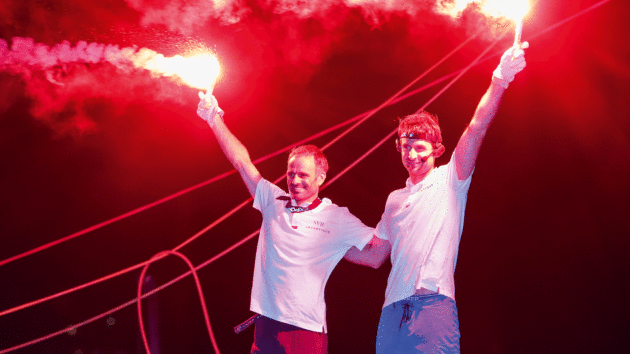
Franck Cammas and Tom Laperche. Photo: Vincent Curutchet/Alea
Blistering performance
The Transat was Italian-American skipper Clapcich’s first IMOCA ocean race with her own programme, sailing the former Malizia in its new colours. Clapcich was a 49erFX champion for Italy, sailed for American Magic in the Women’s America’s Cup, won The Ocean Race sailing the previous 11th Hour Racing with Charlie Enright, and skippered the female crew on the Upwind by MerConcept Ocean Fifty. This result is the perfect platform for her campaign for the 2028 Vendée Globe.
Meanwhile, for British co-skipper Will Harris it is a landmark result on an ocean racing career path with limitless potential. Harris has been German Vendée sailor Boris Herrmann’s first lieutenant since 2019 and most recently skippered Malizia on many legs of both The Ocean Race and Ocean Race Europe – nobody knows the IMOCA better than him.
Harris and Clapcich’s result was lauded by the French media, as two relative unknowns (to the French audience at least) stealing a march on many leading names.
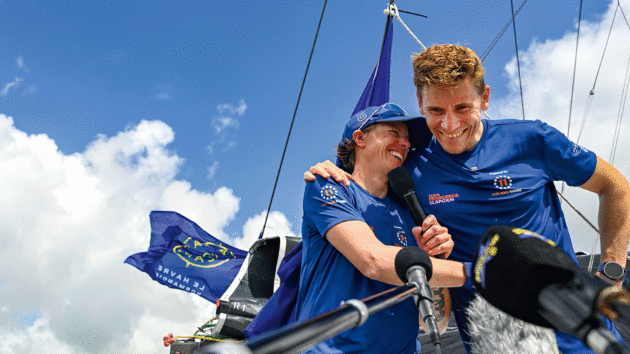
Francesca Clapcich and Will Harris. Photo: Jean-Louis Carli/Alea
A grinning Clapcich said after finishing: “I am so excited about the performance. Sometimes I was surprised and impressed how well we were able to push the boat. It gives me a lot of confidence for the future. It shows the boat is not one of the newest ones but it has a strong say in this fleet.
“For me sailing with Will was incredible. We have a really good relationship and on and off the boat I’ve discovered how great and professional a sailor he is. He has so much experience. We were pushing the boat so hard but still learning little tweaks all the time. At times it felt a lot like the Figaro. Every day we were trying to do better. And hand steering was intense – on The Ocean Race we hardly touched the tiller, it was all on the pilot.”
Harris has had a phenomenal season, going straight from skippering Malizia in the Course des Caps, to winning the Admiral’s Cup as navigator on the Monaco small boat, to The Ocean Race Europe. He previously received an offer of support for his own Vendée Globe and Ocean Race programme, though it came to nothing, so is hopeful this result might be a calling card for a 2028 Vendée entry.
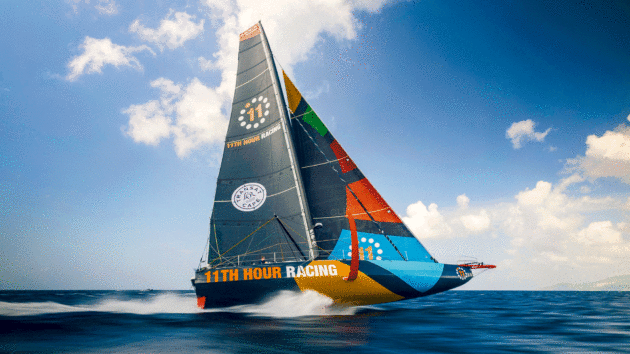
Francesca Clapcich and Will Harris surprised many by bringing the IMOCA 11th Hour Racing home in second place. Photo: Jean-Marie Liot/Alea
“I am really happy about it,” said Harris. “Besides the result there is a lot of confidence that we’re progressing as sailors and in the fleet. It wasn’t like we got lucky or fluked something – we had to consistently be good and fast.
“It was really nice to see that we weren’t losing places at the end. Getting past Sam [Goodchild] was important. That night before we overtook him, we said, ‘We’re really happy to be on the podium’, but then we said, ‘Okay, let’s try and go on the attack a bit’. That’s when we started playing with a few gybes and managed to just sneak ahead of Macif. It is not every day you see the boat that won the Vendée Globe going backwards on you!
“We wanted to be fast, but we wanted to keep the boat in one piece. I put that down to us having good experience of how to look after the boat, how to push. Before the start I really wanted to have a clear picture in our heads of how we were going to tackle the race as a team, what we thought were our strengths and weaknesses and how we were going to sail to those. Now it feels amazing to come here and say that we really followed that plan.”
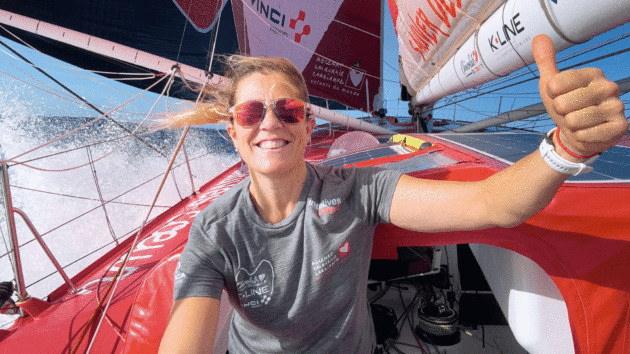
Sam Davies teamed up with 24-year-old Violette Dorange, finishing 6th in Dorange’s first foiling IMOCA race. Photo: Team Initiatives Coeur
Mixed fortunes
Behind Briton Goodchild and Berrehar in 3rd, Italian Ambrogio Beccaria was 4th with his new project backed by paint company Mapei, Switzerland’s Justine Mettraux took 5th on her last race with TeamWork-Team SNEF before she too gets an new IMOCA, while 6th was Sam Davies and Violette Dorange on Initiatives Coeur; making one of most international IMOCA results sheets ever.
But the class is in a state of flux. On the one hand there are nine new IMOCAs in build and two new-generation boats raced in this Transat. But since the Vendée Globe – as is often the case – many sponsors have left, among them Bureau Vallée, Maitre Coq, Maxime Sorel’s partners V&B/Monbana/Mayenne, Group Apicil, and most recently PRB.
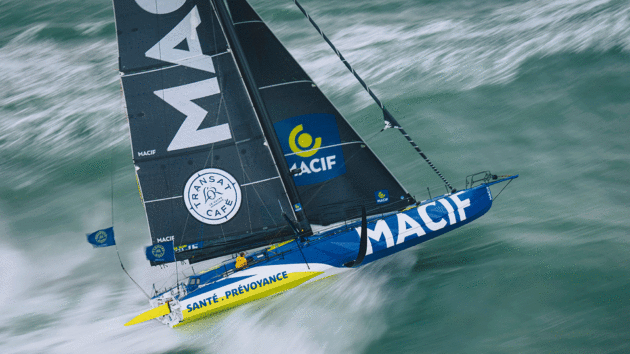
Photo: Vincent Curutchet/Alea
More importantly, the economic and unstable political situation in France is making it extremely hard for commercial backers to commit to multimillion-euro IMOCA programmes.
IMOCA president Antoine Mermod remains predictably upbeat, saying he has over 100 enquiries for the next Vendée Globe and believes there will be close to 40 entries for 2028. But class veteran Yann Eliès is much more circumspect, citing a number closer to 30.
The biggest churn is in the ‘second and third division’ of the fleet. Recently there were 30 IMOCAs for sale and the market is difficult, making it especially painful for sailors who took loans against their boats believing a strong demand would hold. Time will tell.
Channel capsizes
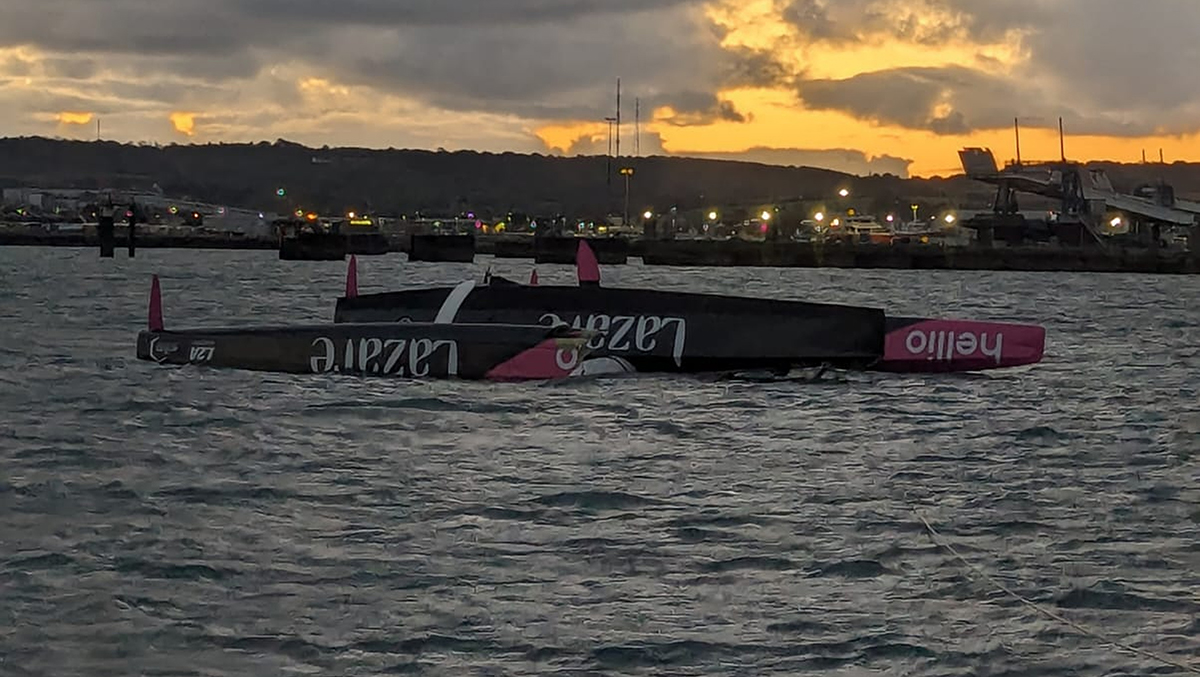
On the night of 25 October, three Ocean Fifty trimarans capsized in swift succession. The first was Lazare X Helio, at 2227 three miles off the Cherbourg peninsula. Winds were 20-25 knots with 3m seas and co-skippers Erwan Le Draoulec and Tanguy Le Turquais were sailing vigilantly, when their boat nose-dived without warning.
Le Turquais reported: “We were upwind, the sea was unpleasant but not overwhelming. It became very rough as we passed through the Alderney Race, and that’s when we capsized. What was very strange was that we capsized from the bow, as if we were downwind.”
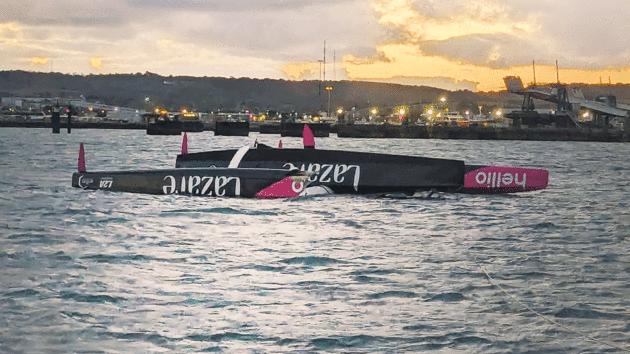
A smashed port float led to Lazare’s capsize. Photo: Jean-Marie Liot/Alea
The duo eased all sheets, expecting the boat to right itself. But instead the tri continued to roll over, the mast hitting the water and snapping, then settled upside down. “We landed on the cockpit ceiling, which became the floor,” le Turquais told the race team.“On contact with the water and our two bodies falling onto it, it exploded. The water rushed in; in a few seconds we were up to our chins.”
Thankfully, the two skippers were able to climb into the central hull, where they could issue a Mayday call and activate their emergency beacons. Half an hour later, a helicopter from the French Navy arrived.
“We were really on the edge of life and death,” said a shocked Le Turquais.
The reason for the capsize quickly became apparent. “Twenty minutes before the capsize, Erwan and I heard a bang,” he recalls. “When we capsized a little later, we realised we had become a catamaran; part of the port float had torn off.”
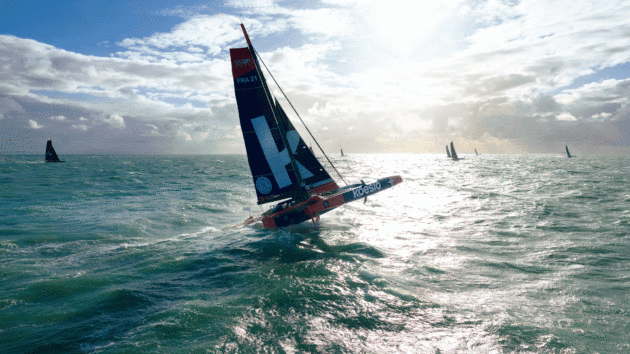
Koesio pushing hard at the start of the race – it was later on that things went wrong. Photo: Jean-Marie Liot/Alea
Uncontrollable
Next to go, just some four hours later, was Koesio, skippered by Erwan Le Roux, a three times winner of the Transat and double winner of the Route du Rhum. “We got a nasty gust of wind – the autopilot couldn’t hold. Audrey [Ogeraux] and I immediately eased the sails, but the boat continued on its course. With the waves, we were both thrown sideways onto the sprayhood,” explained Le Roux.
Koesio heeled over to 90°, the mast broke, and a second pairing found themselves aboard a capsized boat filling with water. “It rushed in very quickly,” said a shaken Ogeraux.
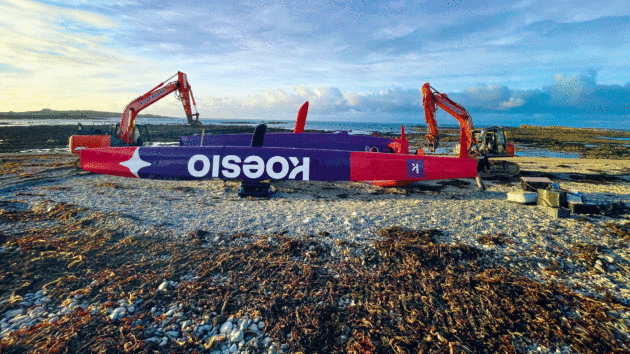
Koesio washed up on a Guernsey beach having avoided rocks. Photo: Team Koesio
A second helicopter rescue was carried out by the French Navy. “We had just witnessed the rescue of Erwan and Tanguy live on the VHF radio,” said Ogeraux, “so it was a bit strange, but we knew what to expect. Except ours wasn’t easy. The diver had to make two attempts to reach Erwan. And seeing the boat from the helicopter… You see that in photos in magazines, but when it’s your own boat, it’s not the same.”
The drifting Koesio turned up on a Guernsey beach the following morning, having avoided being smashed up on the many rocks nearby.
Then at 0505 Inter Invest turned over just off Aber Wrac’h in a sudden windshift. “We didn’t feel the boat lean on the mast; everything broke at once,” explained Matthieu Perraut. He and Jean Baptiste Gellée were also airlifted off while ex-Figaro racer Adrien Hardy’s special purpose trimaran Merida salvaged Inter Invest.
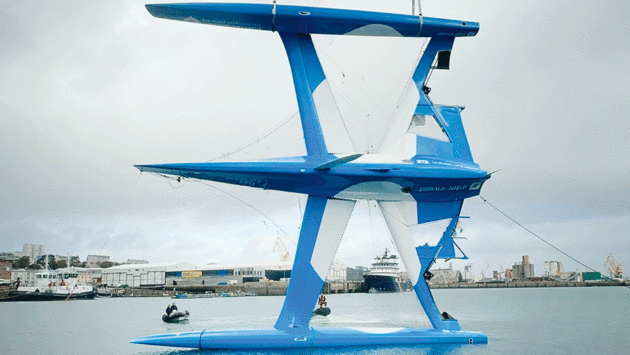
Salvage of the Ocean Fifty Inter Invest. Photo: Team Inter Invest
Safe to race
Ocean Fifty skipper Luke Berry was skipper of Le Rire Médécin Lamotte in this year’s race. He and co-skipper Antoine Joubert were rescued by Merida two years ago after capsizing off the Spanish coast. He is very aware of the pitfalls but firmly believes the Fifty class is safe to race transatlantic.
“We were all a bit traumatised after that first night,” he recalls. “But the wind was very unstable, there were wind shifts of up to 30° with gusts of plus-10 knots each time.
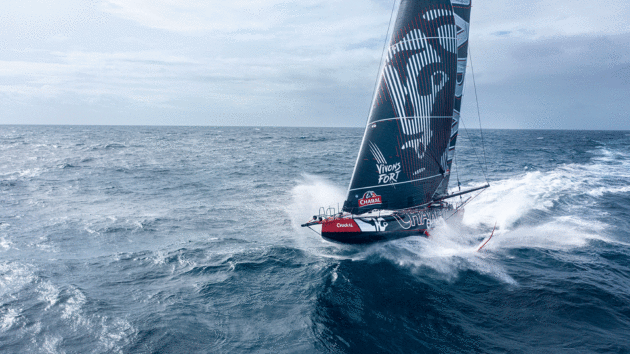
Jérémie Beyou and Morgan Lagravière led the IMOCAs home with Charal. Photo: Yann Riou/polaRYSE
“I think it’s difficult to accept that when you’re in the lull you’ve got to be under-sailed. Some of them probably put the sails up a bit too early. But at no point we found ourselves to be in any danger.”
All three boats which capsized are of different designs and vintages: Lazare a 2023 VPLP design, Koesio a 2020 VPLP, and Inter Invest a 2023 Neyhousser. Berry observes, “The [most recent] boats are a lot stiffer – on the older boats in a gust the boat will sort of bend before getting up on one hull. The newer ones have got a lot more ‘pop’ in them.
“And the new boats have got an enormous aerodynamic surface area under the hull. If you take a look at Lazare when they were turning it back over you can see the surface area of potential windage underneath the hull. It is very aerodynamic and good for performance. But when the wind gets underneath it, it’s as if you’ve got another sail underneath the boat. But it’s difficult to say if that [was a factor] or not.”
 If you enjoyed this….
Yachting World is the world’s leading magazine for bluewater cruisers and offshore sailors. Every month we have inspirational adventures and practical features to help you realise your sailing dreams.Build your knowledge with a subscription delivered to your door. See our latest offers and save at least 30% off the cover price.
Note: We may earn a commission when you buy through links on our site, at no extra cost to you. This doesn’t affect our editorial independence.