



Whether you’re foiling into a start line at 30 knots or lining up in a keelboat, Dylan Fletcher shares key rules for getting off the line cleanly with Andy Rice
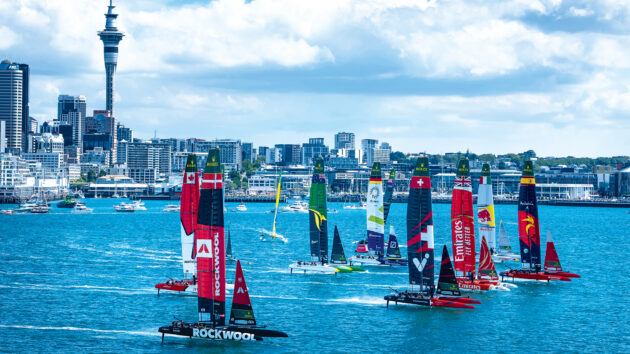
Starting has always played a disproportionate part in the outcome of a race. The shorter the duration of the race, the more this is true. Dylan Fletcher knows this very well from his experience competing in SailGP, where the races often last less than 10 minutes. Even though a reaching start against eleven 50ft foiling catamarans appears to bear little resemblance to a conventional upwind start for a large fleet of keelboats, Fletcher argues there are some fundamental principles that apply to any scenario.
“Time and distance judgement is key to any kind of start and the more you do of it the better you get,” he says. “I think that doing a lot of Moth sailing during the summer really helped my SailGP starting because in the Moth you have to eyeball it.” Fletcher explains that in the Moth, you have no technology to tell you where the line is. Judging that approach to the line and doing it multiple times helps with any other starting, whether it’s SailGP, on a Cape 31, or an RC44. In the following five tips, Fletcher shares not only how to give yourself the best shot at a winning start, but one that puts you in the best place for your overall race strategy.
What outcome do you want?
Which side of the course do you think is paying? Is it an even course or is one side looking favourable? This is the bigger picture that you need to work into your starting strategy. Everything you do in the build-up to the start needs to work back from the outcome that you want.
In a 49er, for example, if there’s just six knots of breeze everyone tends to take their place on the line really early. If I want to win the starboard end, I know I’m going to be at the starboard end potentially nine minutes before the start gun. So, when the orange flag goes up, I already need to be on the line.
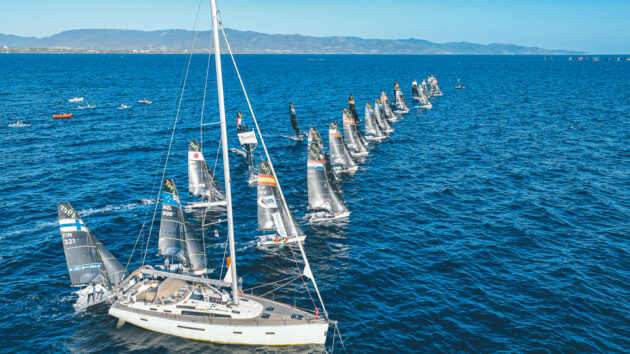
Going for a committee boat end start on a right-favoured course can be a winning, but higher risk strategy – here at the 2025 49er Worlds in Cagliari. Photo: Jesus Renedo/Sailing Energy
Understanding your outcome and making sure you work back to the right process is absolutely critical. Identify your ideal point on the start line and where the fleet is lining up. This will show you where the opportunities are potentially going to be. Doing a timed run before the start, particularly in displacement keelboats where the timings are quite predictable, will give you a good sense of how to time your approach with a good deal of accuracy.
Dial back the risk
Some starting approaches are riskier than others. You need to work out the risk versus reward factor of the start you’re considering. Working back from our overall outcome in SailGP, our aim for the season is to make it into the three-boat grand final at the end of the year in Abu Dhabi. We know that if we go around mark one in 5th place (just better than halfway in the fleet) and we overtake at least one boat, it gives us a good enough average to achieve our overall aim of making it into the top three. We don’t need to take massive risks on the start line. So how can you apply this to a keelboat start and your own scenario? We look at how to apply this in the next tip.
Left-hand track
Let’s say you’re racing on a left-side favoured race track where you need to hold your lane on starboard for a long time. Alternatively, there might be a good bit of port end bias to the way the line has been set. Do you really need to win the pin on a port-end favoured start? It’s a high-risk strategy that can go really well or go really badly.
Depending on your overall goal, maybe it’s good enough to let the pack fight for the pin. You can instead start a third of the way from the end where there’ll be more space to get a clean start. Make sure you’ve got the best transits available and/or that you’ve pinged the line as accurately as possible. We’ve already talked about the importance of time runs and the pin-end scenario is where it matters the most.
If you feel like you’re arriving at the pin a little too early, don’t just stay there and hope for the best, or bail out in the last 30 seconds. There’s no time to salvage a good start if you bail out that late. Bail out with at least a minute to go because that’ll give you more time to reset. This allows you to look for a second opportunity to secure a good approach to the line.
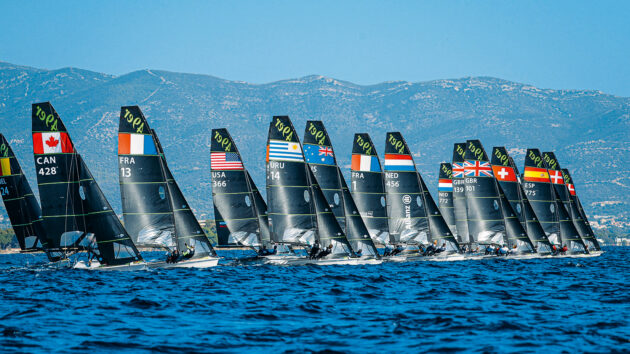
In the 49er fleet you need to secure your spot on the line early. Photo: Jesus Renedo/Sailing Energy
Do the ‘dead bird’
What if it’s a go-right race track, like it so often is at Lake Garda, for example? Starting right next to the committee boat as the gun fires is perfect of course, but potentially high risk. This is especially true if you’re starting on a black flag or a U-flag. A lower risk approach but almost as effective is to do the ‘Dead Bird’.
I’m not sure why it’s called that, other than it might have been a favourite of America’s Cup helmsman Ed Baird, and it’s ended up being the ‘Dead Bird’. The tactic involves coming into the line behind the front row, right near the committee boat. As soon as you can tack, you flop over on to port tack and make a beeline for the right-hand side.
Of course, this is sometimes easier said than done. But even a poorly executed Dead Bird could get you into clear air going the right way. This is compared with many boats further along the line who got great starts but just don’t have the opportunity to tack on to port until many minutes further up the track. They might be ahead of you at start time, but you’ll be ahead of them five or 10 minutes later.
Resist the panic-tack
If everything is pretty even across the race course, there’s no bias in the line, and no side is paying particularly, it’s about getting into a clear lane as soon as possible. Your goal is being able to achieve your best VMG speed. In this instance, it doesn’t really matter where you start, so pick what you’re comfortable with.
In the 49er with Stu Bithell, our super strength was starting near the left-hand end of the line, so that was our default setting when there were no other major factors to consider. Don’t underestimate your ‘super strength’. When you’re racing in an important regatta and the pressure is on, lean on what you know works best for you.
Of course, sometimes you’re going to get it wrong and you’ll find yourself gasping for air in the second or third row out of the line. I’ve made this mistake myself a thousand times where I tack out straight away in the hope of finding something better. But it’s nearly always better to wait 10 seconds, take stock of your situation, and choose your moment to tack out on to port. Chances are you’ll make a much better choice if you can resist the panic-tack and, instead, give yourself a moment to think.
See all of our Expert Yacht Racing Tips sponsored by Musto.
 If you enjoyed this….

Yachting World is the world’s leading magazine for bluewater cruisers and offshore sailors. Every month we have inspirational adventures and practical features to help you realise your sailing dreams.Build your knowledge with a subscription delivered to your door. See our latest offers and save at least 30% off the cover price.
Note: We may earn a commission when you buy through links on our site, at no extra cost to you. This doesn’t affect our editorial independence.