


An aluminium cruiser from workboat builders in Italy? Jochen Rieker sails this modern design to see which sailors it suits
Stem 50 review: Top-quality adventure yacht

More and more sailors are not just dreaming about but actually planning extended cruises to far-away places. While the majority may take any GRP boat across the Atlantic or into high latitudes – usually the yacht they already own – some will opt for a purpose-built, more forgiving, more utilitarian craft.
Aluminium explorer and bluewater yachts have thus become somewhat of a trend. In fact, they represent one of only a few booming market segments. New yards and their innovative designs are complementing the dozen or so speciality builders from France and the Netherlands who still have a stronghold in this growing niche of the sailboat market. Now Italy has joined the party.
The Stem 50, which premiered at last year’s Genoa Boat Show, offers yet another interpretation of a 4×4 for the high seas, the latest of the recent alu breed. And while few sailors may have heard of the brand, its builder is anything but a newcomer. In fact it’s recognised internationally for its purpose-built workboats.
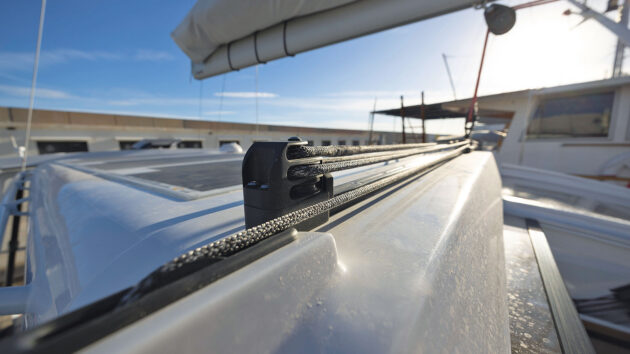
Practicality is key here: mainsheet kept out of the cockpit on the rollbar. Photos: Andreas Lindlahr/EYOTY
For 40 years, Stem Marine, founded by Ezio Menna in Medesano near Parma, has produced rescue, patrol, and firefighter boats to the highest industrial standards. With a staff of 85, they also developed evacuation systems, stretchers, and shock-absorbing pilot seats.
That same engineering prowess and artisan excellence has now shaped a 15m go-anywhere yacht, one where “every detail has been conceived and crafted with the utmost care and precision”, as managing director Michele Corradi puts it.
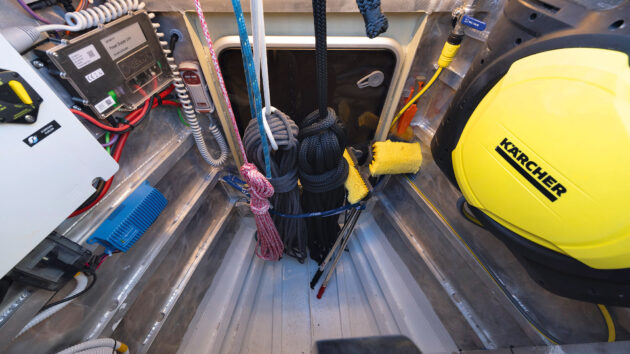
A good size watertight bow locker. Photos: Andreas Lindlahr/EYOTY
While the vision to venture into sailing goes back some 20 years, it wasn’t until 2022 that Corradi tasked Nicolas Purnu, a French naval architect formerly with Marc Lombard Design, with this project. Last summer’s launch followed three years of development – a lead time that is testament to the thoroughness of Stem’s approach.
And it shows. From deep down in the watertight aft compartment to the meticulous electrics installation, this boat doesn’t take anything lightly. She means business.
Her dual autopilot set-up, for instance, follows IMOCA standards: it provides full redundancy, allowing you to switch from starboard to port unit within an instant – no other action required than turning a knob on the control panel.
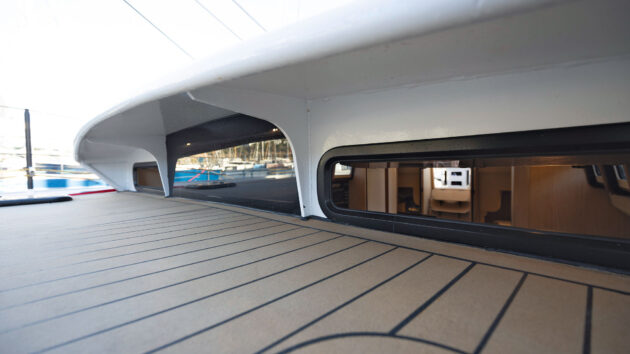
Coachroof overhang cuts glare to saloon windows. Photos: Andreas Lindlahr/EYOTY
Aircraft quality
The attention to detail continues: the forward sail locker isn’t just a big, deep cavity in the deck – there are shelves, welded so they can be used as a ladder that at the same time help you properly put away fenders, ropes, and the furled Code 0 instead of dumping everything in a pile.
Or take the top shelves in the saloon. They’re made from milled, machine-bent and welded aluminium sheets, as used on commercial aircraft, carrying up to 20kg of load each. Hinged and dampened to safely open downwards, they won’t spill whatever is stored inside. Why, you wonder, has no other yard done it this way?
The list of clever details could easily fill pages, and we’ll highlight a few more later on. Instead of playing it safely, staying inside of what is proven, the yard presented one of the most elaborate new builds in years.
Michele Corradi calls the 50 “a unique yacht for discerning sailors who seek something beyond what traditional production boats can offer.”
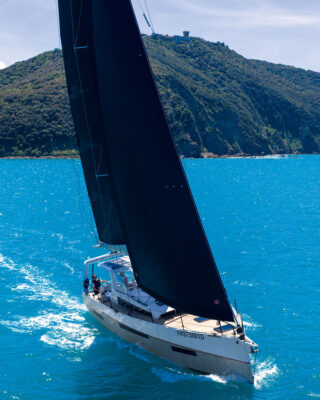
Large genoa provides plenty of power upwind and makes the Stem 50 a joy to sail in light to medium breeze. Photo: Luca D’Ambrosio
Hard lines
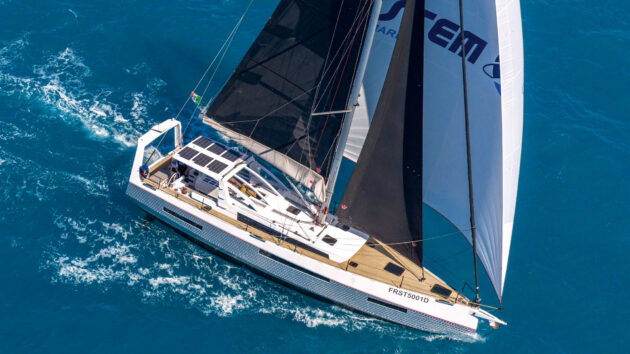
Fittingly, the Stem 50’s hull lines look different to most of the competition. Chamfered topsides make for a sporty appearance, highlighted by the white paint that contrasts nicely with the otherwise bare aluminium, polished to a half-moon pattern.
Seen powered up in the breeze from the front or the side, she could be mistaken for a performance cruiser. Her fine entry and slender bow mask the volume she carries from amidships to the stern. The aft section, however, comes across as mighty as that of a freighter with the nearly vertical transom and the big roll bar towering above the deck.
While boat number one sports all the extras available for the cockpit layout, including a rigid hardtop and the arch aft, the Stem 50 in standard configuration only comes with the targa-bar above the companionway, which carries the traveller. That gives her a lighter, more elegant, less functional character than the test boat.
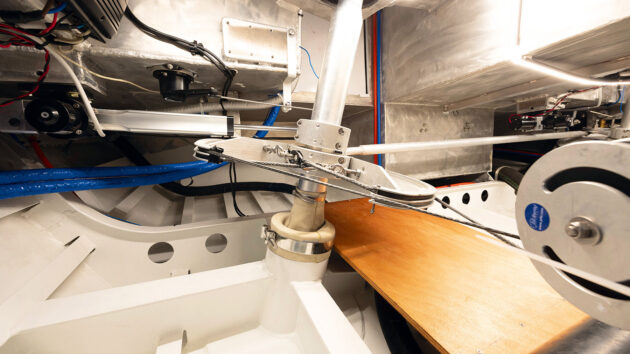
Rudder feedback is excellent, as is the engineering of systems. Photo: Luca D’Ambrosio
Yet, without the hardtop, you give up on another unique feature: fully retractable rigid sprayhood windows that open and close at the touch of a button. There are three segments to be operated individually, sliding into the hardtop roof for maximum cockpit ventilation.
It does come at a price, though: The rigid bimini sets you back €53,000, the servo-actuated polycarbonate windows another €13,500. Having experienced the feature during a week of testing off the Catalan coast with temperatures as high as 35° at times, it does feel tempting to tick those boxes anyway.
The cockpit itself is spacious enough to seat six to eight people. Benches measure a generous 2.06m and are separated by a solid aluminium table base with drop-down leaves to either side, complemented by many storage shelves and boxes for crew gear.
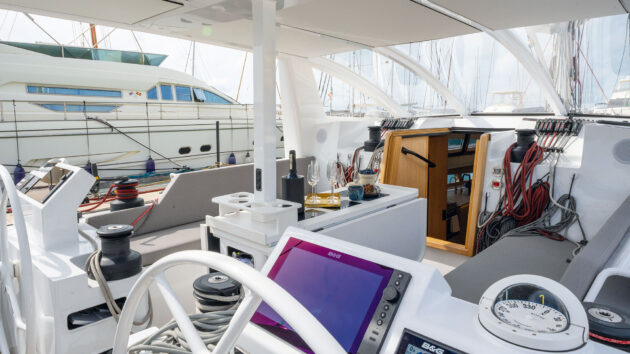
Cockpit gets busy with full crew. Sheet loads on the primaries next to the pedestals suggest an upgrade to electric winches. Photo: Luca D’Ambrosio
The backrests are nearly vertical, so not the most comfortable on long passages. But they are high enough to give a feel of protection, an impression enhanced by the rigid sprayhood and hardtop that effectively holds off most spray.
Two electric Antal winches next to the companionway are mounted lower than the coachroof to allow for easy hoisting and trimming. But in order to do so, halyards and tweakers need to run downwards at an angle to the stoppers and onto fairleads, a setup which increases friction and thus wear on the ropes.
Unlike their push-button counterparts, the primary winches are mechanical as standard. They’re positioned inside the twin helm stations, which makes it safer and more ergonomic to grind than to be bent over outboard near the side decks. Yet the 90° diversion again increases the loads considerably, especially with the big genoa in some breeze. This makes it almost a must to opt for electric winches.
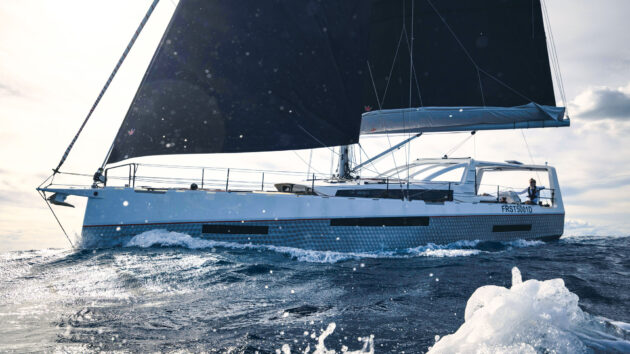
‘In car terms, she’s an SUV among the nautical 4x4s’. Photo: Andreas Lindlahr/EYOTY
Dedicated mainsheet winches nearby help with organising and distributing rope handling. Several letterbox-type containers in the coamings and pedestals help tidying up loose ends on long legs or in the marina. When short-tacking, however, they are a bit cumbersome to use, so you end up with a fair bit of spaghetti strewn across the cockpit floor.
The layout in general is geared for sailing with a small, active crew; if all winches are manned, space becomes a bit scarce, especially around the wheels. Visibility forward is good. But with the hardtop blocking the view above, you have to lean out of the cockpit in order to check mainsail trim or traveller position.
Getting onto the deck is a bit of a climb because of the high coamings. There are welded steps next to the helm stations to help your ascent, but for me they feel too narrow to negotiate easily when wet.
The aft end of the cockpit hosts a grill and a sink underneath the helm seats. Two showers and two telescopic bathing ladders turn the wide platform into an oceanic pool terrace. The liferaft has a dedicated and easily accessible stowage space there as well.
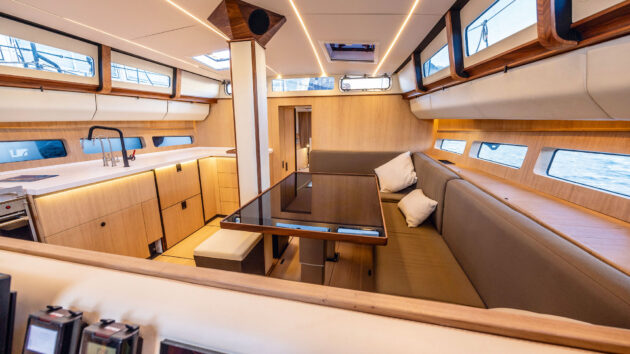
while the longitudinal galley lacks bracing support, the interior offers plenty of clever solutions, like the airplane-style hanging lockers and a plexi tabletop to store and check charts. Photo: Andreas Lindlahr/EYOTY
Robust build
When conceiving the boat, three principles guided the yard, Michele Corradi says: “safety, ease of sailing, and comfort”. With robustness their highest priority, they started with an exceptionally solid hull. Frames every 75cm, and half that in the area surrounding the keel box, provide for an impressive strongback.
Thrown about in some nasty chop and up to 30 knots of breeze, the Stem took it with ease during sea trials for the European Yacht of the Year Award last October.
Watertight crash boxes forward and aft add to the peace-of-mind qualities of the build. So do the keel and rudder attachments. While many aluminium explorer yachts offer variable draught, either as an extra or as standard to facilitate anchoring in shallow waters, Stem decided otherwise. “We prefer a fixed keel”, says Corradi. “It provides much better efficiency and requires zero maintenance.”
This construction is rock-solid: the top of the 735kg fin, precision-milled from a massive block of aluminium, is inserted deep into the keel box and bolted through horizontally. Therefore, any potential impact loads are distributed widely and evenly.
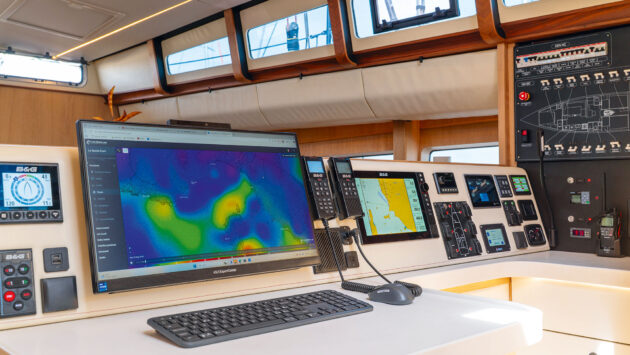
The central nav station is a busy place. Geared for electronics, it features only a small table. Photo: Luca D’Ambrosio
At the other end, the fin carries a 3.4-ton torpedo-shaped lead bulb, providing for a low centre of gravity while keeping the overall displacement at bay.
However, it means you must contend with a draught of 2.4m, limiting the choice of marinas and anchorages, and you risk snagging some lines, floating nets or lobster pots when underway. At request, the yard will offer a telescopic keel as an option.
The twin rudder set-up, made from Jefa components, provides loads of grip and feel while being light to the touch. The system is easily accessible through the aft cabins as well as the lazarette.
Each helm station connects to one rudder via low-friction blocks and Dyneema SK 78 braided rope for full redundancy. To disconnect the rudders, you simply remove the aluminium push rod between the quadrants if you should ever have to.
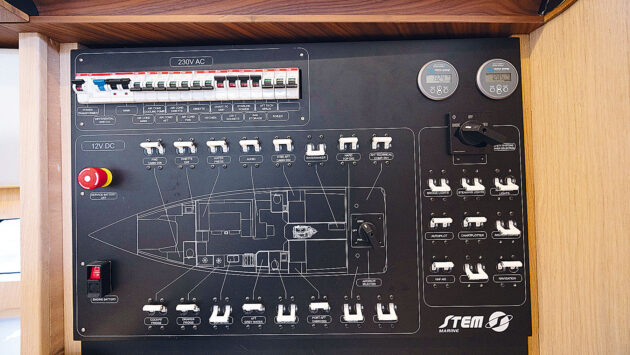
Electric installation meets top workboat standards. Photo: Andreas Lindlahr/EYOTY
Considering the width and height of the stiffening knees that support the bearings, and judging the strength of the machine-tooled rudder blades, it’s something you’re unlikely to have to do.
Sports utility vehicle
At 15 tons displacement in light configuration and 18 tons in cruising spec, the Stem is on par with the new Boreal 52 and the German BM 50. The Allures 51.9 and Ovni 490 weigh 15% more. Combined with a rather generous sail plan, a sail area to displacement ratio of 23.5, this Italian aluminium yacht brings something new to the market of sturdy world cruisers. In car terms, she’s an SUV among the nautical 4x4s.
The three-spreader fractional mast is not particularly tall compared to a Hallberg-Rassy 50, for instance, but the Stem’s large 72.9m2 furling genoa offsets this handily.
The sail plan, in fact, provides plenty of gears. The optional staysail, as a heavy-weather alternative, measures only 21.9m2. Rigged on a 2:1 halyard, its tack is attached to a padeye at the aft end of the sail locker, connecting with the fully welded bulkhead. This jib can be sheeted via a self-tacking track, minimising work when battling upwind. The mainsail sports three reefs, all of them handled from the protection of the cockpit.
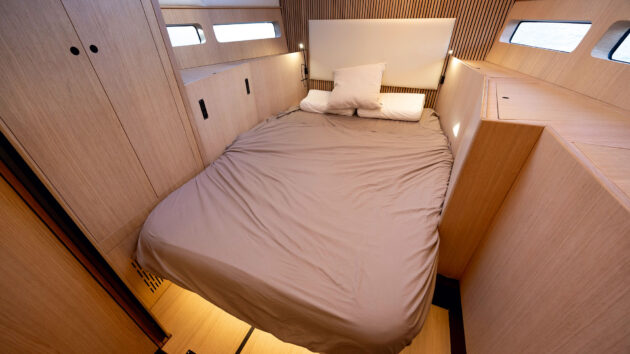
Unusual forward cabin layout has a low berth and open-style wet room shower to starboard. Photos: Andreas Lindlahr/EYOTY
Under way
Sailing the boat proved reassuringly straightforward. The Stem 50 tracks nicely and is well balanced. You can keep her in the groove with little work on the wheel. When pinching upwind, she tacks through 90° true wind angle, averaging 5.6 knots of boat speed in 12 knots of wind – not the fastest boat out there, yet better than average for the bluewater segment.
She comes more to life at 50-55° to the true wind, picking up almost a knot of speed then and feeling much happier. On a beam reach, she easily logged 8 knots or above and topped out at 8.5 knots under Code 0 at 110° true. In more breeze and waves, she hit 10 knots reaching under genoa and full main, all while maintaining her easy, sea-kindly manner.
When heeled over on her hard chine, she tends to trim and pitch rather gently over her narrow bow, while being completely ignorant to the forces hull and rig have to cope with. It is a reassuringly unshakeable yacht, as it should be.
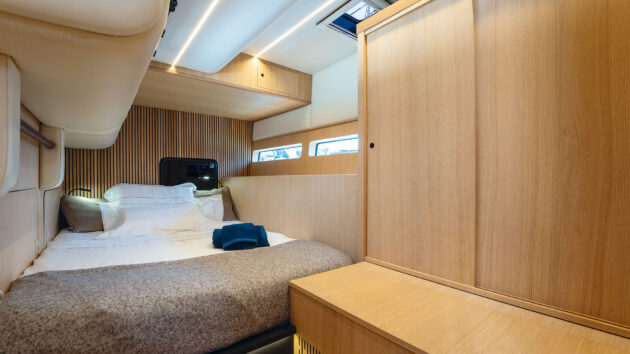
Aft cabins are nicely designed and well ventilated, but berths lack in width. Photos: Andreas Lindlahr/EYOTY
That same feeling is felt in the interior, which remains quiet regardless of the conditions outside. Stepping down the companionway the navstation is right in front, allowing for easy communication with the crew on deck. Two heads compartments either side are also hugely practical at sea, as they save going through the interior in dripping wet-weather gear.
Forward to starboard is the U-shaped sofa with a large saloon table opposite the galley to port. While generously sized, the galley has a longitudinal layout – an unconventional choice for a bluewater yacht because there is only the mast support to brace against on port tack. The yard is happy to discuss if you’d like something different, though.
Large coachroof and hull windows provide for an airy feeling, amplified by a headroom of 1.96m to 2.01m. And because the Stem offers vision through two recessed windows in the forward superstructure, underneath an overhang, you can safely navigate from the inside, a feature hard to underrate.
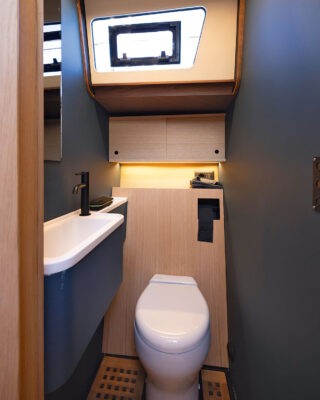
Small day heads on starboard. To port is a proper bathroom as standard. Photos: Andreas Lindlahr/EYOTY
And you have to love the hinged plexi-top of the saloon table, where you can safely store all your paper charts, with the top one accessible for quick reference. As mentioned, stowage space is plentiful, with easy access to all lockers and drawers.
The Davide Gelmini-designed interior feels comfy and plush while looking pleasantly different from the usual. Bright oak contrasts nicely with black fittings and frames.
There were some imperfections typical of prototypes.
A gap between the companionway and the engine room, for instance, caused a higher-than-usual noise level in the saloon, hitting 70dB at a mere 5 knots of boat speed (the 80hp Yanmar can provide for 8 knots of cruising speed).
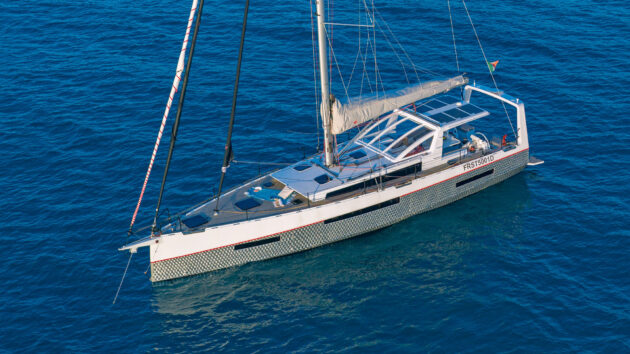
Rigid dodger and bimini top provide robust protection. Luca D’Ambrosio
Still to be addressed are the narrow berths in the aft cabins. They measure 1.22m wide at shoulder level, where 1.40m would be more appropriate on a 50-footer. The yard is planning to raise the cushions and to sacrifice a bit on the side stowage for this. This is a measure that could suit the forward cabin as well, where the berth feels a bit too low and boxed-in between the wood-panelled cladding.
Stem 50 specifications
LOA: 16.06m 52ft 7in
LWL: 14.34m 47ft ½in
Beam: 4.42m 14ft 5in
Draught: 2.40m 7ft 8in
Berths: 6 (+2 in saloon)
Disp (lightship): 15,000kg 33,069lb
Engine Yanmar: 80hp 59kW saildrive
Water: 620lt 164gal
Fuel: 350lt 92gal
Sail area/disp ratio: 23.5
Disp/LWL ratio: 142
Price: €989,000 ex VAT, as tested €1,236,560
Design: Nicolas Purnu
 If you enjoyed this….

Yachting World is the world’s leading magazine for bluewater cruisers and offshore sailors. Every month we have inspirational adventures and practical features to help you realise your sailing dreams.Build your knowledge with a subscription delivered to your door. See our latest offers and save at least 30% off the cover price.
Note: We may earn a commission when you buy through links on our site, at no extra cost to you. This doesn’t affect our editorial independence.
Verdict
While she is not as fine-tuned yet as comparable aluminium yachts from the more established brands, the Stem 50 complements the ever-increasing market segment of explorer yachts. In particular, few boats of her kind exceed the material quality and sail performance she provides. Even fewer offer this many innovations. Experienced owners will be able to tailor her to individual perfection, especially with a yard eager to prove what it is capable of. Consider her the well-behaved Mediterranean version of a bluewater yacht with an occasional Transat project in mind, as opposed to some more rugged high-latitudes offerings that look and feel rather different. At €989,000 ex sails, ex tax, she seems reasonably priced and definitely worth some consideration. A good opportunity to step aboard and see for yourself will be at the Yachting Festival in Cannes in early September.