



Luperon, in the Dominican Republic, is indisputably one of the Caribbean’s best hurricane holes. Stephen Maher reports on its unique appeal – and meets legendary cruising writer Bruce Van Sant
My friend and I were stuck in the rundown marina on the outskirts of Varadero, Cuba’s biggest tourist town, waiting to haul out my 1983 Sabre 38 so that we could replace the centreboard cable, which had let go during a rough crossing from the Florida Keys.
We consoled ourselves with trips to the lovely beach and excursions to the lively farm market in Santa Marta, but mostly with beer – you could buy a 3lt carafe for about a single US dollar.
I’d planned to sail to Rio Dulce, in Guatemala, to leave my boat for the next hurricane season. But over drinks at the bar, an English cruising couple told me about Luperon, on the north coast of the Dominican Republic.
Sailing there sounded better than recrossing the Gulf Stream to get to Rio Dulce, so the next winter, after a memorable passage through the Bahamas, we sailed for Luperon. It took us three days to cover the 185 miles, banging south and east into the tradewinds, pounding through the waves on long, unproductive tacks – taking care to steer clear of Haiti. When finally in sight of the Dominican coast, the wind suddenly died.
North of the Dominican Republic is the open Atlantic, dominated by a relentless eastern tradewind. When that wind fades, the seas do not calm immediately, so we were stuck, sails limp, while the boat lurched through the ghost swells. We could see the lights of Monte Cristi off our bow, but we’d run down the boat’s battery and were afraid to use the electric motor to make the last push to Luperon. Eventually, on the third night, we put the dinghy in the water, strapped it to the starboard side, and propelled ourselves the last 10 miles using the Tohatsu outboard.
We were exhausted when we nosed into the narrow channel of Luperon Bay, and collapsed in our bunks as soon as we dropped the anchor. In the morning, we came out into the cockpit to see the verdant green hills, which Christopher Columbus praised in his log when he first sailed along this coast.
“This is the most beautiful mountain range that I have seen, looking exactly like the mountains of Cordoba,” he wrote on 5 January 1493. It is still as beautiful as it was then – lush and fragrant. After months among the semi-arid islands of the Bahamas, it was a pleasure to smell the hot land breeze.
It was also a pleasure to see the smiling face of Pappo, who came cruising up in his yola – an open glassfibre boat – to welcome us to town and offer us a mooring for just US$60 a month, the same price we sometimes paid for a single night in the Bahamas.
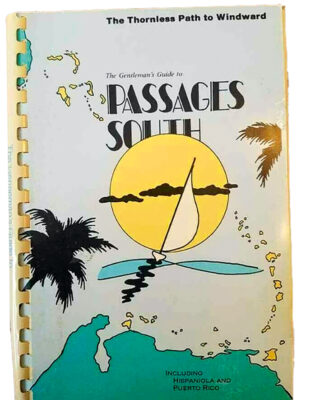
Bruce Van Sant’s The Gentleman’s Guide to Passages South is the cruising bible for this part of the Caribbean
The thornless path
To get to Luperon I relied, as does everyone, on the indispensable The Gentleman’s Guide to Passages South: The Thornless Path to Windward by Bruce Van Sant, which explains the painless way to handle the so-called ‘Thorny Path’ from Florida to the southern Caribbean.
Van Sant, now 87, lives in a lovely bungalow in Puerto Plata, with his wife, Rosa. He calmly reports that he is dying, but remains cheerful and happy to talk about his life’s work – the guidebook he compiled after many years of sailing, carefully recording his routes.
Van Sant grew up daysailing in Florida and was a systems engineer for IBM. When he went cruising around the world in a 51ft Yankee Clipper ketch, he brought a scientific exactitude to his observations, filling his computer with meticulous records, so he could compare journeys over the same grounds taken years apart.
During tens of thousands of miles at sea, Van Sant developed a deep understanding of the seas and winds here – and how they move around islands – and the safest and most comfortable way to make passages.
He started giving seminars in Georgetown, Bahamas, where cruisers – often inexperienced retirees – stop on their way from Florida. “They’re laying around forever in these harbours, and they run into things in navigation and boat stuff that they really can’t deal with,” he says. “They could when they were back in Lake Erie, but now they’re out in God’s great world, and it’s a little different.”
When Van Sant discovered that cruisers in Puerto Plata were selling copied versions of his lecture notes, he decided he should do so himself. So in 1989, he published a spiral-bound 238-page book, which sold out in three months. In 2012, he published the 10th and final edition. Cruisers throughout the Caribbean still rely on his advice on how to make long passages when the wind is going to be blowing into your face the whole way.
The key lesson of his book is to avoid doing what we did as we crossed from the Bahamas – banging upwind – and instead make east by sailing on the north coasts of islands at night, when the katabatic wind comes down from the land, lifting the easterly tradewind.
It’s good advice. There’s a reason why he has sold 50,000 books.
Tucked away
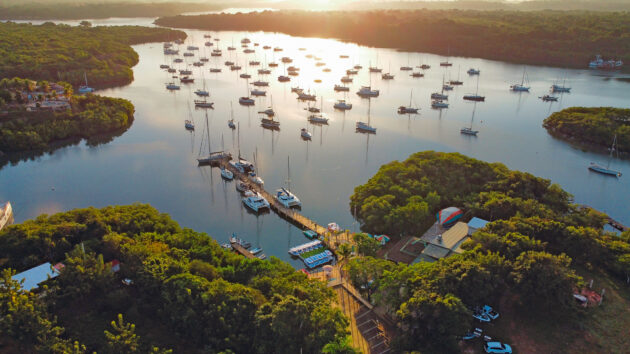
Luperon is the best hurricane hole in the Caribbean for two reasons: its geography and its people.
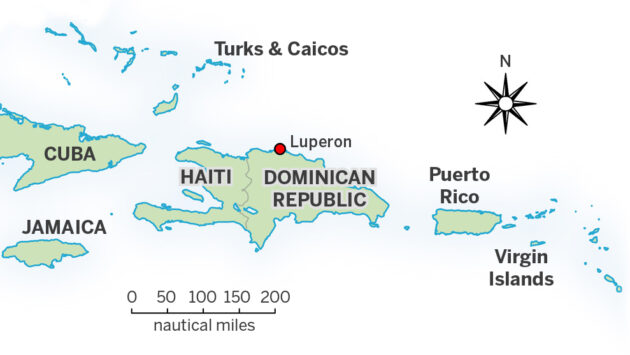
The geography is unbeatable. Situated between the cruising grounds of the Bahamas and the Windward Islands, it is about 50 miles south of Turks and Caicos, 40 miles east of the Haitian border.
The mouth of the harbour is small, only 350m wide, and it opens up into two mile-deep mangrove-lined bays, like an upside-down ‘V’. The relentless waves kicked up by the tradewinds run into shallow water near the harbour mouth where manatees and sea turtles often bask. On nights when the sea is especially lively, you can hear the waves breaking from the still water in the anchorage in the western bay.
Luperon was later renamed after Gregorio Luperón, one of the founding fathers of the Dominican Republic.
Alison Lofthouse is a Yorkshire sailor who settled here with her husband, Miles, and the couple make their living looking after boats for absent cruisers. “[Waves] don’t come around the corner. They go straight. And that’s all to do with the mangroves and how it’s all built,” she explains.
The mud is very deep in places, excellent for anchoring, but the main geographic advantage are the mountains that run east to west across the island. “Sierra Central has the highest mountain in the country, the highest mountain between the Northern Rockies and the Andes,” explains Van Sant.
The vast horizontal piles of rock south of Luperon mean hurricanes do not strike the harbour directly. There has not been a direct hit in recorded history. Clifford Lyon, an American who sailed into the port in 2014, watched Hurricanes Irma and Maria both pass to the north in 2017.
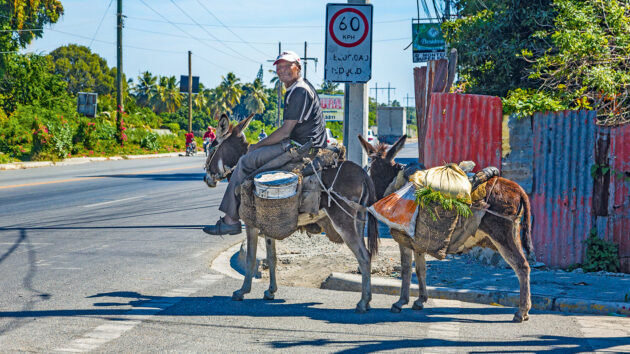
Heading to market, local style
Luperon life
But Luperon is also a splendid place to drop anchor and go ashore. When Van Sant first arrived in 1980, there was one other yacht in the bay. The streets were unpaved and most of the people were farmers and fishermen living in wooden huts with thatched roofs. Now there are more than 200 boats here most of the time, the streets are paved and most buildings are made of concrete.
Sailors, mostly a mix of Europeans, Canadians and Americans, are constantly coming and going, many on their way to or from the Bahamas and the Windward Islands. Some leave their boats for hurricane season. Some stay to take a break and regroup before continuing on. Others are retirees who live here all year, enjoying the relaxed living and low priced ‘gringo’ bars.
The yachts have brought money, as tourism has buoyed incomes throughout the country.
But prices for budget-conscious cruisers are still good. Moorings are inexpensive by Bahamian standards – about $90 a month – and excellent fresh fruit and vegetables are available from stalls in town. You can get a lunch of stewed chicken, rice, beans and salad for US$3-4.
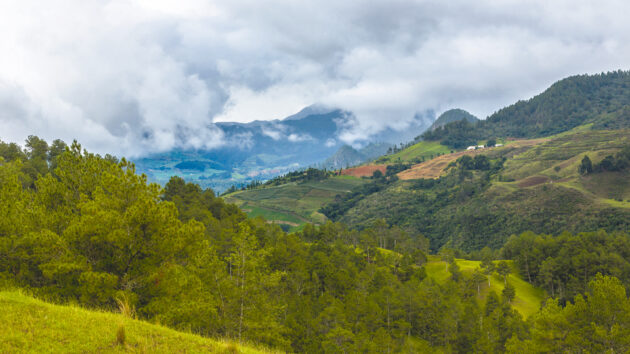
Lush countryside inland from the coast.
Sailors make their way ashore from their boats – mostly older monohulls – in dinghies daily, tying up at a floating dock attached to the moulle, a 300m concrete pier for offshore fishing boats. There’s also a nice marina (Puerto Blanco Marina & Hotel) and a haulout yard. At the end of the moulle is a ramshackle town with a population of about 3,000, and despite the broken sidewalks and garbage in the streets it is friendly and, importantly, safe.
For boats and people
“The most perfect thing about Luperon is that the people are kind, and they’ll always help,” says Lofthouse. “Doesn’t matter what it is. If you run out of petrol, or your car breaks down, you’re going to get rescued. You don’t have to worry about a thing and you’re not going to get ripped off.”
“We still have a rural mentality, a traditional mentality, a mentality of service,” says Pablo Rodriguez, a local tourism expert. “When a foreigner comes along, we welcome them, we give them food, we give them drink, and if necessary, we offer them a bed to sleep in. We take care of them, we protect them because we understand that hospitality is always part of our tradition, part of our culture.”
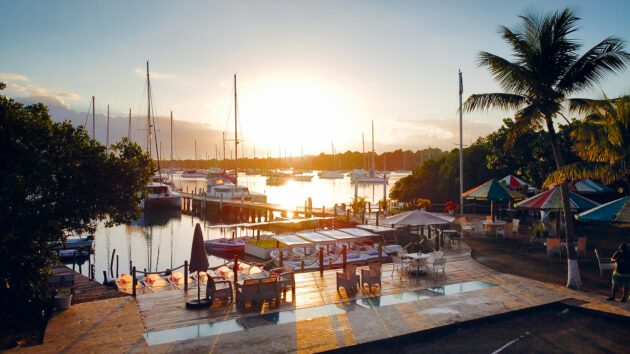
Welcoming bar and restaurant just off the pier at Luperon. Photo (and main photo): Pedro Rodriguez
In the lush hills outside of town, you can see farmers clearing their fields with machetes, riding to town on horseback, and bringing their produce to market in three-wheeled cargo trucks. Nobody swims in the murky water of the harbour, but beautiful Playa Grande is a 15-minute walk from the marina, and there is snorkelling at the harbour mouth.
But it’s not for everyone. Some cruisers accustomed to the posher Bahamian ports leave in a hurry, put off by the town with its incessant noise of unmuffled three-wheeled moto taxis and over-amplified bachata music. The spotted rays and pelicans share the bay with floating plastic. Rats dine openly on sailors’ refuse in the open dumpster on the moulle.
But the sailors who like it here hope it will stay as it is. “Enjoy your stay, but don’t waste your time grousing about the conditions of harbours to whose commerce you add little,” Van Sant wrote in Passages South. “Undeveloped ports are a growing rarity for the cruiser. Enjoy the Dominican Republic’s while they last.”
 If you enjoyed this….

Yachting World is the world’s leading magazine for bluewater cruisers and offshore sailors. Every month we have inspirational adventures and practical features to help you realise your sailing dreams.Build your knowledge with a subscription delivered to your door. See our latest offers and save at least 30% off the cover price.
Note: We may earn a commission when you buy through links on our site, at no extra cost to you. This doesn’t affect our editorial independence.