


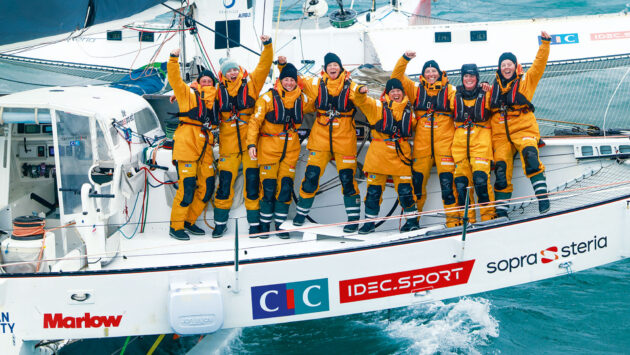
The Famous Project became the first all-female team to sail non-stop around the world in a maxi multihull, in 57d 22h 20m
The mast on the trimaran The Famous Project CIC towers as high as a 10-story building. At 110ft, or 33.5m, it is a carbon skyscraper that carries the power of this massive yacht, the 250m2 mainsail. And this engine is suspended on a chunk of metal, a mainsail hook, which by a system of levers locks the sail in position onto the rig.
Two weeks after the crew of the 103ft tri set out on their Jules Verne Trophy bid, this vital component broke. The locking mechanism failed, the hook at times stubbornly sticking in position.
Deep in the South Atlantic, crew Bex Gmür Hornell climbed the giant mast – first inside the tube, as if scaling a pitch black bell tower, then outside to diagnose the problem.

A weather window opportunity meant a lumpy departure for The Famous Project CIC Jules Verne Trophy attempt. Photo: Jean-Marie Liot/The Famous Project CIC
But the hook could not be reliably fixed, instead requiring coaxing, fiddling and force at every mainsail adjustment. And so the crew faced an impossible decision: continue into the Southern Ocean with a compromised boat, knowing record pace had almost certainly slipped from their grasp? Or stop in Cape Town, return to France, and pray that they could start again.
They continued, pointing south, pushing on and on until they arrived back at Ushant on 26 January. In doing so they did not set a Jules Verne Trophy record, but they did something else altogether.
The pioneering Famous Project
The Famous Project is the brainchild of French former Vendée Globe skipper Alexia Barrier. In 2022 Barrier announced plans for an all-female tilt at the non-stop, around the world record.
No all-female crew had ever completed a Jules Verne Trophy bid. In 1998 Tracy Edwards attempted it with Royal & SunAlliance, but dismasted in the Southern Ocean. Only a handful of women have crewed on the world-girdling multihulls alongside men: Dona Bertarelli completed the course with her team on Spindrift, but never claimed the record.
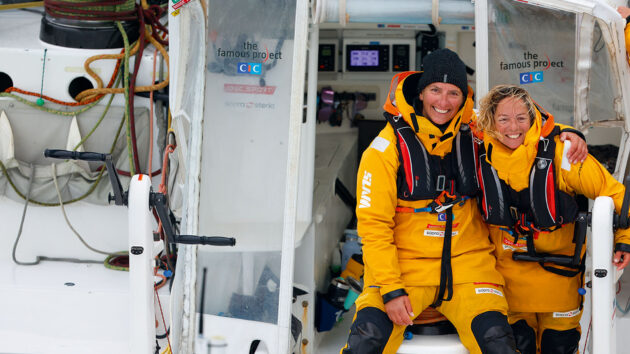
Photo: Mark Lloyd/Jmliot Images/CIC
Adrienne Cahalan navigated Steve Fossett’s 125ft cat Cheyenne to what was a record time of 58 days in 2004, but Fossett’s campaign was ineligible for the Trophy. Ellen MacArthur skippered a Jules Verne attempt which ended with a broken mast, before setting her solo record.
Barrier’s project to plug this glaring gap in sailing history swiftly gained momentum. The campaign attracted hundreds of applications, the crew training on a MOD 70 before taking delivery of IDEC Sport, at the time the boat that held the Jules Verne. They worked with coaches including Brian Thompson, who set the record in 2012. And Barrier locked in enough budget – just – to make an attempt in the winter of 2025/26.
One of Barrier’s first appointments was co-skipper Dee Caffari. Caffari brought experience not only of six previous circumnavigations, but skippering teams with very diverse levels of experience, from the Global Challenge to the Volvo Ocean Race.
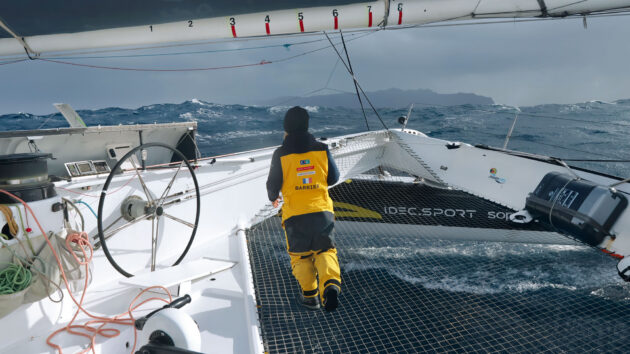
Off Terceira Island in the Azores. Photo: Deborah Blair/The Famous Project CIC
“My job was to make life easier for Alexia,” Caffari explains. “This was her project, her brainchild, and I was to help facilitate it to happen. She asked my opinion. I challenged her a few times, but eventually we would be on the same page.”
By the time autumn arrived in Brittany, the crew had settled into eight. Joining Barrier and Caffari were offshore racers Annemieke Bes (NED) and Stacey Jackson (AUS); former Olympian and Ocean Race crew Támara Echegoyen (ESP); Rebecca Gmür Hornell (NZL) and Deborah Blair (GBR), both in their early 20s; and boat captain Molly Lambert LaPointe (USA), who had worked on everything from classic superyachts to the Maiden Project.
Accolades were less important than personality: so few women had maxi multihull experience. “I made the selection with Dee to get people who are able to be nice to each other, whatever the level of stress or fatigue, and also able to learn from each other,” recalls Barrier.
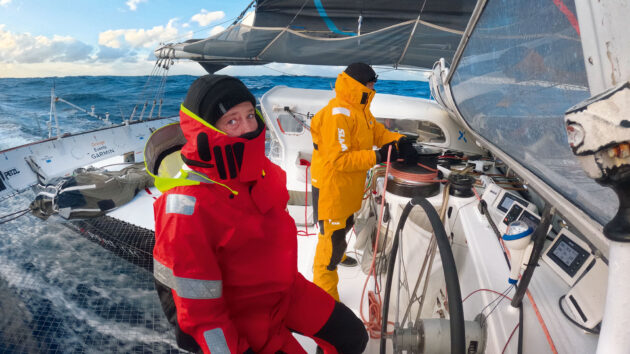
Layered up against the South Pacific cold – unlike modern Ultims, IDEC Sport’s cockpit is totally exposed. Photo: Deborah Blair/The Famous Project CIC
When to go
The decision on when to start a Jules Verne passage is critical. High budget campaigns will spend countless hours analysing polars against weather systems, running theoretical route after route to find the optimal time to go. Barrier’s team benefitted from the services of Christian Dumard – one of the very best in the business, who had worked with Joyon and IDEC Sport previously.
The crew, however, had just a fraction of time on the boat compared to most teams. “We’d probably done 10 days max training, which is ridiculous. But as Christian said, how else do you learn to sail a multihull around the world, but by sailing a multihull around the world? So we did,” recalls Caffari.
“I [worked] from what I knew of the boat before, because I’ve been routing this boat quite often in the past. And then we see what speed they really go, and we adapt it on a daily basis,” explains Dumard.
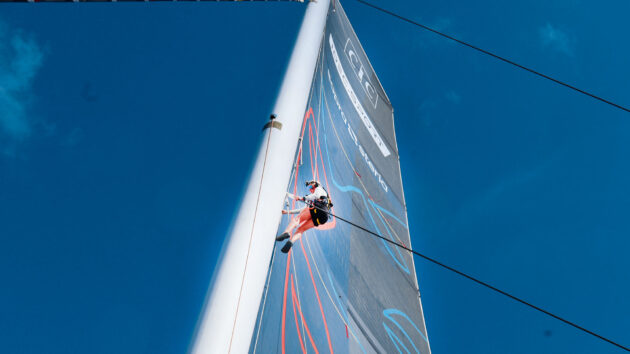
Up the mast for rig checks on Day 10 of the attempt. Photo: Deborah Blair/The Famous Project CIC
“So at the beginning, they were quite a bit slower than the potential of the boat. But later they sailed very fast, so they were using all the potential.”
The team identified a window at the very end of November. But it wasn’t a totally clear road – with high pressure systems in the North Atlantic which could cause speed bumps. Pre-departure, Barrier hinted that if they didn’t get past these systems, they could always return to Brest and restart. In reality, that wasn’t an option.
“Objectively, I knew we didn’t have a chance to come back and try again,” Barrier told me after the finish. “Just because we didn’t have the money. Coming back could have meant never going again. So it was the only chance.”
“The weather window is never going to be perfect,” says Caffari, “But actually, we weren’t looking for perfect. We were looking for an opportunity.”
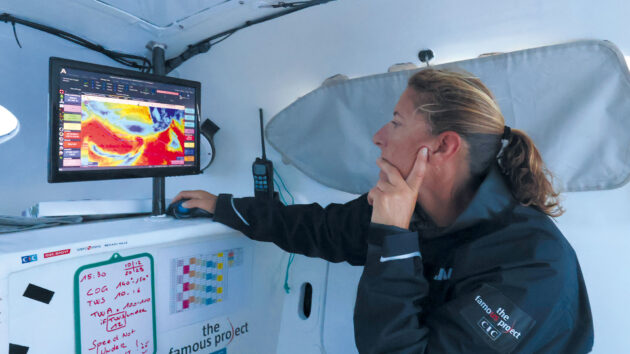
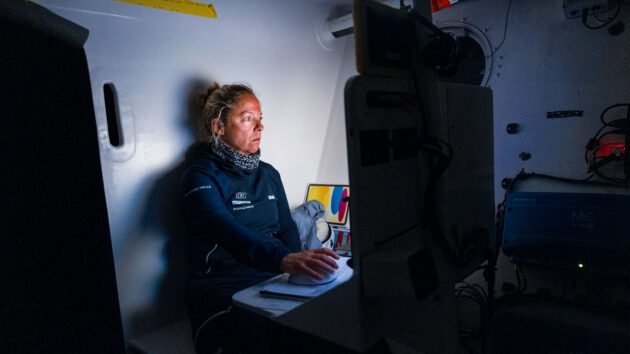
Dee Caffari at the nav station. Photo: Deborah Blair/The Famous Project CIC
So, on 29 November, they set off. Initially the crew were still learning the boat, building confidence in the autopilot. They didn’t push too hard, and inevitably, hit some speed bumps. But they were on their way.
“And then everyone comes good. You do the miserable bit, and suddenly you can take a few layers off, and it gets a little bit easier,” recalls Caffari.
“But actually, the tradewinds were strong. There were quite big waves, and the boat is a big beast to manage that we weren’t used to. Then the Doldrums just seemed to go on forever.
“It wasn’t until the South Atlantic that we were like, ‘Oh, this is what Brian told us about.’ Flat water and easy miles. Suddenly we had the set up right. We were confident with the pilot. We were starting to increase our mileage each day. We were within a day [of the record] in the South Atlantic, and everyone was thinking, actually, we can do this.”
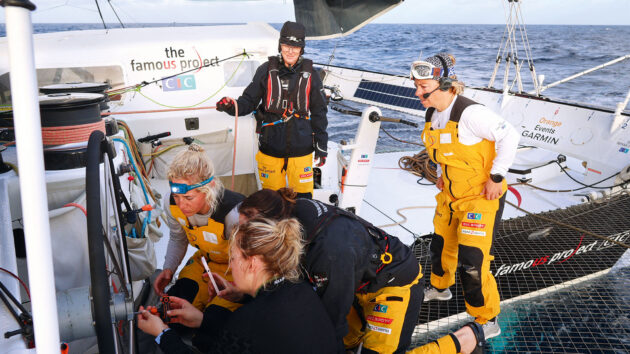
Steering repairs on Day 5. Photo: Photos: Deborah Blair/The Famous Project CIC
Heavy responsibility
Then, 13 days into their challenge, the hook failed. “I think anyone else would have stopped, because to go into the south not at 100% – that’s a big decision to make. I said to Alexia, ‘I’ll support you on anything,’” says Caffari.
“It took time to think it through and see all possible solutions that we could have,” recalls Barrier. “I said to the crew, there are other spots. We go and we’ll see. And if it’s a disaster, we will stop in Australia or in New Zealand. But we won’t stop now.”
For Caffari, the decision to continue was the right one, though she admits the process was difficult: “I think I was a bit disappointed that it took us so long to make that decision, because I felt like we’d waited three days. But it was what it was.”
Caffari – who has never not completed a circumnavigation – was also of the opinion that they weren’t looking for alternative ports. “It helps nobody for us to stop on the other side of the world. If we’re going, we’re going all the way around. I will make this happen!”
The Famous Project was the brainchild of Alexia Barrier, who was also skipper and CEO of the campaign. Photo: Alex Champy-McLean/The Famous Project CIC
She explained their decision to the crew, and initially everyone seemed in agreement.
“Then I could see Tamara really struggling. She’s got 20 years of Olympic campaigning behind her. For her, if we’re not at 100%, what’s the point? So we had to re-address it. And I was like, ‘Right, we’ve been doing 650-mile days easily. So 500 miles a day. We can get around in sub-50 days’. You could see everybody shift their mindset.”
“But I felt the pressure of the decision. Is this the most sensible thing to do?”
In the boat’s blog Barrier mused on the decision: “Because no one will remember a number… but everyone will remember an achievement.”
Article continues below…
The Famous Project becomes first all-female crew to sail non-stop around the world
Today, Monday 26 January 2026, the eight-person crew aboard The Famous Project became the first all-female team to sail non-stop…
Creative solutions
Committed, The Famous Project CIC plunged south, heading past Cape of Good Hope on 16 December.
“The Southern Indian Ocean wasn’t too bad. We were quite far north, so it didn’t feel cold. It was quite a nice introduction to the south,” recalls Caffari.
They developed different techniques to unjam the malfunctioning hook – heading up onto a reach to bounce it loose on waves, or gybing every time they wanted to shake out or put in a reef. If neither worked, boat captain LaPointe or Gmür Hornell would be dispatched up the rig to free it.
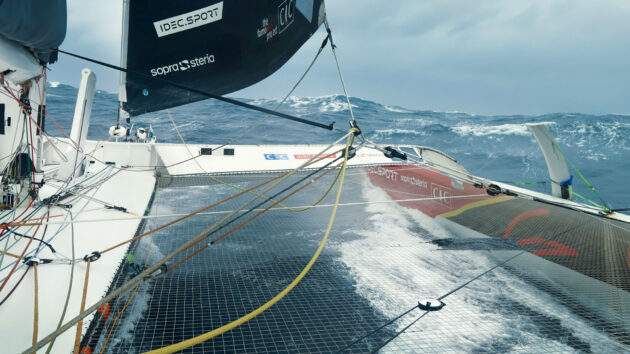
Challenging sea state in the final 24 hours before the finish. Photo: Deborah Blair/The Famous Project CIC
Besides being frustrating, they were often losing time or wasting miles sailing on the wrong heading. Unlike the established wisdom – that the time to put a reef in is when you first think about it – Caffari says they had to weigh up the risks of waiting. “Do you go for every reef a bit earlier in case it takes you longer? Or do you push it further so that you maybe could get away without doing it?”
“They never knew if they would be able to take the reef or not,” recalls Dumard, “So in the routing, we had to minimise the number of manoeuvres with the mainsail. And to be careful, at least in the Indian Ocean, not to go in winds which were increasing too quickly. Because if it’s 15 knots and they have full main, then it increases very rapidly to 35 knots, if it takes two or three hours to take the reef then we would have got into trouble.”
40-knot days
By the Pacific, boat speed was picking up. “It was enjoyable sailing and it delivered what I’d been promising the crew, with long waves. Sometimes the conditions were just so lovely, you wanted to drive. Everybody got to drive at 40-plus knots. We got comfortable at that pace,” recalls Caffari.
They clocked off major landmarks, crew birthdays.
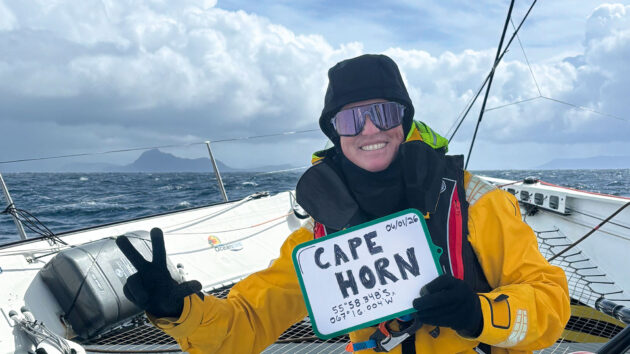
Rounding Cape Horn. Not long after, the team found ghost netting had ripped off the starboard board. Photo: Deborah Blair/The Famous Project CIC
“The miles go fast in a big trimaran. The Kerguelen Islands to Cape Horn went really quickly. Point Nemo was quite emotionally charged. For four of us, the last time we were down there was when we’d lost John Fisher [from Sun Hung Kai/Scallywag in 2018]. And it was also really close to the point where Royal & Sun Alliance lost the rig – we actually had it marked on the chart. I sent Tracy [Edwards] a message at New Year, and she replied, ‘Just keep the stick in the air!’”
At higher speeds, the motion of the big trimaran was relentless. “You lie in your bunk and literally all your internal organs are being shaken. Sometimes it’s just impossible to sleep. The boat makes a certain noise above 30 knots, and it’s deafening down below.”
They rounded Cape Horn on 6 January. Not long after, they realised that an earlier collision with a ghost net had ripped the starboard board from under the hull. They continued.
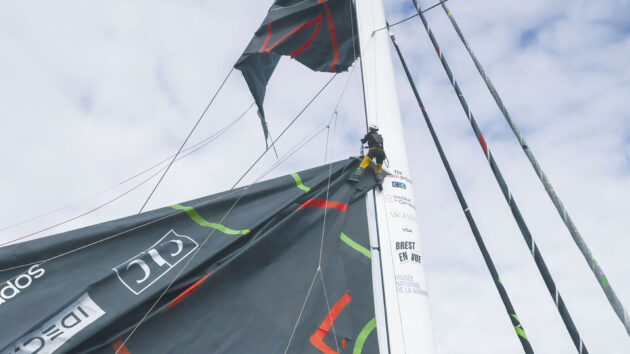
The trimaran’s huge mainsail shredded irreparably just days from the finish, so they sailed trimming the wing rig. Photo: Deborah Blair/The Famous Project CIC
“The boat was born without foils, that’s what I said to the girls. So that was not an issue,” recalls Barrier. “The most important thing is telling the truth to the crew, so telling them that on port tack, we’d be 15% down on performance from the starboard tack. These numbers were enough to keep them confident.”
As Day 50 at sea loomed, some rationing was required – they had packed food for 49 days, but several crew members had eaten less than anticipated, so had enough meals, though treats and toiletries were in short supply.
War of attrition
But worse was to come. Three days from the finish, the mainsail tore above the second reef. Then it ripped again, from leech to luff. “At the end, it felt like we’d been through a war and we had the scars of battle. It just was one thing after the other,” recalls Caffari.
In the event, the reduced sail would barely impact them. A massive Atlantic depression, Storm Ingrid, stood between them and the finish. Both The Famous Project CIC and Thomas Coville’s Sodebo, just ahead, had to slow to let the worst pass in front of them.
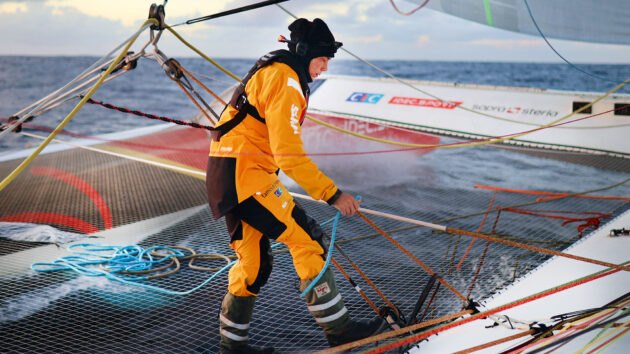
Annemieke Bes working the pit. Photo: Deborah Blair/The Famous Project CIC
“It was 40-50 knots. We were on bare poles – our mast alone is 30m2, so we rotated that. That was our trim with our head car plugged in. Less than 24 hours from the finish I was thinking, this is questionable. We just need to finish.
“We had a moment where we were coming up too high, trying to point at the finish instead of waiting for the wind to shift. The faster you go around the world, the more you’re coming back in the winter storms into the Bay of Biscay, they all pile up onto the continental shelf. It’s all about sea state on a multihull. And 8-10m waves were just a little bit too much,” recalls Caffari.
Dumard estimates the peak wave height was probably 13-14m, though a buoy to the west of Brest measured one wave of 18m.
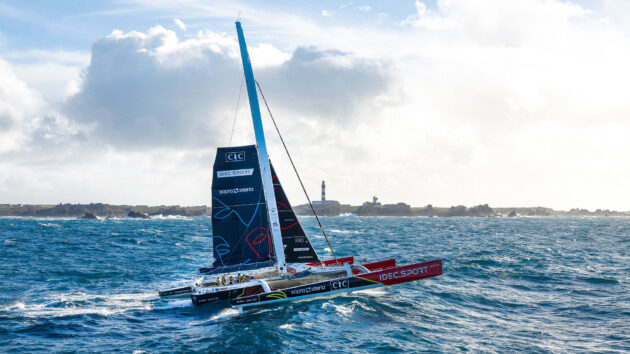
Departure from Ushant. Photo: Jean-Marie Liot/The Famous Project CIC
“The boat could take it, but there was just one wave where I didn’t think we were coming back. I was going ‘Eeeek!’ We should have looked at the heel angle, but everyone had their eyes closed by then. The two outside were hanging on the winches and three inside had fallen out of their bunks. When waves are so high you can’t see the sky, and they start breaking, you don’t know where things are going next.”
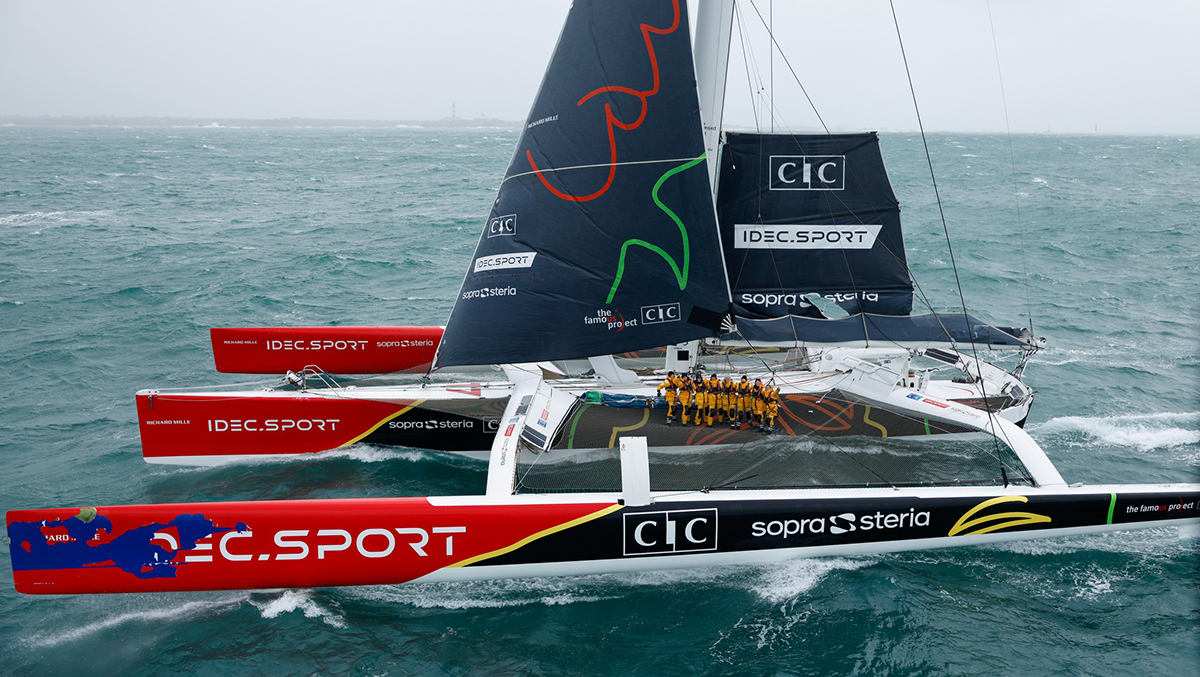
But the bows popped up, they headed a little lower, the wind came around, and the finish was suddenly within reach. The Famous Project CIC crossed the line off Ushant on Monday 26 January 2026, becoming the first all-female team to sail non-stop around the world in a maxi multihull, and set a benchmark time of 57d 22h 20m in the Jules Verne.
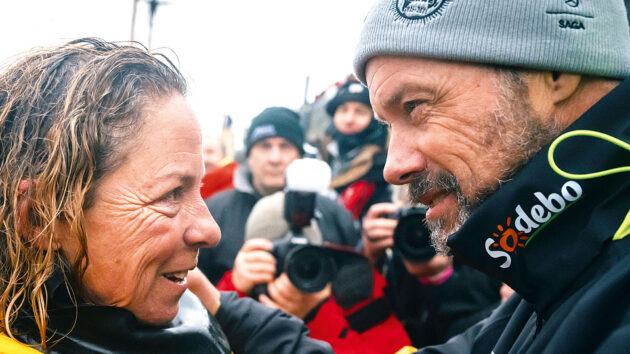
Jules Verne record holder Thomas Coville congratulates Alexia Barrier at the finish. Photo: Vincent Curutchet/Jmliot Images/CIC
“I was just thinking, we’ve done it. It was relief. We’d had to really fight for those last miles,” remembers Caffari. “Alexia sat down next to me, and said, ‘I’m really proud’. We just hugged each other.”
So did The Famous Project CIC achieve what it set out to? There have, inevitably, been naysayers. But – on a boat that’s now 20 years old – their passage is the sixth fastest ever. Thomas Coville’s Sodebo finished the day before, taking 12 hours off a record that had stood for nine years.
“Everything he did exaggerated how hard ours was,” points out Caffari. “Did he do it on his first time? No. It’s taken three attempts. It’s taken years to work his boat up.
“If we can change perceptions by showing that you don’t have to wait for everything to be perfect, whether it’s finances, training time, weather window. Sometimes you’ve just got to go. You’ve got to show what’s possible.”
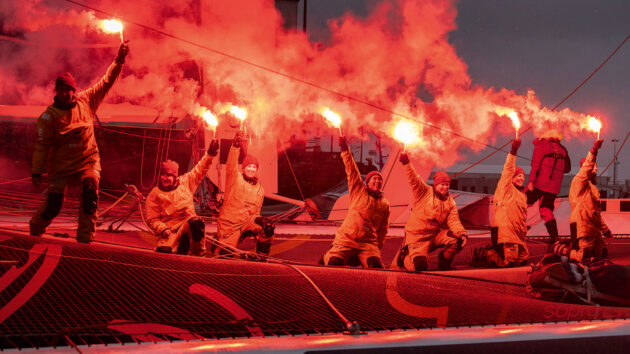
Celebration time for The Famous Project CIC crew. Photo: Fred Tanneau/AFP/Getty
Coville gave a generous speech to the Famous Project crew on the dock. “They said some lovely, lovely words for what we’d achieved, but also for the tenacity and resilience Alexia showed to put that project together and make it happen. That was my choke-up moment, to get those words from a peer who had just achieved something quite phenomenal himself,” says Caffari.
Barrier reflects: “Even more beautiful than our time and our record is this message that we want to pass on to everyone to just dare to realise your project, your dreams.
“It’s super scary to do the first step. But if you start, you will write your history.”
“Now, of course, the biggest fear is that we don’t continue the momentum because we’ve gained all this knowledge and experience,” adds Caffari, “and we’ve learnt so much that we want to use it again.”
 If you enjoyed this….
Yachting World is the world’s leading magazine for bluewater cruisers and offshore sailors. Every month we have inspirational adventures and practical features to help you realise your sailing dreams.Build your knowledge with a subscription delivered to your door. See our latest offers and save at least 30% off the cover price.
Note: We may earn a commission when you buy through links on our site, at no extra cost to you. This doesn’t affect our editorial independence.