




After bringing a 55-year-old Swan back to life, Georgie Holman took on a memorable transatlantic
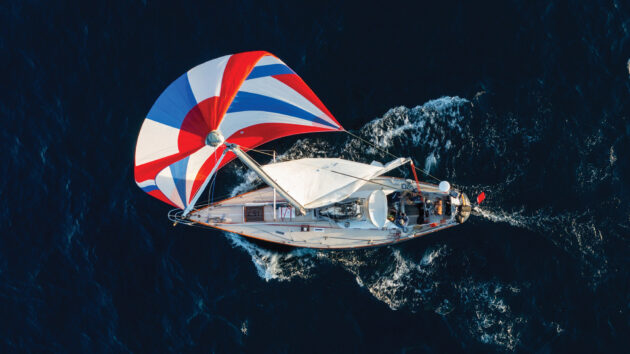
At around 2am, beneath the inky outline of Faial, the lights of Horta shimmered across the water. After two weeks at sea, the sight of everyday details on the island felt momentous.
Streetlights dotted the hillside above the harbour and the sweet, earthy smell of land drifted on the breeze. We rounded the harbour wall and dropped the hook in the crowded anchorage. With the deck squared away, we all sat quietly in the cockpit, savouring the unfamiliar sensation of being still again.
Thirteen days earlier we’d left Newport, Rhode Island. Eight weeks before that, Maru Noa had been sitting frozen in a boatyard, ice in her bilges and covered in shrink wrap. She’d spent years ashore, waiting for the chance to sail again. Now she had carried us safely across the Atlantic.
Jasper and I breathed a deep sigh of relief. After months of uncertainty, long, cold days of hard work in the boatyard, and more than 2,000 miles at sea, we had made it to the Azores.
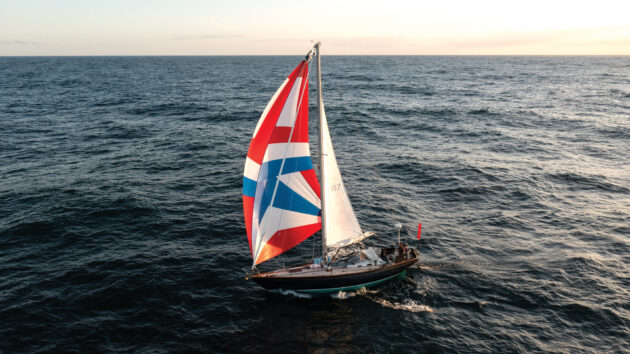
Broad reaching under gennaker on a beautiful mid-Atlantic evening. Photo: James Chapman
The beginning
After four years running the Fife yawl Latifa together in the Pacific, my partner, Jasper, and I had decided it was time to find a cruising boat of our own. Our budget was limited, but we knew what we were looking for: a strong, capable offshore yacht with beautiful lines and a proven pedigree. We were willing to sacrifice space and modern comforts for sailing performance and style.
Then one morning a message arrived from our friend, Sam, who has a dangerous habit of browsing boat listings online. It was a Craigslist advertisement: a 1971 Swan 43 designed by Sparkman & Stephens, lying ashore in Rhode Island. The few photos on the ad were poor quality and showed a boat that had clearly seen better days, but beneath the faded paint and peeling varnish we could see the elegant lines of one of offshore sailing’s great classics.
At the time we were based in the Pacific Northwest and the Swan was 3,000 miles away, but we had soon booked a flight across the continent for Jasper to go and see her.
We dove into the decision headfirst.
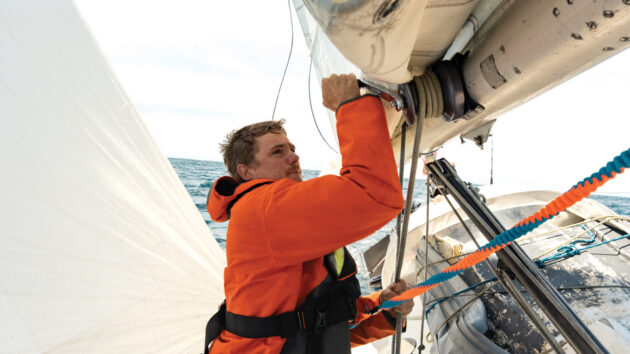
Jasper hauling in a reef. Photo: James Chapman
The boatyard
When we arrived in Rhode Island in early March, it quickly became clear why most boats don’t launch until a few months later. The yard was almost deserted. Maru Noa stood in a huge icy puddle, cocooned in shrink wrap.
Fortunately, the previous owner had winterised the boat thoroughly. She had been ashore for about four years and seen little sailing in maybe 10, but she was clean and fundamentally sound, with a brand new engine. Standing in the empty saloon, it was difficult to imagine that in less than two months we could be sailing her towards England.
We first had to make the boat habitable. We could only afford three nights in a Newport B&B, so one of our first jobs was to go to Ikea in Boston to buy the essentials: bedding, galley equipment and enough household items to turn the boat into a home.
Over the following six weeks we worked full-time in the yard preparing Maru Noa for sea. We tried to focus solely on what absolutely needed doing to launch and to safely cross an ocean. The aim was for function over perfection, as our intention was to do a full refit once we arrived home to Cornwall and had saved up some more money.
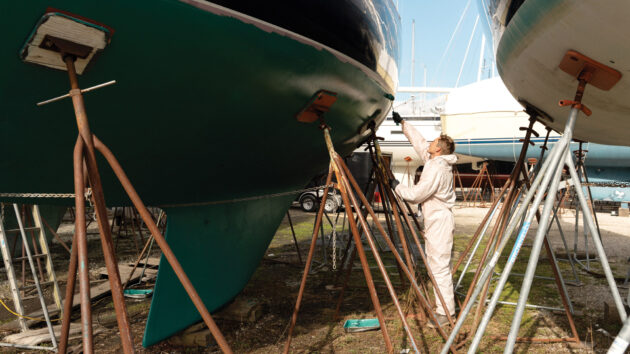
Applying the final coat of antifoul. Photo: Georgina Holman
The major projects included servicing through-hulls, rewiring sections of the electrical system, installing new batteries, repairing plumbing, checking and servicing the engine, rebedding hatches, fixing deck leaks, fitting a Hydrovane wind steering system and applying antifouling.
Those months in the boatyard were not easy. We were living and working atop a ladder, trying to stay warm with only an electric radiator and hot water bottles, while watching our savings disappear into chandlery bills and hardware stores.
At times I questioned whether we’d taken on more than we could handle.
Spring brought some relief when it finally arrived, as the weather began to improve and the yard came to life around us. We made friends with our boat neighbours and the list of jobs gradually grew smaller. Somehow, despite the scale of the project, we launched a week ahead of schedule.
After years ashore, Maru Noa was a boat again. It was amazing to see her in her element and to take in her sweet S&S lines afloat.
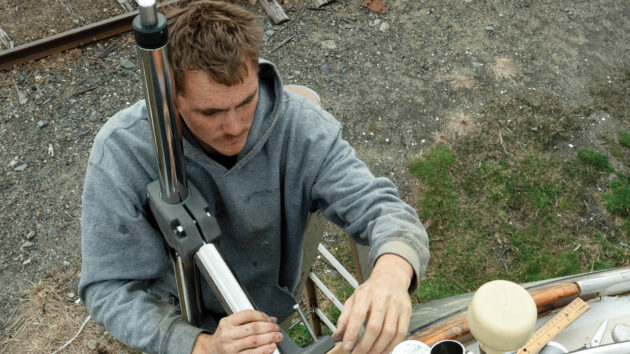
Installing the Hydrovane self steering. Photo: Georgina Holman
The passage
After launch we spent a couple of weeks alongside in Newport carrying out sea trials, solving a few inevitable problems, dialling in our safety equipment and rewiring the mast before departure. Finally, on 2 May, 2026, we slipped lines.
Accompanied by Jasper’s father, Tino, and our good friend, James, we sailed to Cuttyhunk Island, our final stop before heading offshore. After eight demanding weeks of preparation and nerves we felt an enormous sense of relief to finally leave the dock behind.
We left on a brisk, sunny morning, into a 25-knot westerly breeze, sailing close hauled for several hours to clear the Sow and Pigs Reef, Martha’s Vineyard and the Nantucket Shoals before bearing away and heading east. The sun set on our first evening offshore and the last of the New England wind farms disappeared astern.
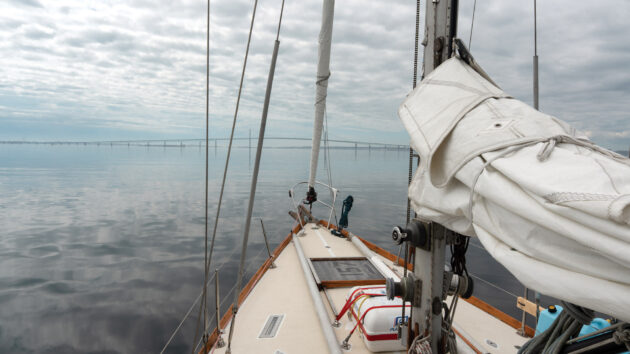
Motoring out of the yard towards Newport, Rhode Island. Photo: Georgina Holman
We gathered in the cockpit to toast Neptune with a small splash of rum. Barely a minute later, under a glowing pink sunset, a humpback whale surfaced close to our port side before breaching astern of us. We took it as a good omen for the passage ahead.
We’d set off on the tail end of a big low-pressure system that was rapidly moving northwards. The first 24 hours were spent running downwind before the breeze shifted south-westerly the following morning, allowing us to come onto a fast reach. Maru Noa immediately found her stride, easily maintaining speeds of 7-8 knots and often more.
Day after day she covered the miles effortlessly, reminding us why the Swan 43 has earned such a reputation as an offshore cruising yacht.
The early part of the crossing was cold.
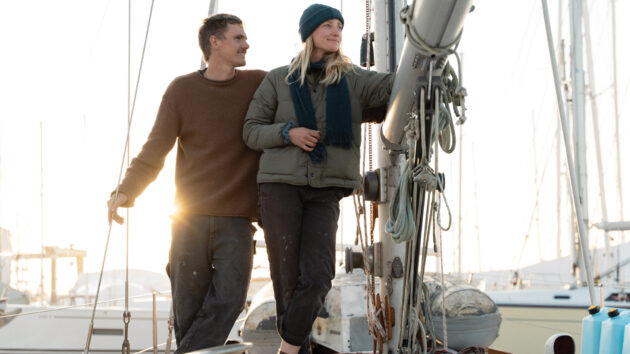
Georgie and Jasper on deck the evening before launch at New England Boatworks. Photo: Georgina Holman
We sailed bundled up in all the warm gear we had: puffy coats, woollen hats and multiple layers, grateful for relatively dry conditions. Life quickly settled into the rhythm of an ocean passage: watches, meals, fixing things and sleep of variable quality.
On our second night at sea Jasper and I were on watch together when we heard the unmistakable sound of dolphins surfacing beside the boat. Peering over the rail, we found two dolphins racing alongside us through water glowing with bioluminescence.
Every movement left shimmering white trails streaming behind them as they dove beneath the hull and emerged on the opposite side. For several hours they remained with us, moving effortlessly through the darkness.
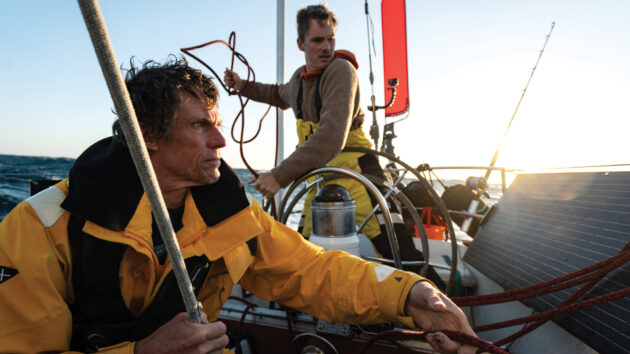
Jasper and his father, Tino, on their fourth transatlantic together. Photo: James Chapman
True test
However, as the days passed, we began to discover some of the realities of bringing an older boat back into service. Salt accumulated on every surface and several deck leaks that had escaped our attention during the yard period made themselves known. Although not concerning, when heeled hard the saloon sofas and bunks became almost soaking wet, making life down below quite unpleasant.
The biggest test came when we encountered our first gale aboard Maru Noa. She carried us confidently through the conditions, sailing under jib alone for much of it and then with our deepest reef in the main.
But the gale exposed our one significant equipment failure of the crossing.
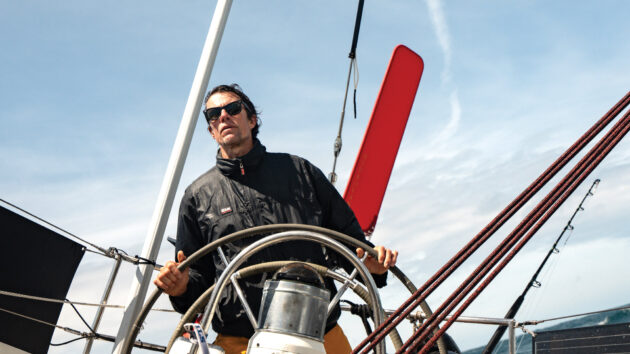
Tino at the helm, moments after being drenched by a wave. Photo: Georgina Holman
Late one afternoon the Hydrovane self-steering system stopped functioning after a small set screw worked loose inside the mechanism. Jasper took over hand steering while Tino climbed out over the stern to investigate and fix the problem.
After half an hour of hanging off the stern and improvised engineering involving hose clamps, rope and considerable ingenuity, the Hydrovane was coaxed back into operation and thankfully the repair held for the remainder of the passage. The team at Hydrovane were incredibly helpful, diagnosing the issue with us over Starlink before promptly sending out the replacement parts we needed to Horta.
Making miles
Around the 1,000-mile midway point we were well into the Atlantic routine. The days merged together in a pattern of watches, meals and changing weather systems. Our world shrank to the horizon in every direction, and gradually the distance to the Azores began to fall away beneath the keel.
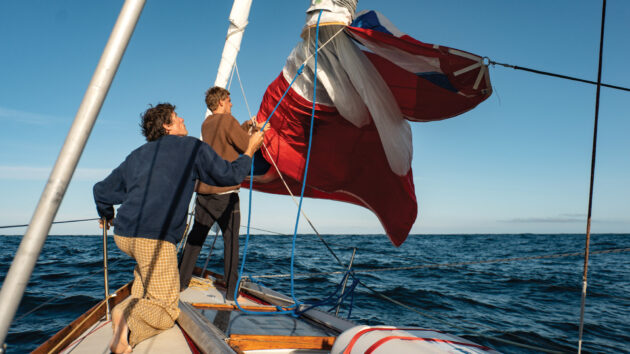
Jasper and Tino on the foredeck setting the gennaker for the first time. Photo: Georgina Holman
The second half of the passage was considerably more demanding. For days we sailed hard to windward in tough conditions, making life on board wetter, noisier and more physically tiring. Cooking became a constant challenge, and sleep came less easily with the constant motion.
As this was our first offshore passage on Maru Noa, there were moments when I felt well outside my comfort zone. As a professional sailor I’ve done my share of time at sea, but it felt decidedly different to be out there charging to windward aboard our own small boat that we had poured all of our savings into just weeks ago. Sailing in the Gulf Stream with wind over tide was particularly violent.
Hidden behind our tattered sprayhood in darkness, with 30 knots of wind and breaking seas, I found myself tensing every time a larger wave struck the boat. At times I questioned why I had worked so hard to be out there.
But alongside the nerves and discomfort, Maru Noa was proving herself and earning our trust with every mile.
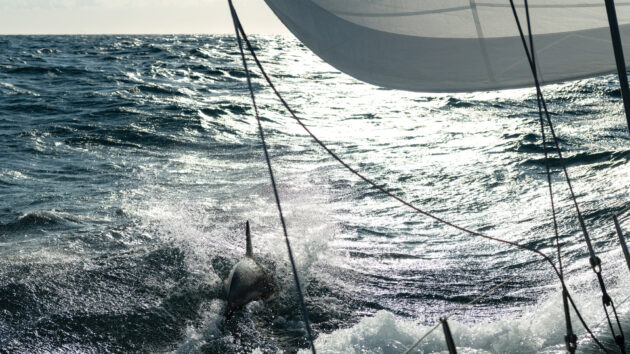
Common dolphins cruise alongside Maru Noa in the Atlantic swell. Photo: Georgina Holman
I knew she was looking after us; I just found it difficult to fully let go of my anxieties after such an intense month of preparation. After one particularly tiring night, I remember sitting in the cockpit as the sun came up, turning the sky a vibrant pink above a roiling grey sea.
In moments like this I could pull myself out of the nerves and appreciate the beauty around us.
Horta approach
Over the final days approaching the Azores the sea state eased and the wind calmed down. We were relieved to be able to bear away, refill our water tanks from jerry cans stored on deck and begin the long process of drying out the boat. Morale improved further when we caught an albacore tuna, perfectly sized for the four of us.
After nearly two weeks at sea, fresh tuna poke bowls with sushi rice, pickled ginger, cabbage slaw, wasabi, sriracha mayonnaise and furikake felt wonderfully indulgent, almost as though we had been transported back to our old life in the South Pacific.
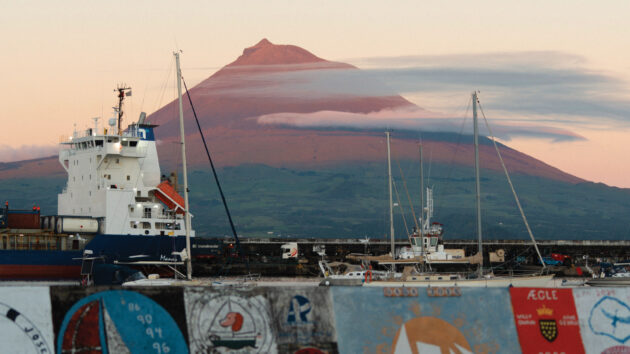
Pico at sunset viewed from Horta Marina, with its iconic harbour paintings. Photo: Georgina Holman
Day 12 brought one of those perfect days that often follow a spell of rough weather: sunshine, a steady breeze and a sparkling sea. Spirits were high. Tino and I spent much of the morning cleaning down below, wiping salt from the cabin sole and carrying sodden cushions, bedding and foul weather gear onto the deck to dry. With sheets, jackets and duvets hanging from every available line, Maru Noa looked more like a floating laundry.
As we drew closer to shore, we became less protective of our freshwater reserves. Without a watermaker on board, we had spent the crossing carefully rationing, washing dishes in seawater. Knowing we’d soon be in port again, we finally allowed ourselves more generous bucket showers on deck.
On our twelfth evening at sea, we glimpsed our first sight of land when the island of Flores appeared faintly on the horizon. What began as a dark smudge gradually resolved into the unmistakable silhouette of a volcanic island, rising steeply from the Atlantic with its summit lost in cloud.
There was still more than 150 miles to sail before reaching Faial, and we continued east through the following day. Late in the afternoon we passed a pair of fishing boats rolling heavily in the swell. The fishermen waved and shouted “Bem-vindos!”, our first interaction with anyone outside our crew for nearly two weeks.
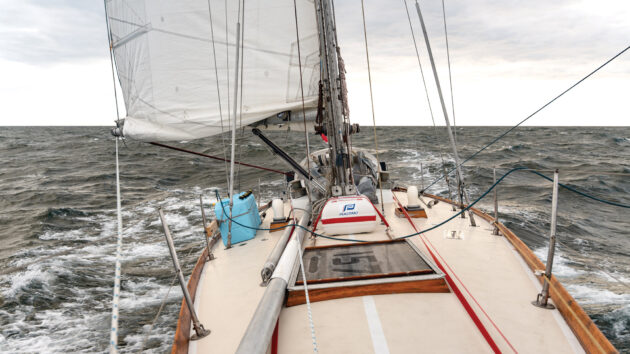
Maru Noa running downwind on a blustery Atlantic day. Photo: James Chapman
As darkness fell we approached the northern coast of Faial. One by one we stood watch, identifying navigation lights and monitoring traffic while the island slowly took shape ahead of us. There is something special about making landfall at night; seeing only a dark silhouette beneath scattered lights and then waking the next morning to discover the landscape in full detail and colour.
At just after 0230 we entered Horta harbour, to the incongruous soundtrack of Abba songs blaring from a party ashore. We wove our way through the tangle of boats to find a spot near the wall. After anchoring we poured ourselves a celebratory splash of whisky and sat quietly in the cockpit together savouring the stillness.
Island life
The following morning we were awoken by the blast of a foghorn echoing around the harbour. A cargo ship was due later that day and the harbourmaster was making it clear that our chosen anchoring spot would not do. After a much-needed cup of tea we moved, inflated the dinghy and headed ashore to complete the formalities.
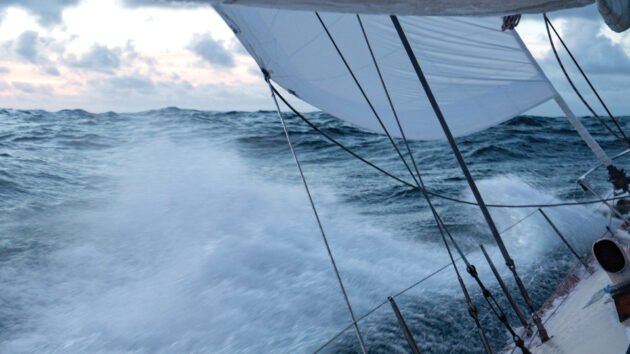
Three days hard on the wind in 25-30 knots wore on both the boat and crew. Photo: Georgina Holman
Horta was busy. A stream of yachts had arrived overnight and we spent nearly two hours queueing between immigration and the marina office. I stood in line in a daze, still swaying gently from the motion of the boat. There were sailors from all over the world, most looking as salty and tired as we were.
Once checked in we secured a berth and tied Maru Noa alongside. Only then did it begin to feel as though the crossing was truly over. As is the custom, our first stop was Peter’s Sport Café. Over cold beers and pastel de nata we adjusted to the simple pleasure of sitting on solid ground. For anyone arriving in Horta after an Atlantic crossing, Peter’s is more than a bar; it is part of the ritual of arrival.
That afternoon we set about rinsing everything with fresh water and took a mountain of dirty laundry to the launderette. Walking back along the dock to Maru Noa, seeing her draped in foul weather gear, lifejackets, lines and sail bags, even mattresses spread out to dry, there was no mistaking the fact that we’d had a rather salty crossing!
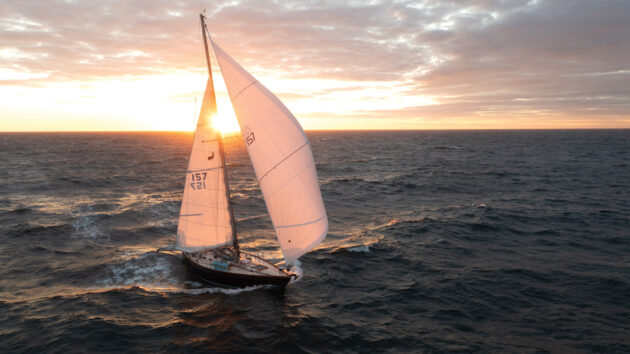
Sailing wing-on-wing towards Faial in the Azores. Photo: James Chapman
Later, freshly showered, we returned to Peter’s for dinner. The place was buzzing with sailors celebrating arrivals and swapping stories. The café’s walls and ceilings are covered with decades of burgees and flags left behind by passing crews, each representing a voyage completed and another story carried across the Atlantic.
Over the following days we settled into life in the Azores. We said goodbye to James and Tino. Just the two of us again, Jasper and I explored Faial’s volcanic coastline, snorkelled in clear Atlantic water and enjoyed the relaxed local culture. Like generations of sailors before us, we also added our own painting to Horta’s harbour wall.
At this mid-point of the ocean, surrounded by boats from every corner of the world and vibrant sea life, it felt like we had finally arrived at the beginning of the adventure we’d imagined when we first bought Maru Noa. Only two months earlier she had been frozen in shrink wrap in a Rhode Island boatyard. Now she was floating in the Azores, 2,200 miles lying in her wake, and ready for whatever came next.
 If you enjoyed this….

Yachting World is the world’s leading magazine for bluewater cruisers and offshore sailors. Every month we have inspirational adventures and practical features to help you realise your sailing dreams.Build your knowledge with a subscription delivered to your door. See our latest offers and save at least 30% off the cover price.
Note: We may earn a commission when you buy through links on our site, at no extra cost to you. This doesn’t affect our editorial independence.