



The crew of the 54ft catamaran Magic Bus was forced to abandon after taking on uncontrollable amounts of water. Sean McNeill reports on lessons their safe recovery offers
About one hour before abandoning Magic Bus in a raging North Atlantic Ocean, skipper Buster Pike attempted to initiate a Pan-Pan call with the US Coast Guard via VHF radio.
Pike, 56, wanted to alert them that he and his crew of four 20-somethings were aboard a leaking and severely compromised 54ft catamaran with no means of propulsion in 40-50-knot winds and 20ft seas. But being approximately 270 miles offshore of the North Carolina coast and with no AIS contacts within range, the call proved futile.
Since there was no SSB radio on board, Pike, who holds an International Safety at Sea Certificate, and crew Evan Spalding, a 23-year-old marine engineer who also has multiple sea safety certifications, both attempted to call the Coast Guard using their mobile phones through the Starlink Mini router.
In a scene straight out of a dystopian horror movie, Spalding wound up in an automated voice response call system where you cannot speak to a human being, getting endless prompts for different departments. Meanwhile Pike, searching for a number on the Coast Guard website, landed on a page that read, “Due to a lapse in federal funding, this website will not be actively managed.”
Not only did the quintet have the misfortune of encountering a gale that was worsening to Force 8-9 beyond forecast, they were doing the delivery while the US government was shut down for 43 days last autumn.
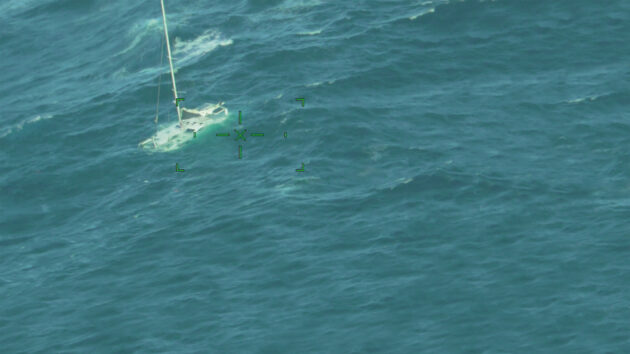
Magic Bus was completely submerged – but still upright – when the Coast Guard helicopter arrived. Photo: US Coast Guard East District
Pan-Pan or Mayday?
Pike eventually ended up speaking with a call handler in the correct department and relayed the situation. Magic Bus was abeam to the sea and rolling dangerously. They had no means of propulsion as the port hull was flooded, rendering the engine inoperable. The starboard engine was also of no use, due in part to a clogged strainer.
“I started with the intent to do a telephone ‘Pan-Pan,’ but while on the call switched it to a ‘Mayday’,” says Pike. “There was just too much water in the port hull, and I was worried about capsizing.”
The decision wasn’t one that Pike took lightly. Nor was it based on inexperience. He estimates that he’s logged between 25,000 and 30,000 nautical miles on deliveries. He’s done a transatlantic, and a dozen round trips astride the US East Coast. He’s been in rougher weather, including his first major offshore delivery in the so-called ‘Perfect Storm’ of the early 1990s, but had never been in an abandonment situation.
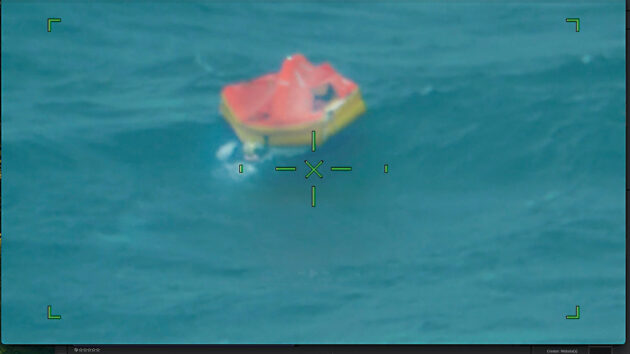
It would later turn out that Magic Bus, which was built in South Africa in 2003, was leaking due to the port rudder skeg falling off. When and how it fell off likely will never be known. The cat was lost to the depths of the Atlantic Ocean. But for two days Pike and crew fought the ingress in creative ways.
They’d left Long Island Sound, Connecticut, bound for Staniel Cay in the Bahamas, an 1,100-mile passage, on Monday 3 November. On Tuesday they discovered that the port engine compartment had flooded, and used buckets, hand pumps and electric pumps to try to reduce the water level. They even utilised the starboard hull engine intake to pump out by running a hose to the port hull through the engine room hatches.
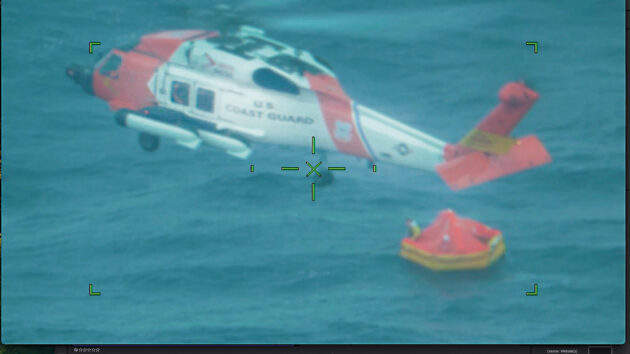
A US Coast Guard MH-60 Jayhawk helicopter crew rescued all five crew from their liferaft in November 2025, around 260 miles off Cape Hattaras. Winds were gusting over 40 knots and breaking waves can be seen cresting above the raft. Photo: US Coast Guard East District
At one point Pike says they had the capability of pumping approximately 5,000 gallons per hour. But every time they started to make progress in the fight, the ingress would take the battle back.
In the middle of a pitch-black Wednesday night all hell broke loose, punctuated by an “All-hands!” cry from helmsman Zach Doerr, an experienced offshore racer. The jib was flailing uncontrollably.
“I was jolted awake by an enormous bang… and a big dollop of spray rained down on me,” wrote Dylan Flack, the 20-year-old son of Magic Bus owner Brandon Flack, in his first-person account of the abandonment. “The working port jib sheet had parted. Then the lazy starboard sheet, whipping about uncontrollably, caught a corner of the closed saloon hatch above me, ripped it clean off the deck, and ripped the clew out of the jib.”
Besides the ingress, the cresting sea was also dumping water into the port hull through the engine room hatch. Located aft, the deck hatch was partially open due to the intake hose running from the starboard engine. The crew could have removed the hose and secured the hatch, but that would have inhibited their ability to fight the ingress. Instead, the added water was spilling into the hull from the engine room, which was located behind the aft stateroom, and weighing the boat into a dangerous list.
“My concern was that the boat would capsize,” Pike says. “The port hull filled up with water fast. It went from a foot or two of water sloshing around to the port hull being awash very quickly. And I’m thinking, are we going to capsize? Catamaran aficionados will tell you that that never happens, but the port hull was awash. And it did eventually turn turtle. But the main concern was the port hull is going down and it’s not going to be a good place to hang out. So, we abandoned ship.”
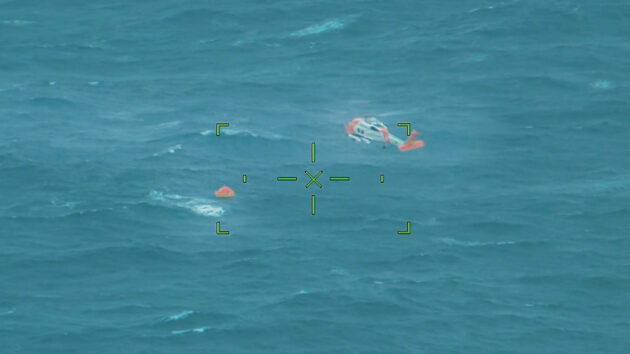
A US Coast Guard diver rescued each crewmember using a basket. All five were uninjured, though several rapidly succumbed to seasickness once in the liferaft. Photo: US Coast Guard East District
Help from above
Back on shore, owner Brandon Flack couldn’t sleep. He had been in phone communications with Pike and crew since the first day trying in vain to troubleshoot the ingress. He knew Wednesday night’s forecast was deteriorating, and he awoke frequently checking for messages. He shot out of bed when Pike called in at 0330 to say they were abandoning ship.
“I wasn’t sure what to do when Buster asked me to relay the Mayday, I wasn’t sure who to call,” says Flack, who bought the cat during the Covid year of 2020 as a means for family escapism and a charter business. “In the back of my head, I had an idea to call 911 (the US emergency number). Maybe I got the idea from a safety-at-sea seminar. But within one minute I was connected with the Coast Guard Atlantic Operations desk.”
Once all five crew were safe in the liferaft Pike cut the bowline, worried that the sinking yacht would pull the raft down with it. Adrift, they sat in the raft with their backs outboard and feet in the centre. Magic Bus’s EPIRB was beeping and whirring, leading the crew to believe it was sending a signal. They didn’t inflate their lifejackets because it would have been more difficult to manoeuvre in the cramped space.
Article continues below…
About three hours passed before a Coast Guard HC-130 Hercules aircraft arrived on scene. The HC-130 crew dropped a survival kit that included a handheld VHF. The drifting crew were able to directly communicate with the Hercules crew, and were told that an MH-60 helicopter crew was en route. But it had to refuel on a US Navy aircraft carrier on both the outbound and return legs as the rescue occurred so far offshore.
In the end, the crew’s ordeal lasted about nine hours, from the Mayday to when they set foot on terra firma at Coast Guard Air Station Elizabeth City, North Carolina, seemingly none the worse for wear.
“Everyone is free to believe whatever they wish, but to me, God will always be a Coast Guard rescue plane,” Dylan Flack wrote. “If you ever wind up in the Coast Guard’s care, turn off your mouth, switch on your ears, and treat every word they say as gospel.”
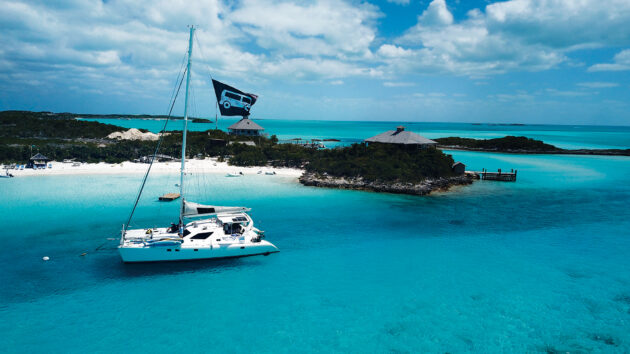
The South African-built 54ft catamaran Magic Bus had served as a family cruiser and well-known charter yacht. It was on a seasonal delivery back to the Bahamas when it sank. Photo: Photo courtesy of Brandon Flack
Safety Findings
Prior to departure Pike held a safety briefing and went over each crew’s responsibilities should an emergency occur. Since Pike, Doerr and Spalding held safety-at-sea certificates, there was broad knowledge about what to do in such a situation.
Doerr, together with Sam Gryska, a 21-year-old family friend who was enrolled in US Navy officer training, were given the responsibility of launching the liferaft.
Weighing up to 120lb (54kg) in its canister, it needed two people. Dylan Flack and Spalding would be floaters, assisting with what needed. Pike would handle all emergency communications.
Magic Bus was well equipped with lifesaving gear, including an ISO 9650 Type 1 liferaft for 12 people manufactured by Ocean Systems, an ACR 406MHz EPIRB, Vesper Cortex-based AIS and Starlink Mini for voice and data communications. Each crew had an inflatable lifejacket harness with AIS personal locator beacons (PLB). Pike personally carried a Gen 3 SPOT tracker, a GPS tracking device that runs off the Globalstar satellite network.
In his debrief of the incident, distinguished maritime safety expert Bruce Brown noted two things that may have been done better: the Pan-Pan call could have been made up to 30 hours sooner and the crew should have inflated their lifejackets as soon as they got in the liferaft.

owner’s son Dylan Flack keeping morale up in the liferaft awaiting rescue. Photo: US Coast Guard East District
Since a Pan-Pan call is an alert call, there’d have been fewer frantic calls (and searches for phone numbers) when the time came to abandon. And since Magic Bus was so far offshore an earlier call would also have afforded the Coast Guard extra time to plan a recovery rather than forcing them to scramble when lives were at stake.
The lifejackets could be inflated either manually by pulling on a tether or automatically when immersed in water. By inflating the lifejackets each crew’s PLB would have started transmitting a distress signal over the 121.5MHz frequency, which would have given the Coast Guard an exact point of reference when locating the liferaft.
“Earlier activation may not always be feasible, but it’s important to understand how activation timing affects tracking,” says Brown. “Additionally, the automatic activation on lifejacket inflation failed for at least two crewmembers, likely due to ribbon tensions, reinforcing the need for manual activation.”
EPIRB uncertainty
One unresolved question is whether the EPIRB was working properly. In the liferaft the crew saw lights flashing and heard beeping noises from the EPIRB unit leading them to believe it was transmitting, but the Coast Guard rescuers say that they never received a signal from the unit. The unit was lost with the raft so the answer will never be known.
Flack says the unit was about 8 years old and was included in the sale of the boat. He tested the unit every year and it passed a pre-departure test. But he’d never had the lithium-ion battery serviced, so it may have simply run out of life.
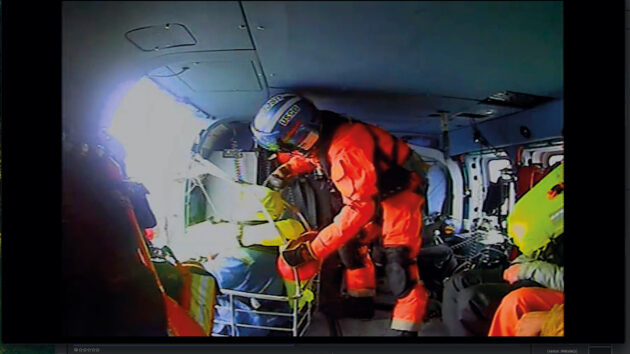
The rescue basket being manoeuvred into the US Coast Guard helicopter. Photo: US Coast Guard East District
It’s also important how the EPIRB was being handled: even something like a hand over the antenna can diminish signal strength and inhibit communication with the satellite.
“An EPIRB works best if it’s floating in the water. The lanyard that comes attached to it is meant to be tied to the liferaft so it can float alongside and send an unobstructed signal to the satellite,” explains Mikele D’Arcangelo of ACR Electronics. “All the testing that EPIRBs go through show they perform better if floating in the water.”
D’Arcangelo adds that it’s important to replace lithium batteries, especially if a unit is a year or two expired. “Lithium batteries work, and then they don’t work.”
D’Arcangelo also noted two new features of EPIRBs. One is a return link service, or RLS, that allows the Coast Guard to acknowledge a distress signal has been received by activating a different colour on the unit’s LED. Newer models also have an LED that alternates between a white strobe and an infrared strobe for spotting in low-light rescues.
“The RLS feature takes some of the mystery out of the ‘is someone coming?’ question,” D’Arcangelo says. “Knowing help is on the way can give peace of mind and the will to live in a life-or-death situation.”
Hero products
Electronically, there were two standout items the Magic Bus crew carried: the Gen 3 SPOT tracker, which Pike purchased at a raffle for $100 and proved invaluable as a redundant tracking device, and the Starlink Mini.
Although not a homing beacon like an EPIRB or the PLBs, the intermittent plots from the SPOT tracker led the Coast Guard to the general area of the drifting liferaft. A device popular with hikers who trek remote areas, SPOT runs off the Globalstar satellite network and relays GPS location data to a group of individuals selected by the user. In normal mode the unit’s location is pinged once every 10 minutes and plotted on an interactive chart for individuals to follow.
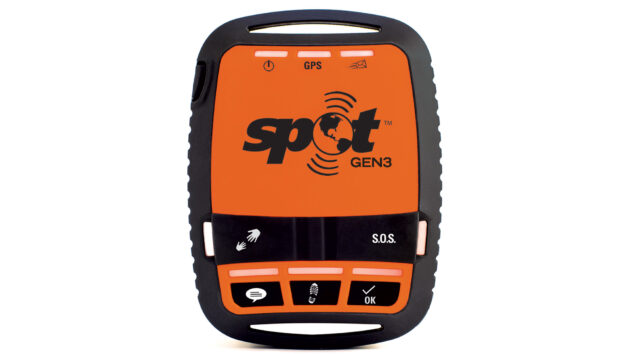
Skipper Pike carried a SPOT Gen3 tracker, and the boat had a pre-owned EPIRB
The SPOT tracker also has an SOS feature, which increases the ping rate to every 5 minutes. Pike activated the SOS mode when he declared Mayday while speaking with the Coast Guard via Starlink. In SOS mode an alert is sent to Overwatch X Rescue, a subscription service that coordinates search and rescue efforts.
When Pike activated SOS a representative from Overwatch X Rescue attempted to call him, but he was on the phone with the Coast Guard so ignored the call. The representative then attempted to call Brandon Flack, the second point-of-contact, who answered.
“They asked if it was a verifiable emergency, which of course it was,” says Flack. “I gave them the latitude and longitude information I had, and they also called the Coast Guard and relayed the information.”
The additional Mayday calls to the Coast Guard illustrate the safety net afforded by sharing your intended route and progress with so many different people.
The Starlink Mini is a portable internet kit that includes an antenna, built-in wifi router, DC power input and portable battery pack. With no SSB, the Starlink Mini was the crew’s only means of direct contact with shoreside assistance. The antenna was mounted on the stern pushpit and the crew used Starlink to call Brandon on a regular basis while troubleshooting the water ingress. It also connected Pike with the Coast Guard when he made the Mayday call. Pike took the antenna and a portable battery pack when they abandoned ship for possible use in the liferaft, although it wasn’t needed because of the VHF dropped by the Coast Guard plane.
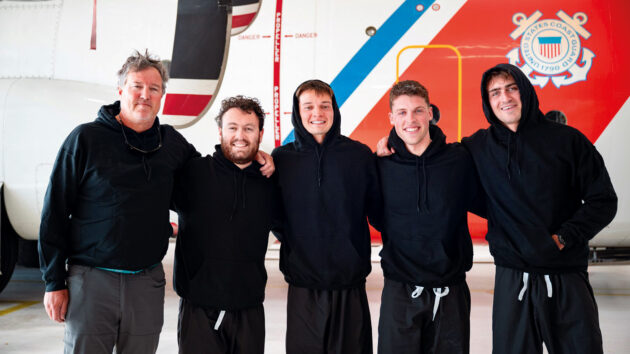
The Magic Bus crew safely back on dry land. Photo: US Coast Guard East District
“The Starlink Mini was invaluable,” Brown summarised in his debrief. He suggested an improvement going forward that could apply to many marine users. “The unit was plugged into a switch with Off/Auto/On, with ‘Auto’ shut down at 10.8V. Switching to ‘On’ would have bypassed that cutoff. That ‘On’ position should be clearly marked ‘Emergency Mode’ on future voyages.”
Overall, the preparedness and experience of the Magic Bus crew was invaluable to the rescue efforts of the Coast Guard.
“When going far offshore, there’s no quick response so before departing it’s important to think through emergency scenarios,” says Lieutenant Commander Michael A Rauch of the US Coast Guard, who assisted in the shoreside coordination of the Magic Bus rescue. “Think through the contingencies and check the weather. What is the plan if you start sinking? Make sure everyone is aware of the dangers of such a journey. Make sure your EPIRB is properly registered and that you know how to activate it. Make sure someone knows your intended destination and how long you intend to be offshore.
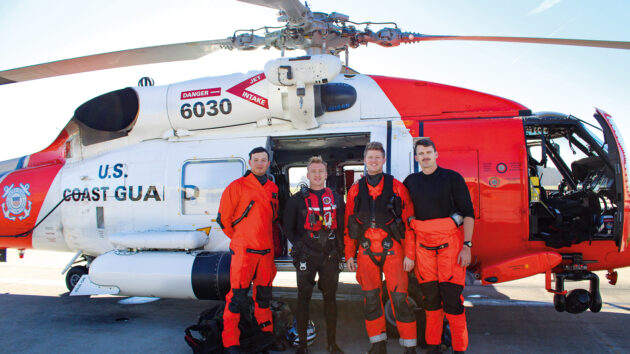
The US Coast Guard helicopter crew who carried out the rescue. Photo: US Coast Guard East District
“The Magic Bus crew was well drilled and rehearsed. They were experienced mariners who knew what to do. Having the proper safety equipment can make the difference between life and death, but make sure everyone knows how to use it all,” says Rauch.
Cause unknown
About one week after being abandoned, Magic Bus was spotted floating upside down by another delivery crew heading south. Photos showed the port rudder skeg completely missing.
About a week before the delivery trip a container ship reported losing 33 containers overboard. Though that position was within 25 miles of where the catamaran was abandoned, it was more than 250 miles from Magic Bus’s embarkation point so it would seem a low probability that a container strike was to blame for the skeg falling off. There was also no visible damage to the keel skeg or the sail drive unit on the port hull.
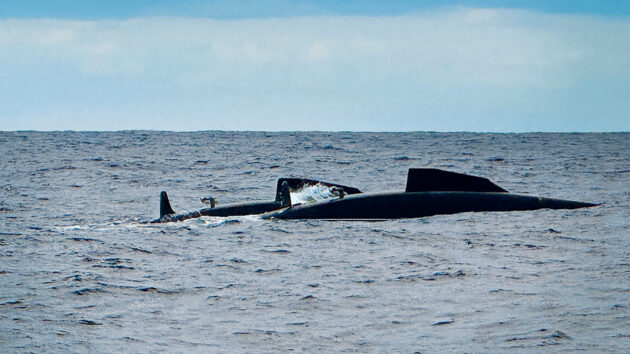
The upturned hull of Magic Bus was spotted about a week after abandonment, showing the port rudder skeg to be missing. Photo: courtesy of Brandon Flack
Brandon Flack believes fatigue could be a contributing factor. The first night at sea Magic Bus was making top speeds of 18 knots in winds of 25-30 knots. Those speeds could’ve put undue torque on the skeg.
“I really can’t say what caused the skeg to fall off,” he reflects. “Wear, tear and age are likely factors. The bottom was cleaned before departure, and the diver didn’t report any cracks. The boat was going 18 knots, that puts sideways pressure on the skeg going through the waves.”
He did suggest another possibility. “The last time I did the delivery I noticed a lot of sunfish out there. One of those things could’ve hung up on the skeg. That’d be enough weight and mass to break it off.”
Whatever the cause, the final journey of Magic Bus proves that things don’t have to happen suddenly to develop into an emergency. The crew had plenty of time – right up until the point when they didn’t. And then it was down to good preparation, good seamanship, and great rescue services that got them safely home.
 If you enjoyed this….

Yachting World is the world’s leading magazine for bluewater cruisers and offshore sailors. Every month we have inspirational adventures and practical features to help you realise your sailing dreams.Build your knowledge with a subscription delivered to your door. See our latest offers and save at least 30% off the cover price.
Note: We may earn a commission when you buy through links on our site, at no extra cost to you. This doesn’t affect our editorial independence.