



An early season charter with Sunsail from Athens was a chance to see authentic Greece, as Helen Fretter discovers when cruising the Cyclades
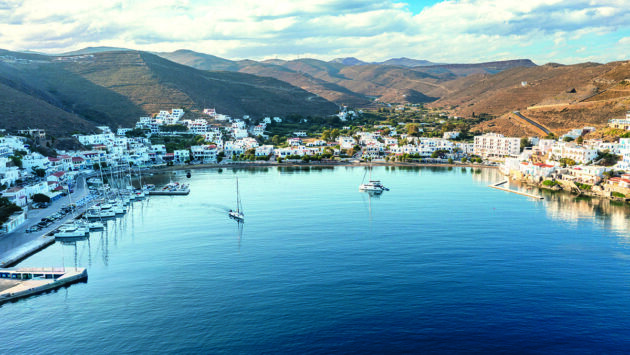
A faint purling of waves against the hull had eased us all into sleep, until I realised that another sound was nudging into my dreams. Swelling choral music echoed through the dark. Wrapped in a blanket against the April night chill, I crept out on deck of our charter yacht to discover the shoreline tinted red and gold as fireworks backlit the many churches of the surrounding towns.
The music was the Paschal Troparion, or Christos Anesti, sung at midnight on Greek Orthodox Holy Saturday. Each church broadcast their service via speakers to create a soaring musical round which rang across the natural amphitheatre of the bay, building to a cacophony of ringing bells and crackling gunpowder.
Amid it all, ours was one of just a handful of anchor lights bobbing off Parikia. This was Greece before the tourist crowds turn up.
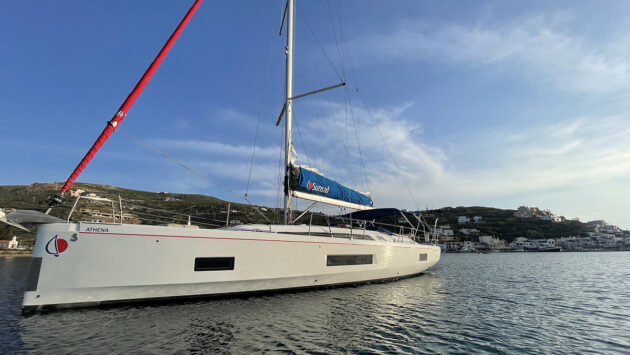
Yachting World editor Helen Fretter and family chartered a Sunsail 46 in Greece for a week in early season. Photo: Helen Fretter
Choosing an early season charter
When we spotted an opportunity to take an early season charter with Sunsail out of Athens it seemed like a rare chance for our family to enjoy some slower paced sailing. With two teenagers competing nearly every weekend in youth racing, and summer exams looming, our calendars were rammed.
When we found some early availability in April, we decided to chance it – sure, the weather could be a gamble. But we reasoned the teens were used to dinghy training through winter so the Mediterranean in spring should seem positively balmy.
Our charter began from Sunsail’s Athens base. Flying into the Greek capital city gave more options out of season than some of the island routes, and the transfer from Athens airport is usually only 30-40 minutes (we arrived in the evening just as Athenians were leaving the city for Greek Easter, so things took a little longer).
The Sunsail base is at Zea Marina, in Piraeus, a full service D-Marin marina with an outer basin crammed with mega yachts. The Sunsail fleet sits stern-to on a seawall, avoiding the trickier berths of the inner basin.
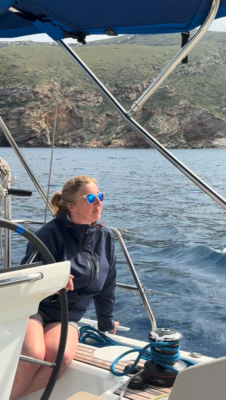
Enjoying flat water sailing between the islands. Photo: Helen Fretter
Space for holiday living
Stepping aboard our very new Sunsail 46 the first thing that struck us all was the sheer volume of living space. The saloon is on a par with some multihulls, and there were no fewer than four double cabins, with four ensuite heads/showers. (Did I mention we were sailing with teenagers? Big tick.).
Sunsail now sends mandatory video briefings to all charter guests before departure, so I thought I knew what to expect of our home for the week. But as we nosed around the aptly named Athena, I found more and more beyond expectation: an electric outboard, electric winches, generator and air-con, a pre-inflated paddleboard, Fusion bluetooth stereo system, and high-spec chartplotters. Plus there was the best equipped galley I’ve ever seen on a charter yacht, with full-size undercounter fridge, separate deep freezer, microwave/combi oven, and enough worktop space to prepare a feast.
On top of the pre-departure videos, Sunsail base staff also gave us a thorough boat briefing tour, and chatted through our routing options, sharing favourite spots and local weather sources.
Being right in the city made provisioning straightforward (though you can also prebook a delivery to the yacht). After a quick walk to the nearest supermarket, and a round of fiercely brewed coffees and morning pastries oozing cheese, honey and pistachio from one of the many nearby bakeries, it was time to drop the lines.
Of sea and storms
A 15-18 knot westerly greeted us as we nosed out into the Bay of Piraeus, and we swiftly hoisted sails onto a broad reach towards the point of Sounion, on the south-eastern tip of the Greek mainland.
Athens is busy with both commercial shipping and fast ferries, so if heading south-west to the Saronic Islands – a popular route from the Athens base – you’ll need your wits about you as you’re immediately crossing shipping lanes. Instead, we followed a quieter coastline route, spotting only occasional sailing yachts or local fishermen.
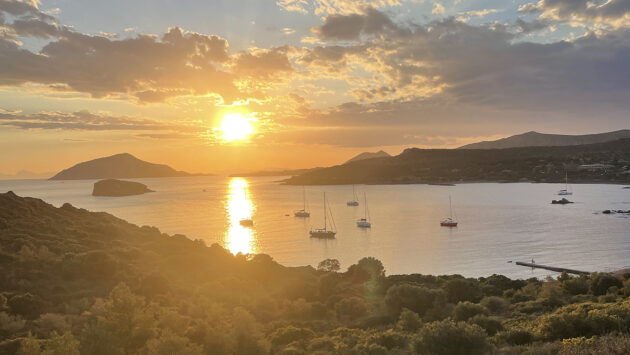
Incredible sunsets over the anchorage off Sounion. Photo: Helen Fretter
The wind eased and backed as we slunk through the cut between the island of Patroklos and the southern tip of the mainland, the still waters dotted with fish farms, until the impressive temple of Poseidon loomed high on the horizon. While the Parthenon may be Greece’s most famous landmark, for sailors a temple devoted to the god of sea and storms was a must-visit.
After taking advice from the excellent onboard pilot book, we dropped anchor off the north shore, popped our tender in the water (electric winches made simple work of launching it from the foredeck) then headed ashore.
Our reward for a meandering hike to the top was truly spectacular views, as visitors gathered on the wildflower-dotted hillside to enjoy the sunset from what must be one of the best vantage points in Greece.
After a deceptively rolly night at an otherwise quiet anchorage, we continued following the Western Cyclades island chain with a building breeze from the north-east pushing us along. This had the most traffic we saw all week, so was an opportunity to dig out a hand-bearing compass and give the dinghy sailors on board a lesson in rules of the road while passing bulk carriers and fast ferries.
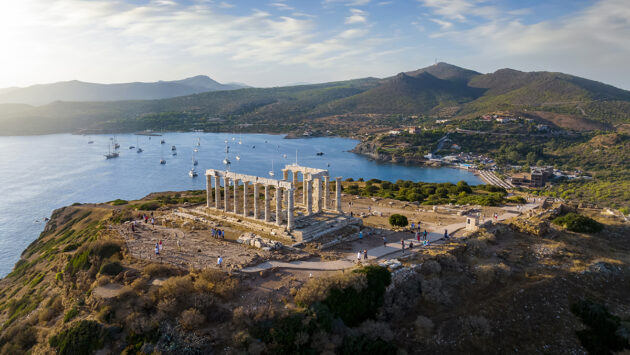
The stunning Temple of Poseidon at Cape Sounion at sunset. Photo: Getty Images/iStockphoto
Cruising the Western Cyclades
The beachside village of Kounduros on the first island of Kea had looked promising for a lunch stop, but as we circled the bay it seemed nothing had yet opened for the season. So instead we carried on to Kythnos, picnicking in the cockpit as we went.
Almost immediately, the breeze rapidly built to 22+ knots, white caps streaking the waters as it funnelled between islands. Though perhaps a little early in the season for a full Meltemi, it was a sharp reminder of how quickly conditions can switch.
Predictably, there was a little inter-family competition as to who could put the biggest number on Athena‘s speedo, and just what our beamy 46-footer was capable of in a strong blow. The full length hull chines turned out to be more than cosmetic styling, the yacht sitting easily on a fast reach with no hint of loss of grip from the twin rudders. After clocking over 9 knots we decided to err on the side of caution rather than push for double figures, and popped a reef in, though it didn’t discernibly slow us down.
The town of Merichas on Kythnos would be our next overnight stop, but we didn’t fancy attempting our first family stern-to mooring while being pushed onto the seawall by a strong westerly. Instead, we ducked into Fykiada while waiting for conditions to ease.
Fykiada is a stunning cove divided by a sand isthmus, which creates a perfect double-sided beach known as Kolona. We joined a 60ft performance cruiser sheltering on the eastern side of the sand bar, which in calmer conditions would make an idyllic swim and snorkelling spot.
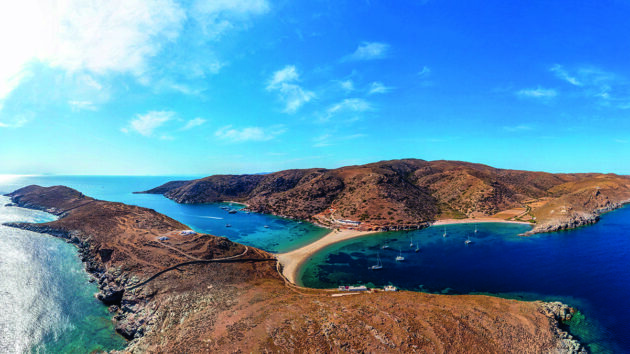
The double-sided sandspit at Kolona Fykiada. Photo: Getty Images/iStockphoto
By late afternoon the winds had moderated as forecast, so we lifted the hook and headed for Merichas. After picking a spot as far from the ferry as possible, tying up thankfully proved stress-free thanks to our bow thruster, and harbour staff helpfully catching visitors’ lines.
Though the pilot book suggested that services were basic, the harbour has clearly had recent investment, yet our overnight berthing fee came to less than €10. Merichas was a perfect introduction to Greek island life, with languid cats prowling the fishing docks as the day’s catch was brought ashore, and seafood restaurants lining the beach.
Mini Mykonos
In lighter winds the following day we slowly continued south, rounding the island of Serifos. We claimed a deserted deep inlet at Malliadiko Beach as our own for the afternoon, launching the paddleboard to explore the cave-lined shore, and briefly snorkelling in its stunning turquoise – though admittedly rather refreshing – waters.
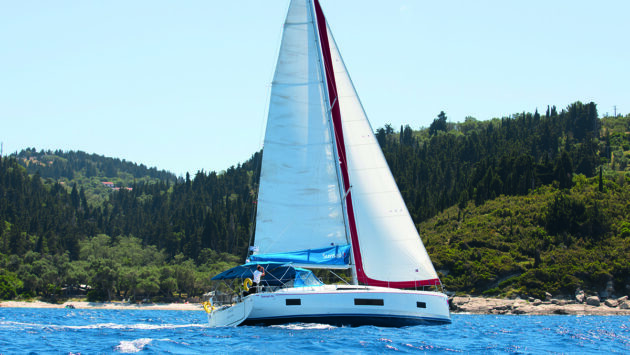
The Sunsail 46 was spacious and comfortable, but fun to sail in a breeze. Photo: Sunsail
Then on to Sifnos, motor-sailing past its cedar-lined hillsides and chapel-topped cliffs. Sifnos is sometimes referred to as a ‘mini Mykonos’, and Platis Gialos is a stylish mix of boutique hotels and eateries with echoes of the Instagram-famous honeypot. But when we visited it was in a sleepy pre-season mood, the harbour near-deserted, most restaurants yet to open. Instead we ate on bean bags at a beach bar full of locals enjoying the balmy quiet before summer began.
The next morning we crept out of port as cockerels were crowing on shore, the lightest of breezes pushing us west to Paros.
The entrance to the main port of Parikia requires focus, with high, jagged rocks littering the approach and the pilot book telling tales of wrecks through the ages, while fast ferries zoom past. After the tranquility of Sifnos, Parikia harbour felt hot, noisy and busy, so we picked up a mooring buoy off the beach.
Returning by tender to Parikia town proved a treat, however. We wandered jumbled stone lanes weaving past whitewashed buildings, with galleries, gelato and bakeries at every turn, before squeezing into a packed taverna serving sea bass and lamb stew. Clergymen and celebrants hurried past carrying white and red floral arrangements, and incense wafted from open churches on every corner, preparing for the midnight service that would later thunder across the bay.
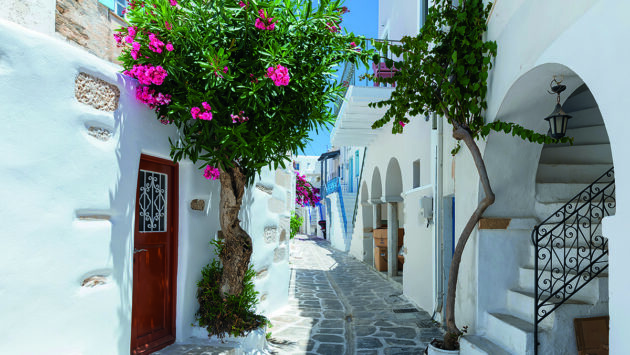
Wandering whitewashed alleys with colorful flowers at Parikia on the island of Paros. Photo: Getty Images/iStockphoto
Greek Easter
By this point in the week we had to concede that, no matter how long we waited, the cracking westerlies of earlier in the week were not about to return and we had a long motor north ahead of us. So we again slipped out shortly after sunrise, and began making miles back towards Athens, passing Siros and Gyaros on our way to Kea.
The wind was vanishingly light, but the sea calm, and the traffic near non-existent, so we each took advantage of the downtime to read, nap, or sunbathe on the foredeck.
The wind began to fill as we approached Kea, and we eased into Spathi, a deep, almost rectangular bay that looked idyllic. But, just as we prepared to anchor, the new breeze swirled and spun unpredictably. Mildly frustrated, we pulled up the anchor and rehoisted sails to head around the top of the island to Vourkari instead.
This turned out to be one of the our best sails of the week, our teenagers relishing the chance to handle a 46-footer like a dinghy, short-tacking on the shifts into Vourkari bay before gliding onto a mooring buoy under sail.
Tied up just off the beach in 4m of water, we realised we’d also serendipitously found our favourite spot of the whole trip. A wedding celebration was in full flow at a nearby house, dancers spilling out onto the lawn, and the shallow water so clear we could see every blade of seagrass beneath our bow.
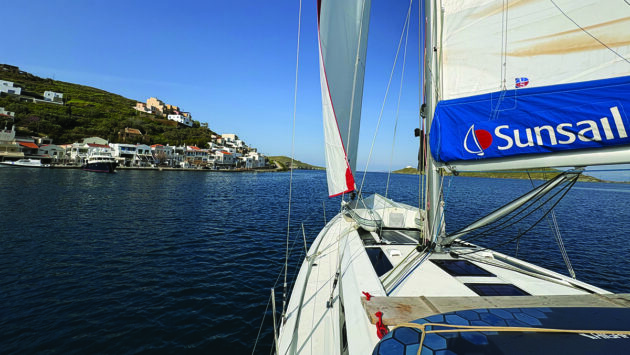
Sailing on and off the mooring ball in Vourkari was a fun exercise in boat handling for the teenagers on board. Photo: Helen Fretter
After a pre-dinner swim, fireworks began fizzing over Athena. Vourkari’s Easter Sunday celebrations began before sundown, and once again we were right in the middle of it.
As we dinghied ashore, locals set fire to a small wooden boat with an effigy on board, pink and orange smoke from flares drifting across the water.
The harbourside restaurant owner greeted us with a big smile, pulling his sister over to translate as he explained “It’s Easter! We’ve spit roasted a lamb. You eat lamb with us?” So we ate smoky lamb and garlicky greens harvested from the island’s soil, and felt very much as if we had been welcomed into a village.
There is something special about visiting a place when it still belongs to the locals. But that doesn’t only come from sailing far from the beaten path. It can be all in the timing. We took an early charter because it was the only time we could, and it turned out to be one of the best times of all.
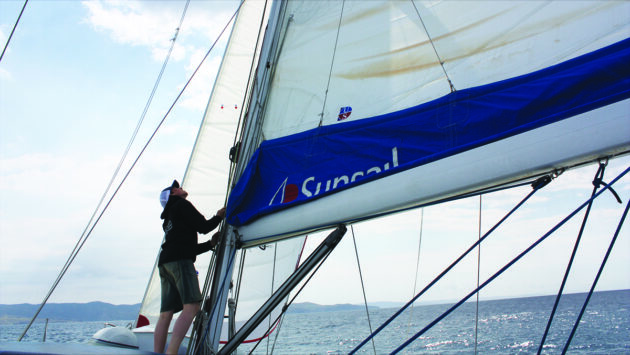
The Athens sailing area is one of Sunsail’s ‘Level 3’ destination, requiring the most experience. Photo: Helen Fretter
Chartering in Greece: what you need to know
■ Sunsail class their Athens sailing area as ‘Level 3’, or requiring the most experience. Meltemi winds can fill in within minutes, so you need to familiarise yourself with the boat’s reefing system well before you need it. Other areas of Greece, including Lefkas and Corfu are ‘Level 1’, so more suitable for less inexperienced or less confident sailors.
■ To charter in Greece requires an ICC or equivalent. We had RYA and ASA qualifications above the required minimum, but they were issued some years ago… Allow time to find your certificates as you’ll need the originals. If you haven’t got the paperwork but do have the experience, there is the option to take a single-day ICC course with Sunsail in Portsmouth before you go.
■ The supplied pilot book (Greek Waters Pilot by Lucinda and Rod Heikell) was excellent, but a brief search online for updates proved helpful at times. We found very good mobile reception across the islands.
■ We were impressed with the efficiency and thoroughness of the Sunsail base staff, who were keen to share local knowledge and seemed almost disappointed we didn’t have any jobs to add to their maintenance list when we returned!
■ Modern charter yachts have come of age. We loved having an electric outboard you could pick up one-handed. Electric winches made launching/recovering the tender onto the foredeck simple, and vastly preferable to towing it. Powered winches also proved useful when we set a stern anchor one night to reduce rolling, and recovered it by attaching a halyard. Tankage was impressive – we never got close to needing a freshwater or fuel top up.
How to get there
We travelled with Sunsail, for more on chartering in Greece and worldwide visit sunsail.com/uk or phone +44 (0)330 029 4267