



Rupert Holmes reports on the latest generation of fast yacht launches many of which are inspired by top-end offshore racers
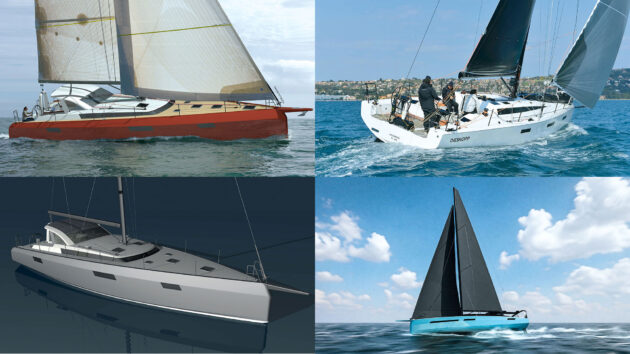
The influence of modern offshore racing on cruising design has never been clearer. Today’s short-handed ocean racers (such as Class 40s and IMOCAs) have proven that powerful hull forms, wide aft sections, high form stability, and refined sail-handling systems don’t just win trophies: they make boats faster, safer, and remarkably easy to handle.
Top naval architects and pioneering yards are increasingly taking these racer principles and applying them to bluewater and cruising models. The result is a new generation of fast cruisers that deliver thrilling speed downwind without demanding crew on the rail or sacrificing on-board comfort.
From light-displacement, vacuum-infused composite hulls and flexible lifting keels to clever weight distribution and modular interiors, these latest designs prove you no longer have to choose between race-bred performance and relaxed living afloat. Here is a look at five standout new launches leading the charge.
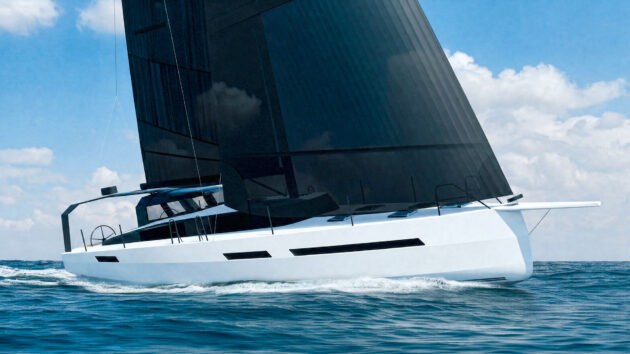
Reduced rocker aft and a canoe body with less draught should make the JPK 48 FC very capable in light airs
JPK 48 FC
This Lorient-based yard is best known for its successful offshore raceboats that have lifted innumerable trophies, including two overall wins in the last seven editions of the Rolex Fastnet Race. However, the firm’s best-selling model is one of its two fast cruising yachts, the JPK 39 FC.
The larger JPK 45 FC also surpassed initial expectations, with 34 units built over the past decade. Its replacement draws inspiration from the JPK 1050, winner of last year’s Fastnet, with the aims of achieving planing speeds earlier, boosting performance on reaching courses, increasing stability downwind and reducing pitching.
For the JPK 45 FC, naval architect Jacques Valer drew a shape capable of carrying a significant payload, including generous tankage and equipment, without unduly compromising performance.
The new boat adds extra waterline beam and carries it further forward. Valer also modified the hull shape to reduce rocker aft and create a canoe body with a little less draught. The resulting increase in form stability allows the weight of ballast – and overall displacement – to be reduced. The new design should also be more capable in light airs, with the result that fewer engine hours will be needed while cruising.
Those with a successful racing background tend to be experts at optimising ergonomics, and this aspect has been further improved both above and below decks.
“We wanted to create a boat capable of sailing far, fast and for long periods in all conditions, whilst remaining simple, forgiving, elegant and a pleasure to live on day to day,” says designer Jean-Baptiste Dejeanty, who also revised the boat’s aesthetics.
A lot of attention was paid to weight distribution and balance. The batteries are under the saloon, while the chain locker and windlass are moved 4m aft to the mast bulkhead, representing 240kg of more centralised weight.
Equally, tanks for fresh water, fuel, black and grey water are below floor and waterline levels, while the bulb keel and a classic, lightweight rig further lower the centre of gravity.
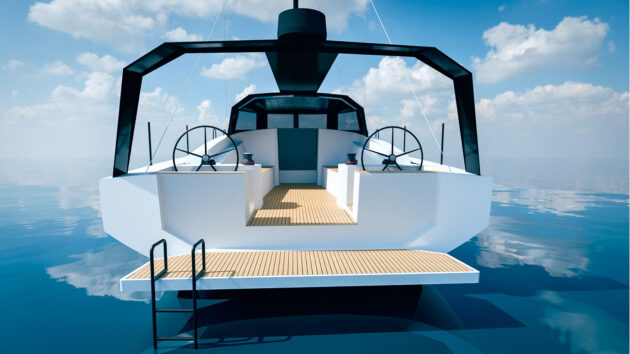
Composite gantry provides space for a large solar array
The 0.9m (3ft) of additional length, along with the wider beam, significantly increase accommodation volumes. The cabins, saloon and galley are therefore all more spacious.
There’s a redesigned heads with a separate shower stall, plus a much larger and completely remodelled owner’s cabin that can be configured in at least five different ways. Stowage space is also improved, as is the larger cockpit that now includes a hinged bathing platform that completely encloses the aft end of the cockpit when raised.
“Modular design also makes the boat suitable for a wide range of uses, thanks to its extensive customisation options,” adds Dejeanty.
In addition to the layout options in the forward part of the hull, there’s a choice of options for shelter over the cockpit. The solid sprayhood that was widely praised on the 45 FC has been refined and can be fitted with solar panels. In addition, it can be connected to a lightweight, rigid composite aft gantry, thus creating space for a larger solar array, giving options for a partially solid bimini. This enables sailing to take place in the open, or sheltered from the elements, without the need for heavy and visually unappealing stainless steel structures. Alternatively, a flush-deck version is available.
A common misconception is that lightweight boats have to be less robust than heavier vessels. However, that’s by no means automatically the case, and JPK has considerable expertise at creating impressively strong and stiff structures for its raceboats. Construction uses vacuum-infused Corecell sandwich, with structural stiffening infused at the same time as the hull to create a coherent monocoque structure.
As standard, there’s a crash box forward, while the aft compartment that houses the steering is watertight. Further Kevlar reinforcement is also offered as an option, while there’s a choice of three fixed keels, with draught from 1.9m (6ft 3in) to 2.7m (8ft 11in).
The first example is currently in build and is scheduled for launch in spring 2027.
JPK 48 FC specifications
Hull length: 14.60m 47ft 11in
Beam: 4.75m 15ft 7in
Draught (standard keel): 2.30m 7ft 7in
Displacement: 12,000kg 26,460lb
Price: €566,670 ex sails, ex VAT
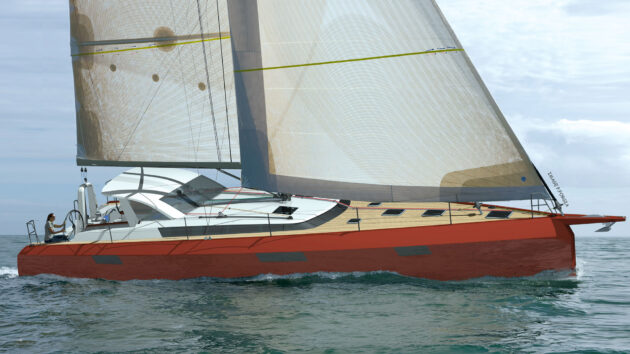
Cigale 15 QR is the result of one owner’s desire for a tough, fast cruiser
Cigale 15 QR
Over the past couple of decades we’ve come to associate aluminium yachts with a rugged construction that’s ideal for very long-distance cruising and high latitude work. But before the widespread use of carbon fibre, many top offshore raceboats were built of aluminium and it remains a viable material for performance yachts.
So it’s perhaps surprising aluminium is not a more popular material for fast long-distance cruising designs today. Nevertheless, Alubat, the yard that also builds the Ovni range in Les Sables d’Olonne, was quick to see the benefits. Its Finot-designed Cigale 16 from 1994 is a wide-sterned, lightweight cruiser that combined early Open class and IMOCA fleet influences with innovative cruising accommodation.
It appealed primarily to very experienced owners, usually with a racing background, who sought a strong and capable distance cruiser with planing performance in suitable conditions.
A further five models from Finot and Lombard followed over the next couple of decades. However, this remained a surprisingly small niche market, served predominantly by a handful of Dutch custom yards, until the advent of Pure Yachts in Kiel, Germany, three years ago.
The 15 QR is a Finot-Conq design that brings the concept right up to date. It’s the result of the vision of another experienced owner seeking a yacht capable of covering long distances at high average speeds, without compromising safety, comfort or access to shallower waters.
A swing keel gives a very manageable draught of just 1.62m when raised, but a massive 3.3m when lowered, which significantly boosts stability and performance. A backstayless carbon mast and square top mainsail are standard, which helps keep the centre of gravity low.
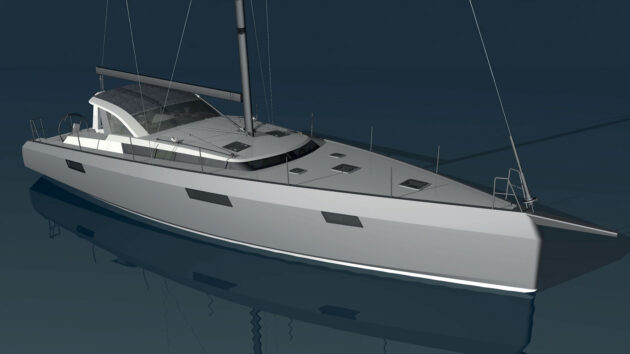
Construction of the first Cigale 15 QR is under way for launch in spring 2027
Careful attention has been paid to weight optimisation, with the thickness of the hull plating, for instance, varying according to the structural loads that will be experienced in each area. As a result, light displacement is only around 12.5 tonnes – an impressively low figure for a comfortable 48ft cruising yacht with spacious accommodation.
A generously sized sail plan, combined with high form stability and deep draught with the ballasted swing keel lowered, means this will be a fast boat. At the same time, ease of handling was a key priority. The central mainsail winch, for instance, combined with an arch that keeps the sheet safely clear of the cockpit in manoeuvres, is a significant advantage.
Bright and welcoming living spaces were also important elements of the brief, and the design has enough beam for an unusual interior layout, including a U-shaped saloon offset to port.
The first boat will be based in La Rochelle, where it will operate as a charter yacht during the summer, before being unveiled to the public at the port’s Grand Pavois boat show in the autumn of 2027.
Cigale 15 QR
Hull length: 14.50m 47ft 7in
Beam: 4.70m 15ft 4in
Draught: 1.62 to 3.3m 5ft 3in to 12ft 10in
Light displacement: 12,500kg 27,558lb
Price: €1,095,000 ex-VAT
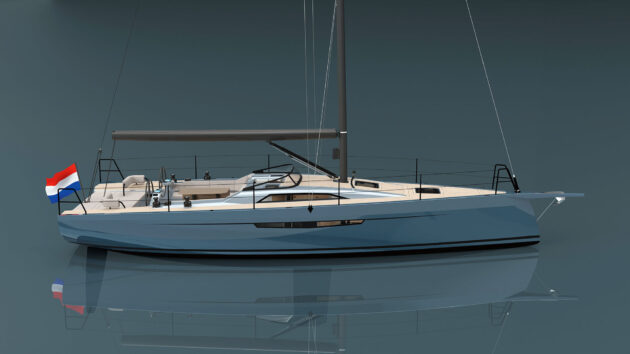
Saffier SE 38 Leader is due to be unveiled at Boot Düsseldorf in January 2027
Saffier SE 38 Leader
At first glance this design has all the key Saffier attributes that have enabled this Dutch yard to grow rapidly over the past few years – sleek styling, a big sociable cockpit and a set-up that facilitates easy short-handed and solo sailing.
However, a closer look shows it breaks new ground in creating a vessel that offers much more spacious accommodation for longer cruises than earlier designs, while still looking stunning. Although it slots into the Dutch yard’s Elegance range, rather than the Luxury line (as with the very impressive Saffier 46 that launched last year), it’s a proportionately much larger yacht than the Saffier SE 33 Life than the extra 5ft of overall length might suggest.
As well as more freeboard, there’s a whopping one-third more beam, resulting in a yacht with a very different feel.
At the same time, there’s still a full upholstered larger-than-average cockpit. The aft end of this has two options. One has sunbeds on top of capacious lockers, while the other is more of an open transom arrangement that gives easier access to the water.
A wide companionway with three easy steps gives access to the interior. This is a semi-open plan in a studio style, with a full galley, large heads/shower compartment, double berth forward and a double quarter cabin aft. Alternatively, a larger, non-structural main bulkhead can be fitted to give privacy to the forecabin.
While there’s much less volume than an out-and-out cruiser of this length, it’s ample for two to four people to enjoy comfortable cruising – and fast, refined sailing – for a week or two.
Saffier SE 38 leader specifications
Hull length: 11.55m 37ft 11in
Beam: 3.80m 12ft 6in
Draught: 1.95m or 2.50m 6ft 5in or 8ft 2in
Displacement: 6,500kg 14,330lb
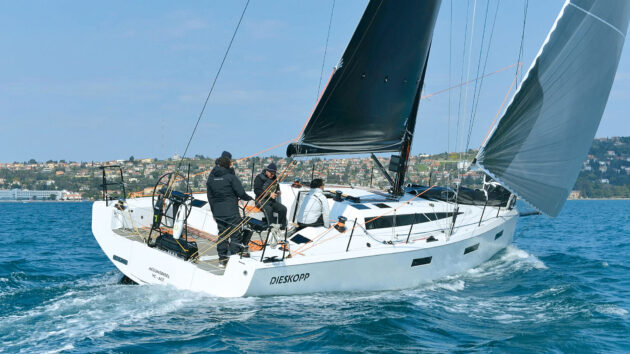
Oceantec 43 Dieskopp is optimised for use in shallow tidal waters
Oceantec 43 J/V cruiser-racer
A custom design to meet very specific customer requirements, this 43-footer includes the usually contradictory imperatives of minimising draught, while maximising performance.
The brief was for a fast, fun family cruiser and club racer for use in tidal waters around a home port in northern Germany. Every centimetre of draught was critical, so naval architects Judel/Vrolijk used a lifting keel that draws only 1.25m (4ft 1in) when raised, but 3.1m (10ft 2in) when lowered. Equally, the small twin rudders should give excellent control, with a much shallower draught than a single rudder.
Hull construction is of E-glass, with a comparable laminate schedule to a Class 40. However, structural elements don’t intrude as much into the accommodation, so the structure is proportionately a little heavier than that of a pure raceboat and strategic carbon reinforcement is also used in areas where stiffness is critical.
There’s a fully fitted three-cabin cruising interior, with weight saving wherever feasible. The number of lockers has been reduced and there’s less wooden trim than a typical fast cruiser, while still maintaining a crisp and welcoming atmosphere. Neat touches include easy conversion of the aft cabin berths from a conventional double to bunk beds.
Although this design intrinsically has very high stability, 600lt of water ballast is also included, in recognition of the fact that, even in race mode, there won’t be a full crew on the rail. A reefable self-tacking jib, plus staysail without a fixed inner forestay, minimises the number of headsails required when cruising.
This commission follows that of Red 2, another 43ft Judel/Vrolijk design built by the Slovenian yard, for a long-standing Class 40 owner who wanted a slightly larger yacht with similar speed potential, but many more cruising comforts than recent Class 40s offer.
Oceantec 43 J/V cruiser-racer specifications
Price: POA
Hull length: 13.30m 43ft 8in
Beam: 4.22m 13ft 10in
Draught (keel raised): 1.25m 4ft 1in
Displacement: 7,800kg 17,200lb
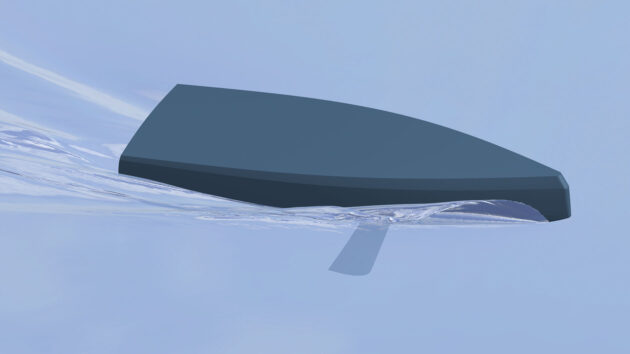
Fluid dynamics calculations for Pogo’s new 50-footer flagship hull
Pogo 50.2
Breton yard Pogo Structures has roots firmly in offshore racing, but cruising yachts have been the mainstay of its output for decades.
The 50.2 will be a flagship model, developed with the aim to find “…balance between performance, comfort and ease of use,” says co-managing director Tanguy Bouroullec.
He adds: “The boat must remain fast without ever becoming demanding.”
The Finot-Conq designed hull is optimised to combine speed, comfort at sea and stability at anchor. The boat will be fitted with Pogo’s trademark efficient ballasted lifting keel and a carbon mast setting a square top mainsail, plus headsails and reaching sails on furling systems, in a similar manner to Class 40s and IMOCA 60s, making for easy handling, without sacrificing speed.
The first Pogo 50.2 is scheduled for launch in late 2027.
Pogo 50.2 specifications
LOA: 15m 49ft 2in
Beam: 4.90m 16ft 1in
Upwind sail area: 144m2 1,550ft2
Price: TBA
 If you enjoyed this….

Yachting World is the world’s leading magazine for bluewater cruisers and offshore sailors. Every month we have inspirational adventures and practical features to help you realise your sailing dreams.Build your knowledge with a subscription delivered to your door. See our latest offers and save at least 30% off the cover price.
Note: We may earn a commission when you buy through links on our site, at no extra cost to you. This doesn’t affect our editorial independence.