



A change of plans while cruising Greece left Richard Thomson reflecting on a summer of extremes
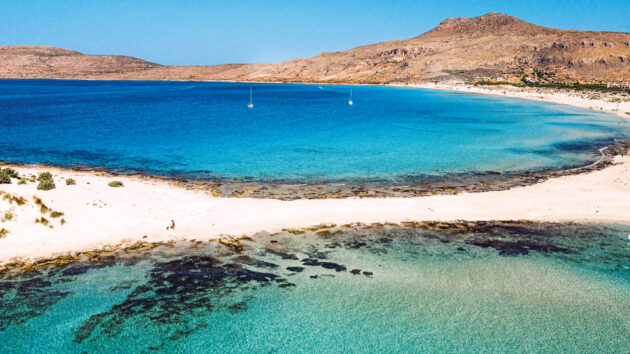
In the lee of the island of Oxia and the low-lying mainland, we altered course and sheeted in, the wind pulsing across the deck of our Voyager 38, Namika. We’d just rounded into the Gulf of Patras and the stars for fast sailing suddenly all aligned. Coming up to a beam reach we rushed parallel to the coast just a couple of hundred metres to windward – and with a mere 5m of water under the keel.
With a strong, steady northerly driving her on, Namika stretched out on the barely rippled, murky green-blue sea. We were passing a river delta landscape – somewhat atypical for rocky Greece – where the rivers Acheloos and Evinos flow down from the mountains and into the Gulf. The land is low lying and barely interrupts the air rushing over mudflats and low scrub. The log reading climbed steadily; 7 knots… and a half… 8 knots… and a half! There we sat for the next two hours, Namika a good knot above her theoretical hull speed.
Keelboat or dinghy, I’ve always loved fast sailing – the boat heeled and alive in the water, spray fizzing in the air. Normally there’s a sea to go with it, so sailing at sustained high speeds in flat water feels a slightly alien sensation, with just the hum of the boat, our wake behind and the shore rushing past to betray a pace which my senses otherwise hardly believe to be real.
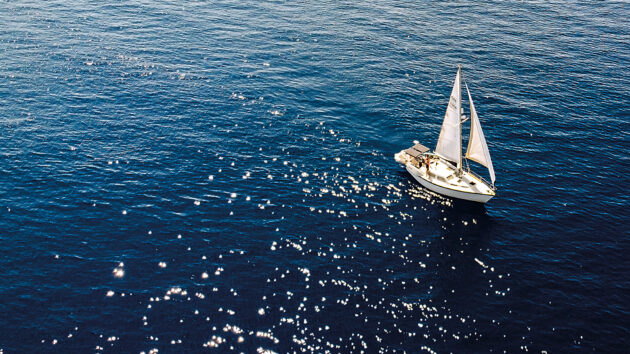
Namika is an unusual sloop-rigged version of the Voyager 38. Photo: Richard Thomson
Our fast pace took us towards the town of Missolonghi which, with swampland all around and houses on stilts lining the entrance to the lagoons, could almost be somewhere along the Mississippi delta. Once the breeze died, foot-long fish leapt out of the still waters to catch insects at dawn and dusk. The mosquitoes aren’t perhaps so bad as they once were – it was here the great romantic bard Lord Byron met his end, likely to malaria. That said, we were glad to have nets over the hatches at night.
My wife, Maxi, and I hadn’t planned on being in Greece at all. With a serious diagnosis for someone very dear to us, we’d spent longer ashore than anticipated and knew we could be travelling back in a hurry. Our original plan had been to move west towards new horizons, but we shelved those schemes to stay in Greece, where we were familiar with weather patterns, distances and, if necessary, airports.
Racing heritage
A sense of retracing our steps got us experimenting with our sail plan. Namika had been raced several owners ago and, while she has been a labour of love, her canvas was a strong point when we bought her. Despite being a sloop, she came with no fewer than seven sails, all serviceable and some almost unused.
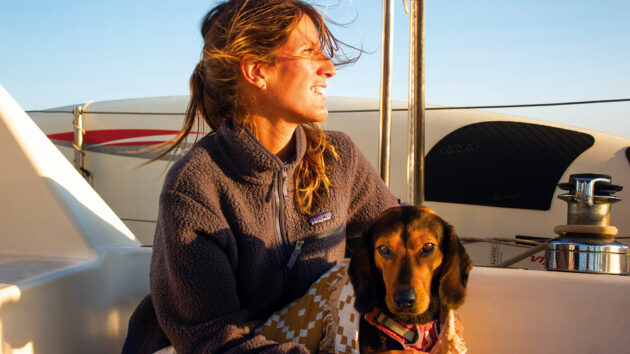
Under sail and the sun’s first rays. Photo: Richard Thomson
Designed by Angus Primrose (of Gipsy Moth IV fame, or infamy, depending on your perspective) our Trident Marine-built Namika is an unusual version of the Voyager 38.
Her sisterships were almost exclusively built as ketches with three cabins and an internal secondary steering position. Namika is sloop-rigged, however, with two cabins and no internal helm.
All Voyager 38s are roomy, but Namika is cavernous with one cabin axed to create an oversized forepeak sail locker. This change to the bulkheads moved the baby stay forwards so that it was parallel with the forestay – more like a cutter stay. But to my knowledge this stay had never flown a sail until last summer.
Namika came with storm sails, virtually unused, and a removable inner forestay which (I was told by the previous owners) was intended to be rigged just inside the furling genoa with the storm jib hanked onto it.
Despite much head scratching and experimentation, I could never see how it was supposed to work. The wire was there, a block and tackle to tension it, but I couldn’t locate an attachment point on the mast. At deck level the extra holes in the stemhead fitting where you might put a shackle were so close as to interfere with the furling drum. Even if I’d somehow missed the attachment on the mast, surely the drawing storm jib would chafe against the furled genoa’s sheets? However it worked, it was beyond me, and after carrying the wire around for a couple of years, we got rid of it.
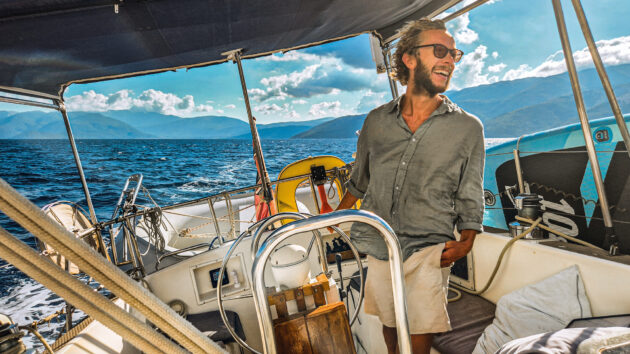
Short tacking up the Ithaca channel in blustery conditions. Photo: Richard Thomson
Now in the lightest of zephyrs, we got the storm jib out of the bag and tried something else. It turned out it was just small enough to go on the baby/cutter stay. The sheets were a challenge, but with a bit of trial and error, we could get a reasonable sheeting angle running inside the cap shrouds and lowers.
By adding blocks just forward of the genoa sheet blocks, we could run the sheets back to cleats just aft of the primary sheet winches. There was wind enough to fill the sail – not to do any meaningful testing – but we were pleased with our progress. We were also happy that the midsection of the mast was sufficiently supported against the extra loading it would receive, with the lowers sweeping nicely aft from the same height. In theory, it all just about worked, but we didn’t know what effect it might have on Namika’s sailing.
A few days of calms followed and we pottered down to the barren island of Dhokos, anchoring by chance alongside two boats whose crews we knew from years past. We spent a delightful evening swapping stories and reminiscing then, with the wind due to return, hatched our plan to venture eastward into the Aegean proper.
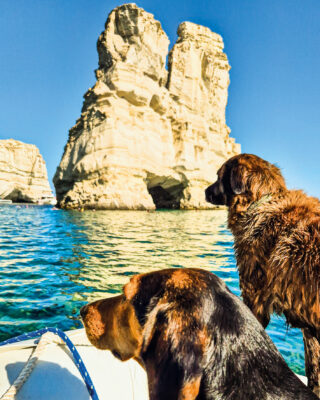
Exploring caves by dinghy on the island of Milos. Photo: Richard Thomson
Perfect harmony
The next day found Namika thrumming along happily on a close reach under first reef and nearly-full genoa. I went forward to hank on the storm jib, run the sheets, then hoist it. The sail was manageable on just the cleat without a winch, and filled nicely in the slot between the larger headsail and the main.
I switched off the autopilot and took the helm. With her long chord keel, Namika is extremely well balanced and very light on the helm. She can even be left without the autopilot for extended periods on a reach with the wheel locked very slightly to leeward.
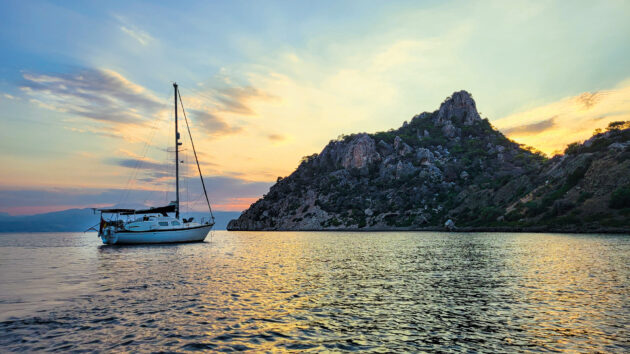
At anchor in the Gulf of Corinth. Photo: Richard Thomson
Fascinatingly, our second headsail added just the right amount of thrust forward of the mast to completely centre the wheel. Namika eased along as if she was designed to sail like this, and yet we know for a fact she was drawn as a ketch, which might even have increased her weatherhelm. I surely had the daftest grin on my face for several hours straight as the miles clocked by under our cutter rig.
As if in celebration, we were joined by a pod of dolphins – smaller, livelier and, it seemed, more playful than ever. The pod took turns to dart expertly back and forth across the bow wave, perfectly matching our mood aboard Namika.
As we approached the island of Kythnos, one began a display I have never seen before – somersaulting and belly flopping, five or six times in a row. In that moment, we were so happy on board and so convinced of the dolphins’ joy that we felt an incredible kinship over this apparent shared love of life. In a difficult year, it was a moment that glows bright in my memory.
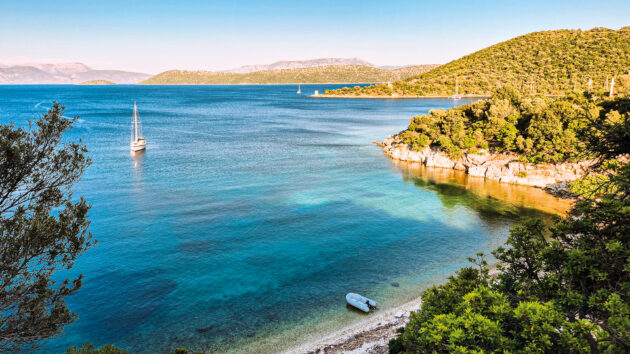
Peace and tranquility in the Northern Ionian. Photo: Richard Thomson
Wild conditions
Very unusually for July in the Aegean, a strange period of southerlies followed where we worked north as far as Euboea. The anomaly would soon be corrected with a screaming Meltemi forecast to follow. We had a friend coming to stay who’d be sailing for the first time, and the open Aegean was no place for her in that forecast, so we scuttled back to the more sheltered waters of the Saronic.
Though reluctant to go backwards, we were glad to have done so: the Meltemi howled for over a week, clocking Force 9-10 in places we’d been a week before. Working out of the Saronic involved some serious beating to get ourselves in position to make the jump back out into the Aegean proper again.
Mindful of the weather in the weeks before, we decided on a little extra precaution and rigged jackstays down the centre of the boat – something that generally only happens for night-time passages. We started at the first reef in the main and full genoa on a broad reach, heading for Serifos in comfortable conditions.
Article continues below…
The wind gradually built as the miles ticked by (not entirely unexpected), and we shortened sail accordingly. By half way we were down to the second reef and a small headsail; our normal ‘it’s windy’ set up. The seas were 2-3m – a little bigger than anticipated and significant for the Med, but not breaking and all still very manageable.
As time passed the wind rose again and I started to have a nasty feeling about the weather. We decided to drop to the third reef as a precaution, which is a tiny slab of sail and was the first time we’d done so in earnest aboard Namika. I clipped on (a rare daytime occurrence for me) and went forward, hauling the sail down to secure the tack with a strop where the bunt of the sail would otherwise prevent directly reaching the ram’s horn.
We have a rule on Namika that whenever anyone thinks of reefing, we do it – and it was just in time. Within perhaps 10 minutes it seemed hell itself was on the verge of breaking loose. The wind began to howl and the waves built rapidly to become enormous, short-period monsters. In the troughs you could see nothing but the wall of water coming at you.
I’m very reluctant to guess at wave heights as they often seem bigger at the time, but I do remember noticing the bigger waves were around spreader height, which puts them somewhere in the region of 5m.
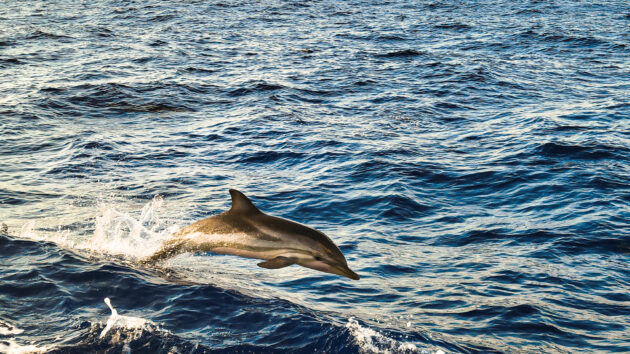
Playful pods of dolphins accompanied Namika. Photo: Richard Thomson
I furled the headsail away, with the furling line so tight we were left with a small triangle still filling, and eased the main. The autopilot went off and, braced well and clipped on in the cockpit, I took the mainsheet in one hand, the helm in the other and sailed Namika like a giant Laser dinghy, surfing up and down the waves to try to avoid the worst peaks as they started to break, only occasionally taking a minor pummelling where a rogue mass of tumbling water arrived simultaneously to a more regular wave, but at an irregular angle.
I was hauling in the main in rare lulls, or in the occasional bad roll where the boom was in danger of going into the water. It’s not the sort of thing you could do for days, but for a few hours was manageable. I was very actively sailing the boat, and it felt mostly controlled in spite of the conditions. Maxi and I had a quick discussion about running off down to Milos (around 40 miles away) or to push on as we were, and we both agreed to stick out the last 15 miles.
In one particularly violent moment, Maxi – temporarily on the high side, holding a grab rail with both hands, and clipped on with a short leash – was airborne for a fraction of a second, hanging on with both hands as Namika lurched.
It wasn’t especially dangerous as she was in our deep cockpit, clipped on, but was a sharp reminder of how a moment’s inattention could turn serious when things get wild. We passed two other sailing yachts, both going the other way, both perhaps 50ft, and reefed right down. At times we glimpsed far more of their keels out of the water than must have been in it, with both boats almost airborne at the wave crests.
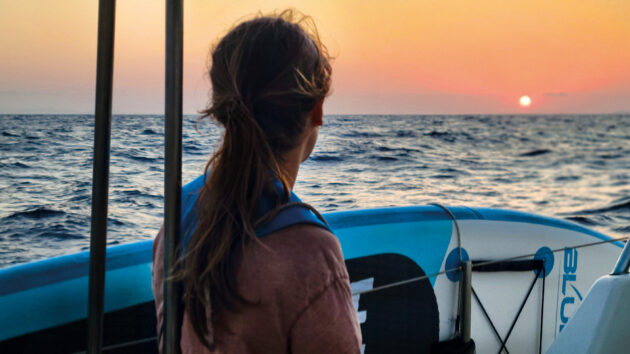
Early morning calm before the afternoon storm. Photo: Richard Thomson
Calm returns
By this point it was wild, exhilarating, with a few heart-in-mouth moments, but starting to stabilise. The wind and seas eased slightly as we started to get a lee from Kythnos some distance to the north, then rapidly once in the lee of Serifos where the seas suddenly died away.
Remarkably, a mile or two later the wind was all but gone as we headed into Livadi. It had been 15 miles since we’d debated whether to change course, and at around 5 knots SOG the conditions must have lasted around three hours. We took stock inside: the boat looked like she’d been turned upside down but, other than the internal shower having opened itself and drained a water tank, there was nothing that couldn’t be easily put right.
Our older dog, Minca, good seadog that she is, had wedged herself in a tumble of blankets and cushions in the aft cabin against the low side. Our younger canine companion, Nydri, had stayed on the cockpit sole the whole time, clipped on and braced between me and the coaming.
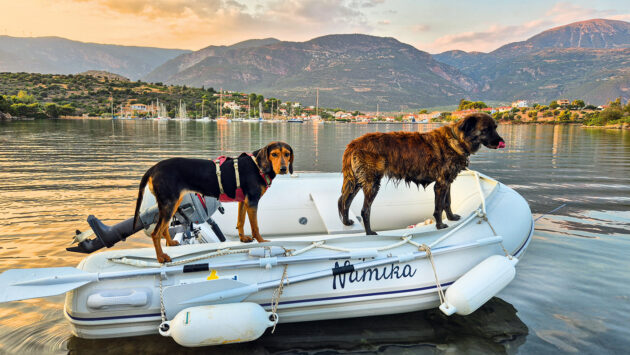
About to head back from a walk ashore. Photo: Richard Thomson
Giddy with relief, Maxi and I dropped anchor before heading ashore to run the dogs, get a drink, and debrief. Reviewing the forecast, we believe a corridor of wind had somehow become funnelled and concentrated across this band of water, whipping up a residual swell from the weeks before to be several times worse than anticipated.
Spartan landscape
In the coming days, benign conditions returned and we pottered across to neighbouring islands to be joined happily by Maxi’s mum. We spent our time snorkelling, sunbathing, eating and enjoying the very best of Greece; explored a partially reconstructed temple in Despotiko; and savoured complete isolation in a remote corner of the Middle Cyclades. After waving goodbye at the end of August, we turned Namika’s bow west and began our journey back towards life ashore.
We were hopeful of a good opening to go round the Peloponnese. Once fully reprovisioned, we explored spectacular caves on the south corner of the island of Milos while getting ourselves nicely into position for a night-time departure. After walking the dogs by moonlight, we upped anchor around 3am to thread our way past a handful of rocks and reefs which we’d studied by daylight on the way in.
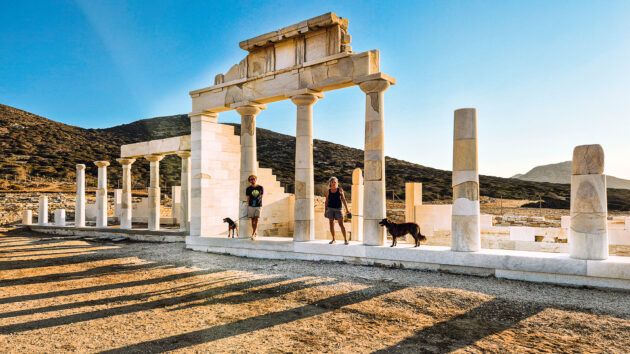
A partially reconstructed temple in Despotiko. Photo: Richard Thomson
Namika always seems happiest on the open sea, and she was soon into her stride with a delicious wind near the beam and a leisurely swell upon which she rose and fell comfortably. As the first glimpse of the sun rose on Homer’s wine-dark sea, we hoisted the staysail and transformed into a cutter once more – despite touching neither sheet nor helm for the next eight hours we averaged well over 7 knots. Days like this are the reason most of us go to sea, and the hours and miles passed in a happy bliss.
The wind gradually moved abaft the beam as we approached Maleas. The cape boasts a slightly fearsome reputation but, through luck or good timing, in three roundings we’ve never really been tested.
Now nearly running under just the genoa, we ambled past this formidable bulk of rock tumbling into the sea, decorated with a remarkable monastery built into the cliff from which generations of monks must have watched thousands of vessels pass down the centuries – no doubt sometimes watching with pity, at others perhaps with longing. We dropped anchor in the emerald waters of Elafonisos, and went ashore to climb the hilltops and breathe in the views.
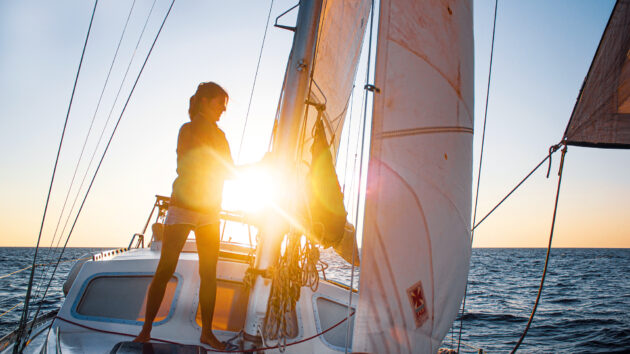
Namika reimagined as a cutter. Incredibly, she seemed as if she was always intended to sail like this, even though the Voyager 38 was drawn as a ketch. Photo: Richard Thomson
With challenging westerlies now pushing us north, we close-hauled high up the eastern coast of this middle leg – an area rarely frequented by yachts even by relatively Spartan Peloponnesian standards – and anchored in a forgotten little bay. With just a handful of locals along the shingle beach and not a yacht in sight for days, we enjoyed tranquil waters and even a wedding down by the waterfront where we were treated to a celebration of live music, lights, and laughter.
Working our way round as the weather permitted, we next dropped anchor in Mezapos; by reputation and appearance a former smuggling haven. It still harbours that impression, and we met characters whose grins, crooked teeth, baggy shirts and gold earrings could have pirated seamlessly alongside Orson Welles in the 1970s classic, Treasure Island.
Historic Methoni, picturesque Pilos and the western Peloponnese followed, and we edged back into the islands of the Ionian which have been Namika’s home waters these last years. Tacking up the Ithaca channel in blustery conditions, we dropped anchor in a little cove on the north east coast of Kefalonia – once more all to ourselves.
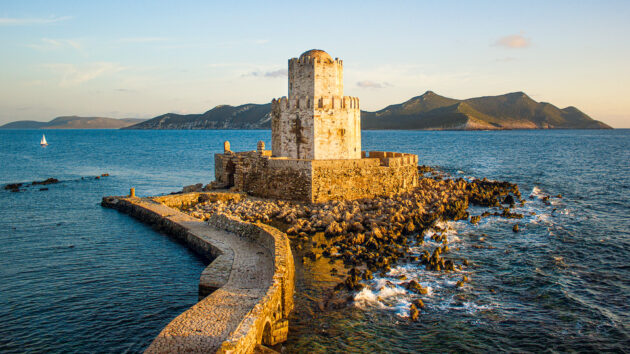
Historic Methoni. Photo: Richard Thomson
After some earlier tests, we’d enjoyed a few weeks of the kind you can only savour. The next day, the phone call came from ashore. There was very little time left. The call was always going to come – it might have been six months, it might have been a year. We scrambled to Preveza airport and were on our way home the next day.
Ashore or afloat, life has few guarantees. At some stage, we must all face difficult times. In spite of this, I can only count ourselves lucky to also leave good times in our wake as the miles wash by.
 If you enjoyed this….

Yachting World is the world’s leading magazine for bluewater cruisers and offshore sailors. Every month we have inspirational adventures and practical features to help you realise your sailing dreams.Build your knowledge with a subscription delivered to your door. See our latest offers and save at least 30% off the cover price.
Note: We may earn a commission when you buy through links on our site, at no extra cost to you. This doesn’t affect our editorial independence.