


Can a design suit both charter and private use? Leopard’s crowd-pleaser is geared up exactly for that
Leopard 46 review: Can the new cat fill the 45’s big shoes?

Every brand has its big seller, its big ticket item. Toyota’s Corolla, Nike’s Air Jordan, Ronald’s Big Mac, etc. For Leopard Yachts, it was the Leopard 45. Also branded as the Sunsail 454 and the Moorings 4500, 379 were built by South African yard Robertson and Caine since 2016, nearly twice as many as any of its other models in Leopard’s three decades.
However, replacing such successful models can be a challenge – particularly, in this case, when you consider the end user is so varied.
A boat that sells equally well to both private and charter markets needs an intelligent design and a durable construction. Where some brands can appear slightly coy and apologetic about the numbers they sell into charter, Leopard is rightly proud to sell half its production run into Sunsail and Moorings fleets, asserting that its robust solutions and fittings ensure ease of maintenance and long term durability.
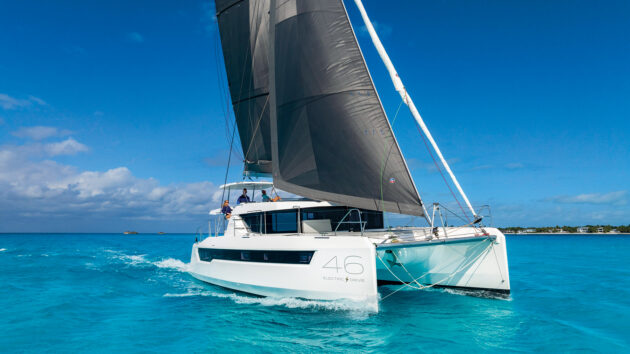
A high, boxy shape helps off er huge accommodation and natural light, while hulls are kept narrow at the waterline. The 46 is rigged to be managed solo from the helm station. Photo: Leopard Catamarans
While maximum space is also required for charter use, its options and layouts need to suit bluewater liveaboard cruising too. In the case of this replacement 46, these include a choice of three to five cabins, which allow space to house a crew inside the main accommodation as opposed to the forepeaks – or offer a proper utility space for liveaboards. Ease of short-handing from a protected helm is another priority.
This increased accommodation space makes for a slightly larger and heavier vessel than the 45. Yet, with Leopard also seeking improved performance capability, designers Simonis Voogd gave the 46 a 1m taller mast, which can fly up to 15% more sail area. The characteristic stepped hulls with narrow waterline remain, as do overlapping genoas to aid performance in light airs. Add in an optional square-top Aramid mainsail, bowsprit and Code 0, and Leopard claims you can now start sailing in 6-7 knots breeze.
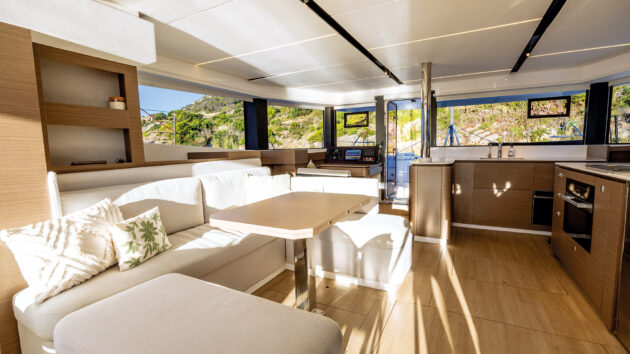
Sliding door between cockpit and saloon can now be fully recessed to create one increased and integrated space. Photo: Photos: Andreas Lindlahr/EYOTY
Result at sea
These options, which were all thankfully fitted on the test boat, provide a marked difference over the standard white sail charter boat setup. While we did manage to nudge over 8 knots with the Code 0 fetching in 15 knots apparent wind (with a small swell off our aft quarter), figures during our trial averaged more like 6.5-7 knots at 60° apparent. Equally, when sailing with main and genoa in up to 17 knots apparent, we were clocking speeds in the late sixes where the polars predict speeds over 8 knots.
The test boat was well laden with extras, while the drag from the fixed (hydrogenerating) propellers could also have affected some of this speed differential during our short trial. In prime conditions, and with the performance sails option set, these polars suggest the 46 should be capable of clocking 9+ knots.
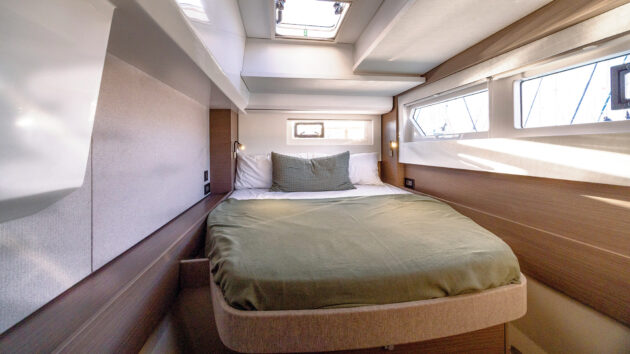
While cabin numbers have increased volume and light has not been affected. Photo: Photos: Andreas Lindlahr/EYOTY
During sailing we engaged the hydrogenerating facility of the props. The engines’ throttles are used to adjust braking power – higher pitch and drag equates to more electrical juice to the batteries, all displayed on a touchscreen interface at the helm. In 12 knots apparent wind, we were sailing at 6.7 knots under Code sail with throttles halfway, yet producing 1kW. Engaging more throttle increased this to 1.3kW. With more breeze and 8 knots boatspeed these figures could double, and it’s easy to imagine how satisfying it would be on a long passage to watch this energy top up your bank (see panel, far right).
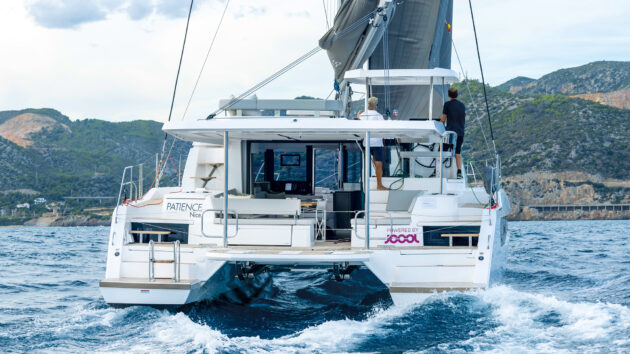
Beyond power management, it’s also easy to set and trim the sails and manage the boat solo from the single pedestal and helm area. From here you’re protected from the sun by a bimini yet have a view of the mainsail through a clear panel. You can also see all four corners of the yacht, for when docking and manoeuvring.
The helmsman has a comfortable double seat with everything led to hand. The test boat also had foot remote switches for the winches, which we found useful when managing the mainsheet through tacks and gybes using its twin sheet system. However, the steering was a little stiff on the test boat, and the wheel is mounted too close to the inboard coaming, which can trap fingers. The spinnaker sheet block mounted in front of the wheel, is also a concern as this can get highly loaded, while the sheet can then foul your quick access to the side deck.
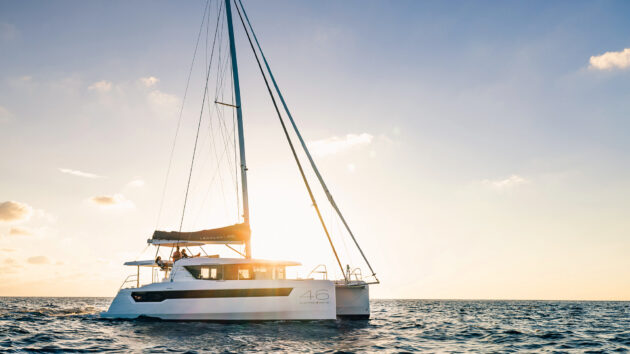
High and bright with long windows above the hull-length chines. Photo: Leopard Catamarans
Exterior comfort
The test boat is an owner’s version, laden with all the expensive extras, and has a professional skipper. The electric-powered bathing platform, a feature also popular on rival brands such as Fountaine Pajot and Lagoon, is a costly option (€45,000).
But this patented Robertson and Caine design uses a low-maintenance belt with electric drive to move it up, down, forward and aft, allowing for easy launch and retrieval and facilitating a dinghy larger than the transom would otherwise permit.
Modern Leopards excel in providing multiple relaxation spaces, including the cockpit, flybridge lounge, and forward cockpit. The latter is a signature of Leopard, with 2,000 boats now built with this layout since 2010. Accessible from the interior via a watertight door, it offers a private space in the breeze or away from dock noise.
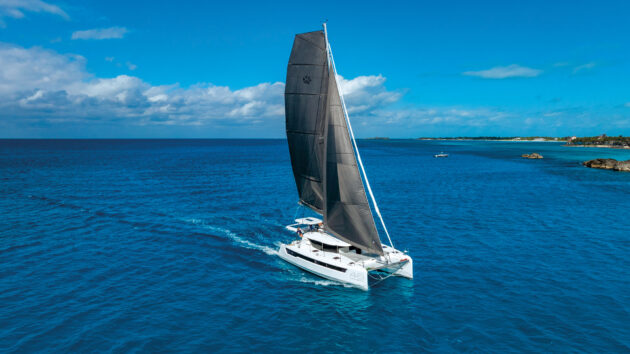
Overlapping genoa and bowsprit with furling Code sail for lightwind sailing. Photo: Leopard Catamarans
A sliding door that retracts behind the helm station opens up the cockpit area of the 46 more than its predecessor. There are now more solutions for integrating seating and tables between the saloon and cockpit too.
Once inside the saloon, the marked increase in natural light is evident, including the move to using clearer, real glass (which requires a stiff structure, so aluminium frames are used in the mullions).
And the forward-facing galley and navstation, combined with that forward cockpit access and natural ventilation from the watertight door, are features that set the 46 apart from the competition.
The reign of crew
The accommodation layout also differs from the norm. Where most cats this size offer an owner’s hull, the Leopard packs in the cabins. “Skippers are kings now,” explains marketing manager Pierre-Yves Chanau, who says they don’t sleep in forepeak cabins any more but take proper cabins.
And with increased demand for crewed charters, keeping a crew content is crucial. Leopard therefore wanted additional cabins within the main accommodation, so where the 45 had a three- or four-cabin layout, the 46 offers four double en suite cabins for private use, or a five-cabin mode for charter.
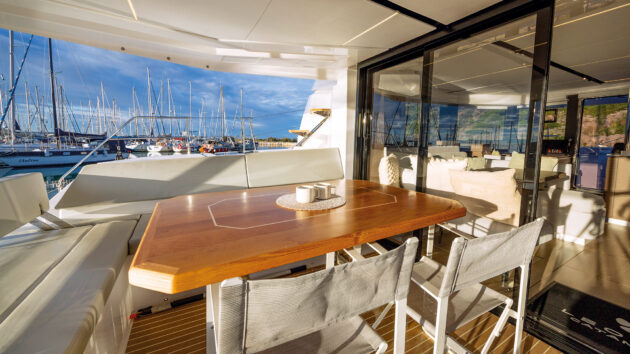
Photo: Photos: Andreas Lindlahr/EYOTY
For private owners who do not typically require four cabins and prefer stowage space, a three-cabin plus utility space is also an option. The test boat had this, which includes a laundry area, plenty of lockers and a workbench.
However, it’s worth considering the reduction in sail locker space this layout brings, with the accommodation taken further forward in the hulls.
The owner’s cabin is still generous, with a vast amount of glazing, but the guest cabin forward of this is pushed into the forepeak, which makes for a comparatively tight shower compartment (although the generous athwartships berth and overall cabin size mean guests are unlikely to complain).
Leopard 46 specifications
LOA: 13.87m 45ft 6in
LWL: 13.42m 44ft 0in
Beam: 7.35m 24ft 1in
Draught: 1.59m 5ft 3in
Displacement (light): 17,672kg 38,960lb
Sail area (upwind): 140.5m2 1,512ft2
Water: 700lt 185gal
Fuel: 690lt 182gal
Engine: 2x45hp 33kW
Price as tested: €1.082m
Contact: leopardcatamarans.com
 If you enjoyed this….

Yachting World is the world’s leading magazine for bluewater cruisers and offshore sailors. Every month we have inspirational adventures and practical features to help you realise your sailing dreams.Build your knowledge with a subscription delivered to your door. See our latest offers and save at least 30% off the cover price.
Note: We may earn a commission when you buy through links on our site, at no extra cost to you. This doesn’t affect our editorial independence.
Verdict
Replacing a big-ticket selling model is never easy, but Leopard has done so tentatively – this is very much a Mk2 evolution. And many things it has improved for good reason, including the circulation, accommodation layout and optional fittings, such as the aft platform and hybrid system, which can modernise the vessel’s ease of use. Adding these and volume brings additional weight, and I’d need a longer sail in more spirited conditions to see if the performance options can meet the promising polars. But the hull shapes and layout, particularly the forward cockpit, provide an advantage over the competition for charter use and potentially even for private ownership cruising too.