




Sailing to South Georgia Island, a family sail-ski-climb adventure for Skip Novak reveals the changing Shackleton Traverse
We hit the cold front square on. From light and variable in the centre of the low, bottoming out at 973mb, the wind took but an hour to ramp up to a point where we needed three reefs in the fore mainsail and only a staysail up front. Early in the day the Windy app was clear what lay in store: 40-plus knots of southerly while we were still two days out of Port Stanley on the return from South Georgia.
When the blizzard set in just before nightfall, off we went on deck fully kitted up. The sail plan pre-emptively set when the wind filled had been optimistic. Soon we were at storm sail configuration – the fourth reef put in was our trysail – and with the staysail deeply reefed on the furler, our de facto ‘storm jib’. Seas of 8m were predicted and it was clear we could not lay Stanley across the wind, but needed to put the wind and sea on the quarter.
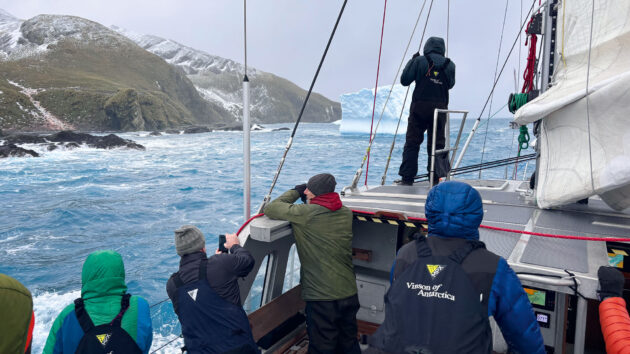
Slipping through the narrow channel in Bird Sound. Photo: Skip Novak
For the next 36 hours things were ‘on the edge’ with the wind above 40, often gusting up to 55 knots. The on-watch had eyes glued to the radar, but were otherwise warm and cozy in the pilot house – a deprivation chamber of sorts against the howling storm. Snow squalls continually came and went, though luckily icing on deck and in the rigging was minimal, checked often with our deck spot lights.
I was hoping like hell the autopilot would not fail. I was pretty sure we’d not be able to hand steer in these conditions. Heaving-to was possibly on the cards and, although we had years ago tested a heave-to configuration in 30 knots, turning up into this seaway would be dramatic in this 75-tonne vessel. Luckily, we rode it out, sliding on top of the quarter sea doing 8 to 15 knots comfortably.
As Captain Haddock would have remarked to Tintin, had they been on board, 50 knots was ‘a mere draft’. Indeed, we came through unscathed.
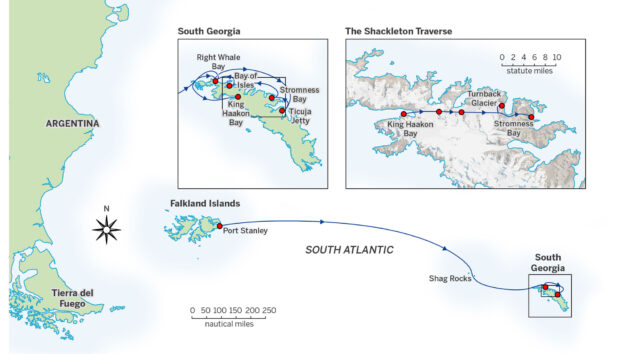
Photo: Skip Novak
Sailing to South Georgia: A dads and kids team
This was the end of a five week project sailing Vinson of Antarctica to the island of South Georgia and deploying a ‘dads and kids’ team to do the celebrated Shackleton Traverse, following the same route from the 1916 epic.
Our sistership Amundsen was also on the island with day trip skiers led by British mountaineer Stephen Venables. For the return from Port Stanley to South Georgia, the starting gun was fired (actually a signal from a very depleted fog horn on Vinson) off Cape Pembroke, last landfall in the Falklands and the 750-mile match race was on!
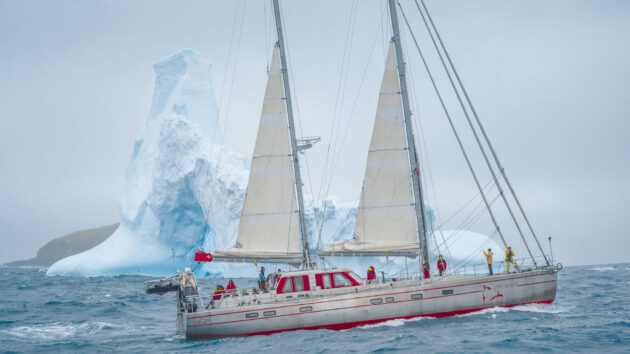
Vinson close aboard a grounded berg approaching Bird Sound. Photo: Stephen Venables
I had been watching the weather patterns for weeks before we set sail from Stanley on 25 August. Granted, this was an early season trip; late southern winter, not yet spring.
In previous expeditions to South Georgia from late August through September weather patterns seemed to be more stable than later in the spring and certainly less volatile than the windy summer months, where snow conditions are poor and the joys of pushing our skis pulling pulks must be foregone for the less pleasant mode of travel in boots carrying big rucksacks.
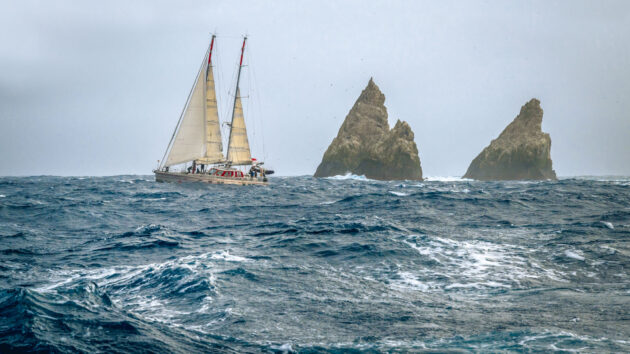
Amundsen clears the Shag Rocks in the wake of Vinson of Antarctica. Photo: Hamish Laird
Powerful low pressure cells were marching across the island of South Georgia one after another, while high pressure north-east of the Falklands also fed the system.
We slipped through the majestic Bird Sound at the north-west tip of the island with Amundsen close astern, having split the Shag Rocks in two, but decided to bail out into the first available shelter of Right Whale Bay to take stock while Amundsen carried on to Grytviken. It did not take much analysing of weather models for us to decide to follow them in the next day to avoid ferocious winds and sea state in the offing from the westerly quadrant.
Storm bound in Grytviken
The place to be was alongside on the Tijuca Jetty with mooring lines well tied in to old rusty bollards and pieces of unmovable machinery from the whaling era. This is also a tactic to avoid ‘cabin fever’ as you can step off and stroll around on shore. It was quite a sight to see these two Pelagic 77s together on this magnificent sub-antarctic island. Not a cruise ship nor another yacht was within a thousand miles of our position.
Within the two arms of Cumberland Bay striking into the central section of the island a vacuum of sorts can be created whereby the winds jump up and over the Allardyce mountain range, leaving Grytviken windless and sunny, although with dramatic lenticular clouds stationed aloft along the spine of the island, a not too subtle warning to keep a weather eye out.
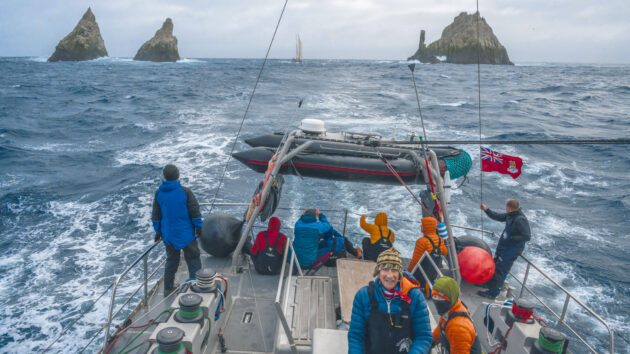
Skip at Vinson of Antarctica’s helm with Amundsen in her wake at the Shag Rocks, passing through the narrow gap with 12m of water. Photo: Skip Novak
Jerome Poncet got stuck into butchering one of our four mutton carcass halves, chucking a leg and shoulder in the oven for slow cooking. The rest of our traverse team of Hamish Laird and daughter, Lenny, Frank Macdermot and son, Zu, with me, my grown-up kids Lara and Luca, plus Falkland Islander and Vinson veteran Steve Brown, and finally Kenneth Perdigon from Barcelona, were off on skis and skins up the 500m to Glacier Col for a warm-up.
We were joined by a full contingent from Amundsen, making a group of 18 people of mixed abilities. It was a glorious day; a seven-hour jaunt to limber up after the incarceration of the voyage.
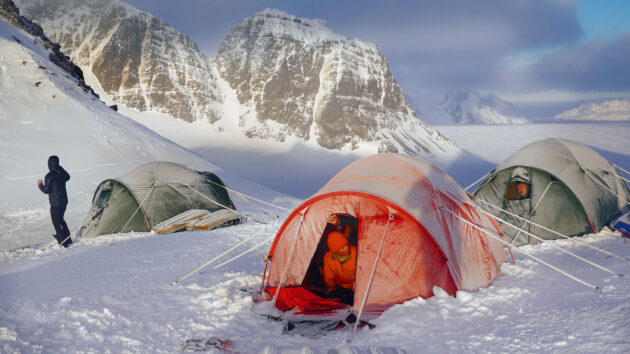
Traverse team managed to set up an overnight camp on the south col’s icy platform. Photo: Skip Novak
Before the days of accurate forecasting (at least for three days, maybe four in this region), this deception of amazingly good weather in Cumberland Bay would have instilled a sense of angst in our climbers and skiers. They would no doubt have been chomping on the bit to get out and tackle their lofty objectives, thinking the management (ie me) was being overly hesitant.
Luckily, we had a relaxed group, a combination of paternal maturity coupled with inexperienced youth, happy to leave our next move in the hands of the weather gods. ‘Playing it by ear’ is another way to describe the methodology, used often in our art of ‘sailing to climb’.
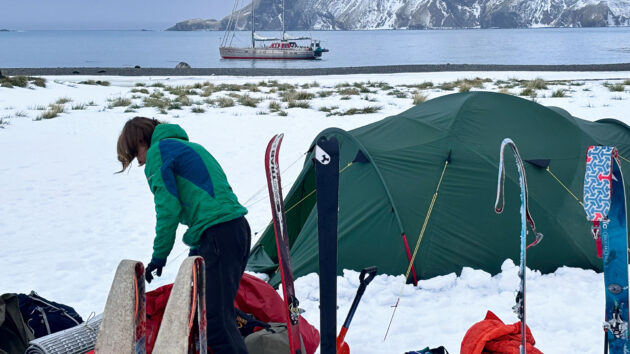
Camp at Anchorage Bay. Photo: Skip Novak
On 2 September we pulled away off the dock, with Amundsen following. They were on the way to Larsen Harbour, the majestic deep fjord at the south end of the island. They would work their way back north ski touring and visiting the wildlife sites, while we headed north to begin the Shackleton Traverse.
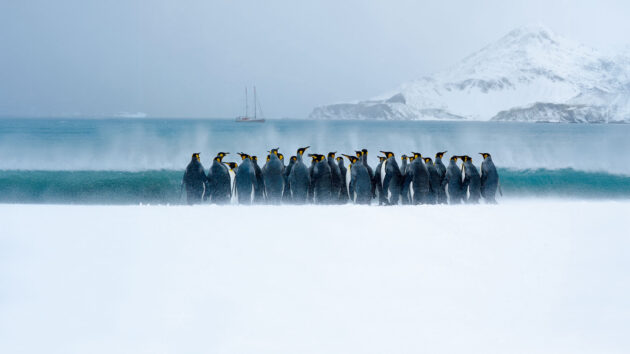
Moving up the coast slowly but surely, we spent a day and night at Stromness Bay with a grand ski tour around the abandoned whaling stations, then a windy landing at Salisbury Plain in the Bay of Isles for a visit to the king penguin colony, followed by a return to Right Whale Bay with four inches of snow on deck.
On board a routine developed, including a bread-making competition, reading, editing photographs, repairing gear, backgammon, and various discussions. There was speculation, some doubt, and renewed enthusiasm whenever the sun made a rare appearance: all very similar to the golden era of polar exploration whenever the weather halts all forward progress.
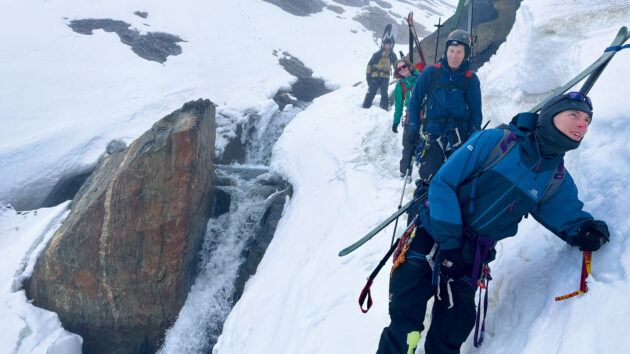
Zu, Frank, Lara and Luca in the ravine above Fortuna Bay. Photo: Zu Macdermot
Shackleton’s cave
Our window finally arrived on 13 September. To begin this overland journey, to my way of thinking, you need a benign forecast of three days to comfortably get stuck in and committed.
Day one was just getting to the start – predawn up anchor from Right Whale Bay, taking five hours to slip back through Bird Sound and around into King Haakon Bay, dropping the hook near Cave Cove, a tiny defile almost hidden from view on Cape Rosa where Shackleton and his men first made landfall after leaving Elephant Island.
This is where the traverse story starts for us. We spent an hour ashore there inspecting the ‘cave’, which is nothing more than a miserable overhang, with icy Swords of Damocles on guard overhead. Shackleton and his five companions heartily ate wandering albatross chicks off the nest above the cove to regain their strength after their epic boat journey.
Today there are no nests. We were there on Vinson in 2024 while on the once-in-10-year wandering albatross survey for the government and we searched high and low all over the Cape.
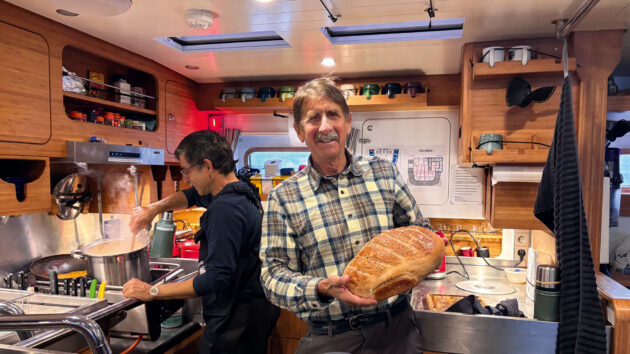
Food prep in Vinson’s galley. Photo: Skip Novak
We continued down the fjord that afternoon and with pulks, food bags, skis and the heavy gear ready, dropped anchor behind the Vincent Islands near Peggotty Bluff and offloaded everything onto snow above the beach.
A lone bull elephant seal took little notice.
On day two we took our personal kit bags ashore just after first light, harnessed up to our pulks and began the long ski and skin up to the Shackleton Gap, followed by a steep pull up on to the Murray Snowfield. On the Gap we radioed Vinson and said goodbye to crew Tor Bovim, Melissa Du Toit, John De Wet and Jerome – they could up-anchor and head back around to the relative safety on the north side of the island.
Snow conditions were mixed, the high winds did their work here and instead of a flat pulling surface the winter snow of the glacier was a patchwork of mini summits – wind-blown ‘sastrugi’, annoyingly at right angles to our direction of travel with more hauling energy required.
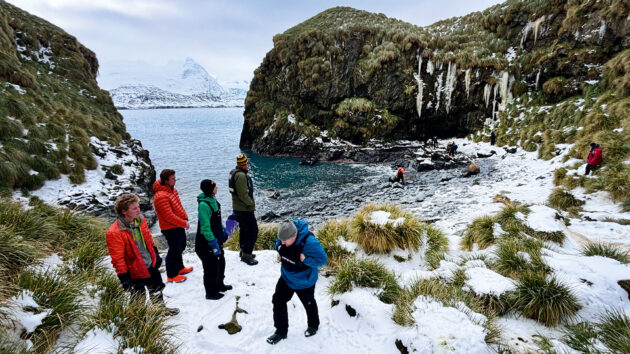
Icicles hang above the ‘cave’ of Cave Cove in King Haakon Bay. Photo: Skip Novak
It was a long first day. By 1600 I was trailing way behind our youthful contingent and, after a steep pull up the last 100m (much steeper than when I was last here in 2011, or maybe it was 14 years of age tacked on to the equation!) we gained the south of three cols that define the Razorback Ridge where Shackleton, Worsley, and Crean made the famous desperate slide, in little visibility, off the crest of the north col into the abyss.
Having always used the centre col before, the south col was therefore an experiment that worked, but just. It was a hard ice platform, just big enough for our three tents – our ice screws came in more than handy for guy anchors. The forecast was benign for day three, but this was certainly an exposed position, with 10°C of frost overnight.
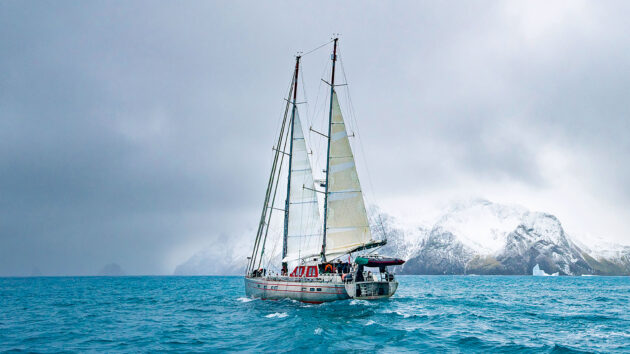
Vinson under reduced sail slides down the South Georgia coast, with williwaws an ever present risk. Photo: Skip Novak
The next morning was a hard and windy start breaking camp. When I climbed out of our cocoon at 0600 we were in the mist – a concerning situation for the descent, but luckily it lifted by 0800.
We were met with spectacular views in both directions, back down the Murray into King Haakon Bay and due east along our route across the Compass Glacier immediately below, then the Crean Glacier and finally across the expansive Nineteen Sixteen Snowfield in the far distance. Optimism returned!
Article continues below…

Skip Novak’s Mission to Save the Albatross
I let go the lines at the pontoon in Cape Town and watched Pelagic Australis motor out of the basin,…

Sailing South Georgia: The inside story of Skip Novak’s 2018 expedition
We were eight days out from the south coast of South Georgia and once again we had skied smack into…
End of the ice
And with that the shocker. Where I had been across that stretch four times previously, usually even a bit later in the season, it was always a clean stretch of winter snow as far as the eye could see. Now we were looking at two substantial moraines descending down the Crean Glacier and the obvious conclusion was the glacier had down-wasted, melting and ablating from top down revealing these rock features, meaning not much depth of true glacial ice is left.
Everyone talks about glacial recession as it is tangible and easily measured over time – not so the depth of ice. You need to be there on it, to see it revealed by the bed rock trawled up into moraines which signals the beginning of the end of South Georgia’s ‘ice age’.
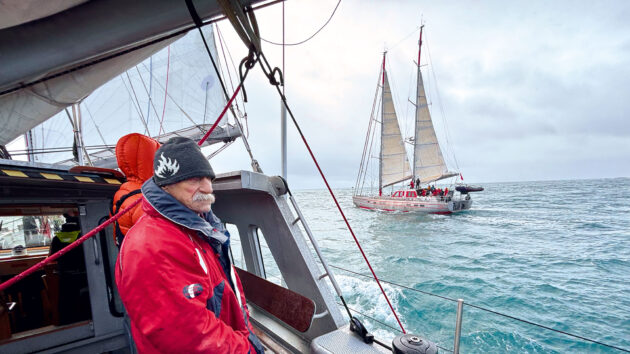
Vinson ‘match racing’ with Amundsen out of Port Stanley. Photo: Skip Novak
Hamish and Steve had done a recce down the descent the afternoon before and determined that it was steep but doable, although with a joggle on the way down. An easy walk down in crampons, but a different story with 45kg pulks in tow. We had to lower off along a fixed rope, which was unwieldy for some, and we consequently lingered in the operation far too long as seracs were threatening from above.
Once safely on the Compass Glacier we let rip by riding the pulks in luge fashion down to the flat – the most fun of the day. It was 1230 by then so we continued skinning on an undulating surface for another two hours and camped alongside the second moraine.
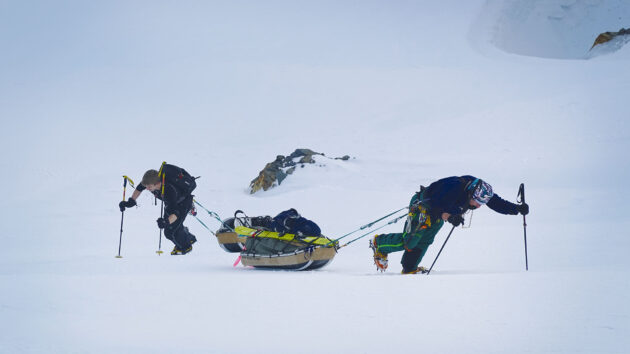
Luca and Skip struggling with towing their pulks up to the Razorback Ridge. Photo: Skip Novak
The next day, after passing the wrecked Wessex helicopter from the 1982 Falklands war (read Operation Paraquat and Across an Angry Sea) – which had moved 450m down slope with the glacier since I logged the position in 2006 – we had to forego camping below the Caird Nunatak, sadly.
The forecast for day four was bad so the consensus was to carry on down the Turnback Glacier to the beach at Anchorage Bay and camp there. This is where Shackleton, Worsley, and Crean tried to descend but were met with a sheer glacial front ending in the sea.
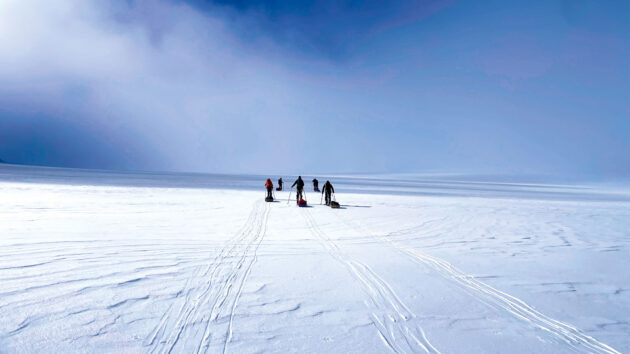
Slipping through the narrow channel in Bird Sound. Photo: Skip Novak
Today it is the normal descent route for various parties doing the traverse as it is an easy down-and-out – for us nothing more than an ice tongue covered in what was left of the winter snow.
Luca’s moment came at the beginning of this descent near the Caird Nunatak. He was on a split snowboard – no problem on the ascents but hard to imagine descending with a pulk.
It was a Bart Simpson moment, he took off and immediately zoomed past me, sitting on his pulk looking very smug and relaxed, the snowboard edge steering his direction of travel. He must be the first to do the Shackleton Traverse on a snowboard, but as he later said, “A first of absolutely no consequence.” I was more impressed by that statement than the actual first.
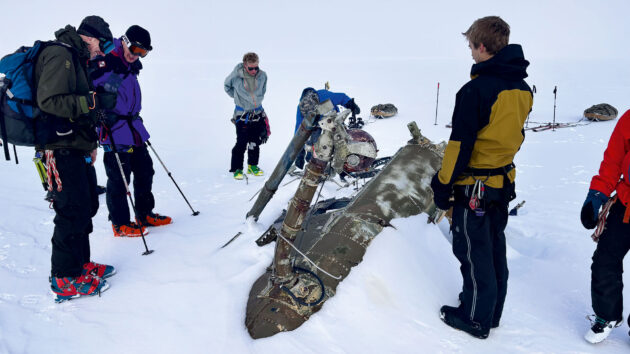
Wreckage of a Wessex helicopter which crashed while taking off in a blizzard during the Falklands conflict of 1982. Photo: Skip Novak
We camped late that afternoon on the edge of the outwash plain, behind a buttress to avoid any katabatic winds coming down the Turnback. Next day we were happily tent bound in the pouring rain brought in from a strong northerly airstream. Lara, Luca, and I were comfortable in our bags, reading.
Frankly, I was not adverse to a day off. Vinson was just around the corner at Husvik, a terrible temptation to reboard for some, but we held firm, not wishing to break the spell of our journey.
Shackleton to Bart Simpson
Next day we skinned back up the Turnback Glacier and over the Breakwind Ridge where Shackleton, Worsley, and Crean could see the recognisable ‘zed stone’ on Busen Point – a folded strata above Stromness Bay. When they heard the early morning whistle calling the whalers to work here, they knew they’d made it.
It’s an historic part of the journey but few people do it. Again, 14 years ago we’d pulled pulks across, easily skiing them down. The vestigial glacier on the east side of the ridge is about gone. Consequently, the descent has steepened off and the exit ravine below is gnarly, with rockfall threatening from above.
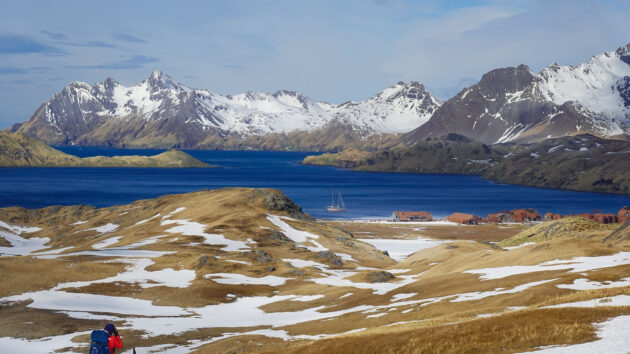
Vinson of Antarctica anchored off the abandoned whaling station at Stromness Bay on South Georgia’s north coast. Photo: Skip Novak
Without gainsaying Shackleton, Worsley, and Crean in the least, this famous traverse is still worth doing, but it must be kept in mind the terrain bears little resemblance to what it was in 1916, let alone in 2011. When you read Shackleton’s South keep that in mind.
On 19 September we took the tourist route from Fortuna Bay to the whaling station at Stromness (‘The Last Day of the Shackleton Traverse’, the description found in any cruise ship brochure touting the island). Nevertheless, it’s a great day out, especially with Vinson of Antarctica waiting for our return, jogging off the beach at Stromness.
The next morning we were off to Stanley to meet that cold front which could not be avoided. No matter, this is what Vinson was built for.
 If you enjoyed this….
Yachting World is the world’s leading magazine for bluewater cruisers and offshore sailors. Every month we have inspirational adventures and practical features to help you realise your sailing dreams.Build your knowledge with a subscription delivered to your door. See our latest offers and save at least 30% off the cover price.
Note: We may earn a commission when you buy through links on our site, at no extra cost to you. This doesn’t affect our editorial independence.