


Nautor’s new Swan 51 offers a world of extra space, but does it still handle like a thoroughbred? Toby Hodges heads to the Med to find out
Swan 51 review: A new generation of performance cruising

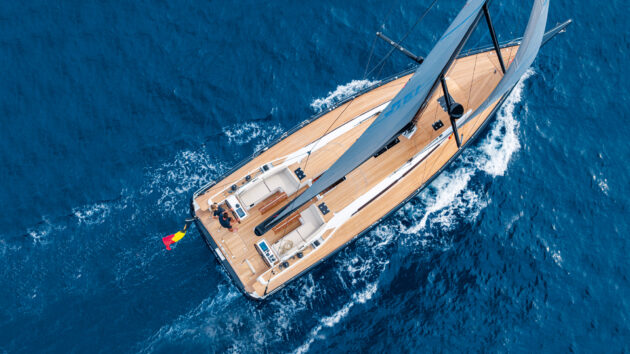
In 1981, Nautor launched its first German Frers design, a Swan 51 that sparked one of the most successful designer/builder relations in yachting.
Yet today’s version (by the same team) is a world apart. Since that original design, with its traditional soft entry, compact aft cockpit, tucked-in stern sections and wineglass transom, volume has swelled astronomically. So much so that the new 51 could probably swallow its original ancestor twice over in a nautical game of Pac-Man.
And yet the new 51 is still arguably one of the most elegant Swans in years, and looked every inch the fast cruiser of today as it made a fitting debut at the Cannes Yachting Festival before we boarded it for sea trials in Saint-Tropez. Times have changed, and while Swan is one of the best at pivoting with them, the obvious question remains: can you add all that volume and still get a premium performance cruising experience?
Normally, light winds for such a trial would be frustrating, but for this type of vessel, they helped evaluate that question.
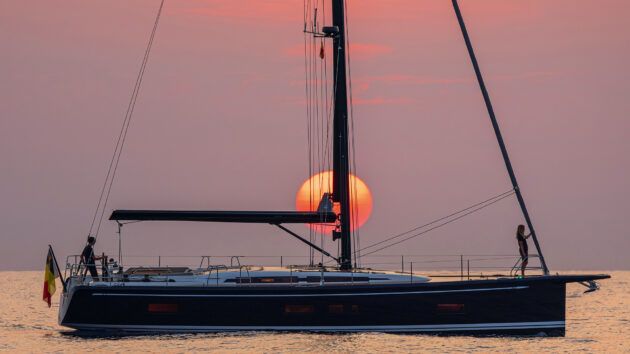
Photo: Stefano Gattini/Studio Borlenghi
Evolutionary gains
The 51 is the latest in the new generation of Frers models, so it benefits from the top-down learnings of the larger Swans. Despite the big boat mentality, it’s designed for couples to manage and cruise.
On the face of it, the 51 may look quite similar in style and layout to the six-year-old 48, but there are big gains in volume here too. By replacing the 48, it also means this €1.45m 51-footer is now the entry-level Swan offering.
Not that that has prevented sales, with four orders taken pre-Cannes, and another five straight after.
I joined the 51 for trials during the last Swan regatta of the Med season. The owner of Vesper, this first 51, was also the owner of the first 48, and he cruises his 51 while campaigning a ClubSwan 50. The main advantages of the 51 over the 48 – space and stowage – are immediately confirmed by his and fellow owners’ feedback. Key stats include 80% increased sail locker space, 85% extra fuel tankage, and a 137% larger tender garage.
“We built 62 of the 48, so we got a lot of feedback from those owners,” head of product Vanni Galgani confirmed. “Storage was the main request.” The 51 offers over 20% more volume and 35% more stowage.
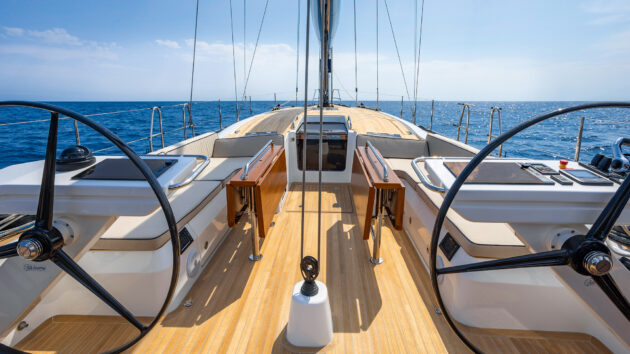
Very clean deck lines are typical for Swan today. The twin tables link to offer generous dining space. Photo: Stefano Gattini
To provide this extra volume, the hull shape is wider and higher, but Frers kept it narrow below the waterline to promote a faster, more powerful hull that should still leave a clean wake. The design team also worked hard on the aesthetics to help disguise the higher freeboard, including a lower, slimmer coachroof, rounded transom corners and curved toerail. “A Swan should be feminine, a she, sexy,” thinks Galgani.
Frers also brought the mast further aft to enhance performance and balance, the latter helped by equalling out mainsail and genoa sizes. An additional benefit is the bulkheads are further aft, creating more space in the sail locker and allowing a wider headboard end to the master cabin. This sail locker is a practical longitudinal shape too, providing 2m length to help accommodate modern furling offwind sails.
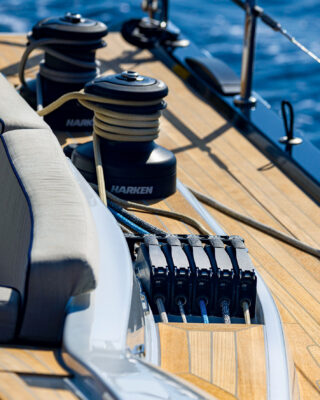
The coamings flare outboard to keep cockpit beam and house sheet leads, but the winch layout may divide opinion. Photo: Stefano Gattini
The surprise top trump
Vesper’s owner is very happy with the design, saying it’s a little slower to accelerate than the 48, but then produces faster speeds and seems very well balanced. Nevertheless, the key advantage over the 48 for him has nothing to do with performance, rather the gains in fuel tankage (650lt over 360lt).
His reasoning here is that the Mediterranean can often be windless and you can be motoring for long spells. Additionally, the harbours are full, so fuel is the currency you really need for independence (avoiding the need to re-fuel on busy docks) – plus a good tender to get in and out of the harbour.
The tender garage is the same glassfibre shell of the Swan 58, so it can easily swallow a 2.8m inflated dinghy.
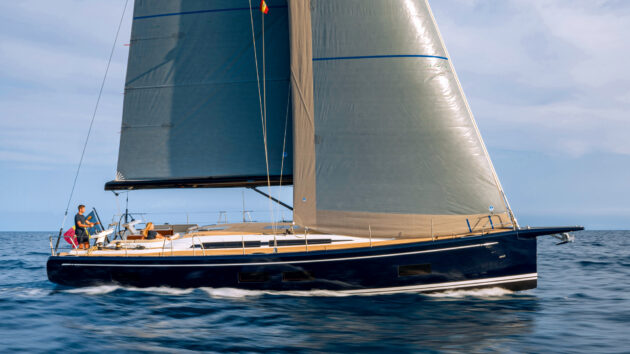
Long lines on a powerful hull. A low coachroof helps keep an elegant aesthetic despite the 51’s high freeboard and volume. Photo: Stefano Gattini
Idyllic scene
Despite these advantages in powered propulsion, a Swan’s sailing prowess obviously remains top priority. Nautor’s takeover of the old harbour of Saint-Tropez made for quite the sight, while docking out from here and sailing in its Gulf would be a magical experience for most. But to business – how does the 51 sail?
After a breathless morning, a whiff of the forecasted breeze arrived on cue at 1300. Shadowing the start and sections of the Swan cruising ORC division race proved a useful exercise as we could line up against nearby other models. Interestingly, we didn’t seem to lose out in pointing or speed to a 58, for example.
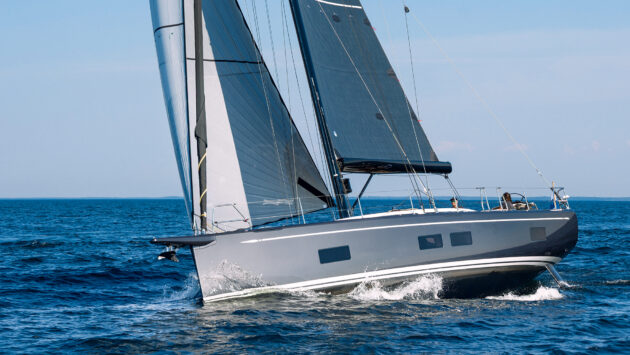
A Code 0 on a powered furler provides pushbutton horsepower and helps boost enjoyment in the lighter breezes. Photo: Eva-Stina Kjellman
Immediately telling is the reactivity of the 51, and the instant control it provides. The twin rudders have been mounted further outboard for more grip, and set in recesses so the leeward blade is exactly vertical at 20° heel – not that we reached that angle, but Swan considers this the optimum heel angle to windward.
In the light, single-figure breeze, we averaged around 5 knots under genoa, while with the Code 0 unfurled we’d typically make one knot beneath true wind speed. Once the wind increases over 6 knots it makes a big difference to the feel and enjoyment. However, I found the helm connection of the test boat a little too stiff, with the chain too tight for the type of single-finger steering you crave in such conditions.
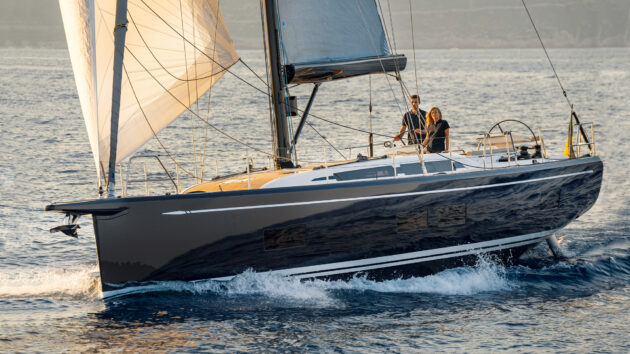
Narrow waterline beam brings some slippery quality. Note how the large hull ports blend into the dark hull. Photo: Stefano Gattini
The Jefa linkage can be adjusted, but the compromise would then be more wheel adjustment needed for the same control.
In terms of figures, the Swan 51 will match or near match windspeeds up to 6 or 7 knots, and at some angles exceed them. Once into 8 knots, it makes around half a knot less.
Despite being laden with crew and cruising supplies, Vesper was well equipped for extracting performance, with little expense spared on sails and rigging options. These include an Axxon carbon mast, an ergonomically-shaped Mainfurl boom furler, a removable staysail, a high-speed Seldén-powered furler for the Code 0, and a gennaker set off the pointy end of the steel reinforced bowsprit.
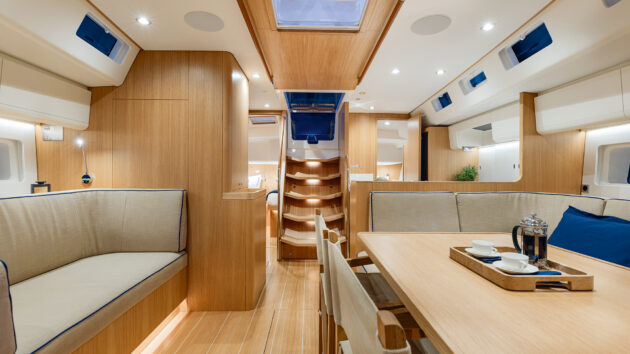
Generous saloon, larger galley worksurfaces and increased natural light all help elevate the 51 over its predecessor 48. Photo: Eva-Stina Kjellman
Hunting the elusive forecasted easterly, we enjoyed a long sail out to sea, averaging 5.5 knots in 7 knots at 32° to the apparent wind, or maintaining 6+ knots at 50° with the Code 0. While nothing electric, it was remarkably pleasant late-season warm sailing.
Command centre
This is a comfortable yacht on which to spend long stints at the helm, whether sitting out to windward or leeward on raised coamings. I recommend the optional granny bars behind the wheels, which offer a nice perch when standing at the helm, plus some peace of mind given the open transom.
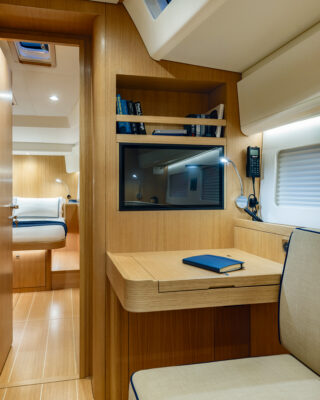
Forward facing chart table is a practical option. Photo: Eva-Stina Kjellman
On this note, the guardrails don’t feel high enough – at 62cm, they may pass the minimum requirements (and this is common practice for many yards), but I’d rather see ocean class vessels fit higher stanchions and rails as standard.
A hero feature of the deck design is the coamings, which flare outboard as they flow aft, allowing space for a huge leisure zone in the same size cockpit as the Swan 55.
These coamings tunnel the sheet and running rigging leads, before making way for the clutches and winches aft. A deep locker each side then swallows sheet tails but these have surprisingly small lids, so you have to be scrupulous with the order in which you tidy away lines.
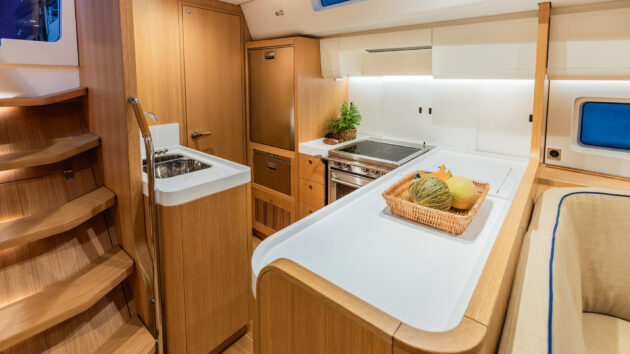
Extra refrigeration space is also offered. Note the curved joinerwork and solid wood fiddles. Photo: Eva-Stina Kjellman
The neat format puts the winches within reach/a stretch from the helm. For those wanting to short-hand, you can use the aft winches only, but the genoa sheet lead aft then becomes a little restricted.
The test boat had remote foot switches for the primaries which helped, however, I still question this winch layout. It keeps them out of the cockpit, but a crewmember has to reach over the aft part of the bench to operate the primary, where they are then beside a loaded mainsheet.
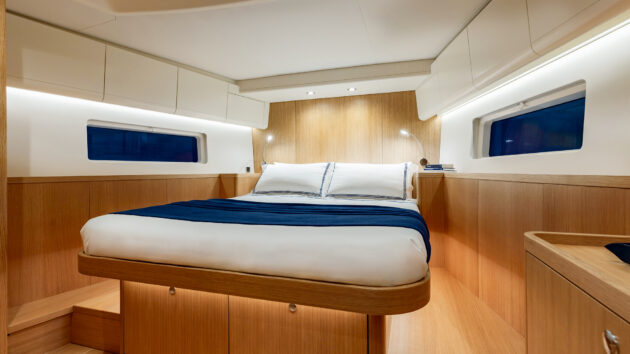
Square-shaped peninsular berth with cutaways each side in the forward cabin. Photo: Eva-Stina Kjellman
No mainsheet traveller option is offered as Swan feels that would compromise cockpit space. Instead, it’s a single-point German-style sheet lead, or a single central winch. This could divide opinion, as performance sailors may want a traveller.
Arguably more importantly, though, is that in my opinion today’s large, fast cruisers should offer a means of keeping the mainsheet out of the cockpit and out of harm’s way. While an arch, as originally mooted on drawings for the 55, is perhaps the optimum solution, one is not currently offered – though since Swan was taken over by Sanlorenzo there are potentially new ranges in the pipeline that may address this issue.
For a premium fast cruiser, the cockpit (and garage) space is impressive. The twin tables are a clever design. They’re multipurpose, so can join to seat an army, but rather than requiring the whole table to lower, just the outboard leaves of the tables drop down to fill in as sunbeds.
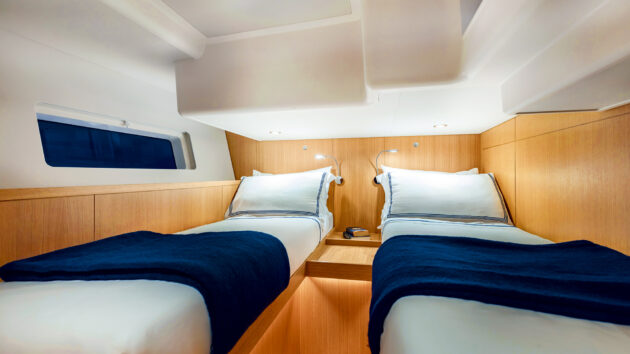
The aft cabins have tall entrance areas and plenty of natural light. Photo: Eva-Stina Kjellman
We sailed without the cockpit cushions in place, which highlighted how important these are for any sort of comfort, as the coamings and backrests are very low. Soft-top style protection will play a vital role, and for this Swan integrates Sunbrella fabric sprayhood, bimini and awning into the design to ensure they’re not a bolt-on extra detail.
Another, more generic critique of modern Med-style cockpit designs which applies here is the lack of anywhere to stow anything temporarily! With no table compartments nor alcoves in the coamings, there is nowhere to put your camera, drink, or Binoculars.
Swan 51 specifications
LOA: 16.90m 55ft 5in
LWL: 14.67m 48ft 2in
Beam: 4.85m 15ft 11in
Draught: 2.45m 8ft 0in or 2.10m 6ft 10in
Displacement (lightship): 18,000kg 39,683lb
Engine Yanmar: 80hp 58.8kW saildrive
Water: 500lt 110gal
Fuel: 650lt 143gal
Sail area/displacement ratio: 21.1
Displacement/LWL ratio: 159
Price as tested: €2,035,000
Design: German Frers
Builder: nautorswan.com
 If you enjoyed this….

Yachting World is the world’s leading magazine for bluewater cruisers and offshore sailors. Every month we have inspirational adventures and practical features to help you realise your sailing dreams.Build your knowledge with a subscription delivered to your door. See our latest offers and save at least 30% off the cover price.
Note: We may earn a commission when you buy through links on our site, at no extra cost to you. This doesn’t affect our editorial independence.
Verdict
German Frers describes the Swan 51 as a ‘pure sailer, more a sportscar than a limousine’. I’d add ‘convertible/cabriolet’ to that automotive comparison as its shallow deck, large cockpit and tender garage more suit the Med vibe over ocean voyaging. But this is the Swan of today’s times. It’s not designed to race around cans or oceans, but to offer a premium warm-weather experience. While I did find some niggles, it’s easy to see how this model will appeal to past 48 owners and could also steal some potential clients of the recent 55 and 58 too, as it has much of the former’s deck space, while the latter is arguably a little large and powerful for a couple to handle comfortably. The 51 is a comparatively easy boat to manage and manoeuvre, yet still offers that delectable taste of Swan performance and prestige. So, in a new era for Nautor, where its Italian ownership is set to build its biggest Swan superyachts ever, it begs the question, is a €1.5m Swan ‘entry level’ in 2026? Hopefully, this means a smaller cruising Swan will follow in time to help encourage younger owners into the brand.