



Life at sea is becoming increasingly popular viewing on the small screen, with a number of hit European reality TV series set on yachts. But why are ocean passages such an interesting concept for television? Amy Bell investigates
Should you be invited to be one of a group of 12 strangers sailing across the Atlantic ocean on a small yacht – and you’d all be filmed during the entire month-long voyage – would you say yes?
For Juanjo Zarate, it was an easy decision. “El mar, el mar… it was tremendously tempting,” says the 82-year-old. “Being brave and taking risks in life is essential. That’s what I tell my children and my grandchildren.”
But neither he, nor the rest of the group, had much idea of what to expect. Aside from the professional captain and first mate, the rest of the crew’s sailing experience was almost nonexistent; they were simply there because in the weeks beforehand each person had happened to meet Spanish director Miguel Ángel Tobias in the moment he was looking for people to take part in a new film.
The idea was to see what happens when you put a group of people who have never met before on a boat in the middle of the ocean. Having long dreamed of sailing across the Atlantic, Tobias was inspired by his discovery of the work of Santiago Genovés, an anthropologist who in 1973 led a transatlantic voyage on a balsa wood raft as a study of human behaviour.
In the weeks leading up to departure Tobias decided to ask the first people he met that he felt should be on board, and ended up with a group ranging in age from 17 to 80 – all of them men, which he says was coincidental – and from different backgrounds.
Photos: Över Atlanten/Kanal 5
“There was no casting,” says the director, who is known for films and documentaries focusing on inspiring life stories, such as El Camino Interior, which follows people walking the famous Camino de Santiago after going through profound personal transformations.
“I didn’t know anything about their lives, but I had a lot of trust. I’ve filmed around the world in war zones, catastrophes, earthquakes, and I’m used to filming without a script… you don’t know who the characters are going to be until you get there,” says Tobias.
“But every human being has a story that deserves to be told.”
Mid-ocean creates a unique environment for an anthropological documentary, above all because the isolation is ‘incomparable’, he explains. “On the boat there’s no escape, you can’t leave”. Aside from navigational devices, it was also a month-long disconnection from technology. “You are totally trapped in this cascara de nuez (nutshell) that demands introspection because, apart from the sailing manoeuvres, there’s nothing else to do.”
Photos: Över Atlanten/Kanal 5
Reality bites
The 3,070-mile passage was far tougher than the director ever imagined it would be. They’d estimated it would take about 20 days on the chartered Puma Cubic 70 yacht Costa Nord, but it turned into 32. There was no wind from the Canaries to Cape Verde, where they had to stop for two days for repairs, and then hit a big storm just before arriving in Martinique.
It was a testing experience, not least because nearly everyone was seasick for most of the crossing.
A serious injury the day after departure – when a spinnaker pole detached and hit a member of crew on the head, cutting his face open – brought the seriousness of what they were undertaking into sharp focus.
Fortunately they were close enough to return to land for urgent medical attention, but they had to quickly adjust to the awareness that an accident thousands of miles from land could be life-threatening.
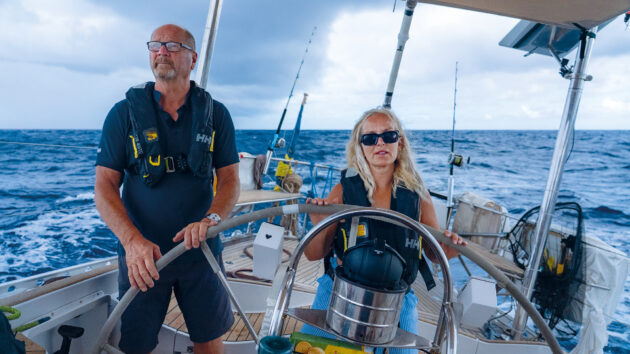
Över Atlanten skipper Gurra Krantz at the wheel of Adrienne II with Swedish actor Eva Röse. Photos: Över Atlanten/Kanal 5
Challenges such as seasickness and tough weather conditions forced the crew to embrace uncertainty, says Tobias: “To accept what happens and let it go; let go of this false sense of control we think we have all the time.”
Leadership qualities
The voyage revealed the strengths of each person on board and they all showed leadership at different times. Zarate, for example, who had been worried about whether he would be physically up to the trip, found that he could handle the conditions better than many and ended up cooking every day for the crew, when seasickness meant no one else could stand being down below.
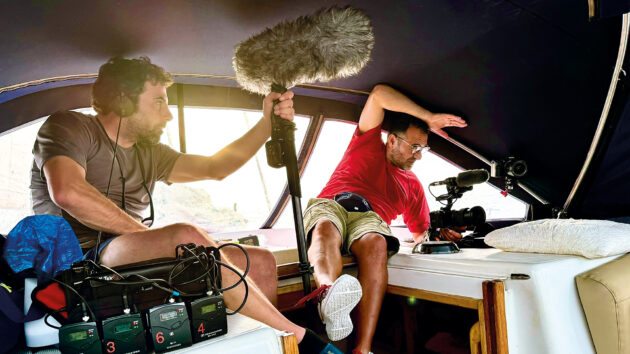
Also afflicted by seasickness, Tobias and his cameraman had to take it in turns to film. “It was hell. But on top of that to have to film a documentary… your head isn’t clear,” he says.
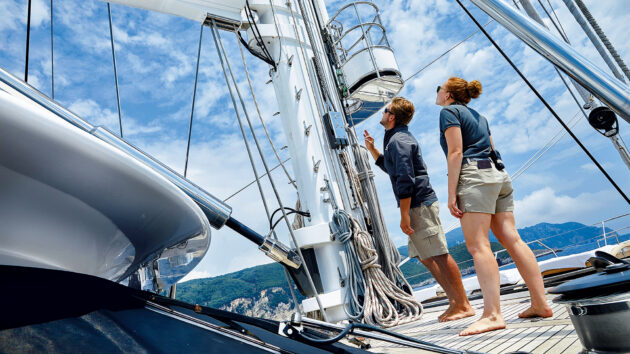
The ‘scripted reality’ series Below Deck, and its spin-off Below Deck Sailing Yacht regularly attracts viewing figures in the millions and has helped launch lucrative speaking and YouTube careers for some of its star crew. Photo: Över Atlanten/Kanal 5 Bravo Media/Getty
Tobias was struck by the way the crew always acted with “generosity, solidarity, looking out for one another”, which he saw as testament to his theory that generations “don’t exist” and that “when we come together we can achieve great things”.
Differences between them, which on land might have caused divisions, were exposed as superficial. “In those circumstances you realise that they are absurd. Everything falls away and what’s left is the human being,” he says.
Offshore sailing is a challenging thing to film: the set is constantly moving, space on board is very limited. Yet it holds a unique appeal for filmmakers looking to see how people respond to being in such an extreme environment.
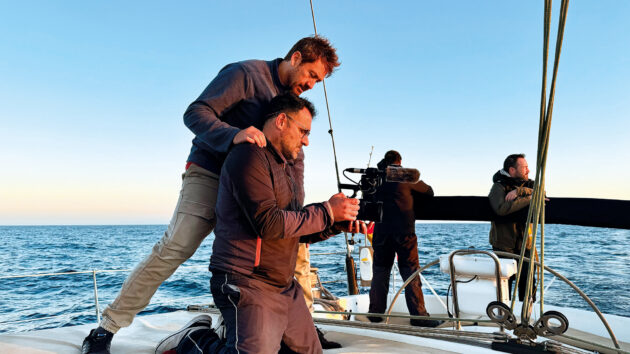
Tobias and his cameraman documented the experiences of 12 novice crew on an Atlantic crossing. Photo: Miguel Ángel Tobias/Cascara de Nuez
Popular format
The Swedish television series Över Atlanten, which takes groups of celebrities across the Atlantic twice a year, has proved so popular that it’s now in its 12th season. The format has also been remade in Denmark, Norway, the Netherlands, Belgium and Poland.
Gurra Krantz, a four-time Whitbread/Volvo Ocean Race sailor and lifelong racer, says that when the producers first contacted him in 2018 to see if he’d skipper the boat for the first Swedish series, building on the success of the original Finnish version, his answer was “absolutely not”.
“For me, sailing has always been racing,” says Krantz. But his wife changed his mind by suggesting it could be fun to try something new.
He found stepping into the world of TV production for the first time a positive experience – the proactive attitude of the film crew inspired him with an energy reminiscent of his early racing days, and the celebrities proved to be “so generous with themselves… you could see why they have been at the top of their game”.
“The format is very simple,” he explains. “We take a boat, put some people in it, leave the dock, sail across the Atlantic. When things happen those things are being recorded and then people edit the whole thing and produce nine episodes.”
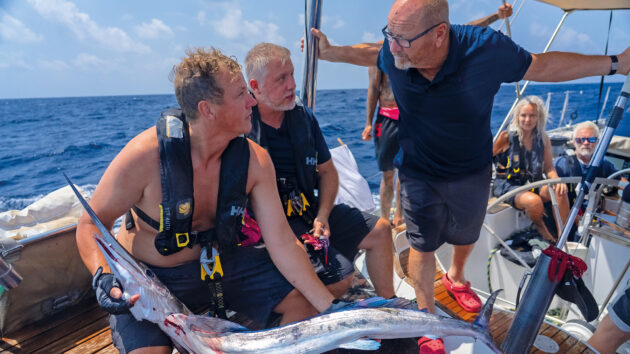
Krantz imparts some of his extensive ocean crossing knowledge to Swedish celebrities on the hit TV reality show Över Atlanten. Photo: Över Atlanten/Kanal 5
The passage generally takes 17 days. In January they sailed from Gran Canaria to Saint Martin, then again in August to Salvador. There have been rough conditions at times, but they try to avoid anything above 35 knots and waves above 3.5m.
Initially the producers rented a boat for each season, but after various complications Krantz bought his own – a Swan 65 extended to 70ft, with a carbon mast and a new keel – which they have sailed for the series since Season 5.
Positive adventure
There are 13 in total on board: Krantz has two watch leaders with him, plus four film crew and six celebrity participants – some are social media stars, others have had long careers in theatre or music, some are former athletes.
As with the Spanish film, the producers of Över Atlanten are not looking to stir up drama with the people they choose. “This is not the TV show for controversy, where you vote for who we’re going to drop in the water,” says Krantz. “It’s actually an adventure, built on positive attitudes rather than anything else. I think that’s part of the reason why it has become so popular in Sweden.”
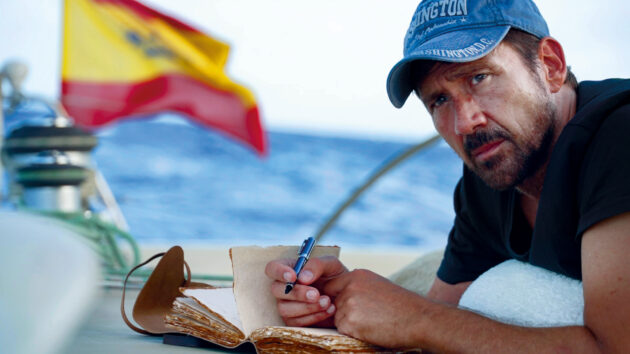
Film-maker Miguel Ángel Tobias chose as crew the first people he met who he felt should be on board for his documentary without auditions. Photo: Miguel Ángel Tobias/Cascara de Nuez
To set the tone from day one, Krantz says he often starts with a question, to get everyone thinking about how they should work together: “I ask, ‘What do you do if you feel like a coffee, what’s the first thing you do?’ And they usually say, ‘Well, I go and put the kettle on’. I say ‘No, you ask the rest of the crew, does anyone else want coffee?’.”
The safety briefing is also crucial and the professional crew need to be on their toes, he says. “Every little moment on that boat, there is a hazard around the corner”. Taking time to teach manoeuvres without rushing, for example, is important.
There have been small accidents – such as burnt arms from the coffee machine tipping over. “We tell them the boat is heeling over but they still don’t understand what that means in practice in the galley, and keep putting the cups back on the same wrong side.”
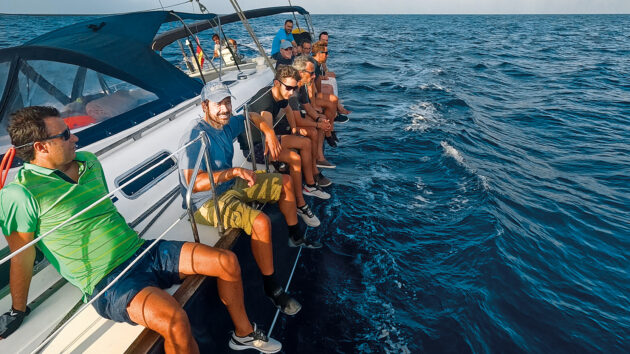
Miguel Ángel Tobias says by coincidence all crew were men. Photo: Miguel Ángel Tobias/Cascara de Nuez
But it is rewarding to see the transformation, how the novice sailors pick things up throughout the voyage such as steering. At first most stare at the numbers on the screen and oversteer wildly, he says. But 10 days later they might be at the helm telling a story, keeping their course “without paying attention to the numbers other than they check what they’re doing”.
No filter
Krantz also observes that the experience on board strips people right back to their personality, and “you see immediately who they are”, and most importantly, “do you care for the others or do you care for yourself?”
For some of the celebrity guests, not having a mobile phone is the biggest challenge. “They have to be here and now on that boat, the horizon, nothing else. They cannot be with their mind ashore,” says Krantz, “but it can take a while to adjust.”
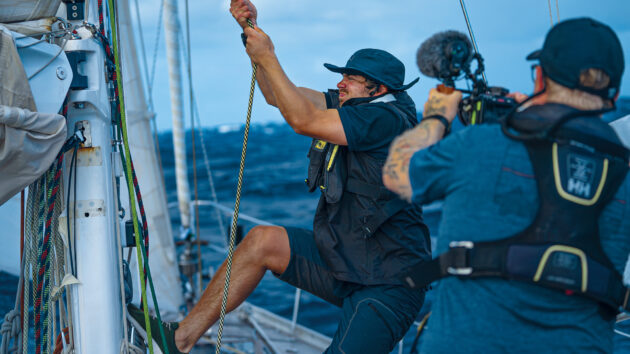
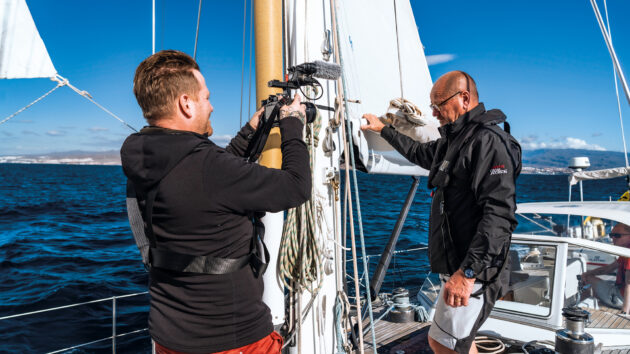
Fixed cameras are set up around the boat, the film crew have handheld cameras and there’s a sound technician. There are two watch crews and the celebrities get involved in everything: hoisting and lowering sails, steering, cleaning the boat and cooking.
Over the seasons several interesting characters have taken part. Krantz recalls Olympic champion cross-country skier, Thomas Wassberg. “He’s from the north and they don’t talk much, so it took us 17 days to get across and 17 words later we arrived.”
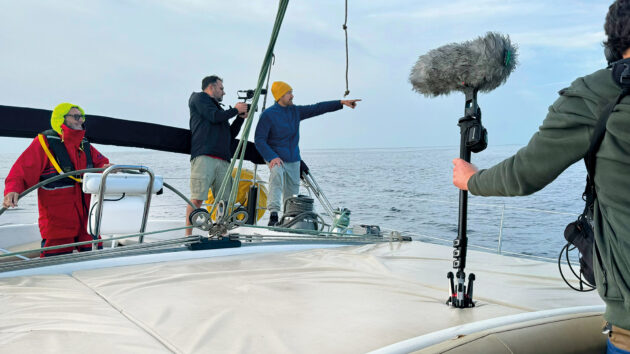
Photos: Över Atlanten/Kanal
“The TV people said, ‘Thomas, remember this is a TV show. Please start communicating, do you mind?’” And all he said was ‘yes’.
But strong bonds have been formed on the passages. Ultimately, people are interesting, and the ocean reveals things about us in the most raw form. It doesn’t need overthinking, says Krantz. “Take a boat, put people in it, leave the dock, things will happen.”
Life-changing
For the crew taking part in the Spanish documentary the experience was transformative. They all arrived in Martinique wanting to make big life changes. None wanted to repeat the experience, but it brought them together in a way that would be impossible to achieve in any other circumstances, says Tobias.
“We talked about life, death, pain,” he adds. “We left the Canary Islands as 12 strangers, and we arrived in America as a family.”
 If you enjoyed this….

Yachting World is the world’s leading magazine for bluewater cruisers and offshore sailors. Every month we have inspirational adventures and practical features to help you realise your sailing dreams.Build your knowledge with a subscription delivered to your door. See our latest offers and save at least 30% off the cover price.
Note: We may earn a commission when you buy through links on our site, at no extra cost to you. This doesn’t affect our editorial independence.