


No-nonsense aluminium explorers with centreboard and doghouse already give Boreal a commanding niche, so why a scow bow on this unstoppable Boreal 56?
Boreal 56 review: Aluminium explorer yacht with a scow-influenced shape

When it’s blowing a gale and it’s hard to even see outside for the horizontal rain or, worse, sand being whipped off the nearby beach, there’s little appeal in going afloat. But if you were to choose one yacht to board in such conditions, even if just to stay in the marina… it might well be a Boreal.
Equally, with more and more floating debris contaminating our oceans, and marine wildlife increasingly (and literally) biting back, you can understand the increasing amount of new cruising yacht buyers seeking belt and braces builds. They may never need that diff lock, get-out-of-trouble functionality, but it’s certainly reassuring to know it’s there.
For those unfamiliar with Boreal Yachts, these are not simply aluminium tanks for off-piste cruising. They prioritise performance and are packed with intelligent ideas which can only be the brainchildren of true ocean sailors, mostly from its founder Jean-François Delvoye.
And so I found myself navigating a precarious pontoon in IJmuiden, Holland, in a strong mid-September gale and scaling the high and bulletproof-looking freeboard of the new Boreal 56. We were conducting European Yacht of the Year trials, the first day and a half of which were lost to the unseasonable weather.
I envisaged a cosy interior, the stove lit, maybe a sauna or some mulled wine on offer, but the notably bright, raised saloon and roomy accommodation will likely appeal to the majority in more agreeable weather. Seated at the table, laptop and drawings at the ready, was the perfect person to explain the genesis of this 56.
Delvoye spent six years cruising with his wife and four children, including two years in Patagonia, a period which really forged his thoughts on the optimum cruising yacht. He had the skills to transfer these visions into 3D drawings, which became the first Boreal 50 (20 years ago). Boreal has since built 113 yachts from its Treguier yard, with up to 12 in construction at a time, and – remarkably in today’s climate – currently has a three-year lead time!

‘We tried an extreme bow shape and it worked’. Photo: Jean-Marie Liot/Boreal
Nose job
The 47.2 was a European Yacht of the Year award winner in 2021, and we tested the 52 a decade ago, so we already know and respect Boreal. They are ballasted centreboarders, bare aluminium cruisers that sail well and offer the protection of being able to stand watches from the forward part of the cockpit or within a raised doghouse. They offer a mix of robust construction with keen attention to sailing motion.
This new 56 shares many of the upgraded features the 47.2 exhibited, especially the desire for a separate crew cockpit layout on a larger model. Then came the novelty: the scow bow influence.
Surely that IMOCA/Class 40/Mini 6.50 scow phase is just a fad? You can see why production yards have been trying fatter noses, but that’s principally for the extra volume it brings? Delvoye insists the shape works on multiple levels, not just for this increased volume, but also the power and stability it brings.
“When doing the initial design, we did a lot of hull shapes using our software,” he explained, using visuals from his computer.
“We tried an extreme one [bow shape] and it worked.” They then built a 10% scale model and tank-tested it before asking Bureau Veritas to run it through their software, which also confirmed the positive results.

Clean design leads lines and winches to hand for the helmsman. You feel protected everywhere with solid grabrails to hand. Here around the pedestal. Photo: Jean-Marie Liot/Boreal
“We had seven orders [at the time] for a 55 open cockpit model, and all changed to the 56!” Indeed, Boreal took 10 orders by September, before any shows or publicity. The boat we tested was the second 56 to launch, and splashed the week before our trials.
It’s not simply that fat stem, nor the chined plated purposeful look which defines this model – what lies beneath a Boreal’s waterline is equally intriguing and defines its handling characteristics.
A long keel trunk or ‘embryo’, as Boreal calls it, contains the centreboard, the ballast (6,600kg), and provides a level grounding plate on which to dry out. The swinging board is NACA profiled, ballasted with 400kg of sand to ensure it will sink, and can be raised from its 3.2m draught in five seconds.
This embryo protects the prop shaft and single rudder while, unusually, there are also two lifting daggerboards aft, either side of the rudder. These boards extend 70cm out of the hull and are designed to help provide some of the grip that twin rudder yachts enjoy, while also maintaining the benefits of a protected single rudder yacht that can dry out.
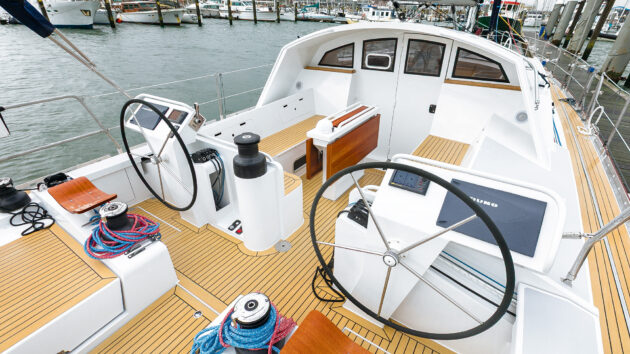
Comfortable, clean helm areas. The central utility winch can be used to do all the heavy work. It can raise the centreboard in five seconds, while simple manual lines on camcleats are used to control the daggerboards. Photo: Jean-Marie Liot/Boreal
Theory to practice
By the third day the wind had dropped to a Force 5-6, and a 12-strong EYOTY jury was itching to try out the 56. The North Sea swell was still large, confused and inhospitable, making for testing conditions. For my first sail we punched out to sea under single reefed main and genoa in 20 knots, making 7.5 knots at 45° to the apparent wind.
Once the wind is above 20 knots or so, Boreal favours changing down to the staysail, which we then did, for no tangible loss in speed. Equally, I noted that once the breeze dropped to 17-18 knots, the log slipped to 6-6.5 knots, and the yacht felt underpowered, so its ability to change easily between these headsail gears is useful.
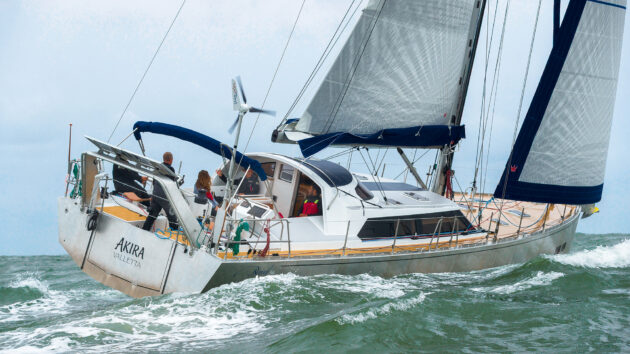
We had plenty aboard for the trials but the Boreal didn’t feel overcrowded. Note the position under the doghouse, completely protected for de-robing before entering. Photo: Jean-Marie Liot/Boreal
During my second sail, we had a spell of 25 knots under staysail, which felt right, sailing with slightly tighter pointing for a bit less speed compared to the genoa.
It was the comfort, protection and motion this Boreal offers that really stood out during sailing in inhospitable short pattern waves and driving rain. You could choose to take it on the chin on the helm, seek protection in the forward part of the cockpit or, if sensible, move into the doghouse! Close the door to this and the comparative silence does the talking.
Motion for the ocean
The soft motion is no fluke, as weight centralisation is paramount. A prime example is the chain locker being located near the mast base (where the windlass is more protected), which helps ensure 400kg of chain is as central as possible. Combining that with 1,500lt water and 1,150lt fuel low and central (in the aft of keel embryo), helps ensure a smooth motion.
Of particular interest was how the full bow shape performed in these conditions. Granted the bows seem to immerse a lot, but I spent some time below decks while sailing upwind in waves and was impressed, both by how secure it feels moving around, with plenty of handrails, and how quiet it is, even in the forward cabin (watching our video for confirmation). Delvoye believes this bow shape actually provides a softer motion through waves when at heel than a pointy bow. That said, if the yacht were more upright, say under engine, you would almost certainly pound more, he concedes.
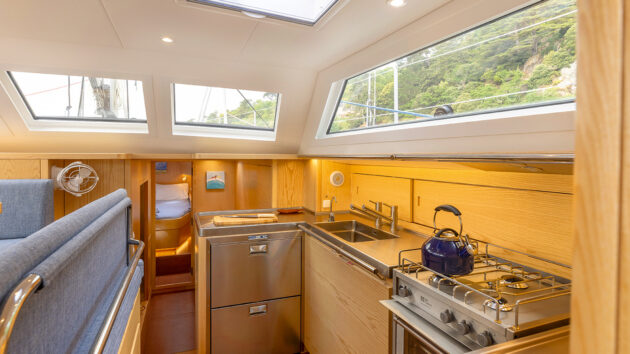
The 56 has multiple hearts, including the longitudinal galley leading to the stove. Photo: Jean-Marie Liot/Boreal
The Boreal is easily controlled, but can be tricky to settle into a groove. As well as the balance of sails, you have to remind yourself of this bow shape, and what’s happening beneath the boat while helming.
For example, the centreboard is not for stability, only countering leeway, while the daggerboards can directly alter the feel of the helm. The boards have a notable effect while on the breeze, where they help keep the yacht on a rail and take a lot of pressure off the rudder, thereby lessening the power needed to drive the autopilot ram.
It’s a playful setup then, where both boards can be left down, or the windward one raised, while you can also adjust the centreboard position when off the wind. This is particularly appealing if you want to surf – having daggerboards alongside the rudder is more like surfboard design where typically three fins are used for grip and control.
Sailing close-hauled in the calmer seas inside the breakwater felt strange for a single rudder yacht with wire steering, I experienced a neutral-slash-lee-helm feel, and would have liked more time to play with the board set up to see how that affects this balance.
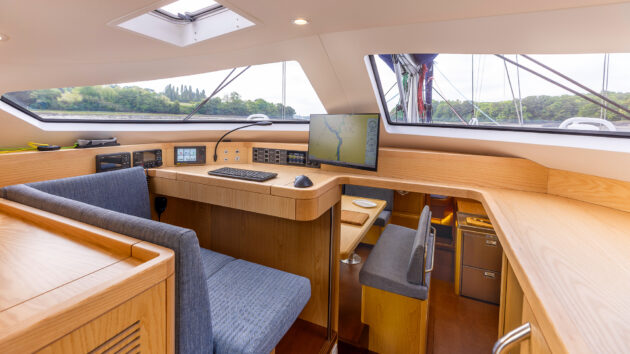
The doghouse reigns supreme for its ideal surround view and protected watch position. The double pilot seat has a lifting section on the inboard end, to help keep you in place on port tack. Photo: Jean-Marie Liot/Boreal
Unleashing the furling gennaker livened things up, especially as I was the lucky one who got to experience this in the best conditions, with 22 knots true, surfing across ugly seas at 100°T/75°A back towards the port.
Where you could expect a moderate displacement single-rudder yacht to really load up on the helm in these conditions, the Boreal proved highly competent, no doubt aided by the daggerboards’ grip. Even with the apparent wind well forward, it remained controlled as we averaged 8.5 knots, hitting 11.5 knots in the surf.
Cockpit comfort
Boreal clearly worked hard on the overall cockpit design and functionality. The layout, principally the separation of guest and sailing areas, is a major selling point, which prioritises the comfort of the helmsman as well as those in the secure cockpit.
‘Boreal clearly worked hard on design and functionality’. Photo: Jean-Marie Liot/Boreal
These are evolutions from the 47.2 though, as we noted when we tested that in 2021, the design stops short of offering a fully protected cockpit. I suggest that could make a valuable option here, as we’re increasingly seeing fully covered cockpits being used on larger yachts.
Otherwise, the cockpit is superb, huge and deep, with high backrests, coamings with really useful, deep outboard stowage, and a large fixed table with long grab rails. This area is all completely free of lines, including the mainsheet, which sheets to the doghouse roof and back to the aft winches.
The helm area again shows where experience has paid. The twin wheels are far enough outboard for visibility to the bow, with sheet winches to hand on each side to ease solo operation. The powered utility winch with remote foot controls proved very useful, as all lines can be led to this central position between the wheels (although that can temporarily block cockpit access). Meanwhile deep, built-in tail bins keep the whole area tidy.
The transom arch includes a crane system for lowering the tender and provides mounting options for regenerative power. The test boat had extra solar panels, a Superwind generator and a Watt&Sea hydrogenerator, providing more power than the yacht could use (the arch would also make a great place to swing a hammock from).
A cavernous lazarette is accessed from the aft quarter lockers, where an inflatable tender can be stowed. Alternatively, a RIB can be lashed onto the wide foredeck. The offset sail locker is also plenty spacious enough for offwind sails.
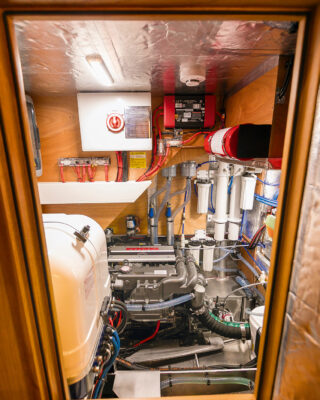
Huge engine room very well laid. Photo: Jean-Marie Liot/Boreal
It feels really sturdy moving forward along the Boreal’s side decks, with long, waist-height rails on the coachroof, support beams for the pulpit, and granny bars at the mast base. In fact, there is something to grab hold of wherever you move on the yacht.
That said, you’ll bang your head on the doghouse roof extension and on the step down from galley to the forward accommodation. While you’ll quickly get used to avoiding those, I did find the gap between the chart table and the companionway base to starboard a concern, as someone is likely to fall down here one day.
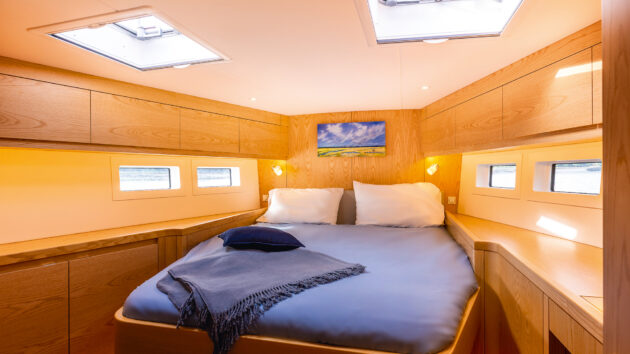
Peninsula double berth with plenty of natural light in the Boreal 56’s forward master cabin. Photo: Jean-Marie Liot/Boreal
In the doghouse
The doghouse is a trump feature. Remove your wet-weather gear under the hard top, hang it in the locker behind the double pilot seat to dry from the heat of the engine box, and sit your watch in comfort. Close the watertight door behind you and you’re in a world of comparative calm – particularly when it’s blowing 45+ knots in the marina.
Boreal is not a custom yard, and views its one layout only as the optimum configuration. Considering the weight centralisation also helps support this format – with tanks and batteries centralised and kept low around the keel trunk, the spaces left under the seats and berths offer really useful stowage.
The majority of its owners are couples, who are on passage for comparatively short amounts of time they spend aboard, so Boreal believes it makes sense to them to have the owner’s cabin forward, where it is away from the dock and noises and can benefit from the space the scow shape helps provide. They can then pick from the saloon or aft berths when on passage.
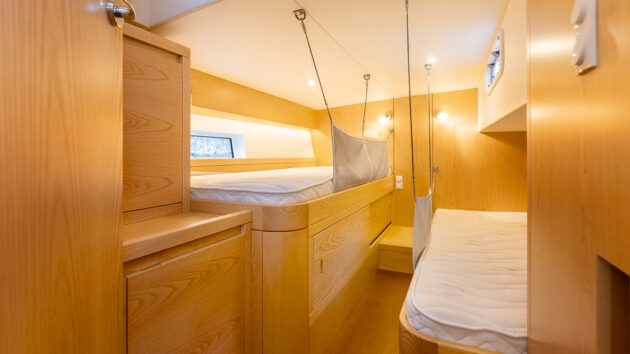
Starboard aft cabin with double and twin berths (with lee cloths) can also be configured with bunks or as a technical workshop. Photo: Jean-Marie Liot/Boreal
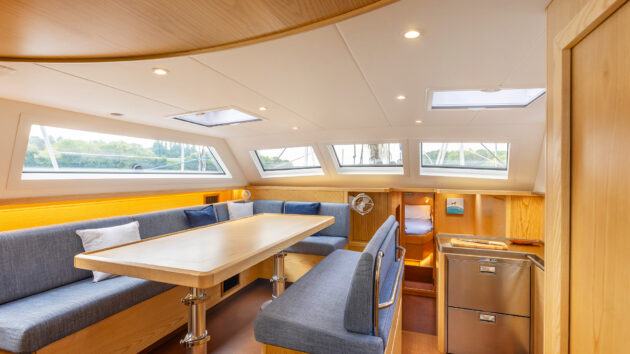
Compared to the old 55, the 56 offers higher saloon seating, from where you can see out properly through the coachroof windows. This long saloon table lowers and converts into a double berth. The galley opposite is also long and spacious, yet with a practical shape.
A countertop return at its forward end contains aft-facing fridge drawers, and together with the island/centre seat, it helps form a near U-shape, offering bracing at heel. It also boasts long, fiddled stainless steel worktops and lots of deep stowage, while extra drawer fridges are available aft of the saloon to port.
Central heating is provided through a Refleks stove that consumes just five litres per day. The disadvantage of these traditional Danish diesel/oil burning systems is they use a flat plate, which is not ideal at heel, admits Delvoye. Boreal also offers an Eberspächer Hydronic system, although these don’t give the same ambience and cost more. Opposite the stove is a long workbench with an optional vice, abundant stowage including long drawers for heavy tools, and space for a washing machine.
The forward master cabin utilises the full bow shape, providing a large peninsula berth. It’s a generous and naturally light cabin, with plenty of stowage, including beneath the berth, but no tall hanging locker.
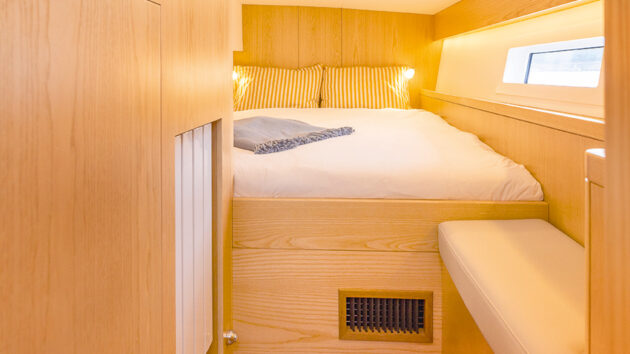
Port aft cabin offers access to the engine room. Photo: Jean-Marie Liot/Boreal
The aft cabins meanwhile feature double and twin berths, both with leecloths and the latter with good separation between berths. This starboard twin can also be configured with bunks or as a workshop/technical cabin. The main access to the superb engine room is through a door in the port cabin, where everything is very accessible, including the watermaker raised up aft, with membranes and filters on the bulkhead.
You also get a good look of the hull construction from here. Boreal always uses the same ratio of plating thicknesses, which allows sailors to visit most waters. For the 56, the keel plates are 12mm, the bottom plates 10mm, while freeboard chines go from 8mm to 5mm. Extruded polystyrene foam lines the hull above the waterline, and cork is sprayed on all the frames – the only place condensation can form is under the hatches, where Perspex covers catch any drips.
Boreal 56 specifications
LOA: 17.12m 56ft 2in
LWL: 14.47m 47ft 6in
Beam: 4.94m 16ft 2in
Draught: 3.18m-1.20m 10ft 5in-3ft 11in
Displacement (lightship): 20,500kg 45,194lb
Ballast (lead): 6,600kg 14,550lb
Berths: 8
Engine: 75hp 56kW Yanmar shaftdrive
Water: 1,500lt 330gal
Fuel: 1,150lt 253gal
Sail area/displacement ratio: 18.9
Displacement/LWL ratio: 189
Price test boat: €1.45m ex VAT (with circa €220,000 extras)
 If you enjoyed this….

Yachting World is the world’s leading magazine for bluewater cruisers and offshore sailors. Every month we have inspirational adventures and practical features to help you realise your sailing dreams.Build your knowledge with a subscription delivered to your door. See our latest offers and save at least 30% off the cover price.
Note: We may earn a commission when you buy through links on our site, at no extra cost to you. This doesn’t affect our editorial independence.
Verdict
You certainly don’t have to go sailing in the type of weather we experienced, but it’s certainly nice to know the Boreal will look after you if you do, and will continue to do so once you’re moored or anchored. With today’s increasing trend for explorer-style aluminium yachts, cynics may wonder if this is just another offering for the current generation wanting a 4x4 just to drive to the shops in. Of course, there will be some owners who may only marina hop and coastal sail such a vessel, but they still do so knowing they have a supremely constructed yacht that will last many lifetimes, maintain its resale value and can, if and when they choose, take them to any waters and depths in comfort. For me, the Boreal offers appealing lines, a practical sailing cockpit and enough focus on performance and handling to be a proper sailing yacht. It’s not the most exciting to helm, but it’ll outperform most others in this voyager sector, while being manageable and giving that prime option of standing a watch from the doghouse. Unsurprisingly, it shares many similarities to the excellent 47.2 in layout, although the 56 will suit those after more space, larger tanks and crucially more stowage for spending longer periods aboard. The bow shape really helps sets this new model apart, both from its siblings and rivals, and it seems to live up to its creator’s predictions during our tests. You could say that for those with far-reaching voyaging aspirations, the Boreal 56 leads by the nose.