




Ferrari Hypersail is a fully electric sailing boat with components from the controversial Ferrari Luce at the heart of this revolution
Give me two wheels any day – I couldn’t care less about cars. At least that’s what I’ve always maintained. But as my wife points out, it only takes the sight of a vintage Triumph Stag to send me down memory lane and when a Grand Prix comes on, everything else in the house stops.
She also reminds me how long I went on about desert rallies after standing in for a fellow TV producer in Dubai and Abu Dhabi. She points out how I wouldn’t stop talking about the technology and tactics and how similar the strategy is to coastal and offshore racing.
Thanks largely to the America’s Cup I’ve been lucky enough to visit a number of the big F1 teams to see how they utilise their technology for the benefit of Cup teams, all of which have sparked conversations at the dinner table.
So I guess it was obvious that I was going to be a bit of a pain when I came back from a very special trip to Ferrari’s famous home of Maranello. And I was.
I’m told you cannot buy a tour of their build facility: the best you can get for cash is a trip around the estate in an official tour bus that begins and ends outside the main gates with no stops in between. So, to get a private tour around this huge, historic and pristine facility was something else – even if it did start with the cameras on my phone being taped over.
The reason for the visit was Ferrari Hypersail, the extraordinary and brazenly ambitious campaign to raise the bar for offshore records.
Article continues below…
Ferrari announces radical 100ft ‘Hypersail’ foiling yacht to take offshore flight to a new dimension
The Ferrari foiling yacht project – named ‘Hypersail’ in reference to Ferrari’s three-times Le Mans winning Hypercar – is being…

Why 50 knots has been beaten but not defeated
The trouble with round numbers is they always feel a bit artificial, especially when we’re talking about limits. Sailing’s so-called…
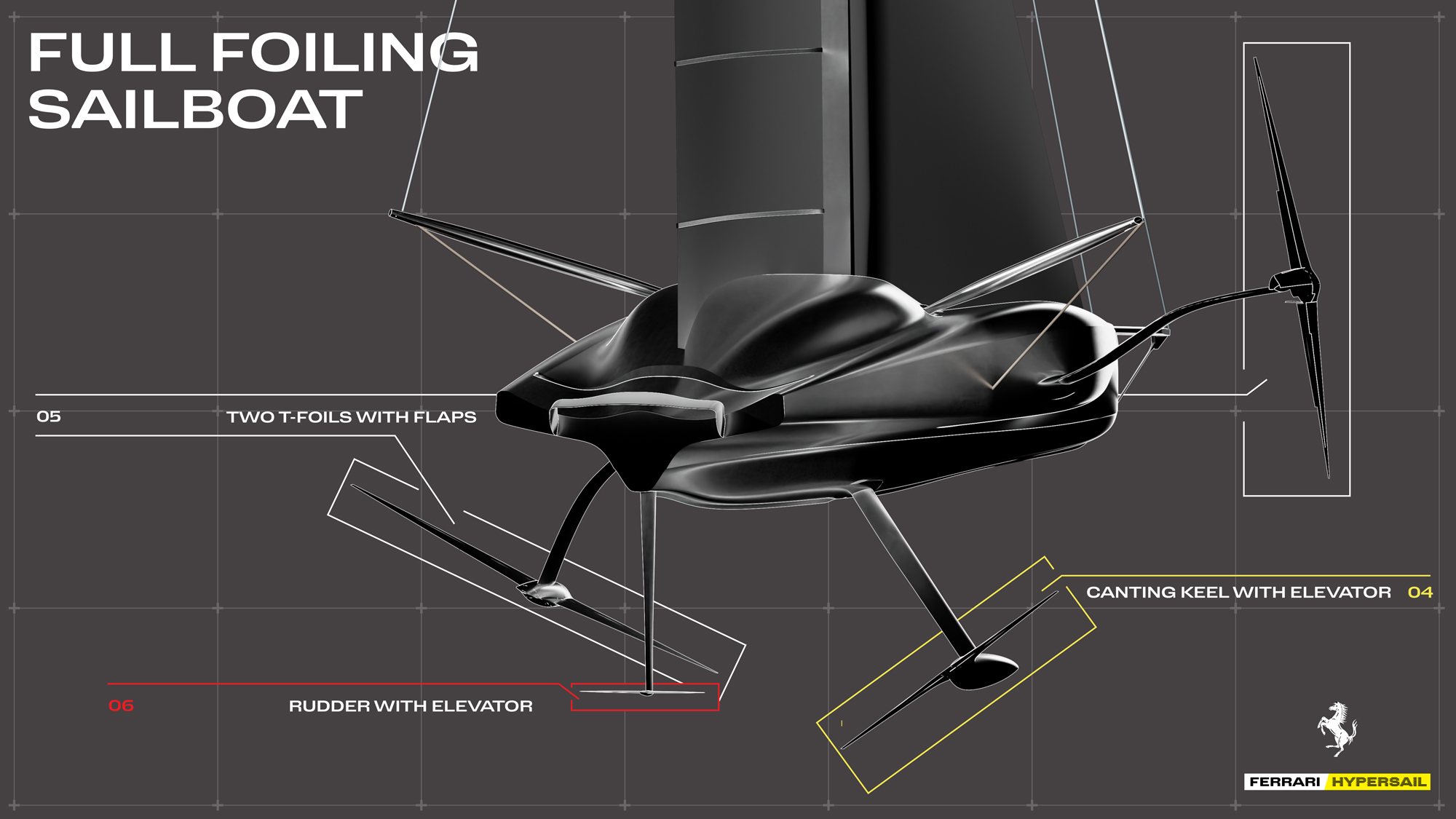
A few weeks previously I’d visited the boat in build at a secret facility close to the west coast of Italy. Next I visited Maranello to see how Ferrari is using technology from its current and future supercars to take this project onto another level.
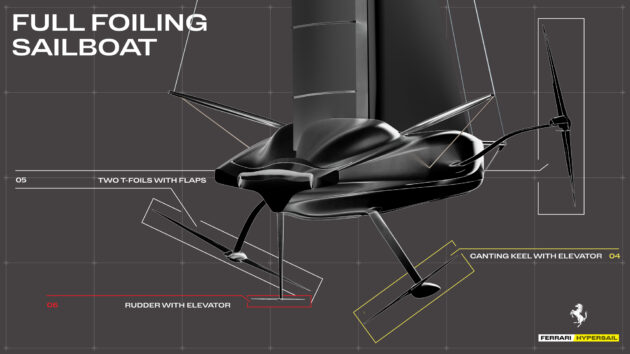
The beating heart of Ferrari Hypersail is the rear e-axle from their controversial electric supercar, the Ferrari Luce, which provides power at one end to drive the prop on the odd occasion that they have to motor, and at the other the power unit for various hydraulic systems.
Ferrari Hypersail is a fully electric boat with no fossil fuel used at all. Instead, it relies primarily on solar power with occasional help from wind turbines mounted on the stern. And until you consider the size and scale of power that is required to handle the massive array of flaps, trim tabs and other moveable foils, to say nothing of the raw power required to operate the cant arm systems and the autopilot, it’s difficult to appreciate the amount of electrical energy that’s required.
Difficult until you stand in Ferrari’s squash court-sized virtual reality studio where they model cars in full size and strap on a set of VR goggles. Whether you’re inside, outside, underneath or on top of the boat you get an unbelievably realistic view of Hypersail at 1:1.
Moving to another building, a full-sized cockpit simulator uses augmented reality to combine real controls with virtual views to help you learn to keep the 32m beast on the boil through gybes at 45 knots. The physical feedback through the real controls as you work with the flight controller drives the message home even further. This is a new world.
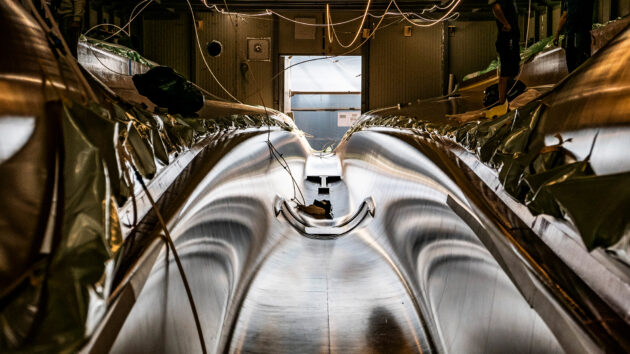
One of a series of slightly opaque images supplied to the press on announcement of Hypersail. Photo: Ferrari / Hyperfoil
In the cockpit the flight controller has a set of jet ski type handlebars, alongside the helm – who has a Formula 1-style wheel and an aircraft flight deck instrument panel.
But the feature that really grabbed my attention was their innovative ‘winch-by-wire’ pedestal system. The five grinding pedestals look just as you’d expect, but these have no physical connection to the winches they drive. Instead, they’re electric.
The more usual array of shafts and gearboxes has been replaced with electric motors that generate power to be used pretty much anywhere on board. The system has been designed so the load on the handles remains the same regardless of the load at the business end, while the crew maintain a steady and efficient rate of around 100rpm.
This in turn means fewer crew can handle much bigger loads thanks to the infinite gearing that’s possible electrically.
As you grind away on the test rig it’s easy to see and feel the benefits of a system that’s likely to be easier to install and probably lighter too. Once again car tech is at the heart of this new technology with electric motors that have come straight from the active suspension in their Ferrari Purosangue and F80. So while my first thought was that I don’t really care about cars, it turns out my wife is right and the opposite is true.
 If you enjoyed this….
Yachting World is the world’s leading magazine for bluewater cruisers and offshore sailors. Every month we have inspirational adventures and practical features to help you realise your sailing dreams.Build your knowledge with a subscription delivered to your door. See our latest offers and save at least 30% off the cover price.
Note: We may earn a commission when you buy through links on our site, at no extra cost to you. This doesn’t affect our editorial independence.