



Circumnavigating in a 20-footer isn’t for everyone, but owner-skipper RW Henson built his remarkable junk rigged micro-voyager for a grand adventure. Sean McNeill reports
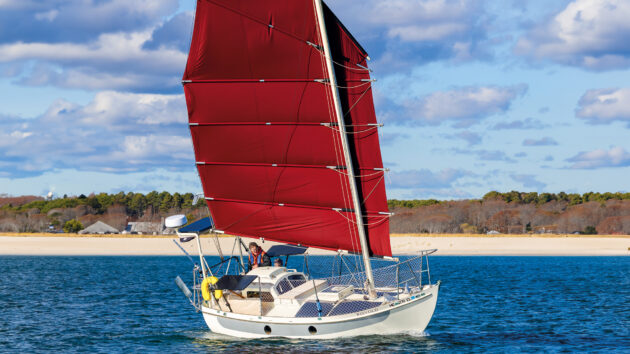
When RW Henson envisioned the ideal boat for his global circumnavigation he knew it needed two basic features – reliability and simplicity. He wanted a vessel that was bulletproof and self-righting, but it had to be simple to handle.
At the time he planned a solo circumnavigation and reasoned he needed minimal space, and didn’t want endless controls to worry about. Or through-hull fittings, for that matter.
The 55-year-old Henson – a retired firefighter, emergency medical technician, towboat operator and father of two from Barnstable, Massachusetts – isn’t strictly a lifelong sailor, though he has long been drawn to the water.
He took junior sailing classes growing up in Newport Beach, California, racing Sabots, but never really enjoyed the competitive programme. He previously co-owned a Drascombe Longboat with a friend, though that was for nothing more ambitious than mess-about sailing. And he is an avid surfer, awaking for dawn patrols to catch the day’s first waves.
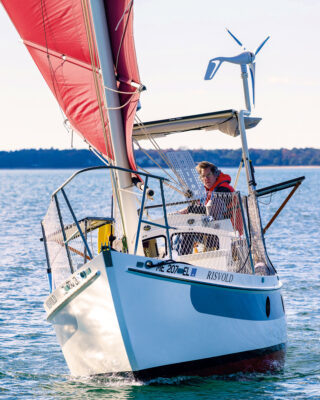
Photo: Tyler Fields
As a boy two books spoke to him, planting the seed of a dream of sailing around the world. “In the late 1970s there was a story in the local paper about Herb Payson and his family sailing around the Pacific Ocean in a leaky old ketch, which later turned into the book Blown Away,” recalls Henson.
“Then in high school in the mid-1980s I read Dove, Robin Lee Graham’s book about being the youngest to sail around the world and I thought, ‘I’m going to sail around the world one day.’”
Article continues below…

Extraordinary boats: The Mini Globe Race Globe 5.80
“Go small, go cheap, go now,” famously said Lin and Larry Pardy, who sailed for decades aboard small engineless yachts…

Extraordinary boats: Maluka – restoration of a 1932 classic
One thing you should do is take your watch off. If you start looking at your watch you’re going to…
10-year project
About 10 years ago Henson began working on his dream in earnest. In the early days of the web in the 1990s he came across the page of yacht designer Tom MacNaughton, a wooden boat aficionado who was one of the first students at the Yacht Design Institute founded by Edward S. ‘Ted’ Brewer at Brooklin Boat Yard in Maine.
MacNaughton was a devoted student and in the late 1970s he formulated the MacNaughton Associates Sheathed Strip Scantlings Rule, still in wide use around the world today. His early design work concentrated on offshore liveaboard sailing yachts because he, his wife and daughter lived aboard and cruised full time, and the designs are still popular.
Henson liked MacNaughton’s designs and thought he’d be perfect to create his simplistic global cruiser. So began a seven-year collaboration process that culminated in the Ha’Penny 20 Risvold, which was built by Artisan Boatworks in Rockport, Maine, and launched last summer. Henson says he could have purchased a used bluewater cruiser and refit it for half of what he spent developing and building Risvold, but he likes to work against the grain.
The Ha’Penny 20 is described as a ‘voyaging yacht sized to be a minimum long-term liveaboard on which one person can live a simple life’. Measuring 20ft on deck and 14ft on the waterline, she displaces a robust 5,314lb (2,410kg), carries 267ft2 (24.8m2) of sail area and has a hull speed of 5.2 knots.
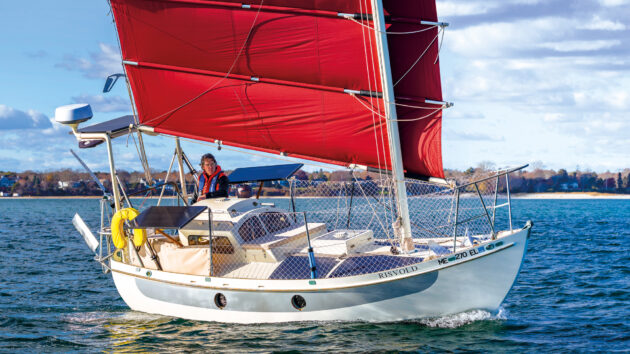
Junk rig means Risvold is not particularly fast, but is reliable and easy to handle. Photo: Tyler Fields
“The Ha’Penny is a heavy-displacement type,” MacNaughton says in his design notes, adding: “Any vessel expected to go voyaging and of reasonable size for anything up to family sailing really has to be a moderate to heavy displacement vessel, and the smaller you go the proportionally heavier she must be.”
The hull is a sandwich of Episize unidirectional glass tape with WEST System epoxy over Alaskan yellow cedar strip planking. With over 1 tonne of lead ballast in the keel, the yacht is self-righting.
Although short in length, Risvold contains quite a bit of headroom. Since there is no cockpit, the pilothouse provides Henson, who stands at 6ft 3in, with 6ft 6in of headroom. With windows surrounding the pilothouse Henson also has an unobstructed 360° view. The skipper can reach the tiller and handle all sail controls, of which there are only three, from the perch. The deck camber at max beam is just over a foot, and enables a cabin headroom of 5ft 8in. Although the owner will have to stoop a bit in the cabin, the two settee berths measure 6ft 6in in length.
Plenty packed in
There are two 200Ah lithium-ion batteries charged by four Solbian flexible solar panels (such as found on IMOCA 60s), adhered to the deck, and three Renogy Shadowflux portable panels that hang from the lifelines and the stern arch. Henson says the seven panels can produce up to 820W, while the AIR Silent X wind turbine additionally produces up to 400W.
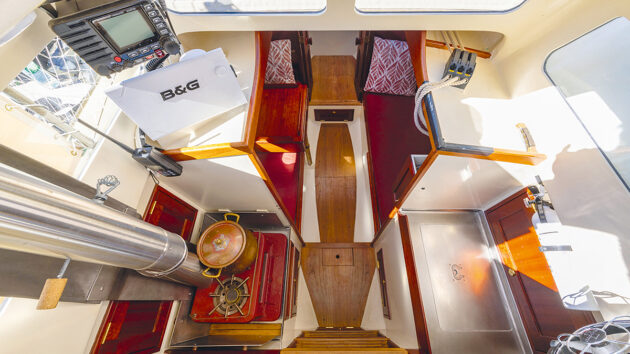
Living space is compact and cosy, but the pilothouse has 6ft 6in of headroom and an unobstructed 360° view. Photo: Alison Langley
Henson also stipulated no fossil fuels on board so there’s no diesel engine, aiding the mandate for no through-hull fittings.
Propulsion is provided through a Torqeedo electric boat drive that can produce up to 6hp. Electronics include the B&G Zeus integrated GPS chartplotter and radar. The Simrad TP20 tiller pilot also links into the system and augments the Monitor self-steering wind vane.
“The electrical system is one element that evolved quite a bit,” says Alec Brainerd, who founded Artisan Boatworks in 2002.
“Originally, the specification was for a very spartan system, just a few lights, but when the Torqeedo drive and lithium batteries and solar panels were added, then there was the opportunity to add radar, refrigeration, an inverter, sat com, etc. And that was a lot to fit into such a small space.”
With no through-hulls for water capture or discharge on Risvold there is a self-contained cassette toilet, similar to that found on an RV. The one item running through the hull is a wire to the propulsion unit, and that is glass-fibred in.
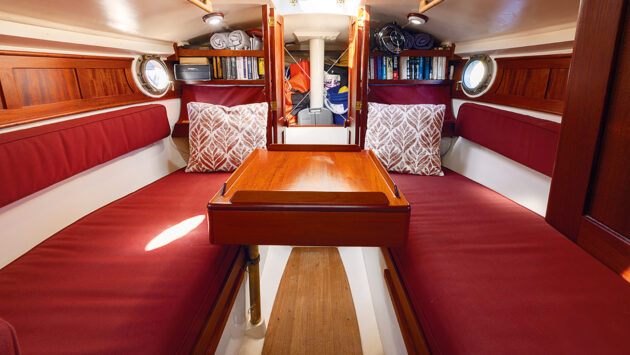
The multifunctional saloon table can sit over or between the twin berths. Photo: Alison Langley
“I didn’t want through-hulls because they can fail and I wanted a lack of failure points on the boat,” says Henson. “If I’m at sea and have water coming in, I don’t want to have to move millions of things to find the ingress point. Now, if I have water coming in I know it’s through something topsides or I have a compromised hull.”
A unique feature of MacNaughton’s designs is that they’re fitted with a Chinese (junk) rig, a free-standing rig with one large lugsail. MacNaughton usually specifies a mast of wood, but Henson wanted carbon fibre. The tube measures 24ft 6in from deck to masthead.
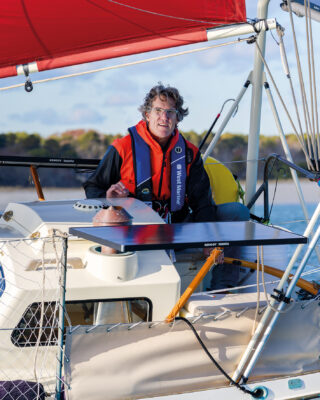
Owner RW Henson is planning a world tour on his diminutive cruiser. Photo: Tyler Fields
The gaff at the head of the sail spans 14ft and supports a large roach mainsail, the top point of which is more than 26ft off the deck. There are five full-length battens (the bottom four are parallel) and a boom along the foot. The battens are made of T6 aluminium tubing, with reefing lines attached to the outboard end of the four parallel battens to shorten sail in heavy weather.
“One of the reasons I wanted a Chinese rig was the ease of reefing and unreefing,” Henson says. “Some people want sails for every condition. I’m out to get from one place to another, and not particularly fast. Part of the journey is not worrying about a sail for every condition, I have one sail for all conditions. Risvold is an exercise in minimalism; it’s got just what I need and nothing more.”
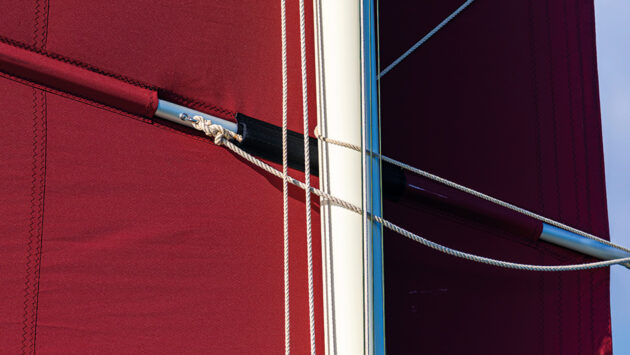
The junk rig has five full-length battens made of T6 aluminium tubing. Photo: Tyler Fields
Best laid plans
Even the best laid plans are rarely foolproof, especially when made for an oceanic passage, which Henson found out one cold, windy night last December in the North Atlantic. He was on day two of a passage from Cape Cod to Bermuda, the island of frangipani and pink beaches, on the intended first leg of his circumnavigation.
South of Nantucket by about 140 miles, he was sailing in winds gusting to 30 knots and 12-15ft seas in the middle of the night. Henson had the sail reefed but had moved the lazyjack line from the front of the mast to aft of the boom. A crash gybe damaged four of the battens, with one being completely broken.
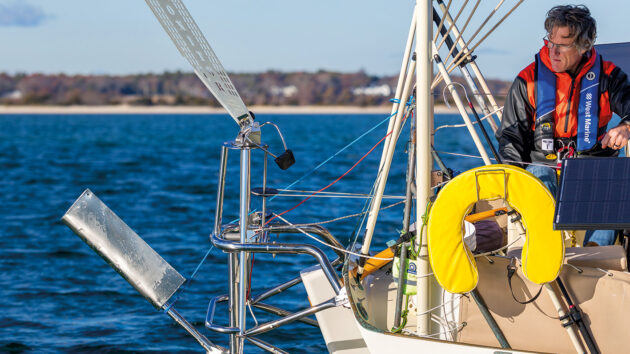
A Monitor windvane is fitted at the transom, beneath a combined solar panel arch/ surfboard stowage rack. Photo: Tyler Fields
“The entanglement occurred when I moved the lazyjack line,” says Henson. “With the sail reefed to the fourth point the head and gaff were able to get stuck outside the lazyjack. That caused a different shape to the sail. When I was trying to figure out what was going on there was the gybe. That pushed the forward end of the boom and the battens through the lifeline webbing and bent a stanchion.”
The incident forced Henson into Newport, Rhode Island, for further preparation over the winter, postponing his circumnavigation until at least April 2026. He had to get new battens, replace the mount on the tiller for the autopilot, and rig preventers to prevent crash gybes when sailing deep downwind. He also opted to fit the hatches with locking pneumatic hinges, so the companionway hatch doesn’t hit him in the head.
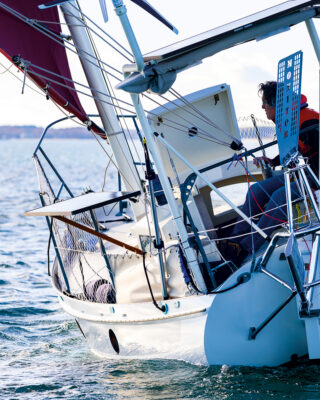
Additional solar panels are on cantilevered supports, plus a wind turbine for extra power generation. Photo: Tyler Fields
“To be clear, it was my error in judgement moving that lazyjack and not understanding how it affected the top of the sail,” Henson says.
“The lesson is this boat is a custom vessel, and the only way to learn is through experience. I learned a ton that night. The boat performed well. It was dry. There were 30-knot winds and 15ft seas on the beam and quite a few breaking waves. I would get pushed over but Risvold would stiffen and stand up. The boat performed incredibly well. I can plan for everything, but I don’t know what I don’t know.”
Childhood dream
Henson’s endeavour is fulfilling a childhood dream, but he’s well aware that he’ll be learning on the fly how to adapt to life at sea. And while he originally planned a solo circumnavigation, that plan also has changed. In the summer of 2021 Henson met Beth, and they married last summer.
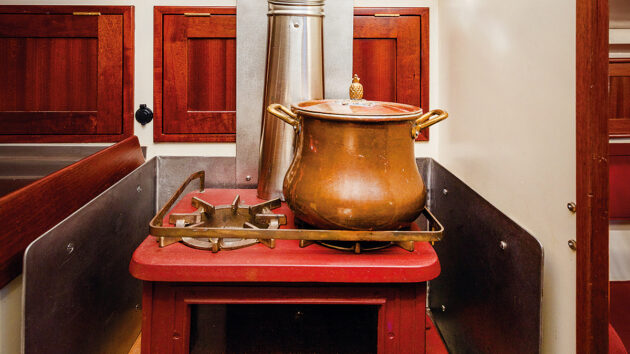
With no diesel engine or heater on board, Risvold instead has a charcoal burning stove. Photo: Tyler Fields
That led to another change, namely to sleeping arrangements. Henson had a wedge built to bridge the span between the settees. Now they can both sleep side-by-side athwartships.
“The plan is to head westabout through the Panama Canal,” he says. “There are a lot of places we want to go. Probably the Marquesas Islands, Tahiti, Cook Islands, Tonga. We want to go to New Zealand and Australia. And we’d like to cruise southeast Asia, we’d really love to see Vietnam, Cambodia and Thailand. I can’t imagine this will be done in less than five years.”
Ha’Penny 20 Risvold specifications
Length (on deck): 6.10m / 20ft ½in
LWL: 5.60m / 14ft 10in
Beam (on deck): 2.28m / 7ft 2in
Beam (waterline): 2.40m / 6ft 7in
Draught: 1.50m / 3ft 7in
Displacement: 2,450kg / 5,403lb
Ballast (outside): 1,031kg / 2,274lb
Sail area: 24.8m2 / 267ft2
Designer: MacNaughton Yacht Designs macnaughtongroup.com
Builder: Artisan Boatworks artisanboatworks.com
More information: risvold.com
 If you enjoyed this….
Yachting World is the world’s leading magazine for bluewater cruisers and offshore sailors. Every month we have inspirational adventures and practical features to help you realise your sailing dreams.Build your knowledge with a subscription delivered to your door. See our latest offers and save at least 30% off the cover price.
Note: We may earn a commission when you buy through links on our site, at no extra cost to you. This doesn’t affect our editorial independence.