



Olympian and keelboat tactician Thomas Zajac shares tips on pre-event planning and on-the-water decision making with Andy Rice
For Zajac, tactics start long before the starting gun. His first step in any campaign is always to research key venues in as much detail as possible. But you also need to balance forecasts and expectations with what is actually happening on the racecourse.
“With modern forecasts, it is easy to become addicted to high-resolution weather models, but a screen only tells half the story,” he explains. Local knowledge and first hand observations are key.
In handicap racing with boats of different speeds, what works for a fast boat will almost certainly not work for a boat that’s middle of the range or one of the slowest in the fleet. You need to cut your cloth according to your means. You need to simplify your decision-making and focus on coming out ahead in high-leverage moments like the start and the leeward gate.
“Remember, in handicap racing, you are racing your own rating. You cannot afford to let other boats dictate your path or ruin your clear air right at the start,” Zajac points out.
Here are his five essential tips for a solid tactical plan based on the speed of your boat relative to your handicap opposition.
Make a mental map
Talk to the locals. Whether they’re a seasoned professional or a club sailor who’s spent 20 years on that patch of water, they possess local knowledge no algorithm can replicate. They know the strange wind shifts caused by a specific headland or the subtle thermal effects that occur as the sun hits the land.
I also research past events at the venue, using websites like TracTrac or SAP Sailing Analytics to look through data and patterns from previous years. This allows me to build a mental map of the racecourse.
When the pressure is on and the countdown is ticking, I’m not reacting blindly, I’m executing a plan based on evidence and historical probability.
Article continues below…
Five expert tips for the perfect start: Dylan Fletcher’s guide to time, distance, and risk
Starting has always played a disproportionate part in the outcome of a race. The shorter the duration of the race,…
5 Expert Tips: How to recover from a bad race
You learn more from your mistakes than from your successes. But when you’ve had a bad result, how do you…
Free lane over bias
One of the most frequent tactical errors in handicap racing is an unhealthy obsession with the ‘favoured’ end of the starting line. While a 10° bias is certainly significant, clear air is almost always worth more than a few metres of theoretical advantage at the gun.
In a mixed-speed fleet, traffic at the biased end is often chaotic. If you fight for the pin end but end up stuck to leeward of a faster boat, your race is already compromised. In a handicap race, I am often willing to give up as much as 30% of a line bias just to ensure I have a free lane at the start. My goal is to ensure I don’t have to tack more than twice on the entire first upwind leg just to find clear air. Every time you tack, you lose momentum.
Trust your eyes
In sailing there is a dangerous psychological trap of wishful thinking, where a tactician follows a pre-race forecast even when the reality on the water is shouting the opposite. If the morning briefing suggested the wind would shift right at noon, many sailors will head right regardless of what they see.
This is a recipe for disaster. You must use your eyes more than your forecast. Look for gusts and the lulls across the course. Observe the angle of boats further up the track; are they pointing higher or lower than you?
This eyes-out approach extends to sail selection as well. If you are debating between a J1 or J2 headsail and the wind is hovering right on the limit, set up for what you see right now at the start. The first upwind leg is the most critical part of the race for establishing your position. If you can achieve a ‘clean launch’ with the right speed, you can usually survive the rest of the race.

Plan your approach to the leeward gate carefully. Photo: Sander van der Borch/World Saili
Plan your gate exit
The leeward gate is a notorious pinch point where races are won or lost. You need to be thinking two moves ahead. I start planning our gate exit before we have even made our first gybe on the downwind leg. As the tactician, I communicate a Plan A to the crew early, for example, “We’re taking the left-hand gate for a fast exit to the right side of the course.”
However, a good tactician always has a Plan B. The traffic situation can change in an instant. A wall of faster boats might converge on your chosen mark, or a sudden shift might make the other gate much more attractive. I wait until we’re in the final quarter of the leg to confirm the final move.
Filter the Info
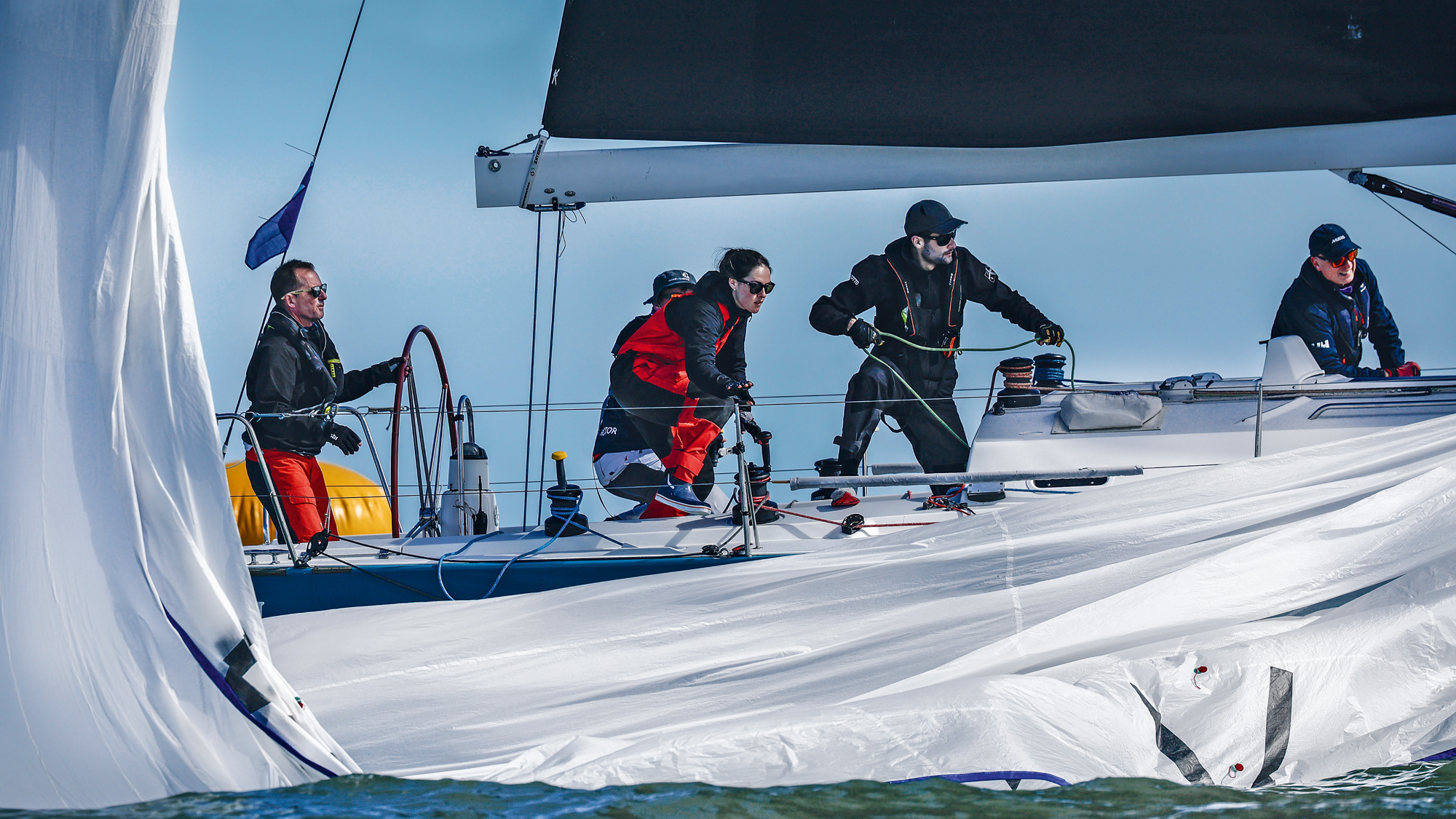
As a tactician, you are the bridge between the environment and the crew. You must adjust your style to the needs of your team.
If I’m sailing with an owner-driver, I act as a strict filter. They need to focus entirely on driving fast; they do not need to hear me rambling about minor 5° heading changes.
With a more professional team, the conversation can be more collaborative, but the rule remains: keep it simple. Provide only the essential information that helps the boat go faster and stay on the right side of the wind. A quiet boat is usually a fast boat.
 If you enjoyed this….
Yachting World is the world’s leading magazine for bluewater cruisers and offshore sailors. Every month we have inspirational adventures and practical features to help you realise your sailing dreams.Build your knowledge with a subscription delivered to your door. See our latest offers and save at least 30% off the cover price.
Note: We may earn a commission when you buy through links on our site, at no extra cost to you. This doesn’t affect our editorial independence.