




Compact but diverse, the Oslofjord is a stunning cruising area, as Janneke Kuysters discovers
After many years of cruising in Scandinavia it never ceases to amaze us how many beautiful places beg to be explored along the island-strewn coastlines. It would take a lifetime to see it all. As always, our fingers eagerly wandered over the charts in winter, looking for a lovely place to sail the following summer. “How about the Oslofjord?” Wietze muses.
The more I look at it, the more I like it: lots of options for sheltered sailing between the islands, or coastal sailing just offshore. Slow and leisurely sailing with daily distances of 15-30 miles, exploring as we go along. The city of Oslo lies at the end of a 50-mile deep fjord. Leading up to the Oslofjord, the Norwegian coast to the west of it has many attractive places to sail to. To the east, the Swedish coast is just as enticing for summer cruising.
“Let’s do it clockwise,” I suggest. With prevailing south-westerly winds, we should have an easy sail to Mandal in the south of Norway. We plan to follow the Norwegian coast to the east, sail up to Oslo and then head south along the Swedish coast. Wietze agrees and we start plotting our courses.
A strong northerly keeps us waiting on the Dutch island Vlieland for well over a week. When we spot a gap, we go for a quick two-day crossing to Thyborøn in Denmark. Another brisk 80-mile sail brings us to picturesque Mandal, up the winding river to the town jetty. Strange triangular structures in the river mouth are reminders of the salmon fishing days of the past. Nowadays, cruise ships anchor outside Mandal, with their guests flocking ashore to see the lovely old wooden houses in the town.
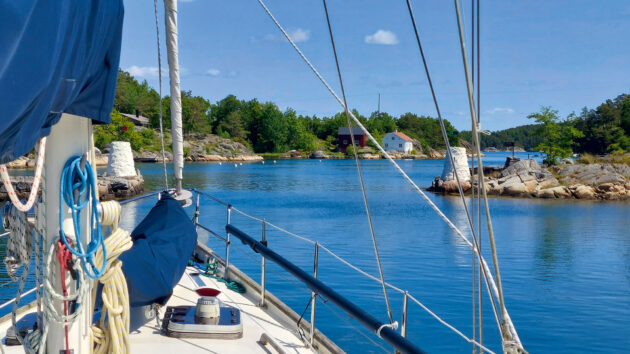
Norway’s Blindleia waterway is narrow and requires careful navigation. Photo: Janneke Kuysters & Weitze van der Lann
The south-westerly breeze stays strong, so we potter through the skerries along the coast. With no waves, just the unfurled yankee and a keen eye on the charts, it makes for a blissful day cruising the ‘Norwegian Rivièra’.
There are many small yacht clubs offering berths to visiting yachts, but also plentiful anchorages and ‘nature harbours’. You can tie to a rock and spend the night, or use one of the wooden jetties in the nature parks. One of the most spectacular is near Ny Hellesund. The Olavsundet is an oval-shaped, fully protected anchorage with two narrow entrances, one in the north and one in the south, making this a popular spot on the south coast.
The wind has resumed its normal south-westerly direction, so we have an easy sail to our next stop of Kristiansand, a big city with a famous fish market. The old harbour area has been upgraded in a spectacular way, including the Kunstsilo – a museum of modern art in old grain silos, right next to the new opera house.
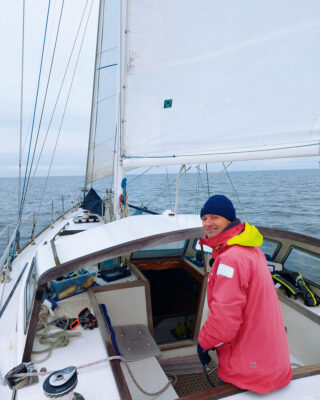
Weitze van der Laan at Anna Caroline’s helm. Photo: Janneke Kuysters & Weitze van der Lann
Norwegian highlight
“Are you sure?” Wietze asks nervously, looking up to our mast head. I check the charts for the 20th time and nod, although I feel a slight tinge of doubt. We’re about to enter one of the highlights of the south-east coast of Norway: Blindleia. It is a 12-mile long, narrow passage between islands and rocks, known for its great weather, natural beauty – and narrowness. There are two bridges on either end of the channel, both with a clearance of 19m. Our mast is 18.5m.
It should be okay. And, after some breathless moments, it is okay. We motor slowly through the narrow passages and enjoy the view. Taller yachts weave in and out the channel to avoid the bridges.
Herring used to be abundant along this coast, so there are many old fishing villages with the region’s iconic red and white houses. Nowadays, villages like Kragerø and Risør are idyllic summer destinations: a welcoming visitor’s jetty, lots of quaint shops and restaurants and sandy beaches.
But we wanted to explore off the beaten track and, on a gloriously sunny day with a perfect breeze, we sailed 20 miles east-north-east from Kragerø up to Brevik, a cute little town with an interesting history.
In the past, freshwater ice was harvested in winter from lakes higher up in the mountains. Through a system of slides it was transported to insulated storage pits in town. Then it was brought to UK ports in summer aboard square rigged ships, destined to be used in iceboxes.
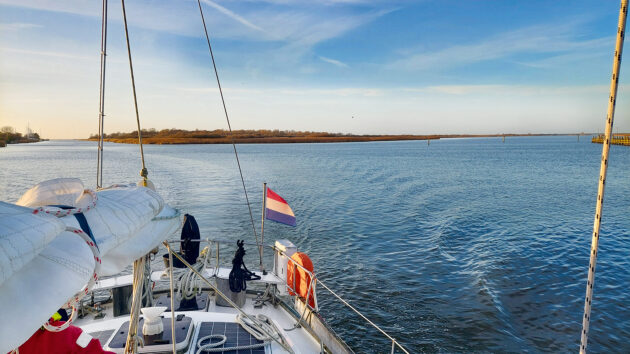
Light winds in summer meant occasional motoring. Photo: Janneke Kuysters & Weitze van der Lann
Canal steaming
Brevik is close to the start of the Telemarks Kanalen. This channel, the Norwegian sister of the Swedish Göta Channel and the Scottish Caledonian Canal, leads all the way up to the middle of southern Norway. It stops in Dalen, and has height and draught restrictions for most yachts, so we left Anna Caroline at the dock and hopped on a century-old passenger ship for an awesome trip through flights of locks, giant lakes and wooded forests.
As we sail on, weaving in and out of the skerries, we are at times overwhelmed by the options. There is simply too much to see and do for one summer. Stavern, for instance: a lovely old town with centuries of navy history in the old dockyards. Or Sandefjord, where the Norwegian whaling industry had its roots. Summer has truly arrived and the temperatures are going up. The wind eases considerably, which forces us to motor more than we’d like.
After Sandefjord, our course was north-north-east, into the Oslofjord. It’s slow sailing in the light breezes, taking our time between anchorages. The winds had been strong further west and brought a big swell to the area, so we were disappointed to have to skip Verdens Ende (‘the end of the world’): a beautiful small port right at the entrance to the fjord. When a swell is running, this harbour is not safe.
The Oslofjord narrows only at the end, and the wind tends to follow its north-south direction. If you’re lucky, like we were, you might have a nice following breeze, though we were already bracing ourselves for long days of tacking on our way back out. Ferries criss-cross the water, saving motorists the long drive around Oslo. The town of Horten lies on the west bank and offers a safe berth for the night, especially near the outstanding maritime museum.
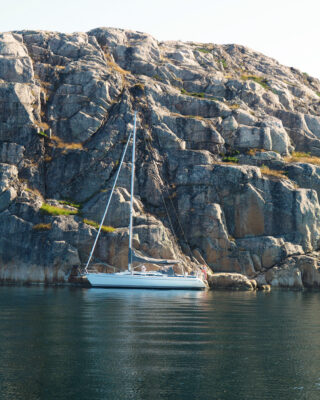
Mooring alongside a rock face. Photo: Janneke Kuysters & Weitze van der Lann
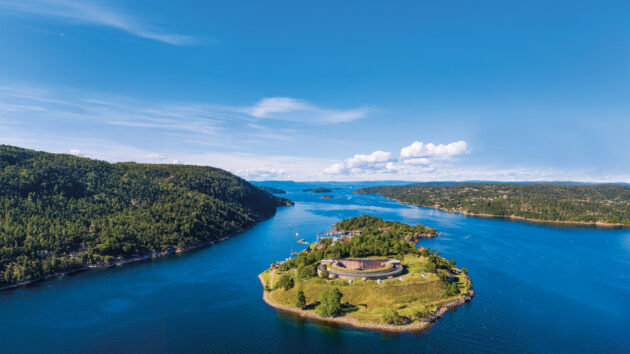
Further north, we find Oscarsborg, another spectacular destination, right in the bottleneck of the Oslofjord. Two tiny islands boast a large, centuries’ old fortress overlooking the entrance to the fjord. Our leisurely downwind course to Oscarsborg makes us a bit too relaxed. “Why would there be two sets of markers quite off our direct track to the port?” I wonder. Wietze is at the helm and stretches his neck to look forward. “There is a funny current swirling there,” he points. My heart skips a beat when I fully zoom in on the chart, “an underwater wall!” Quickly, we adjust our course and breathe out again.
Oscarsborg was the site of the famous Battle of Drøbak Sound in World War II, where the German fleet didn’t count on torpedoes being launched from hidden cellars. It’s a beautiful place, where we lingered longer than expected. Late one evening we sat alone on the tiny Commander’s Beach to enjoy the sunset. It feels as if we’re the only ones in the world, though the steady flow of ferries and ships hint we’re close to the capital.
Oslo attractions
Norwegians are keen powerboaters, but there is also an active sailing community. In and around Oslo you’ll find marinas to suit all needs, from the luxury Aker Brygge to smaller club islands just outside the capital. Oslo has many attractions, but highlights for cruisers are to be found on the Bygdøy peninsula: the Fram museum and the Kon Tiki museum. Both ships are impressive in themselves, though the thought of the voyages that have been undertaken with them sent chills up our spines.
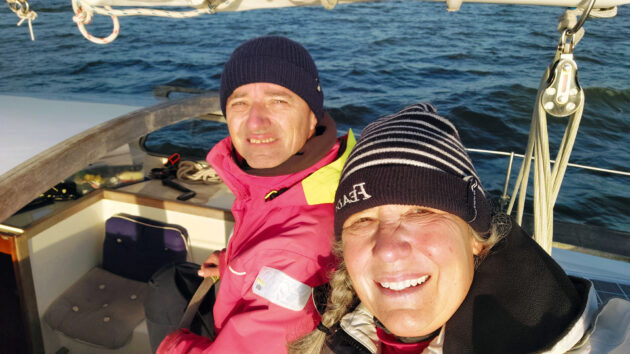
Hats and coats required on a chilly start to the sailing season. Photo: Janneke Kuysters & Weitze van der Lann
We take our time sailing south, out of the Oslofjord, while we can’t believe how lucky we are. Again, we have a following breeze. There’s lots to be enjoyed underway, both in anchorages and lovely little towns like Son or Moss. The ‘Norwegian sailing capital’ Hankø is also worth visiting.
Sailing through the skerries requires careful navigation, but it is so rewarding: boat speed is usually higher due to the lack of waves. The winds are light and our course through the skerries is winding. For safety, we sometimes run the engine to keep going when there is lots of boat traffic. When it’s nice and quiet, we let Anna Caroline decide how fast we go: a 17-tonne steel boat has a mind of her own.
We took a bit of a detour to motorsail up the fast-flowing River Glomma to the city of Fredrikstad. The old town on the east bank is a gem: a bastion and a village all in one, beautifully preserved and a joy to stroll around. There are excellent facilities at the nearby yacht club or along the visitor’s quay in town.
Once across the border to Sweden the skerries, and thus the excellent sailing, continue. The Scandinavian summer is in full swing: it’s hot and the steady flow of low pressure areas brings different conditions every day. We must remain vigilant about the weather, especially in more exposed anchorages.
For centuries, this coast was all about herring, so there are many quaint towns with very sheltered harbours to be discovered. After a round of provisioning at Strömstad, we sailed a mere four miles to the Koster archipelago to drop our hook. This very popular archipelago is delightful: you can row ashore and wander around.
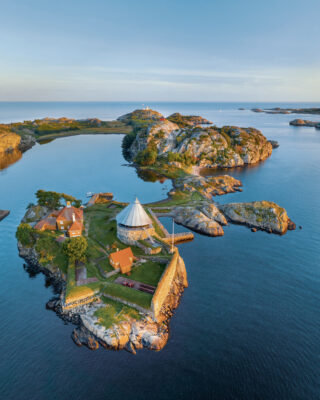
Staverns Fortress in the Oslofjord. Photo: Vidar Moløkken/Visit Norway
The higher up you go, the more masts you see rising up between all the rocks – there are yachts everywhere. Depending on the weather, you can go further out to the smaller islands and tie up to the rocks. We’re in awe of the skippers that have the courage to do so – in our heavy, larger steel boat with painted topsides we’re not that brave and opt instead for the ‘inside track’, visiting the lovely towns of Grebbestad and Fjällbackasit.
As we slowly sailed south in early August, the weather forecasts were not great: a deep low pressure area with a robust front was approaching. The forecast strong south-westerly winds forced us to seek shelter.
“Or,” Wietze pointed at the charts, “we keep going and take the back door.” Puzzled, I followed his finger on the chart and saw what he meant. The islands Orust and Tjörn are embedded in the Swedish west coast – or so it seems, because there is a navigable channel all around them. We happily turn Anna Caroline’s bow east.
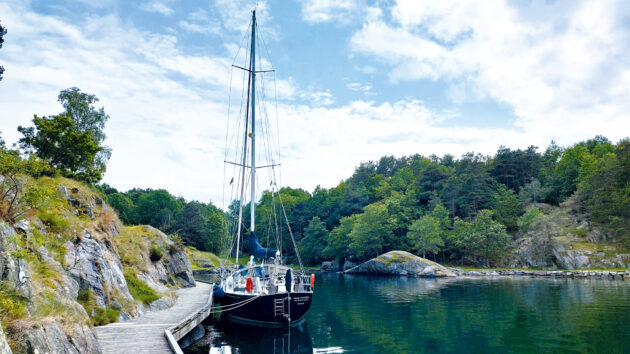
Nature harbours are great places to stay. Photo: Janneke Kuysters & Weitze van der Lann
Hot dog!
The channel was surprisingly quiet, even in the middle of summer. The steep, mountainous walls prevent the gusts from reaching us, but they do produce mild katabatic winds. We sail with full canvas, but one hand on the halyard in case we need to reef quickly.
After spending the night at a couple of beautiful anchorages, we tied up to the floating pontoon of the Svanesund Yacht Club, where fellow yachtsmen urged us to go to the annual ‘Korvätartävling’. We had no idea what we were in for, but it turned out to be a hotdog-eating contest, to set a new record for the number of people eating a hotdog at the same time, at the same place (we proudly joined in the effort).
Once the weather improved, we took the channel between Orust and Tjörn to head west again. This channel has some challenging, shallow parts where our 2.1m draught makes the echo sounder scream. We motored slowly, carefully counting each marker as we passed them. Again, we were spoilt for choice of anchorages. Further south is the famous archipelago around Marstrand, where the city’s impressive fortress can be seen from miles away.
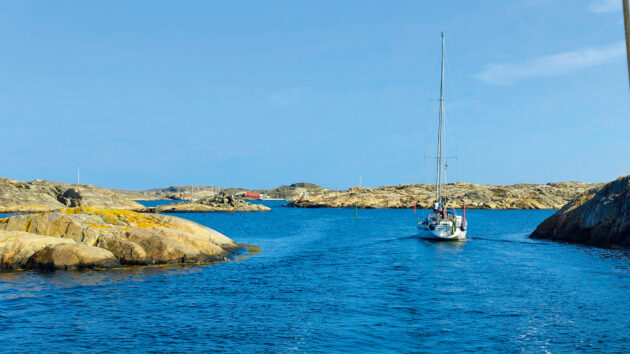
Sheltered conditions in the skerries. Photo: Janneke Kuysters & Weitze van der Lann
Marstrand is the Swedish sailing capital with two very active yacht clubs, hosting a packed regatta calendar. The skerries make for interesting race courses, regardless of the weather.
Marstrand is filled to the brim with yachts in summer, so we opted for the tiny island Åstol, just north. Åstol is basically a big rock with a fishing village on it. The tiny port is charming and gives good access to the boardwalk all around the bay.
We wandered through the small streets and stumbled upon a lovely rock pool, where the locals were enjoying a cooling swim. Returning, we find that the stall next to our spot at the quay had just opened for business: oysters and white wine. Perfect!
As we were getting closer to Gothenburg, the gaps between the skerries get wider, giving a more offshore sailing feel than we’ve experienced in the past weeks. Our course crosses the big shipping route into Gothenburg, but with a strong breeze and a beam wind we can stay well clear of the large shipping. There is one more archipelago to visit before leaving this enchanting cruising ground.
 If you enjoyed this….

Yachting World is the world’s leading magazine for bluewater cruisers and offshore sailors. Every month we have inspirational adventures and practical features to help you realise your sailing dreams.Build your knowledge with a subscription delivered to your door. See our latest offers and save at least 30% off the cover price.
Note: We may earn a commission when you buy through links on our site, at no extra cost to you. This doesn’t affect our editorial independence.