



A mid-ocean rig failure and battery overheat turned an amazing Pacific sail into a tense race to safety for Adam Ainsworth
We were adrift, 2,800 miles into our 4,100-mile Pacific crossing, with only enough fuel to take us another 450 miles. After that, it was anyone’s guess. A month previously we’d provisioned for 35 days and, with cautious optimism, slipped through the Panama Canal into the Pacific.
My partner and I had sailed oceans together before. Built in 2018, our Moody 45 DS had earned her sea miles. She’d toured much of the Mediterranean, crossed the Atlantic and lingered in the Caribbean before pointing west from Panama. She was strong, proven, and – we thought – a known quantity, ready for the 4,170‑mile haul direct to the Marquesas.
We knew the doldrums would be a challenge and that most people motored through them but we wanted to do it properly: pure sailing, engine off from Panama to Polynesia. It was a romantic promise to ourselves – a purist’s dream of steady trades, 150‑mile days and a vanishing wake. It turned out the ocean had other ideas.
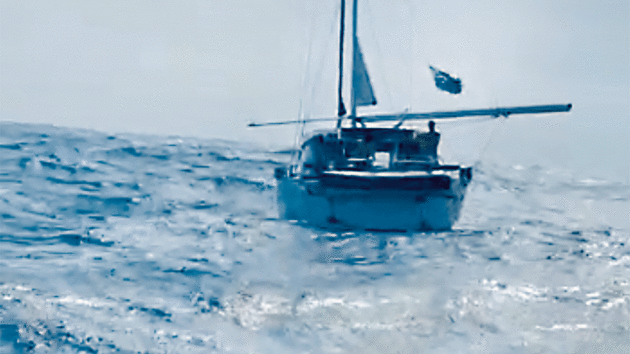
No option but to motor uncomfortably in 2.5m seas. Photo: Adam Ainsworth
The breathless ocean
From day one, the Pacific lay flat and windless, as though holding its breath. Our Code 0 drooped uselessly, the boom creaked against the preventer, and the log rarely showed more than 3.5 knots.
The Intertropical Convergence Zone had sprawled far south, erasing the trades everyone counted on. A pod of 5m-long pilot whales slinked under our keel, moving slightly faster than our 1 knot. It was an incredible sight – but only served to underline how slowly we were moving.
We spent long, shimmering hours coaxing motion from nothing. Code 0 up, down, up again, managing half a day’s progress in a full 24 hours. One night we slipped backwards, watching the GPS plot an 11-mile retreat.
It was demoralising but not disastrous. “Eventually the wind will come,” we told ourselves.
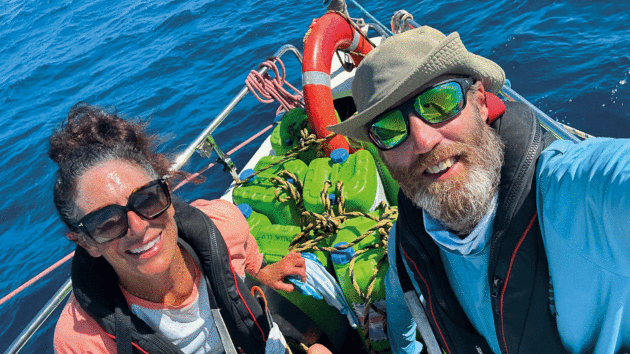
Gratefully received spare fuel transferred. Photo: Adam Ainsworth
Slow boats make poor power. Our Ramoran hydrogenerator produced almost nothing below four knots. Meanwhile, the freezer (newly added for this long crossing) demanded steady charging. To keep it running, we fired the auxiliary generator for 1-2 hours daily until an oil‑pressure warning forced us onto the main engine for electricity.
The sound of a motor in the middle of the Pacific is a heartbeat you don’t want to hear. We tried to ignore our sense of unease building with every hour of diesel burned.
First failure
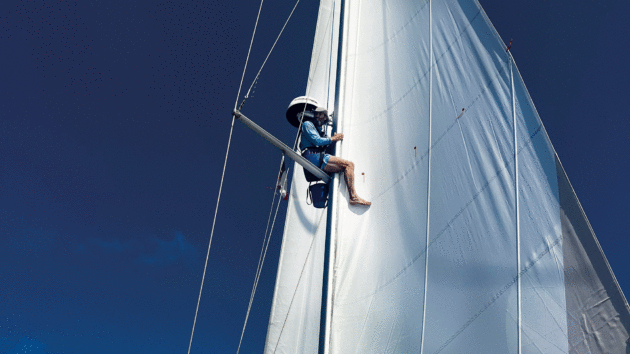
On the sixth day, we noticed the jib go slack. I climbed the mast to the top and reconnected a shackle. As I climbed down, relieved to have found such a simple solution, it seemed sensible to inspect the rig.
I discovered three strands detached below the swage terminals on the D1 port side and four on starboard. There are 19 strands on each. This was a serious development. Concerning but manageable, we thought. We were wrong. Strand by strand, the rig unravelled.
By day 26 the port D1 completely came away from the mast and had to be cut away with an angle grinder as it was swishing along the deck dangerously. By day 32 both port shrouds were gone entirely; the port D2 had sheared at its base and swung from the second spreader; only the starboard D2 still clung slackly to its fittings. The mast groaned with every roll. It was physically and emotionally extremely stressful.
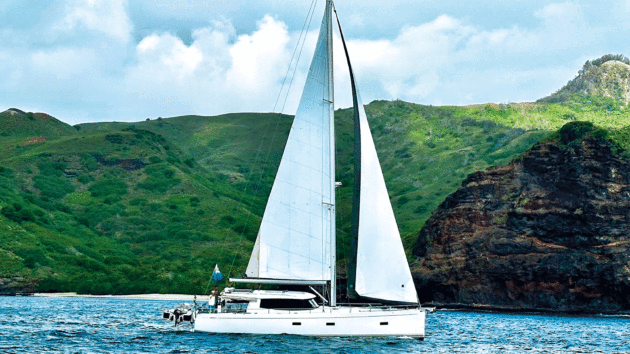
Adam Ainsworth and his partner had planned a classic trans-Pacific cruise. Photo: Adam Ainsworth
We had help, if only virtually. Our offshore WhatsApp group included riggers scattered across the Pacific and the USA who guided us through a plan: a jury rig of 12 lines and eight blocks, built from every spare metre of line aboard.
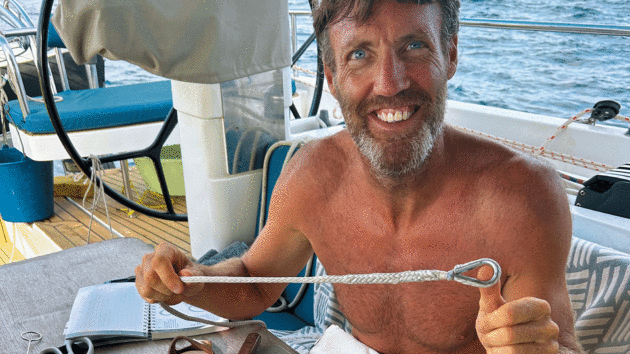
We rigged the whisker pole to port and the boom to starboard and led lines every which way we could to try and recreate the angles of the missing shrouds. We rigged lines around the spreaders and back to the stern cleats as secondary backstays. The icicle hitch became our lifeline, so we could release lines from our two winches and re-tension other lines.
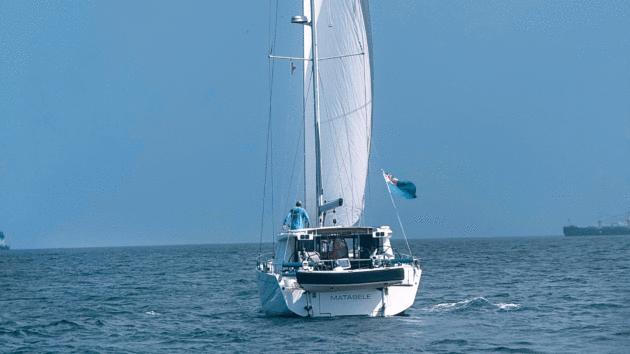
Flukey tradewinds saw the Code 0 struggling to make more than 3.5 knots early in the voyage. Photo: Adam Ainsworth
After days of tweaking and tensioning with truckers’ hitches, ratchet straps and Spanish windlasses, we learned that lines have to be run through blocks back to a winch to get the necessary tension, especially when the whole mast is moving so dramatically.
The loads were huge and we even saw Dyneema soft shackles explode under the pressure. Metal hooks on the end of our ratchet straps were pulled out to 90°and then to failure. We rigged back-up soft shackles on each loaded padeye in case the primary shackle blew out (which happened twice). Five times we climbed the rig to adjust and reinforce the web of running rigging that now held the mast upright.
The sixth time, I stopped at the foot of the mast with the harness on. The mast was flexing half a metre to starboard, every roll a potential breaking point. If it went, I’d go too. I unclipped. From then on, we worked from the deck, throwing a messenger line over the spreader to reeve heavier ropes aloft. Crude but effective.
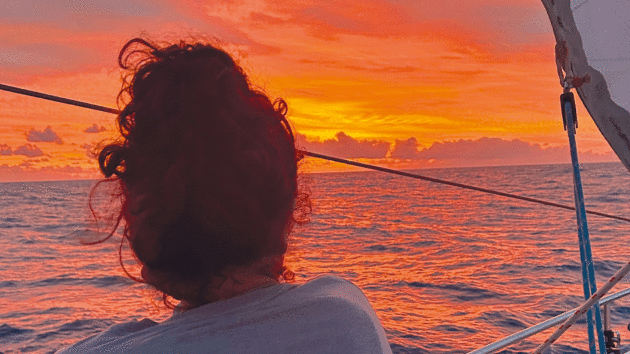
Photo: Adam Ainsworth
That decision, not to climb, came straight from my gut. It was a sobering moment and we agreed that we’d not climb again. The mast, somehow, stayed standing.
After the third shroud failed we realised we were no longer a sailboat. We’d been using a scrap of jib and a tiny main just to try and stabilise the boat and move along slowly, but it was bending the mast too much: we had little choice but to motor the remaining 1,300 miles. Too many windless days, too many hours charging batteries and powering essential systems meant our fuel stores were low.
Now a month into our passage we contacted JRCC Tahiti, the coordination centre that tracks offshore yachts through passage plans. Within two days they’d found a cargo ship, 365 miles away, willing to divert. They plotted our rendezvous with quiet precision, relaying instructions by WhatsApp.
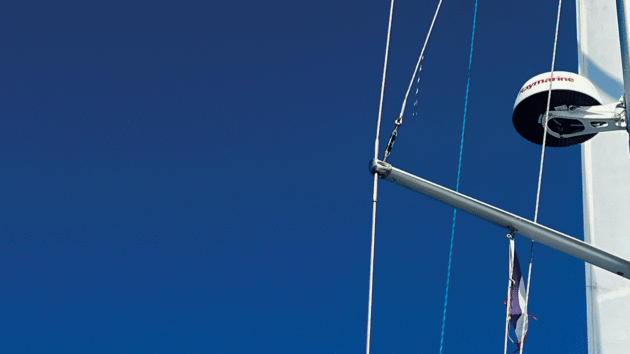
Strands becoming detached on the wire shrouds. Photo: Adam Ainsworth
When the vessel finally appeared over the horizon at 17 knots, a huge 245m behemoth with a 40m freeboard rising above us, the professionalism of her master and crew stunned us. The fuel transfer of vital jerry cans on long lines, executed in rolling seas, was textbook.
When it was over, the ship didn’t turn away immediately. The captain held station until he saw that we had taken all 14 of the 25lt jerry cans of diesel they had so kindly given us. Only then did he call: “Good luck!” We never learned why he volunteered to help when two other vessels had declined JRCC’s request. He owed us nothing but he gave us everything.
Article continues below…
South Pacific Sailing: ‘Niue is a tiny country almost no one has ever heard of’
It feels like a big deal to finally leave New Zealand’s shores, after all the hard work we’ve put into…
Sailing from Fiji to New Zealand without an autopilot: ‘The Bay of Islands is a sailing paradise’
In the past five years I’ve done 13 ocean passages. Each has been wildly different, and yet I’m struck with…
274 hours of noise
After 274 hours of running the engine, the boat lurching through 2.5m swells, her wounded rig creaking overhead, sleep came only in 10-minute bursts. Sleep deprivation does strange things: not madness, but a slow erosion of judgment. Every wave sounded like breaking metal; every vibration felt terminal. We were beyond fear, into determination. “Keep the mast up. Keep the boat moving. Get to Hiva Oa.”
Through it all, my partner cooked (she is French after all). Muffins one morning, crêpes on another, even a full English breakfast when she spotted my lowest ebb, each a tiny act of defiance against fatigue. She kept the atmosphere human, even cheerful. Seamanship may save the boat, but morale saves the crew. We were in it together and we worked on everything together.
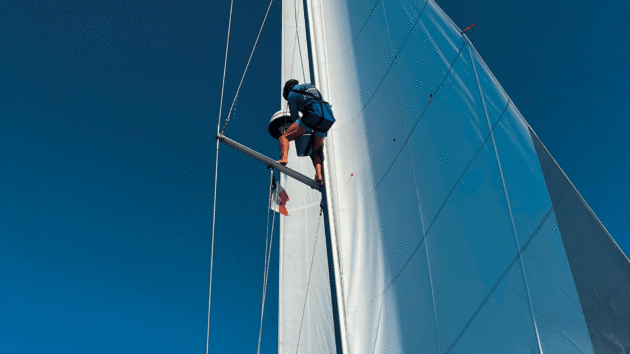
Ainsworth climbed the mast five times until it became unsafe to attempt a sixth ascent. Photo: Adam Ainsworth
That’s not to say it was easy: far from it. With extreme sleep deprivation comes huge emotional swings, and there were tears from both of us at various times. Support came from outside the boat as well. Yachts 38 South and Ole Pinelle shepherded us for five days when they could have got to Hiva Oa quicker.
Having just 1,000 miles to go felt like sighting land. It wasn’t; a thousand miles is still half an Atlantic. But seeing three digits on the plotter told us we could endure the rest. We just didn’t know what was next.
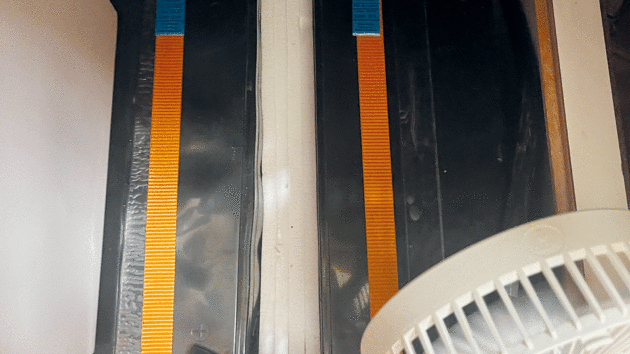
A fan powered by the one remaining good battery cooled an overheating battery bank threatened by thermal runaway. Photo: Adam Ainsworth
Smoke below
The first omen was smell: acrid, metallic, the air turning sharp. Then came the hiss – low, insistent, like steam. When we opened the battery compartment, the feeling of dread turned visceral.
The boat’s battery bank had swollen grotesquely, cases soft and bulging, fusing together in a mess of heat and threat. Thermal runaway. At sea, it’s one of the few emergencies with no textbook solutions. We were still hundreds of miles from land, our generator crippled, and now the batteries were poised to explode.
Every scrap of rope, line, blocks and ratchets on board were drafted into service to hold the mast up once the shrouds started to fail. Photo: Adam Ainsworth
The engine alternator regulator had been pushing 15-16V into the batteries for days on end and I hadn’t spotted it. We shut down the system, vented the cabin, put fans on the expanded batteries, using the one remaining battery which hadn’t died.
For an hour we hovered, ready to launch the liferaft. Our grab bag waited by the raft alongside the flare box and extra water. Everyone has a list of grab bag contents, but this became very real as we slid photographs of our children inside, the only personal items we could not leave behind.
The bank cooled slowly from over 70°C to 35°C; we thought the worst danger had passed. But it changed the tone of the voyage. From that point, we stopped assuming things would be okay.
After the scare, we were even more on edge. We were already rationing water to 4-5lt in total per day — just enough for drinking, cooking, and brushing teeth. Dishes were done in seawater, ‘showers’ by bucket over the stern. Ironically, food was never the issue.
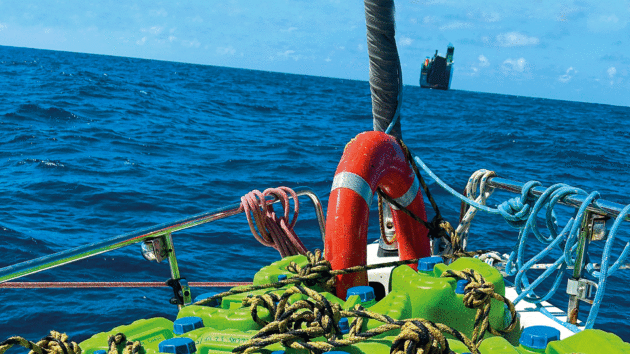
The captain of the cargo ship MV Tarago 365 miles away diverted his vessel to rendezvous with Ainsworth’s Moody 45 DS and, in a textbook operation, transferred 14 jerry cans, each with 25lt of precious diesel. Photo: Adam Ainsworth
Early on, a short‑billed spearfish had taken our trailing lure, a miracle from the sea far taller than me that fed us for five weeks from the freezer. Dolphins came and went.
A flying fish flew through the bedroom window and landed in the bed, as did a small bird. Even in adversity, the ocean offered us some humour. What it withheld was kindness, the waves did not relent.
Landfall
On day 42 the Marquesas came into view behind the setting sun from 35 miles away. Surreally, with the mast lurching and creaking every single minute, it felt like we could yet lose the rig within sight of land. Stress levels were running high.
In the small hours of the morning we carefully navigated into an anchorage in Hanamoena, Tahuata, eight miles from Hiva Oa, to get some rest before moving into the busy main bay. It was 43 days since leaving Panama, but we had arrived.
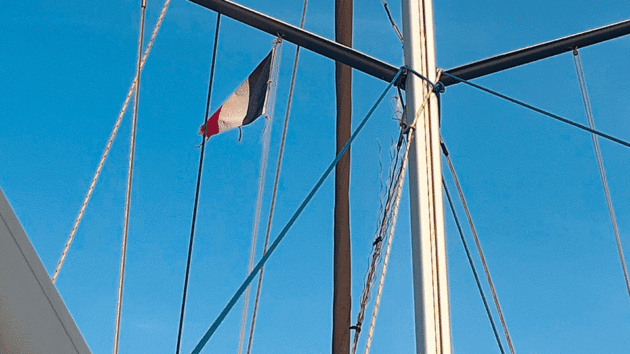
All manner of ropes and lines were deployed to steady the mast once the shrouds started to give way. Photo: Adam Ainsworth
That morning we stepped out onto the deck slightly confused as to why we were not moving, and were confronted by a squadron of manta rays, feeding graciously around us. There was someone snorkelling about 20m away. Unbelievably, it was a cruiser friend of ours who’d left Panama the same day as us and arrived two weeks earlier.
Later, in Hiva Oa, a rigger replaced the absent D1s and D2s and inspected the rest of the standing rig. The damage was sobering but reparable. Two weeks later new batteries arrived on a supply ship. Our logbook, now heavy with salt and graphite smudges, holds 4,170 miles’ worth of lessons.
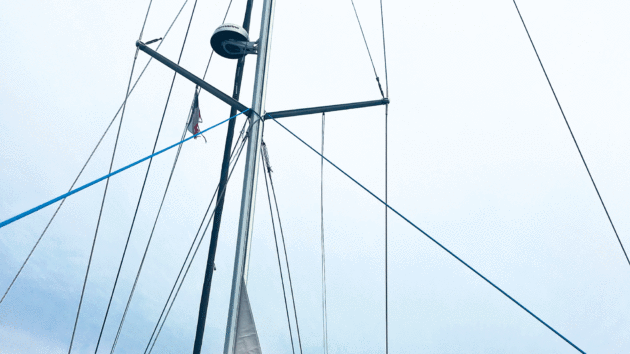
In-mast reefing allowed a tiny main to be flown, reducing strain on the mast. Photo: Adam Ainsworth
Fixing rig failure: Lessons Learned
Every ocean crossing changes you; some rewrite your understanding of seamanship altogether:
- Wind is not owed. The Pacific’s calm can stretch for weeks. Plan fuel reserves for the worst, not the best. A hydrogenerator isn’t magic (below four knots it gives almost nothing). Without backup generation, batteries suffer, and suffering batteries can turn lethal.
- Communications made everything easier. We are very grateful to have Starlink’s offshore capability on board.
- A watermaker isn’t a necessity. We managed without one: rationed, disciplined, salt‑scrubbed, we were fine. You can’t count on rain though, we were lucky not to have a single squall in 43 days, but we didn’t get meaningful rain either, which we usually collect.
- If you’ve got time on your hands, make a soft shackle. Don’t throw away old lines, you might need it. Rigging fails gradually, then suddenly. Carry spare Dyneema (we didn’t), enough line to rebuild your standing rig from running gear if you must. Our 250m of spare rope and a half‑dozen soft shackles were literal saviours. We learned a lot about the different stretch capabilities of our yacht’s lines. Spinnaker sheets were good, climbing lines were not. Keep working on the solution, you can always make it better.
- File a passage plan. When the crisis came, JRCC Tahiti already knew who we were, where we were going, and how to reach us. Their efficiency, and one generous ship’s captain, bridged 365 miles of empty ocean.
- Pack your grab bag with humanity. Safety manuals list flares, water, EPIRB, but when you think you might be leaving your home forever, you’ll reach for something personal. Crew dynamics matter as much as kit. Stoicism and optimism aren’t opposites; they are paired survival traits. While I focused on the rig and numbers, my partner kept us human.
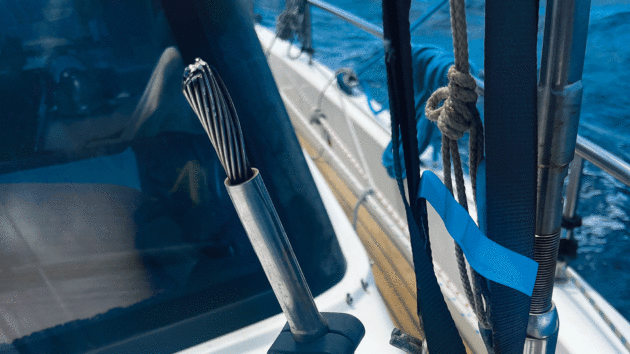
Flailing shroud had to be cut off with an angle grinder for safety. Photo: Adam Ainsworth
Looking back, what began as a purist’s dream became something harder and truer: a reminder that crossing an ocean is never about mastering nature but negotiating with it. The Pacific will give what it wants, when it wants, and take without apology.
We left Panama hoping for perfect wind and self‑sufficiency. We arrived in Hiva Oa with melted batteries, a rope‑held mast, and faith restored in seamanship and the kindness of strangers.
 If you enjoyed this….
Yachting World is the world’s leading magazine for bluewater cruisers and offshore sailors. Every month we have inspirational adventures and practical features to help you realise your sailing dreams.Build your knowledge with a subscription delivered to your door. See our latest offers and save at least 30% off the cover price.
Note: We may earn a commission when you buy through links on our site, at no extra cost to you. This doesn’t affect our editorial independence.