



Olympian Odile Lambriex van Aanholt talks to Andy Rice about maximising time on and off water
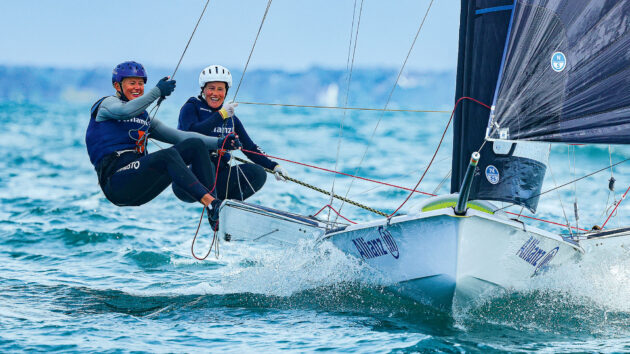
Time is always the most precious commodity for any racing sailor, whether part-time or professional. For Odile Lambriex van Aanholt going for another Olympics, life should get more simple the second time around.
Having won Olympic gold at Paris 2024 with her experienced crew Annette Duetz, she knows how to run a successful campaign, yet she is more time crunched than ever before – partly because she gave birth to her daughter in mid-2025, and also because Duetz retired from competition after the Games.
Van Aanholt has started sailing with new crew Karlinde van Arendonk who, apart from a bit of Optimist sailing, is a newcomer to sailing. However, the former elite field hockey player came out on top of a nationwide search to become van Aanholt’s new 49erFX crew, beating more than 100 other candidates from sailing and non-sailing backgrounds.
Now van Aanholt has a race against time to get her new partner sufficiently sailing-savvy to fight for that Olympic gold at Los Angeles 2028. So managing time is a more critical skill than ever. At its simplest level, it’s about organisation.
“One thing that I’m much better organised about since becoming a mum is making sure I’ve got all my gear,” says van Aanholt. “That might sound obvious, but time is so valuable, you owe it to yourself and your teammates not to waste it.”
She has also learnt techniques to make the most of limited training time. Here are Odile’s five best tips for maximising efficiency on and off the water.
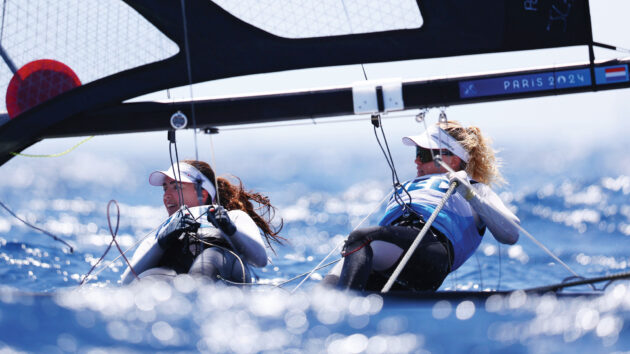
Van Aanholt aims to keep it fun with new crew Karlinde van Arendonk. Photo: Sailing Energy/49er Class
Embrace the fun
One thing I’ve pushed for with my [Dutch Sailing] federation is the need to have fun. Not only is it more fun to have fun, in the end it will make you faster too.
Just because we’re taking something seriously, doesn’t mean we shouldn’t have a laugh and a joke along the way.
Which is why I was very careful to choose my teammate not just for their technical skills or attitude, but for someone who I will enjoy spending a lot of time with.
I find that the happier I am, it becomes exponentially easier to make progress because you get something like a flow state, a sort of free feeling where things come to you. Whereas if you’re not having as much fun, it becomes much harder to make those gains, even if you put a lot of structure around your campaign.
In the early days, before I had a lot of success, it was hard to convince my coaches and my federation of the value of this, but now that I’ve produced the results they accept that this is the approach that works for me. But I think it’s an approach that would work for most people.
Find your flow
What’s really great about sailing is when you get in that ‘flow state’, where you get that really nice combination of being physically and mentally in sync with what you’re doing.
You’re getting these mental cues of seeing the breeze on the water, or a bit of a wave or a chop, but then you feel the mainsheet in your fingers or the tiller in your hand and it’s really easy to get totally into it and forget about the outside world and about everything else going on. To just really be in that moment.
That was easier to achieve when I was sailing with Annette [Duetz, her previous crew], but when building up the skills with Karlinde I have to spend some of the time in ‘coaching’ mode, which I’ll come to in the next tip.
In racing you’re aiming to achieve that flow state for as much of the time as possible, because you want a really free state of mind so you’re ready for anything. You’ve got your eyes open and you’re not missing any shifts. You’re not worried about the boat speed.
Of course there’ll be people trying to disrupt that flow – lots of other competitors who are just annoyingly getting in your way. But the aim is to minimise those distractions and put yourself in a position to get right back into it and focus on your main speed and strategic goals.
Article continues below…
When to coach… and when not to
When you’re one of the more experienced people on the team it’s obvious that you’d want to pass on that knowledge to the less experienced team members as quickly as possible – to bypass the ‘unnecessary’ mistakes.
But in the case of working with Karlinde, I’m also learning that sometimes it’s really good for her to learn things herself. So there’s actually a benefit [to making mistakes]. Let people figure it out themselves and they’ll learn it in a different way, because if you learn something by yourself by trying something and it either works or doesn’t work, that’s a different kind of ‘click’ compared to someone telling you, “This is how you should do it because this is how it works.”
So, we’re finding a balance between sometimes giving quick pointers like, “Hey, next time in this breeze, look out for this because that might help you,” and also letting them figure it out themselves. Otherwise you get someone who’s just good at following, whereas I think every sailor needs to be a leader. Even if you have different roles on board, you need to be the leader of your own task.
I kind of go into a flow state now and then, come out of it for a little bit, but dip right back in. It’s also something we’ve been working on with the coaches; making sure there’s enough room for my progress in both as well.
Be good enough
Sailing is such a complicated sport it’s difficult to cover all the bases and be really good at everything. You have so many conditions that there’s probably always going to be someone quicker than you in any given condition.

You need consistency in all conditions. Photo: Jason Ludlow for SailGP.
But if we can get at least top five in all conditions, then we’ll stay in the regatta and we’ll count on it not being those conditions all of the time. Sailing is less about being perfect but being good enough in all conditions and in all areas.
Then it’s really nice if you can have a few superpowers, like speed in a light breeze; I know I can go fast in the light, or do those perfect gybes and tacks, and that gives you a little bit of extra confidence in those conditions.
But it’s impossible to be the best in everything all of the time. Sometimes you might think the next priority for the campaign is obvious, but it’s not always obvious to your teammates.
So if you find yourself disagreeing, voice it out. It’s also really easy to get nit-picky about everything. It’s good to keep things simple. We always say you’ve got the three big things: you’ve got the start, you’ve got speed, you’ve got strategy. Those are your biggest things to work on most of the time.
Maximise shore time
It’s not always possible to get on the water as much as you’d like, so you need to maximise your use of the time off the water. I’ve done a lot of visualisation in my sailing, especially when I was new to the 49erFX. You kind of want that muscle memory and mind memory to click.
Also think about how you spend your time waiting for a postponement flag to come down, all that time waiting for the wind to settle. It’s too easy to get caught up in your phone. A much better distraction is something like playing cards with your friends in the fleet.
It means you’re connecting with your teammates and also keeping your mind sort of active. Even during a game you have to make decisions, while not being in a super stressed state. It’s nice to have something that distracts you from worrying about the racing and gets your head into a different space.
In association with Musto…
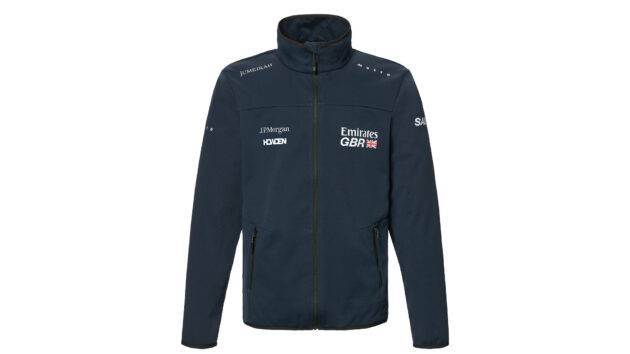
Rumour has it that when Grant Dalton turned up to race on board Flyer II in the 1981-82 Whitbread Round the World Race, he arrived with a suitcase! Things have come a long way since then and Musto has now launched a new collection of waterproof bags and luggage, purpose-built for sailors and adventurers.
The eight-piece range spans compact daypacks through to expedition-grade wheeled luggage, combining Musto’s decades of maritime engineering expertise with modern travel functionality, tried and tested by Musto ambassadors, who demand their kit stays dry and safe.
Adam May, Olympic chief technical officer of the British Sailing Team, put the new Musto 40L Waterproof Backpack through its paces on and off the water: “The best waterproof bag I’ve used, and I’ve gone through a few! Just the right size for a day on the water coaching, comfortable to wear, reassuringly robust construction, and a very satisfying external zip pouch.”