




Downwind sailing is the bit we look forward to – but it can require strong helming skills and safe techniques, as Nikki Henderson explains
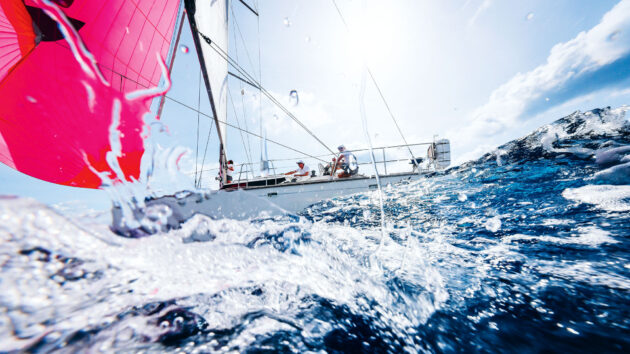
I’d wager that every sailor’s dream involves some version of downwind sailing. Whether that’s hiking hard on the aft quarter rail sending it in 25 knots, or racking up effortless 200-mile days during a tradewind crossing, or perhaps a gentle Sunday afternoon cruise under a colourful chute.
But, as with most of the best things in life, downwind sailing comes with risk. A mistake downwind – the worst of which can be an unexpected crash gybe – is to a sailor what letting go of the cliff face is to a rock climber. Other safety measures need to be in place or the error might not be survivable.
Two fatal incidents during the 2024 Rolex Sydney Hobart Race, which involved two crash gybes on separate boats and another close call (a MOB who was rescued) on a third, saw the topic of downwind sailing safety resurface (the CYCA’s official report is an instructive read for any sailor, racer or cruiser). While fatal incidents remain thankfully rare, it’s still prudent for us to ask ourselves: how can we sail downwind safer?
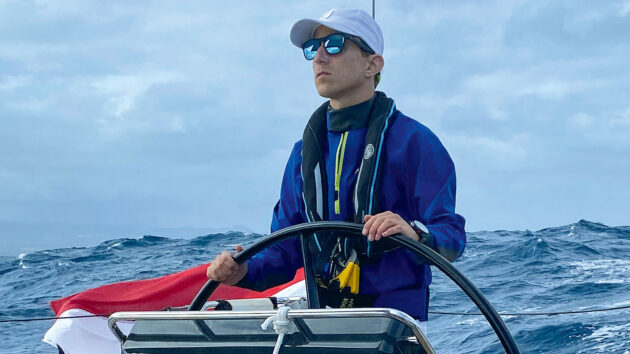
For many, an ARC is the first tradewind passage with sustained downwind miles. Photo: Lex van Dam/Paradox/WCC
The risks
What can actually go wrong? An accidental crash gybe poses the greatest threat to both human life and to the boat. The boom, mainsheet, vang, preventer can move violently across the boat with enormous force. If someone is in the wrong place, the consequences can be catastrophic. A controlled gybe carries the same threat – just with more warning. Other significant dangers include:
- Spinnaker pole accidents
- Broaches and ‘Chinese’ or crash gybes
- Crew overboard
- Rig or gear failure.
- Collision with another boat or a lee shore.
Unfortunately, these events rarely occur in isolation. Crash gybes often come in pairs. Gybes can lead to broaches. Rig and gear failure can knock crew overboard. An MOB scenario can panic a helmsperson, and they may crash gybe during recovery.
Most serious downwind sailing incidents are the product of more than one problem compounding. Understanding why these problems occur is the first step towards prevention.
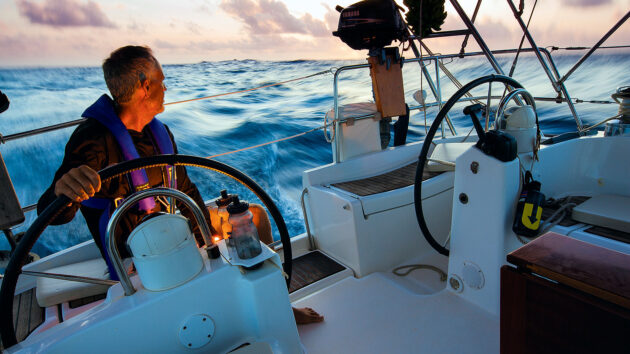
Monitor whoever is on the helm for fatigue and distraction, particularly at watch changes. Photo: Tor Johnson
The causes – Helming
Most serious downwind incidents are usually connected to the driver, either human or autopilot.
As conditions become more demanding, the margin for error shrinks exponentially. Double the wind speed, and the driving becomes not twice, but four times harder.
In moderate 12-15 knot downwind conditions, a helmsperson may be able to steer by referring just to the instruments and the sail shape.
If winds and sea state increase, to say 22-25 knots, the helmsperson must work harder to anticipate gusts, co-ordinate continuously with the trimmers, and react to wave sets – all as the boat surfs fast.
If conditions exceed the skill or confidence of a helmsperson, mistakes happen. People aren’t always self-aware or humble enough to step down, so look out for warning signs (such as staring down at the compass rather than the water; or standing rigidly, disconnected from the movement of the boat).
Avoid having the helmsperson trying to multi-task. Chatting, looking out at wildlife, navigating, judging a possible collision or – worse still – trying to lead manoeuvres, increases the risk. The more demanding the conditions the more important focus becomes.
Top tips
- Watch the water. Use a compass or analogue instrument as a support, not as an alternative.
- Match helmsperson experience to conditions.
- Swap helms regularly as conditions become more physical.
- Run a support system – have a second person shadowing the helmsperson.
- If in doubt, steer higher.
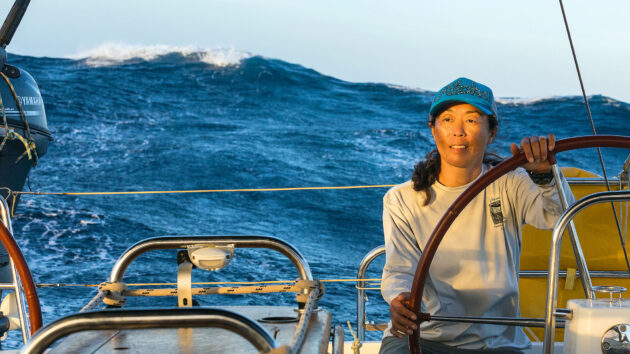
Helming downwind in swell requires skill and confidence. Photo: Tor Johnson
Human Needs
Sailing ability is not a constant metric. Fatigue, hunger, dehydration, stress and distraction all degrade performance of even the best sailors.
If an autopilot begins making an unusual groaning noise or responding slowly, most sailors will quickly investigate and consider if it needs a break, a reset, or some lubrication. Yet crews often ignore similar warning signs in themselves and others. An exhausted helmsperson reacts slower. A hungry trimmer loses concentration. A sleep deprived navigator will make worse decisions.
Fear is also a human condition. A healthy respect for danger keeps people safe, but a debilitating sense of terror does the opposite. I’ll never forget a candidate on my RYA Yachtmaster Instructor course shaking with fear when asked to helm downwind; no wonder he lasted barely five minutes before crash gybing.
A panicking crew member can be erratic, hard to manage, and their fight or flight response can leave them unable to follow instructions. And it’s worse than that, because fear is contagious.
Top tips
- Make eating and hydration mandatory, and food and water accessible.
- Celebrate sleep and recovery.
- Rotate roles before performance deteriorates.
- Regularly check crew wellbeing: consider asking ‘what’s your energy level from 1 to 10?’ at every watch change.
- Control and understanding help counteract fear – keep people informed during difficult conditions.
- Encourage concerns to be voiced early.
- Focus discussion on facts, plans and procedures rather than speculation.
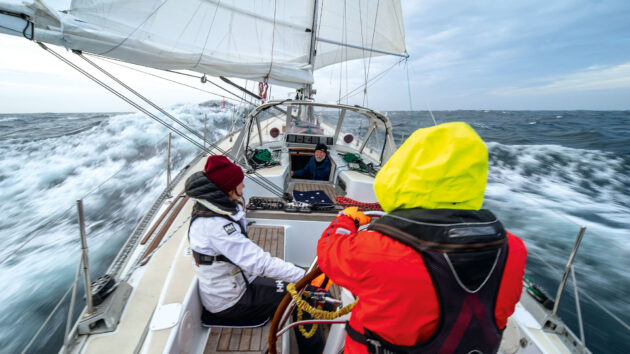
Sailing a passage with an adventure sailing company like 59° North is a great way of getting offshore downwind helming practice. Photo: 59° North Sailing
Crew positioning
Many injuries are caused not by mistakes themselves , but because somebody was in the wrong place at the wrong time. Someone’s head was too high; a mainsheet whipped them during a gybe; a broach caught someone off balance; a pole fell on the bow person’s head. This isn’t just bad luck; danger areas are predictable. Safe positioning can be habitual if you drill it in hard enough.
One of the most effective habits sailors can develop is moving around the boat in a ‘sumo’ state – legs bent, core brace, low centre of gravity – keeping their feet athwartships for balance and constantly holding on with one hand to something solid.
Top tips
- Get the whole crew to practice clipping and unclipping tethers efficiently.
- Never stand under the spinnaker pole.
- Mark mainsheet danger zones on the deck: ease the sheet and traveller to their downwind position (on dock). Swing the boom over to the opposite side and note the arc that the slack mainsheet swings through.
- Keep crew informed before manoeuvres.
- Enforce positioning rules consistently and not just during sail changes.
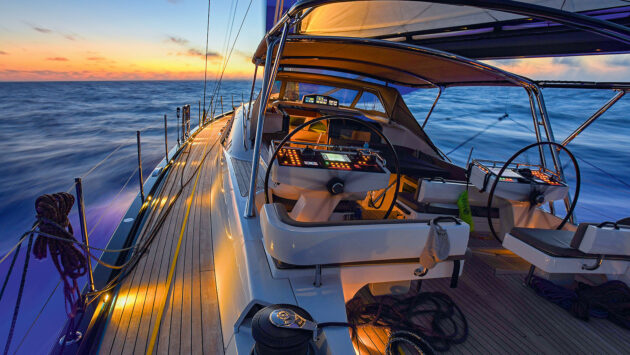
At night or in low visibility conditions, an autopilot may helm better than a human. Photo: Rick Tomlinson/Oyster World Rally
Environmental conditions
Conditions do not directly cause incidents, but the skill required to manage them does increase.
High winds make driving challenging, but unexpectedly changing winds are the riskiest. Squally conditions or an approaching front can swing winds by 60° or more. Unstable and shifty winds, especially over 20 knots, are particularly difficult to drive in.
Wind speed is not the whole story and big waves are not the only challenge. The test amplifies if you cross an oceanic current, sail over an area of dramatic underwater topography like a sea mount, or negotiate overfalls and messy breakers near headlands or rocks.
Visibility is another oft-overlooked factor. Low cloud or fog obscuring the horizon can be very disorientating. Darkness removes visual references. Be very cautious of a dark, cloudy night with a new moon.
Once in colossal conditions there are additional risks, like pitchpoling if the bow buries into the trough. Stalling and wallowing in the lee of two large waves can lead to a crash gybe. If the boat surfs fast it can broach, catch a wave on the beam and possibly capsize.
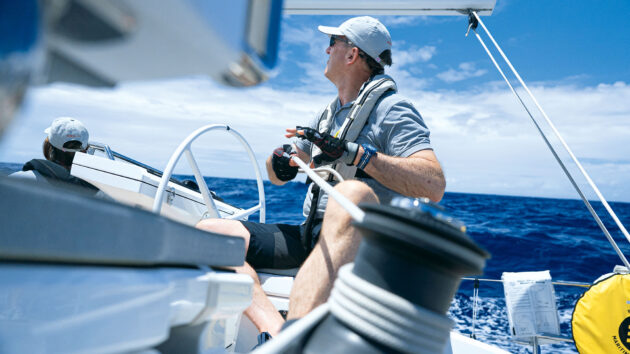
Downwind trimmers also need to maintain focus. Photo: Ugo Fonolla/Oyster Yachts
Top tips
- Assess sea state as carefully as wind strength.
- Be cautious of fast-changing conditions.
- Avoid sailing excessively deep in unstable seas.
- Monitor steering accuracy constantly. If course steered has a greater range than the margin between the TWA you are trying to keep and a crash gybe, something needs to change: Alter course to allow for the human error; Change helmsperson; Adjust sails; Increase response setting on autopilot
- Simplify sail plans as visibility decreases.
- Delay non-essential tasks during deteriorating or changing conditions.
Transitions
Incidents are more likely to happen at moments of change. Be wary of changes to the boat’s mode such as a gybe, bear away or sail change. Spinnaker douses or hoists can tempt a helmsperson to steer too low.
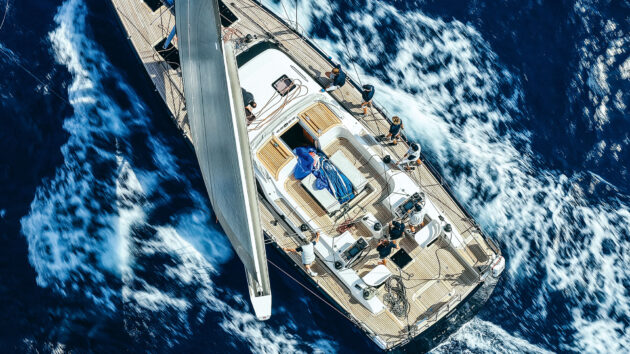
Fun racing – either full-on competition or cruiser regattas such as this Contest Meeting – can be a great way to hone crew communication and trimming skills. Photo: Sailing Energy/Contest Yachts
Any shift in sail trim like pole adjustment, reefing or headsail changes can also distract. The dangerous period is not just the manoeuvre but the minutes immediately afterwards while the crew and boat settle into the new rhythm.
Be equally cautious of watch changes, helm rotation and any moment where people move around (eg the helm hands over the wheel temporarily to adjust clothing).
Top tips
- Time changes carefully, eg avoid helm changes as a squall approaches.
- Use rolling watches to ensure the whole crew on deck isn’t new to the conditions.
- Make watch handovers thorough and always include an overlap.
- Ensure key roles remain focused on primary tasks.
- Assume a manoeuvre isn’t complete until 10 minutes after it has happened.
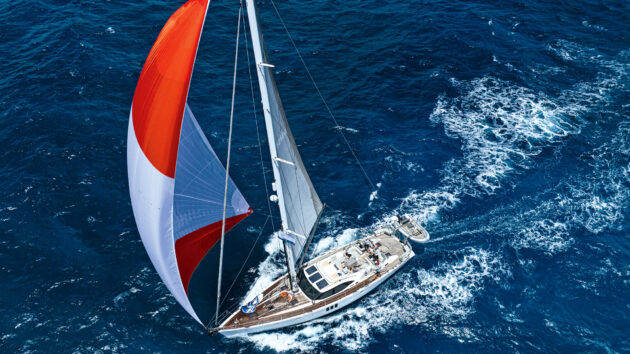
Match sail choice to the difficulty of conditions – an asymmetric set-up is most forgiving. Photo: Ugo Fonolla/Oyster Yachts
Downwind set up
The safest downwind setup is usually the most stable one, so match the set up margin for error to the conditions.
An asymmetric sail set up is more forgiving. The TWA range between spinnaker collapse (>160°) and broach (<120°) tends to be around 40°. This still leaves another 20° room for error before any catastrophic crash gybe. The spinnaker or the headsail will collapse if the helm steers too deep, so it tends to have a low accidental gybe risk.
A symmetric set-up is less forgiving. The helmsperson must steer a tightrope between keeping the sails full and not crash gybing, which means keeping a TWA range of maximum 30° with no room for error. Too much movement in the kite and the boat can roll, risking a Chinese gybe.
The symmetric kite floats around the forestay to windward and gives a pre-warning before a crash gybe, but a poled out headsail doesn’t offer any warning signs pre-gybe. The latter is the least fool-proof sail set up.
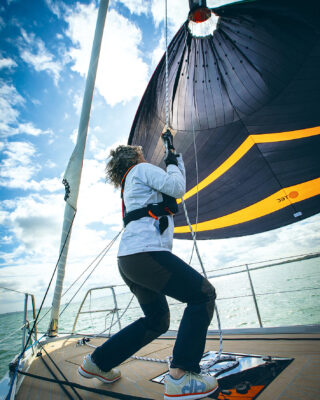
Using a snuffer to hoist an asymmetric. Photo: Richard Langdon/Ocean Images
Top tips
- Prioritise stability over depth.
- Monitor rudder angles and reduce sail area if steering becomes too manic.
- Match sail plans to conditions and not to what you hope ‘should’ be the case.
- If you start to roll with a spinnaker up, strap it down flat by lowering the pole and sheeting on harder. Or, drop it altogether and fly an asymmetric.
- Make sure the vang spring is effective and station someone on it if winds increase to avoid a broach.
- If the course steered by the helmsperson/autopilot has a greater range than your margin for error, change something. If flying a symmetric set-up, consider changing to an asymmetric set up. If you’re flying an asymmetric, consider reducing sail area. Reef the main, swap the kite for a smaller one, fly just a headsail, or furl the headsail.
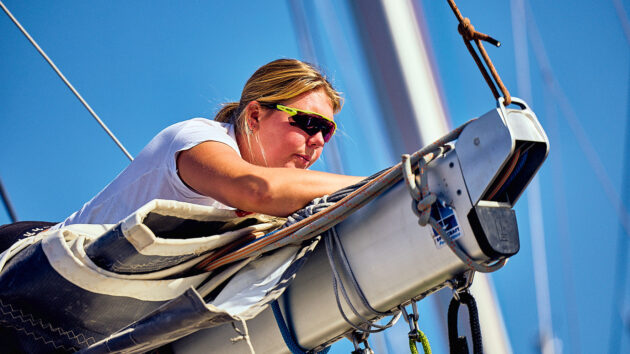
Thorough checks pre-departure will pay dividends. Photo: James Mitchell/WCC
Team culture
Accidents blamed on ‘bad luck’ are often systemic cultural failures. Safety systems and rules only work when they are applied consistently. If they aren’t obsessively enforced until they become habitual and happen automatically, there will always be a chance they’ll be broken, short-cut or forgotten.
Rules that are followed in heavy weather but ignored in moderate conditions eventually get seen as optional.
The strongest safety cultures identify a small number of non-negotiable rules and enforce them relentlessly. They may include clipping on at night, no chit-chat while driving or staying clear of designated danger zones.
There’s an art to leadership here – you need to strike the balance between complacency and micromanagement. Too many rules and you dilute the important ones.
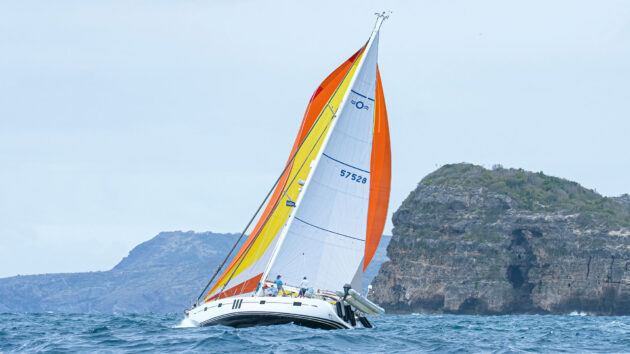
Have someone on the vang to avoid a broach if winds increase, eg when funnelling through islands. Photo: Ugo Fonolla/Oyster Yachts
Top tips
- Identify genuine life-or-death critical safety rules.
- Enforce consistently even if it’s overkill for the conditions.
- Keep things simple.
- Implement consequences if rules are broken.
- Lead by example. Never break your own rules.
- Use physical aids to reinforce rules like marking out dangerous zones.
Consequences
We cannot eliminate mistakes completely. In fact, they’re inevitable. Safe downwind sailing means preparing not just to prevent incidents, but also managing them.
Exit strategy
Every downwind sail set-up should have an exit strategy. A well-rehearsed, well thought through response can turn a major incident into a manageable problem.
Ask yourself: what if the sock doesn’t come down? What if someone falls overboard? What if steering fails? What if the wind suddenly doubles in strength?
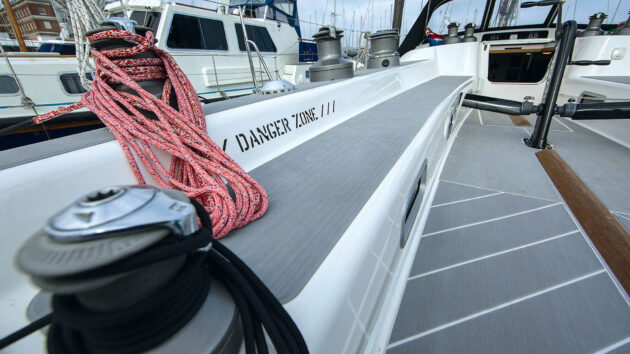
Clear prompts to crew to avoid areas where mainsheet/block may swing on 59° North’s Falken. Photo: James Astrums/59° North
Ideas
- Rig systems that allow for rapid depowering from the cockpit – especially for the kite (using a martin breaker on the tack line, for example)
- A crew member in the water disappears in 6-10 minutes if you are moving at 10 knots: add an AIS transponder to your danbuoy.
- Practice emergency spinnaker drops regularly.
- For cruisers who use socks on kites, lengthen the sock line enough to run through a turning point and onto a winch so you can pull it while sitting down in case of broach.
- Make a downwind reefing procedure.
- Print and laminate emergency procedures (MOB recovery, rig failure etc) and pin to the heads wall.
Safety Nets
Assume everything that might fail, will fail. Then consider if there is anything you can add/do to protect against a bad outcome if it does fail or a mistake is made.
- For steering gear, keep the autopilot powered on to steer via the quadrant if the wheel/tiller is out of action.
- For blocks, add a safety strop in case the shackle breaks.
- For lines that might break, consider doubling them up. So, a second preventer or a back-up headsail sheet. A flogging jib with a broken sheet in 35 knots is very dangerous and hard to get under control.
- Get crew familiarised with quick releases for their tether in case dragged overboard.
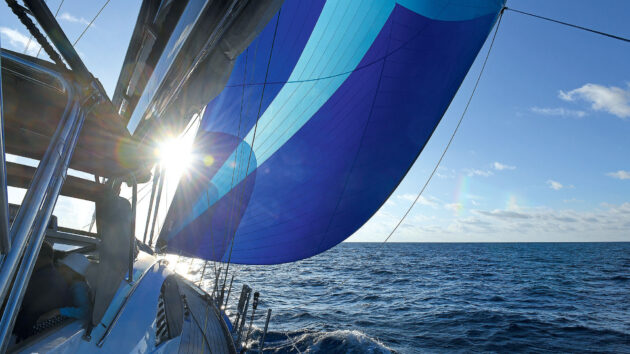
A tradewind passage followed by island landfall under spinnaker: the downwind dream. Photo: Rick Tomlinson/Oyster World Rally
Preventers
One of the most effective safety nets in downwind sailing is a preventer. Despite the name, preventers don’t prevent gybes. Provided they hold fast, they hold the boom to windward and stop the boom swinging across the boat in the event of a gybe.
Preventers seem to have an image problem, particularly among racers. They are often seen as uncool, a hassle, and something only cautious cruisers use. Yet, some fatal crash gybe incidents might have had different outcomes if an effective preventer had been rigged.
If the likelihood or consequences of a steering mistake are high, rig a preventer. This is especially true when sailing a symmetric sail set-up, in intensifying or unstable conditions, or with a fatigued or anxious crew.
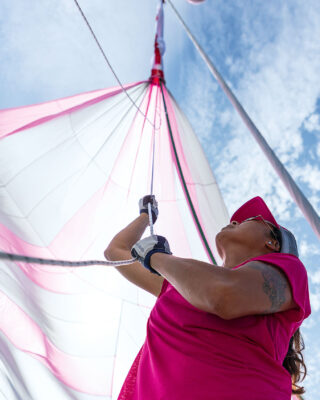
A spinnaker can be doused quickly and safely with a sock or snuffer. Photo: Tor Johnson
Top tips
- Rig preventers as part of your standard bear-away or gybe sequence.
- Lead them aft to the cockpit where they can be adjusted safely under load.
- Run them as close to perpendicular to the boom as possible, usually via a turning block near the bow.
- Make them long enough that the boom can be eased after a crash gybe.
- Consider incorporating a fuse or weak point that will fail before major rig damage occurs.
- Preventer adversaries argue that preventers put undue loads on the boom and gooseneck, particularly if the boom drags in the water. Station an active crew member on the preventer who can ease it promptly if needed.
Building experience
A skilled downwind helmsperson is deeply attuned to the boat and the forces acting on it, recognising changes early and responding instinctively. People often describe this as ‘driving by feel’, which makes helming sound like a dark art. It isn’t. It’s a learned skill.
Good helms learn to interpret heel, rudder load, boat speed, sail pressure and wave sets so that they can anticipate what a gust or a wave will do before it happens. ‘Experience’ slims the gap between perception and response. Some people have a natural affinity for helming, but almost anyone can become a competent helm with enough practice.
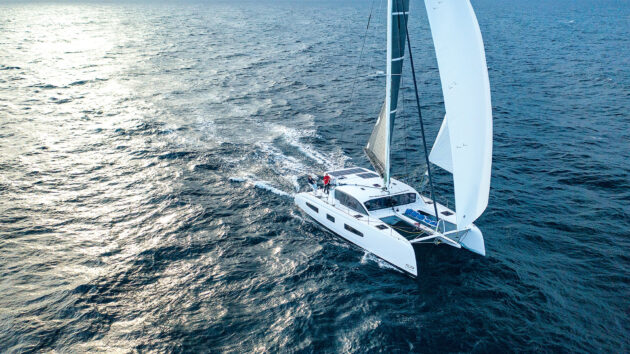
Multihull downwind sail options range from performance asymmetrics as on this Outremer 52, to gentle cruising under parasailor. Photo: Robin Christol/Grand Large Yachting
The key is guided exposure. Learning downwind helming takes time. You need enough challenge to generate feedback, enough safety margin to make mistakes, and enough time on the water to build instinct and muscle memory. A smaller and less powerful boat is best for training; something that allows safe mistakes.
Long tradewind passages are the most valuable to anyone learning to helm because they offer hours of continuous steering in relatively manageable conditions.
Yachtmaster mile-builder passages and adventure sailing companies such as 59° North, Rubicon and Sea Dragon provide great opportunities.
Once the fundamentals are established, racing offers the fastest way to improve. Cruisers reef early and rely heavily on autopilots. Racers tend to experience more sail changes, steering hours and time operating near the edge of control.
The learning curve is dramatically steeper provided the environment remains supportive.
 If you enjoyed this….

Yachting World is the world’s leading magazine for bluewater cruisers and offshore sailors. Every month we have inspirational adventures and practical features to help you realise your sailing dreams.Build your knowledge with a subscription delivered to your door. See our latest offers and save at least 30% off the cover price.
Note: We may earn a commission when you buy through links on our site, at no extra cost to you. This doesn’t affect our editorial independence.