




Toby Hodges takes a look at three new multihulls coming to the the market this year. Is performance taking over the multihull market?
Smart glass cabins, modular flat-pack builds, twin engines, and structural loads routed directly through the coachroof, the latest generation of performance multihulls is throwing out the traditional rulebook.
While trimarans were once strictly the domain of ocean-racing speed demons or spartan cruisers, three bold new designs are proving that three hulls can deliver the ultimate blend of pace, protection, and luxury living.
From Grand Prix naval architects to boutique boutique builders, here are the three brand-new trimaran concepts redefining what it means to travel fast on the water.
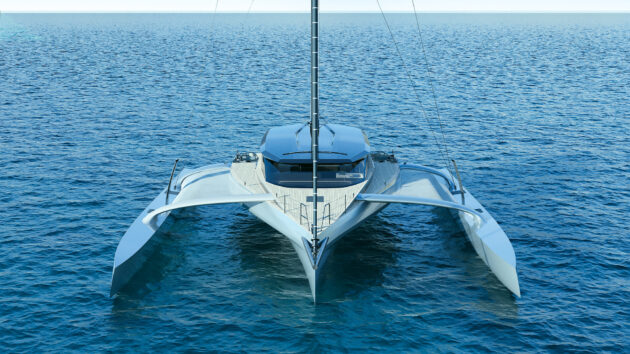
VMG 53 – a powerful new luxury fast trimaran to take on the catamarans?
VMG 53
Space, speed, safety and cutting-edge style are elements we’ve seen combined successfully on a performance multihull before… Arguably not on a trimaran, though.
Gunboat seemingly invented the concept of performance luxury cat cruising around 25 years ago, when it offered unseen Grand Prix speeds in a comparatively easy-to-handle package with new areas of living space. It has been much imitated since, albeit still on two hulls.
Now, after three years in development, new US company VMG (Velocity Made Good), is launching what it considers the future of luxury production multihulls with its new trimaran range. And it gains instant credibility from the companies it has brought together to help realise this, using some of the industry’s leading designers and builders. These include VPLP and Thorne design, interiors by Christophe Chedal Anglay (also Gunboat) and manufacturing at composite expert Oliver Dawson’s Evolution Marine in South Africa.
“For decades, the industry has watched VPLP’s trimarans dominate the world’s oceans, long anticipating the day this technology would be realised in a commercially produced vessel,” states VMG.
The initial concept belongs to Mike Schwartz, who I met alongside his co-founder, Karl Reed. The pair have long envisaged a fast cruising trimaran, but one with features that include easy sail controls, twin engines and a tender garage – elements that bring it right up to date with today’s expectations of luxury performance.
The use of twin engines on a trimaran is perhaps a first, a concept that should offer redundancy and manoeuvrability without today’s reliance on thrusters. The idea also makes space in the central hull for a tender garage. The argument here is that multihulls have long relied on davits, which can be an awkward way to retrieve a dinghy, and result in hanging a large weight right aft. Schwartz wanted the type of tender garage a large monohull offers, which enables one person to easily operate it and helps centralise weight more.
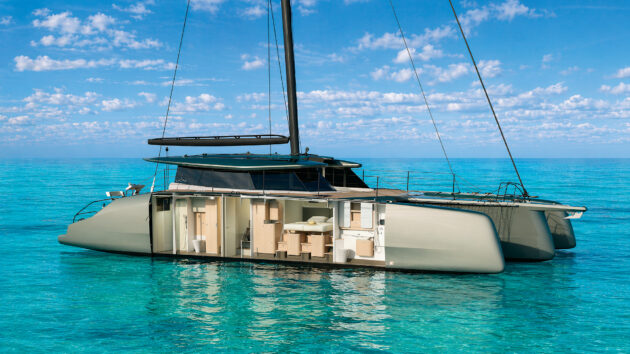
Tall, generous accommodation in amas
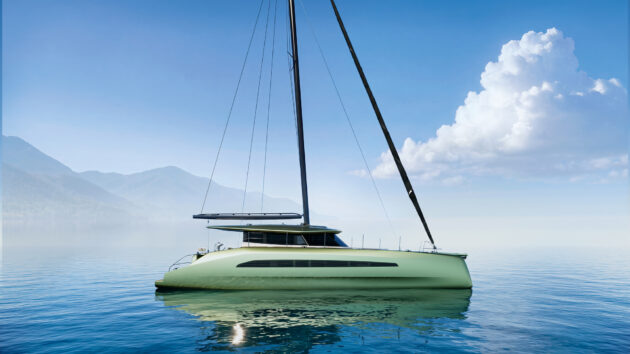
Other notable elements VMG offers include a forward sail pit and a smart glass-controlled cabin on the main deck level. Large cats are often offered with aft helms for a direct steering experience, or a single forward cockpit and helm. The VMG 53 provides both. The latter also links to a forward sailpit, again a little like early Gunboat designs. This facilitates sail controls from one position, including the hidden powered daggerboard, while this area is a comfortable space to seat guests.
Anyone who has stepped aboard a Neel will know the benefits of having a cabin on the main deck, which brings prime views and easy connection to the living and sailing zones.
But how to make it private? VMG has created an on-deck suite that offers surround visibility, yet uses smart glass that will become opaque at the touch of a button to create privacy. This instant frosted glass also doubles as a projection screen for navigation info or media.
Three more guest cabins are offered, including a full owner’s hull to port. There is also abundant stowage, including an adventure locker in the port bow, with customisable board or bike racks and dive tank compartments.
VMG’s Regatta edition has a 26m Marstrom carbon mast that carries 113m2 of mainsail and a 255m2 gennaker, so it should offer a sporty experience. This version has a hull laid-up in composite glass sandwich, foam-cored carbon deck and roof and carbon epoxy bulkheads, while a GP edition can have a full carbon hull too.
Evolution Marine is gearing up to be able to produce up to five a year, and we will carry out the first test sail when it launches in Cape Town.
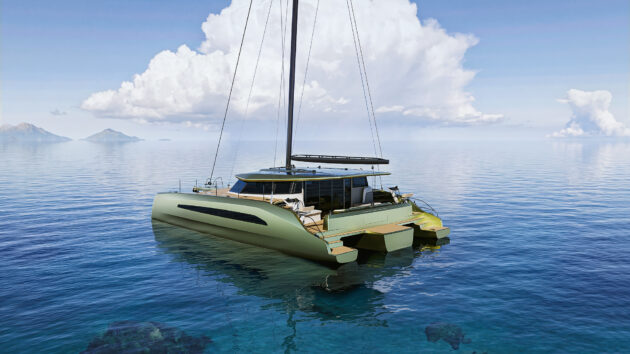
Central hull boasts a tender garage to avoid the need for davits
VMG 53 specifications
LOA: 17.22m 56ft 6in
LWL: 16.14m 53ft 0in
Beam: 8.8m 28ft 11in
Draught: 0.8m 2ft 8in
Displacement: 16,500kg 36,400lb
Contact: vmgtrimarans.com
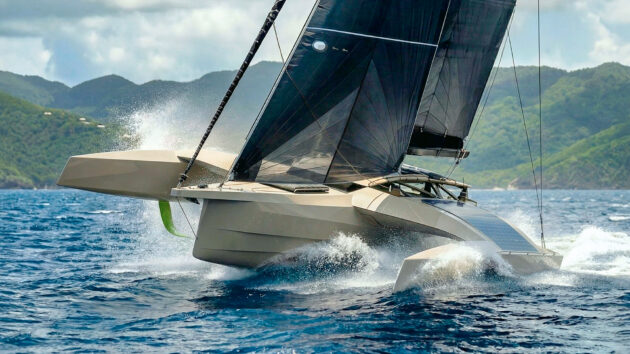
Innovative Ipsum 45 should be capable of cruising at 25 knots
Ipsum 45
This is one of the most innovative, striking and absorbing new multihull designs I’ve ever seen. The 45ft modular trimaran offers a breakthrough in structures and space, and is capable of sporty or adventure cruising at 25 knots.
I met up with its founders at the International Multihull Show, where this large graphic of the yacht anchored off a remote surf break (shown right) sold the project instantly.
Ipsum is a startup French brand that has created a design whereby the three hulls are able to accommodate a variety of layouts and convertible configurations to suit anything from sporty sailing and racing to full adventure cruising. It takes the latest offshore multihull technology for construction, protection, steering and control and offers that on a platform designed to adapt to each owner’s needs.
This modular aspect means pre-fabricated base boats (hull and floats) can be transported in a container to be finished to suit each customer.
Among other things the range of options Ipsum presents includes wing sails, a convertible doghouse, an adventure pod with board racks and, fundamentally, new levels of accommodation space at this size and sporty format.
Design is by Loïc Goepfert, a visionary who created the innovative (albeit short-lived) Alibi catamaran brand, and since 2019, has worked with virtuoso naval architect Guillaume Verdier.
Their research into the recently launched Gitana 18 Maxi Edmund de Rothschild, probably the fastest and most futuristic multihull now afloat (and also its monohull counterpart, the Ferrari Hypersail project), not only lends serious credibility to this ‘labour of love’ design, but also helped Goepfert realise some key design parameters.
He explains how the new foiling Ultim needed a structure capable of handling the eye-watering loads across the extensive full beam.
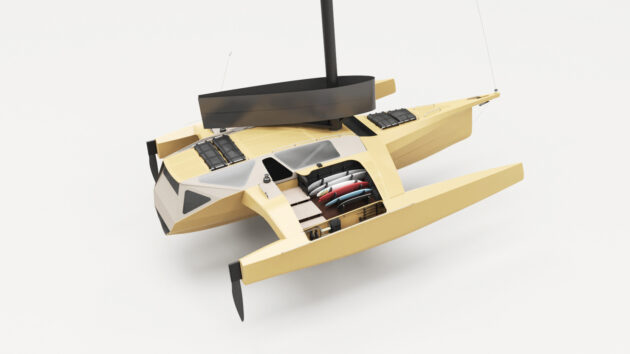
One option between the amas includes customised stowage and racks for watersports gear. This image also shows the ACC Wing Sail option
Applying this thinking to the Ipsum 45 helped them envisage a roof that takes the rig loads and frees up new levels of interior volume. Where most conventional boatbuilding requires the structural bulkheads to carry the main loads, which defines the interior layout, Ipsum says that by routing the structural loads through the roof, they are left with a completely open volume to use for their interiors.
This results in unseen volumes at this size, which are completely customisable to suit, from leaving race-ready bare, to the option for two double cabins in the main hull alone.
It also means sailors helm from beneath the roof, which can be left open on the sides, offered with a fabric cover, or enjoy a fully protected and sheltered position with a clear horizon view.
“It’s the same philosophy we developed on Gitana 18. Two helm stations are positioned on each side of the roof, with tiller extension to hand, or the boat can also be fully controlled from inside, thanks to a steer-by-wire system,” Goepfert explains.
The space between the central hull and the amas can be left as traditional netting, or Ipsum has developed an intriguing ‘Newing’ option, which converts the space into living or stowage volumes, effectively offering double cabins each side. These feature campervan-style pop-top roofs with private entries and heads compartments. They can be fitted out as studios or adventure hubs with racks for paddle, dive, surf, foil, or kite gear.
Ipsum can manage a full build, or offers a master kit, which includes hull, floats, roof. Options abound, from construction choices to coverings and interior modules. With this in mind, Ipsum says a build can take from 5,000 hours for a pro team to create a bare interior boat, to double that for a solo builder doing a full custom fitout. Likewise, displacement will also vary from a race-light 4 tonnes to 7.5 tonnes cruising spec.
Pricing is therefore hard to gauge, but its website states: ‘A bare minimal carbon build can come in under €400,000. A fully fitted cruiser with ACC Wing Sail and custom interior can easily exceed €1m’.
“We want owners to really be able to choose everything and be able to fit it to their wishes,” adds Goepfert. “The DIY approach acts as a fantastic filter; it connects us with truly passionate sailors.”
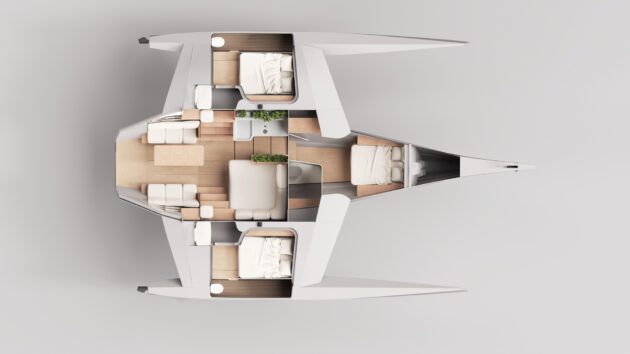
Modular design means layout can be very flexible
Ipsum 45 specifications
LOA: 14.2m 46ft 7in
Beam: 9.15m 30ft 0in
Draught – boards up: 0.59m 1ft 11in
Draught – boards down: 2.20m 7ft 2in
Displacement: 4-7.5t
Contact: ipsum.yachts
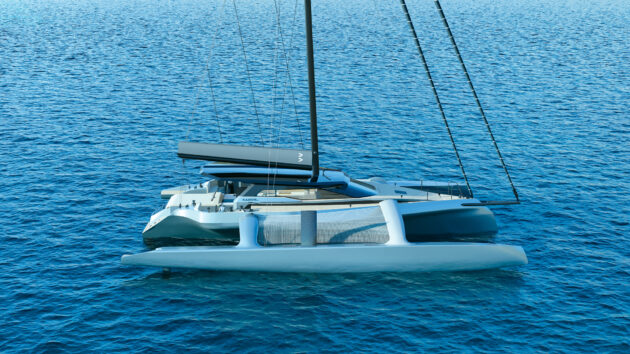
Sleek, powerful lines for the Kairos trimaran
Kairos trimarans
Five years ago we sailed the novel IC36, a sporty cat from new Czech brand Independent Catamarans. The fresh design and ideas packed into that model, together with the open feeling of the cockpit, stayed with me long after that trial, and it’s interesting to see it return this year with a full new range of much larger multihulls, in both trimaran and catamaran formats.
The Aion catamarans span from 52-60ft, while Kairos is the name given to the tris, the new flagship range that includes a 52, 58 and 66ft model. Both feature modern lines by Emilio D’Onofrio/Zero13, together with exterior and interior design by Lorenzo Guadagnucci.
Aimed at experienced owners seeking top performance, the long, low, muscular lines of these trimarans in particular look good, as does that open-air format the large cockpit once again provides.
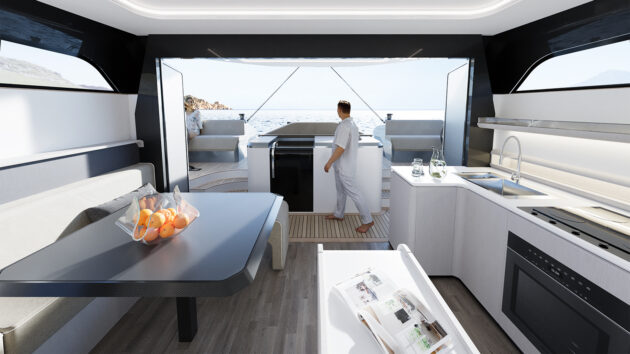
Saloon opens up to the vast cockpit living space
The wheels are placed outboard of the low, protective coachroof to provide good visibility from the same height sole. Meanwhile, the aft cabin on the main hull, complete with huge sunpad above and twin ballroom-style stairwells each side that lead to an aft terrace, will also appeal to those looking to blend their speed sailing with some serious luxury at rest.
The 52 offers six to eight berths, on a platform displacing just over 9 tonnes, where the 66 adds another cabin and an extra metre’s beam for 12.7 tonnes light displacement.
The Kairos range is priced from €2.4m.
Contact: independentcatamaran.com
 If you enjoyed this….

Yachting World is the world’s leading magazine for bluewater cruisers and offshore sailors. Every month we have inspirational adventures and practical features to help you realise your sailing dreams.Build your knowledge with a subscription delivered to your door. See our latest offers and save at least 30% off the cover price.
Note: We may earn a commission when you buy through links on our site, at no extra cost to you. This doesn’t affect our editorial independence.