


Racing round the world via the great capes is an ultimate bucket list item, but what’s it really like? Rupert Holmes found out when competing in the Globe 40
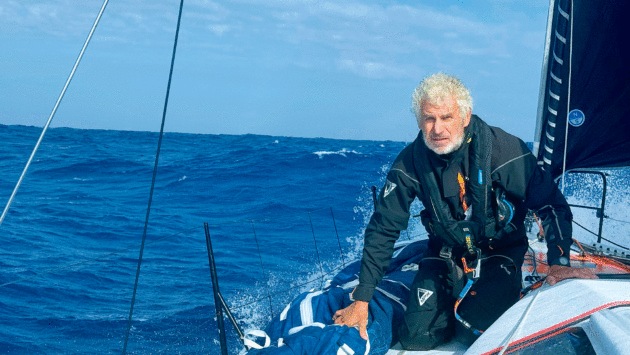
Four days from the Cape of Good Hope it’s still proving impossible to identify a safe route past the cape and the infamous west-going Agulhas current. At this point we’re 25 days into the 40-day, 8,000-mile second leg of the race, taking us from the Cape Verdes to Reunion in the Indian Ocean.
A full gale blowing against the Agulhas, which can reach five knots, can produce breaking waves capable of inflicting serious damage to large ships. And we have 40-plus knots of breeze forecast, plus we’re double-handed in a 40-footer.
Should we slow down and stay to the north-east, waiting for this low pressure system to pass? It’s tempting and we certainly don’t want to risk breaking the boat, or ourselves. But more depressions are on the way and we don’t want to give away unnecessary ground. Fortunately, the next two weather model runs show the low passing further south, so conditions should be manageable.
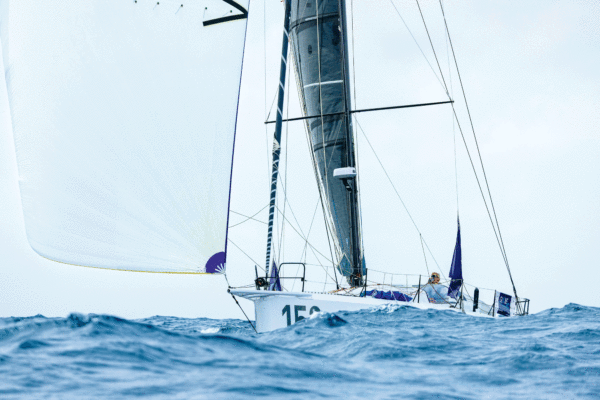
Photo: Jeam-Marie Liot/Globe40
Even so, four days later and 750 miles further east, a 60-70 mile wide swirl of the Agulhas with wind against current is impossible to avoid. We’re at 40° south, with a northerly wind gusting to 37 knots. Even with two reefs in the mainsail and just a small staysail we’re screaming along at speeds in the mid-teens.
This course is beam on to the seas, so we try bearing away to take the waves on the quarter, hoping it will be a safer angle. But the boat accelerates to 20 knots, repeatedly slamming violently into the wave ahead, so we return to the original course.
The sea state is so confused that moving around inside is only safe if you adopt the climber’s mantra of always having at least three points of contact. To move one foot you must hang on firmly with both hands. Periodically Jangada 40 falls off a big wave, with a juddering crash that submerges it in almost solid water, before carrying on as if nothing had happened. We both wonder how much longer the boat’s structure can survive this kind of pounding.
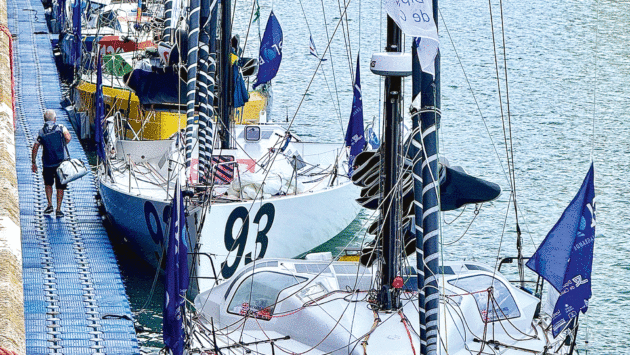
The fleet lined up in Cadiz. Photo: Richard Palmer
Robust 40s
Despite their very light displacement and enormous power, Class40s are supremely seaworthy, with massive stability. They’re also among the smallest and most accessible craft with sufficient speed to navigate around severe weather systems deep in the Southern Ocean and can be set up to be very easy to handle, even in severe weather.
Jangada 40 is a Tizh 40 design by Guillaume Verdier and one of the last of the ‘sharp bow’ designs, built just before the scows came to dominate the class. It’s a well-proven design, in which Yannick Bestaven won the brutal 2015 Transat Jacques Vabre. It also has far better shelter, with a cuddy at the front of the cockpit, than other sharp bow Class40s.
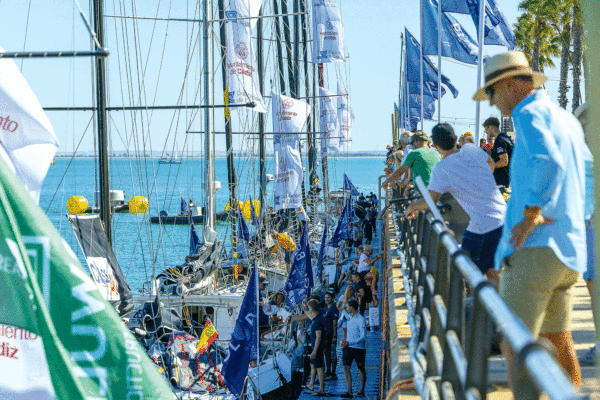
Attracting plenty of interest ahead of the start in Cadiz. Photo: Jeam-Marie Liot/Globe40
I suggested the Globe 40 race to Richard Palmer over a curry after Cowes Week three years ago. Three weeks later we were shopping for a boat. He took ownership in the Caribbean just after it had completed the 2023 Transat Jacques Vabre.
By this time Richard and I had already raced 10,000 miles together on his JPK1010 Jangada, including the RORC Transatlantic and the 2022 Sevenstar Round Britain and Ireland Race, becoming the first two-handed boat to take overall victory in the latter. That season Jangada also won RORC’s overall Season’s Points, the first two-handed entry to do so.
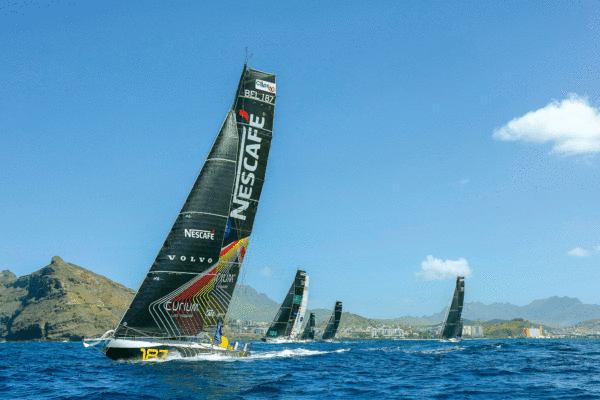
Though the fleet all started together, there was an unofficial ‘sharp versus scow’ contest within the race. Photo: Jeam-Marie Liot/Globe40
However, early setbacks to our Globe 40 campaign included an injury that prevented Richard from competing in the 2024 Caribbean 600, scheduled as an important first learning step with Pip Hare and French sailor Paul Brandel, the previous boat captain and TJV co-skipper.
A significant ingress of water when the boat was under guardiennage in Antigua awaiting shipping back to Europe didn’t help, nor did a gut-wrenching whack of the mast against the ship’s crane as she was unloaded in Lorient. This all led to us losing much of the 2024 season, with the result that ourselves and Wilson were the only teams at the start of the Globe 40 Race without significant Class40 experience.
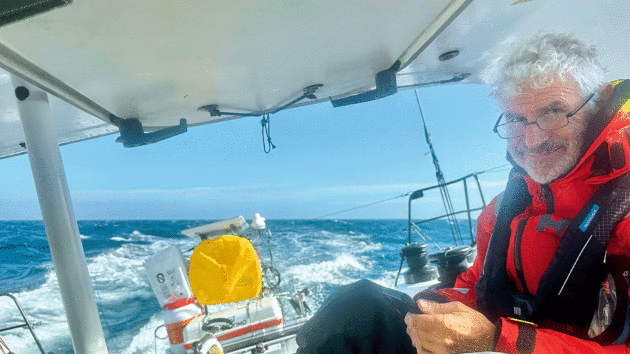
Jangada 40 is a Verdier-designed Tzih 40 with good crew protection in the cockpit. Photo: Richard Palmer
Fortunately, a massive refit in Cowes managed by Brett Aarons over the winter of 2024/25 went smoothly. This included stripping the boat back to its shell, NDT testing the structure, adding watertight bulkheads and longitudinal stiffening, plus rewiring and new electronics, rigging and sail wardrobe.
The effort and skill that went into this phase was undoubtedly a key factor behind the reliability of the boat during the race, as was the hard work and deep knowledge of technical manager and preparateur, Loïc Féquét.
Lorient has been my home port for the past four years, so in one sense departing for the Prologue race from Lorient to Cadiz didn’t feel much different to sailing on any other sunny afternoon. But it was impossible to avoid thinking of the enormity of what might lie ahead.
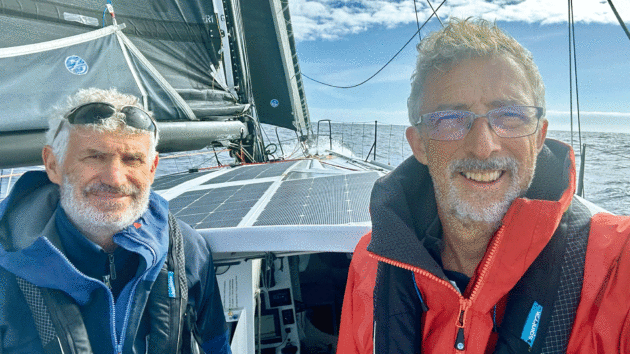
Rupert Holmes (left) and Richard Palmer hatched their plans to compete in the Globe 40 Race over a curry after Cowes Week. Photo: Richard Palmer
Heading out
Happily, we were the first of the older sharp bow designs to round the north end of Ile de Groix and bear away south-west across Biscay, where we escaped a near miss with a whale. Cape Finistere provided our first taste of big breeze, sailing upwind in 32-33 knot gusts. By contrast, Whiskey Jack – the only boat to route outside the Finisterre traffic separation scheme – encountered gusts to 57 knots.
Other early high points included helming past Cape St Vincent, the most south-westerly point of Portugal, sailing faster than the waves in full planing mode. You could therefore choose which waves to jump on – or avoid – by looking ahead, rather than glancing over your shoulder.
Four days into the leg from Cadiz to Mindelo, Cape Verde, we were in very light airs just to the south of Fuerteventura, just a couple of miles behind Wilson and around 30 ahead of Whiskey Jack.
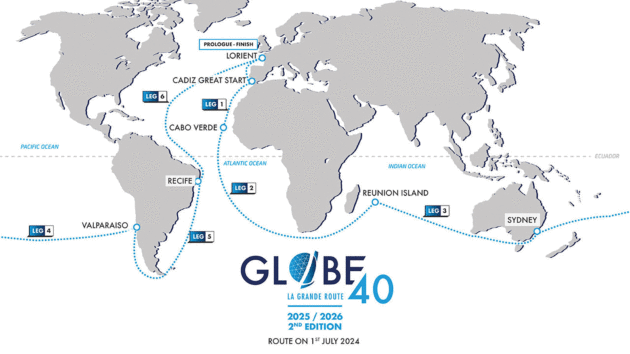
The six stopover ports. Photo: Globe40
But after the wind filled in we had the first of many low moments: losing a new A6 spinnaker in the middle of a dark night, when the splice attaching the head of the sail in the sock to the halyard failed. The sail was swept into the blades of the hydrogenerator, which rapidly shredded the fabric.
We quickly determined the larger A2 spinnaker had the same defect and therefore also couldn’t be used for the rest of the leg. We reached Mindelo just 160 minutes behind Whiskey Jack, losing two points relative to her that would haunt us for the rest of the race.
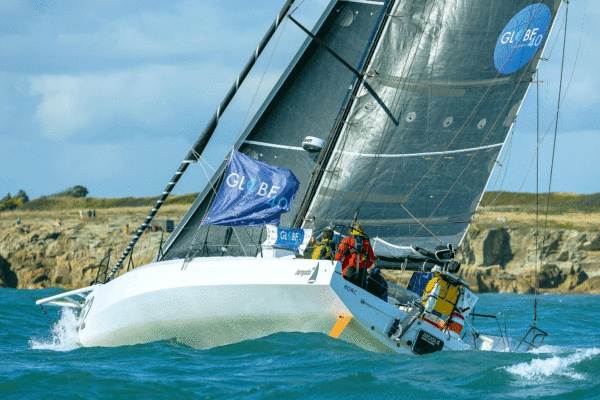
‘Competition throughout the fleet remained super-tight’. Photo: Jeam-Marie Liot/Globe40
Problems to overcome
Similarly, damage to the bobstay to the west of the Bass Strait between mainland Australia and Tasmania cost valuable time. We’d been sailing at speeds up to 20 knots with the FRO set in 30 knot-plus winds and 5m seas, but luckily spotted the problem before the sprit sustained damage. However, we had to wait six days for the sea state to subside to safely shimmy out to the end of the sprit to make a repair.
After we’d led them for almost 5,000 miles, Whiskey Jack then overtook in the final 100 miles of the long beat up the east coast of Australia. We were little more than two hours behind at the finish inside Sydney Harbour, but this was a triple-point scoring leg and it may as well have been a two-week deficit.
The first three days out of Valparaiso, heading towards Cape Horn, were some of the toughest of the race, in full upwind mode in 25-35 knots and a brutal sea state. It was physically tough, next to impossible to sleep and the entire fleet suffered damage.
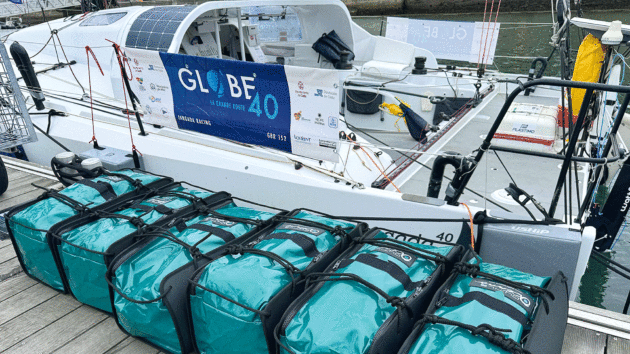
Freeze-dried provisions ready to be stowed. Photo: Richard Palmer
For us this was restricted to a leak in the port water ballast tank and failed padeyes for the leecloths that hold the stack of gear, food and sails to windward. Neither could be repaired until conditions moderated and the loss of 700kg to windward inevitably impacted performance. This was then compounded by the lower spreaders punching a hole in the lightweight masthead Code 0 in the calm that followed, necessitating another time consuming repair.
When you’re properly tired and losing ground it’s very easy to get things out of proportion.
Yet a key skill is the ability to regulate emotion and keep a positive frame of mind, even when faced with repeated knockbacks. On short 24-hour races a common refrain when things get tough is that it’s only temporary – eventually the sun will come out again, and all will be well. Racing around the world takes this to a whole new level and ‘temporary’ in the context of the Globe40 can be as long as 10 days.
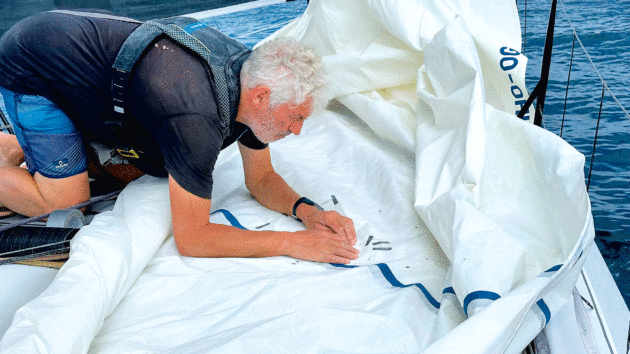
Rupert repairing a hole in the masthead Code 0. Photo: Richard Palmer
Nevertheless, the high points overwhelmingly outweighed the lows and the Pacific leg was particularly good. We took a conservative approach to the start in Sydney Harbour, but then led the sharp bow division for four days, only relinquishing the lead – and 3rd place overall – on the approach to New Zealand’s Stewart island.
The competition throughout the fleet remained super-tight and even when we crossed the International Date Line, after a week at sea, the first four sharp bow boats were still only an hour apart. Next was a blisteringly fast three-week sleigh ride, notching up numerous 300-mile days, with peak boat speeds of 27 knots.
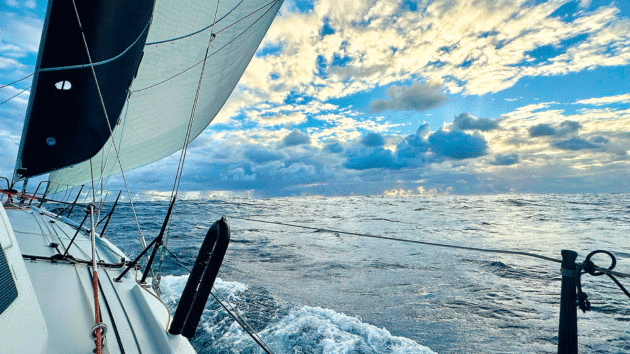
Heading north on the return leg in the South Atlantic. Photo: Rupert Holmes
A dead heat
The newer scow bow boats are in a different league in terms of speed and Belgian Ocean Racing – Curium beat the outright 24-hour distance world record for a 40ft monohull, covering 459.78 miles at an average speed of 19.2 knots, and hit a 31.5-knot top speed.
They dominated the fleet on this leg and, having averaged 320 miles a day, held a narrow lead on Credit Mutuel approaching the virtual finish line, but sailed into a calm in the lee of the headland south of Valparaiso, allowing the French boat to catch up. The result was so close that, even after analysis of each boat’s data logs, the race committee had to declare a tie.
Four days later, when we were 100 miles from the finish, Wilson appeared on AIS crossing our path a couple of miles ahead. A few minutes later Whiskey Jack popped up 10 miles astern. The three of us charged through a dark night under big A2 spinnakers sailing at a consistent 11-14 knots, with frequent surges to 16 or 17 – and all three crossed the finish within less than an hour.
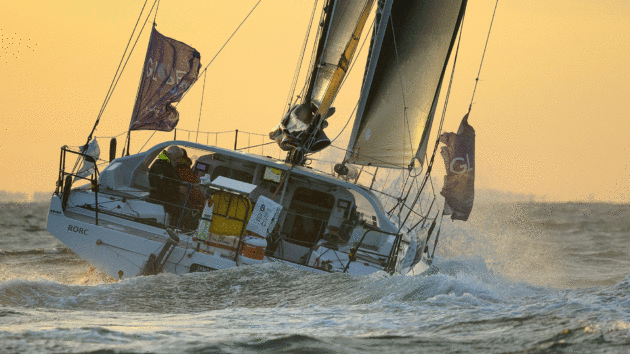
A picture-perfect evening for Rupert and Richard’s finish in Lorient. Photo: Jeam-Marie Liot/Globe40
The feel-good factor you get from mastering complex skills is a big driver for me. From the outset I was aware this race would also be a race to learn as fast as possible. We certainly all speeded up considerably relative to polars, a factor race director Miranda Merron noted in Valparaiso. But it seems we all improved at a similar rate, so no-one gained a competitive advantage.
In the south we were usually accompanied by a menagerie of sea birds, including numerous albatross, though sadly nowhere near as many as I remember from my first time there in the mid-1990s. We never tired of seeing them and observing the way they effortlessly glide for hundreds, if not thousands, of miles.
After the tough departure from Valparaiso Richard and I had a prosaic rounding of Cape Horn, under spinnaker on a crisp moonlit night. The good weather held past Staten Island and as far as the Falklands, but by this stage of the circumnavigation I was increasingly tired and could feel my reserves of resilience diminishing.
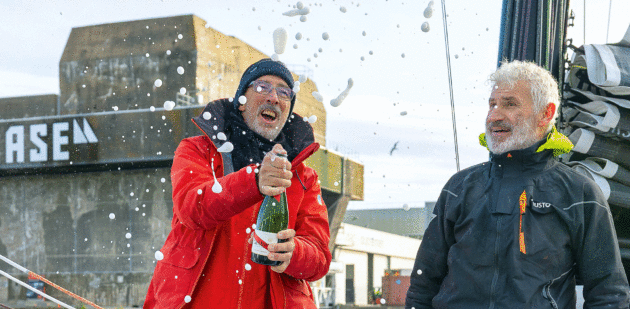
Well-earned celebrations! Photo: Jeam-Marie Liot/Globe40
In the South Atlantic it’s much more difficult to dodge the vigorous new lows that spin up in the lee of the Andes. North-east of the Falklands we were hit with the biggest winds of the entire circumnavigation, recording gusts to 55 knots, while Free Dom and Wilson both reported over 60. Here we also met a wave that tipped Jangada to an angle the instruments measured as 70° (though a mere 50-55° is more likely).
When I covered the finish of the inaugural edition of the Globe 40 for Yachting World, the strong sense of camaraderie among the teams was especially striking. This was equally evident in the second edition and helped make the stopovers, when we were also joined by family, special. Our stopover on Reunion island, with its dramatic volcanic scenery, was particularly memorable, as was Christmas and New Year in Sydney.
The end of such an intense project – we sailed 34,000 miles in 32 weeks – is always a big milestone and many competitors were conscious it would mark the start of a very different phase in their lives. I had many ongoing projects to return to, but was unsure how I’d feel at the finish.
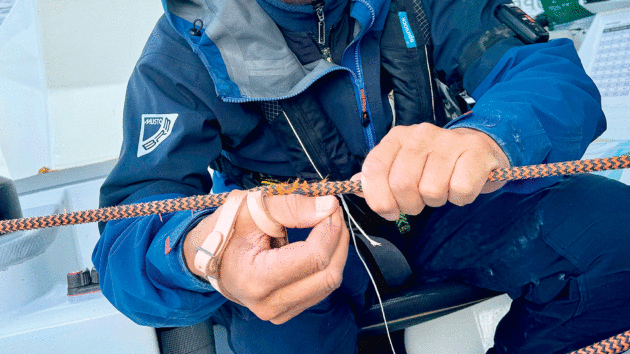
Adding a whipping line. Photo: Richard Palmer
Five days before I wrote the following, which turned out to be pretty accurate: “I don’t know what I’ll feel at the finish. Relief? Certainly – there are many potential pitfalls in getting a boat like a Class40 round the globe.
“Deflated? Most likely. If you successfully cruise round the globe, then you simply celebrate the achievement of your circumnavigation. But when you’re racing it’s a different story – everything is measured – and there’s no hiding that you could have done better, even if the final standings don’t show how close the competition was throughout and the tiny margins between boats.
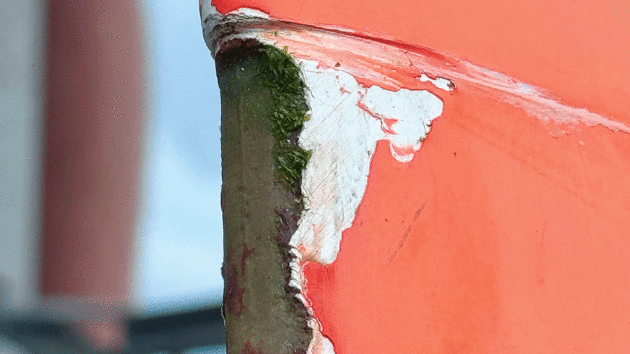
Minor damage to keel and rudders due to contact with debris. Photo: Rupert Holmes
“Elated? I hope so – it’s been an amazing journey, with some great people, lots of learning and many special memories.”
Article continues below…
Island-hopping across the vast Indian Ocean
There’s a saying among sailors that plans are only ever made in the sand at low tide. Sailing the world…
Sailing the Transatlantic Race on Hound: ‘Hound is a poster child for a bygone era of yacht design’
It’s early morning on 25 June, and last night was tough. The wind peaked at 32 knots and up on…
Globe 40 fleet
1st: Ian Lipinski – Credit Mutuel #202
The pre-race favourite, Lipinski has a stellar track record including rare consecutive Mini Transat victories. Sailed with top-flight co-skippers including Antoine Carpentier, Amélie Grassi and Alan Roberts.
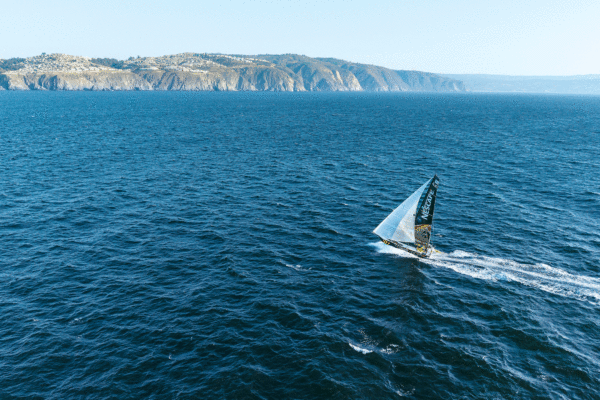
The Belgians approaching Chile, where they finished in a dead heat with Credit Mutuel. Photo: Photos: Jeam-Marie Liot/Globe40
2nd: Jonas Gerckens – Belgium Ocean Racing – Curium #189
Pushed Lipinksi’s team hard throughout, and started the final leg on equal points. Raced with
a rota of co-skippers including Benoit Hantzperg and Djemila Tassin.
3rd: José Guilherme Caldas / Luiz Bollina – Barco Brasil #151
Caldas is an amateur sailor with three Cape2Rio victories, and also a top neurosurgeon. Barco Brasil is his second Class40 and he approaches sailing with the same passion for learning and diligence, finishing 3rd overall and first ‘sharp’ bow boat.
4th: Thibaut Lefevere – Free Dom #139
Reunion Island-based team sailed with a rota of co-skippers, including Maxime Bourcier, putting in an excellent performance to take 4th on tie-break.
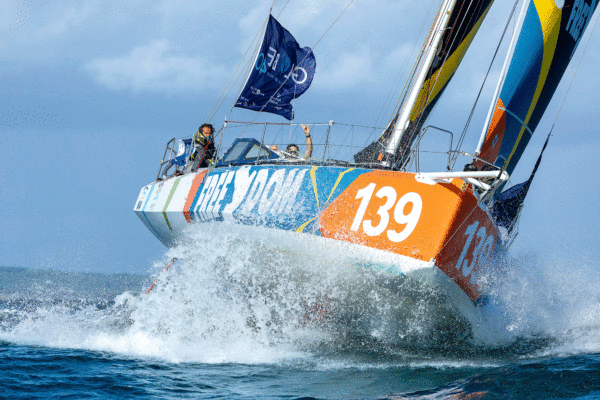
Free Dom
5th: Lisa Berger / Jade Edwards Leaney – Wilson around the World #93
Berger won the 2019 Eurosaf Mixed Offshore Championship and raced Mini 650s for three years.
6th: Melodie Schaeffer – Whiskey Jack #128
Schaeffer won the Canadian Rolex Sailor of the Year after competing in the inaugural Globe 40.
7th: Richard Palmer / Rupert Holmes – Jangada 40 #152
Have a track record of success in long-distance short-handed IRC racing both together and separately, including overall victory in the 2022 Sevenstar Round Britain and Ireland race.
8th: Lennart Burke / Melwin Fink – Next Generation Boating #187
This young German team competed in the Globe40 on the recommendation of Boris Herrmann. Rig damage forced them to drop out of Leg 3.
 If you enjoyed this….
Yachting World is the world’s leading magazine for bluewater cruisers and offshore sailors. Every month we have inspirational adventures and practical features to help you realise your sailing dreams.Build your knowledge with a subscription delivered to your door. See our latest offers and save at least 30% off the cover price.
Note: We may earn a commission when you buy through links on our site, at no extra cost to you. This doesn’t affect our editorial independence.