


Jeanneau’s 9th generation Sun Odyssey range has a lot to deliver on – we major on the SO455, the range’s first all-new design
Jeanneau Sun Odyssey 455 review: Can the 45 footer really replace two iconic models?

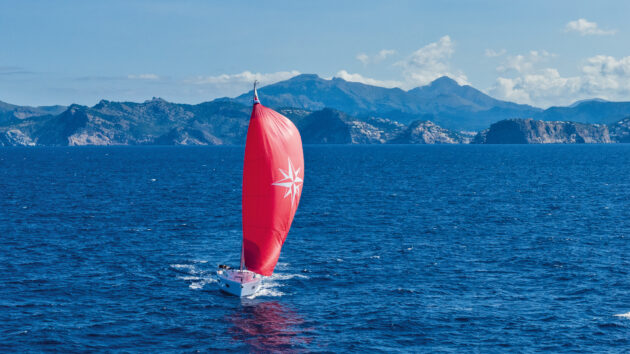
Combine the innovation of the larger Sun Odysseys from Jeanneau’s previous range, with the sportiness of its smaller models, and the potential for this new 9th generation is strong. But is parent company Groupe Beneteau and Jeanneau asking too much of this popular family cruising marque?
While the SO415 is a tweaked version of the SO410, this SO455 is the first fully fresh design of the new generation and has a lot to deliver, as it replaces two popular models to become the new flagship of the range.
The SO440 and SO490, launched seven years ago, were particularly innovative designs, the first production yachts to take the full bow sections used on ocean racing yachts and employ them for internal volume benefits, a design feature now used by most cruising yacht brands. They were also the first breed using Jeanneau’s ramped side decks to allow for safe walkaround access.
So while Jeanneau’s SO yachts have long been regarded as the consistent all-rounders, you get the impression that with the release of a new generation they have to bring that demanding balance of versatility with enough fresh thinking.
Tasked with replacing two models, the SO455 has to outperform its 45ft competitors yet also offer the space of 50-footers. So not only is it up against award winners such as the Hanse 460 and Bavaria C46 and needs to undercut them, but it also has to rival the likes of the Dufour 48, even the new Oceanis 52.
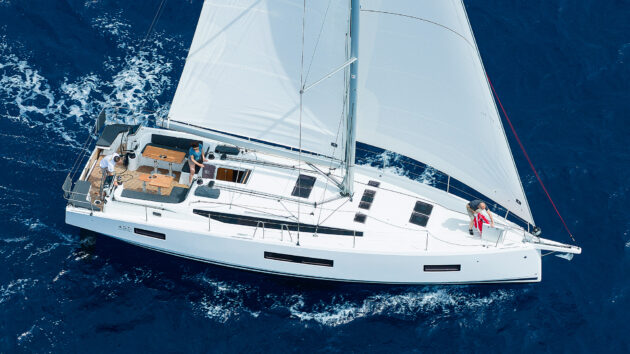
The best view we have of the cockpit (limited images so far), but note the wraparound coamings aft and primaries which are well inboard. Photo: QAPTUR
Jeanneau says this SO455 has the dimensions of the SO490, including the forward cabin and boasts the same cockpit space and aft cabin space as the Oceanis 52. Yet this is contained within its 45ft hull length and 4.5m beam, at a displacement that is over 3 tonnes less.
For a model that will be almost as popular in charter as it will for private ownership, this logic has appeal too. These sailors seek the space but not necessarily the length, for easy manoeuvring and responsive sailing, combined with deck lounging area and comfortable cabins. This focus results in an unsurprisingly voluminous shape, featuring a full bow and particularly generous cockpit, which retains the ramped side decks.
Curious to see if it works at sea, we reserved two sailing days for our trial this April, but had to contend with very little breeze. However, while this is a generalisation, I should add that some of the most reliably good sails I’ve had on production yachts in recent years are those from the Marc Lombard Design Group, and that was the case with the SO415 – which I sailed in ideal Force 5.
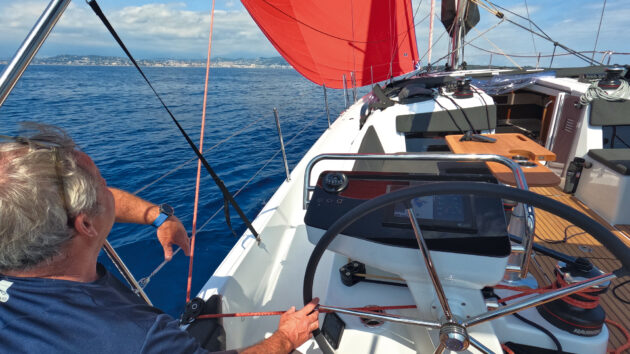
Comfortable helmsman’s spot but the kite sheet fouls side deck access to leeward. Photo: QAPTUR
Heavy hitting
Manoeuvring, lifestyle and flow have been prioritised on the SO455. Boarding from aft via an open transom highlights this impression, with split tables helping emphasise a wide, comfortable cockpit. The single-level cockpit sole is low, leading down four companionway steps to a one-level interior. While enhancing flow, the open transom design eliminates the option of a central seat or a plancha grill and sink, a popular feature offered by competitors like Dufour.
This large cockpit is the heart, intelligently designed to keep sailing systems practical yet separate from the spacious lounging area. Central to this is arguably this yacht’s best feature: the inboard position of the primary winches.
Rather than the novelty coamings of the SO490, which folded out into sunpads, the coamings return around the aft of the benches, both to enclose the cockpit seating each side in a C-shape, and to offer this inboard winch placement. The mainsheet and headsail sheets are led under these coamings through 90° cheek blocks to the winches. While this adds some friction, it allows you to work the main, headsail or spinnaker sheets from a practical standing and protected position.
Unlike many production yachts these days, which squeeze the winches into the quarters to maximise cockpit space, this design also leaves comfortable room for the helmsman, for crew to access the ramped deck, and keeps the mainsheet out of harm’s way.
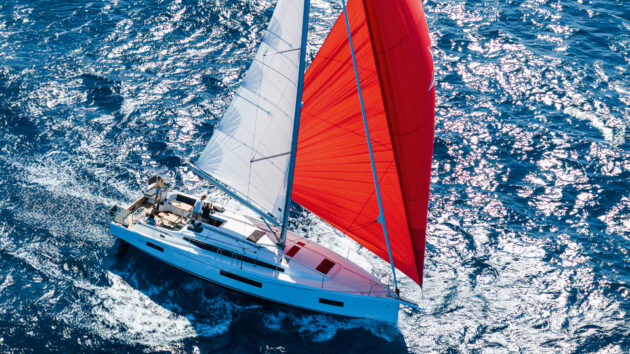
Above: in a brief spell of 7.5-9.5 knot winds the Jeanneau clocked a respectable 7-8 knots under kite. Photo: QAPTUR
In practice, the compromises are that the leeward spinnaker sheet fouls the ramped deck access, the turning block for which is right by the helmsman’s thigh. And the small tail bags by the primaries struggled to contain sheet ends. That said, the bags used on the coachroof to keep the longer running rigging tails do an excellent job.
We had the standard white sails aboard, in a stackpack main and genoa, which was useful for the typical light wind Med conditions off Cannes as they provide more sail power than the other options of furling mast and self-tacking jib.
However, these sails are Dacron, where a fully battened laminate main with more roach, as well as a flat deck furler in the performance pack, would have helped provide that extra few per cent. Indeed, were it not for the optional Code 0 and asymmetric set off a bowsprit, it would have been fruitless sailing.
For the majority of the time we sought any ripples of a reluctant breeze that averaged 4-6.5 knots. We tacked through 95° at 3-3.5 knots ‘upwind’ under genoa and only just nudged 4 knots under Code sail fetching in anything less than 6 knots.
Our fixed three-blade prop acted like a kedge, and Jeanneau agrees this had the biggest impact on our performance, but there was also an issue with our starboard rudder, which we found to be set slightly lower on the stock (Jeanneau has since identified a defect with how these blades are set, and is checking and adjusting them in the assembly process).
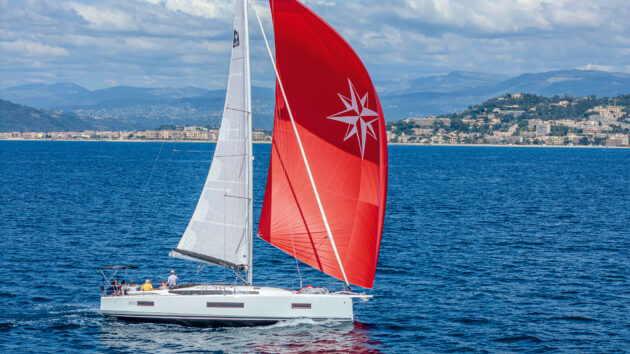
A powerful Lombard shape with long waterline and full-length hull chine. Photo: QAPTUR
Best till last
With plenty of time to trim and fiddle, I appreciated the jib tweaker system, which is easily adjusted from the coachroof. As Jeanneau has done for some years now, heavy jib tracks and cars are eschewed in favour of leading headsail sheets through thimbles on adjustable lines led to cam cleats.
The test boat had the uprated 80hp engine, which delivered 8.7 knots flat out, or 7.3 knots at cruising revs. However, cruisers intending to cover distances may wish to upgrade the standard measly 190lt diesel tank, which is less than the SO415. A 200lt extra diesel or water tank is at least an option.
Unleashing the asymmetric sail brought some vitality, creating enough apparent to almost match the 4-6 knot breeze when beam reaching. And just as we were on the final run to port and I was thinking such figures were arbitrary, we were given a welcome brief spell of 7.5-9.5 knots wind that allowed the Jeanneau to clock respectable 7-8 knot speeds under kite.
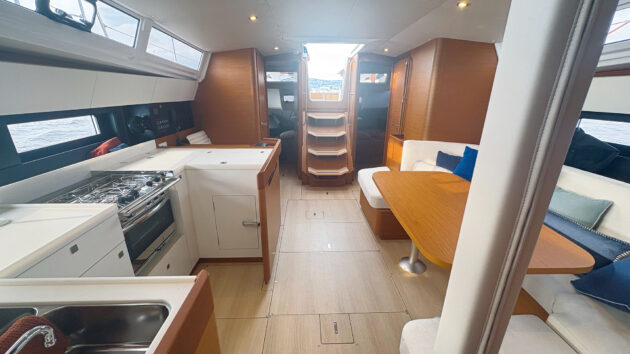
The inboard extension to the galley helps make it a practical space by offering an integrated handrail and a U-shape for bracing.
It made a telling difference, as once the wind hits 8 knots, it equates to movement, heel and feel. The SO455 instantly felt less sluggish, more responsive and enjoyable. More like the Lombard Sun Odysseys I know.
The helmsman has an enviable spot on a double seat in either quarter, and the option to extend feet out forward. For crew, the choice position is to sit facing aft under the protection of the sprayhood. I was impressed with the sun protection given by this sprayhood and the connecting large bimini, and how easily they can be rigged or removed. A full cockpit enclosure can also be chosen, while Jeanneau is developing a retrofittable hard top bimini, too.
The twin cockpit tables are smart, as they fold over to leave good space to get into the cockpit benches or to work at the winches, yet retain deep, central drinks holders, with cutaways in the forward area for handholds. As standard, these tables have fixed legs, but the telescopic versions of the test boat flaunt the huge lounging space when lowered.
Such is the beam here that between these tables is space for both a liferaft and a genset (or stowage if not taken). The cockpit is also extended via a large swim platform easily lowered on a purchase system. There’s good access to the lazarette stowage and steering gear, where a dinghy might be stowed if davits aren’t chosen. And up forward is a deep sail locker and chain locker with enough space to house fenders.
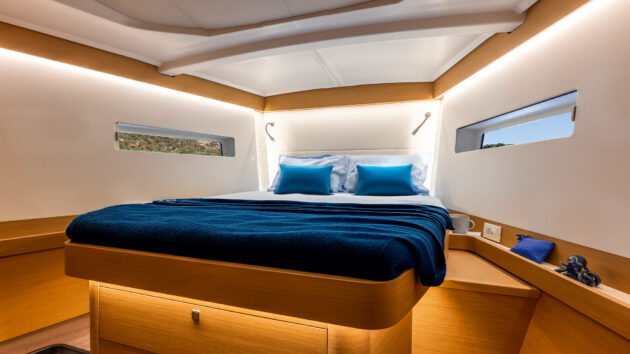
Spacious and light with a generous en suite, the master cabin benefits from the full bow sections and rivals that of the previous SO490
Jeanneau’s flow
Piaton has designed the interior with a modern look with traditional touches, such as rounded corners and veneers. It feels roomy and light, emphasised by a fore-and aft-style galley, and plenty of white trim and glazing. Meanwhile, Jeanneau has focused on bringing a more quality feel, so, for instance, all headlining and floorboards are screwed in place, thicker wood trim is used on furniture where it may get rubbed, and laminated panels are employed in the galley and heads for ease of maintenance.
The test boat has the familiar three-cabin with two heads format, while both four- and five-cabin options can be chosen for charter. It also has Jeanneau’s classic standard teak Alpi finish, which I find too orange, whereas the example on show at Boot Düsseldorf had a smart lighter grey cedar, and charter versions have a darker trim.
The standout feature is the bucket-style sculpted nav seat, complete with a lift-up footrest and a headrest that drops down from the locker above. It’s the most comfortable I’ve come across on a production yacht, offering chaise-style seating when you want a nap or to be convivial with the saloon, or a forward-facing position for office or chart work at the good-sized desk.
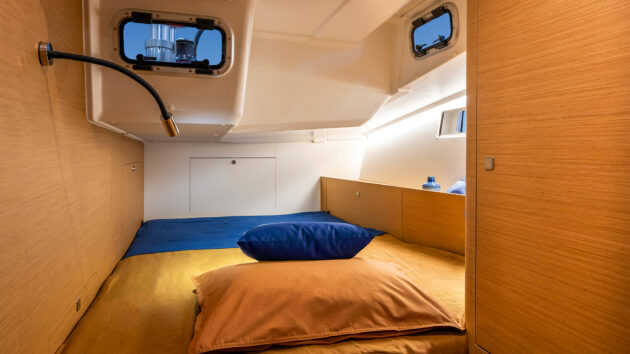
The aft cabins are near identical – spacious but no frills
The other notable feature is the workshop/utility space to starboard, which makes so much sense over a third heads in this owner’s layout. It offers abundant dry hanging space, shoe stowage, and a bank of removable storage crates.
There are areas here and throughout, though, where the finish is a weakness, including with machine-cut panels left rough, unsealed plywood and end grain in lockers and fixtures that appear less durable for high-volume and charter use. Mounting the VHF hub in a locker below the sole also seems too susceptible to water ingress.
However, there’s plenty to like. Where there are stowage spaces or seacocks, it’s been made easy to access below the floorboards. Otherwise, these secured floorboards have spacers on their sides to help locate them solidly.
Compared to many competitors, it feels blissfully quiet walking through the boat. Jeanneau uses injection-moulded decks with vacuum-infused hulls and structures glued in.
Moving around at heel is aided by a long, solid grab rail integrated along the inboard galley side, arguably a better solution than a headboard rail, as it allows people of all heights to use it. This extension to the cabinetry also provides crucial bracing in the galley area.
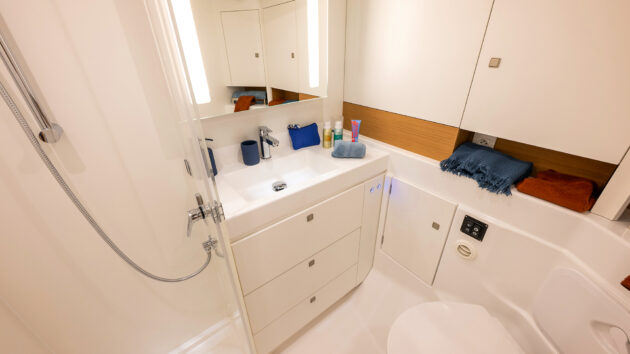
The galley is generous and light, with domestic-style comforts such as a 190lt fridge, spice rack, slide-out double bin and alcove for charging AC accessories. Stowage is good in general, including in the saloon, where the table can have an inboard bench that stows under the table to access the bilge. Charter versions can have a table with interchangeable legs to fill in as a berth.
The forward master cabin gives the feel of a 50-footer, including the 2×1.6m island-style berth, excellent light and ventilation and a generous en suite with a separate shower. The near-matching aft cabins, meanwhile, are more conventional no frills – they’re spacious enough but offer no reclining space.
Jeanneau Sun Odyssey 455 specifications
LOA: 14.28m 46ft 10in
Length inc bowsprit: 14.78m 48ft 5in
Hull length: 13.74m 45ft 1in
LWL: 13.58m 44ft 7in
Beam: 4.49m 14ft 9in
Draught: 2.35m 7ft 9in
Disp (lightship): 11,230kg 24,758lb
Ballast: 2,691kg 5,933lb
Berths: 6-10
Engine: 57hp 42kW Yanmar saildrive
Water: 380lt 84gal
Fuel: 190lt 42gal
Sail Area/disp ratio: 20.9
Disp/LWL ratio: 125
Price as tested: €435,964
Design: Marc Lombard Yacht Design; Piaton Yacht Design
 If you enjoyed this….

Yachting World is the world’s leading magazine for bluewater cruisers and offshore sailors. Every month we have inspirational adventures and practical features to help you realise your sailing dreams.Build your knowledge with a subscription delivered to your door. See our latest offers and save at least 30% off the cover price.
Note: We may earn a commission when you buy through links on our site, at no extra cost to you. This doesn’t affect our editorial independence.
Verdict
Jeanneau continues to specialise in subtle innovation with each new generation, while offering fit-for-purpose, well-priced designs. In Marc Lombard Yacht Design, it has a sure bet when it comes to sailing sportiness. While the light winds of the SO455 test hampered that qualifier, the stats are there, backed up by the performance of the smaller 415 (see overleaf) and past models. In terms of bringing something new, the SO455’s inboard winches, galley layout and nav seat can be highlighted. But in its attempt to offer its new models at the lowest comparative starting price, Jeanneau has cut some corners. It leaves the question of whether discerning buyers will be happy to live with that, and the obvious signs of volume production when it comes to the finish quality. However, when you consider some of our reports and videos of the competition, where floorboards and door handles are constantly creaking, it can be argued that Jeanneau has made good efforts and gains here. The choice between this 45 and a 50-footer depends on whether you prioritise handling and responsiveness over marginal gains in volume... a nice decision to have.