



Weather forecaster for the British Sailing Team since 2015, Simon Rowell, gives his advice on using a barometer to understand the forecast

Most yachts have a mechanical barometer on board, either a brass or a stainless one screwed to the bulkhead somewhere convenient – ideally close to the navigation desk so it can be read while doing the log. These often get tapped before the reading is noted, so as ‘to unstick the needle’.
A meteorologist’s plea: DON’T TAP YOUR BAROMETER!
This is because it’s a delicate mechanical instrument, and all you do when you tap it is to put an unknown error onto the reading. Almost all yacht barometers are uncalibrated, but that doesn’t matter because you’re not interested in the absolute value, just the rate of change of pressure, either up or down.
Modern weather forecasting sources have become very good, with the Met Office and other similar agencies around the world giving generally reliable forecasts. In these forecasts the ‘what’ of the forecast is usually predicted accurately, eg a low pressure system bringing south-west 20-25 knots, veering north-west 15-20 knots as the front arrives.
The part of the forecast that usually has the most error, particularly with unstable systems like depressions, is the ‘when’. That front may come over earlier or later than expected. This is why it’s really important when getting your forecast for the day to think about what you can see, measure or feel as the weather comes through.
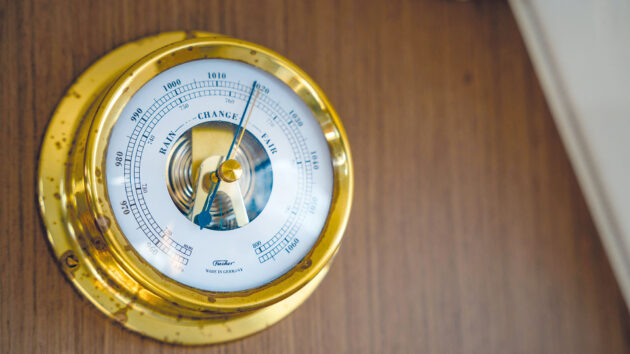
Mechanical barometers still play a valuable role on very technical yachts. Photo: Tatiana Dyuvbanova/Alamy
With depressions there’s a well known sequence of events. Usually in the northern hemisphere if a low is passing over we expect a sequence of: warm front; then a fairly steady – if grey and possibly wet – warm sector; and behind this the more active cold front with associated squally showers. Behind that there’s usually the colder, drier air coming down from the north-west, which will often feel warmer due to the fact that the sun’s out.
If you’re expecting this common sequence, then you’ll also have the forecast arrival times of the fronts. Try and translate those forecast times into what you can see (a lowering and thickening progression of clouds) and what you can measure – most obviously your barometer will be falling.
While you can’t use the barometer reading as an exact value (because it’s probably been tapped…) you can measure the drop, and compare that to the expected drop from the forecast.
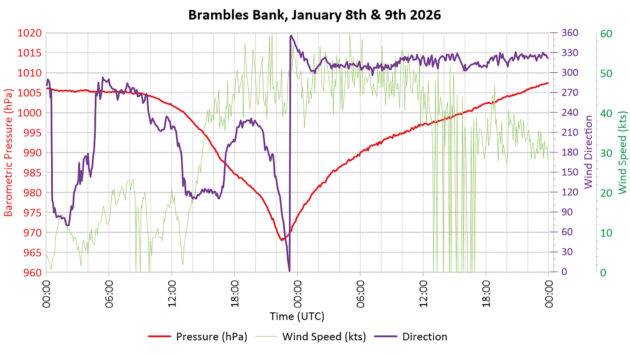
Plunging and rising barometric pressures as Storm Goretti passed over the Brambles Bank in the Solent in early January 2026
Rate of change
The rate of change of pressure is a very important metric, and is one of the main reasons to do hourly log readings even in waters you’re very familiar with.
The Shipping Forecast uses the following terms to describe pressure tendency:
- Rising (or falling) slowly: pressure change of 0.1 to 1.5hPa (hectopascals) in the preceding three hours
- Rising (or falling): pressure change of 1.6 to 3.5hPa in the preceding three hours
- Rising (or falling) quickly: pressure change of 3.6 to 6.0hPa in the preceding three hours
- Rising (or falling) very rapidly: pressure change of more than 6.0hPa in the preceding three hours
I always start to look more carefully at the weather when the barometer starts to change by more than 1hPa per hour, so the top end of the ‘rising or falling’ category.
One initial important point to make from these terms is that large pressure changes lead to strong winds whether the pressure is rising or falling – just because the cold front has gone through and the pressure is going up doesn’t mean the wind will immediately ease.
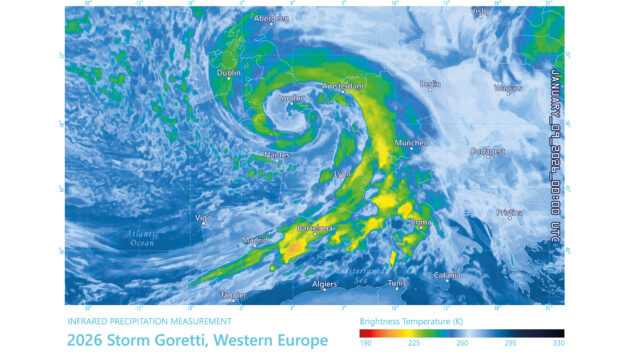
Storm Goretti passing over Brambles Bank January 2026. Photo: Frank Ramspott
Sudden drop
Using the barometer to follow the progress of a low, and give an idea of how strong it will be, is part of your whole weather monitoring system, together with wind speed/direction and cloud types. January 2026 has given us some very strong examples of lows going through, and Storm Goretti, the first of the year, had one of the largest and fastest pressure drops I’ve ever seen.
The pressure at Bramble Bank on the south coast of England near Southampton dropped from 1,005hPa to 966hPa in just under 15 hours – 2.6hPa/hour on average. It then rose back up to 1,000hPa in just over 15 hours, 2.2hPa/hour. Both of these rates are in the ‘very rapidly’ changing category.
There are two main takeaways from this – the wind speed remained at Force 9 or above for hours before the lowest pressure, and for hours after it. Also, and equally as important, the lowest point occurred when the centre of the low was closest, and at about that time the wind backed from south-south-west all the way back to north-west in a matter of 5-6 hours.
The sea state in open water would have been horrendous with the wave train from the initial direction still dying down, and the new one building up, all the while with 50 knots blowing.
This is an extreme example of the most important and most obvious use of your barometer; to give you advance warning of stronger conditions. However, it’s an important measurement for another reason, in that it gives you an idea of how you are moving in relation to the weather systems around you. You can, in a broad brush sense, navigate by barometer.
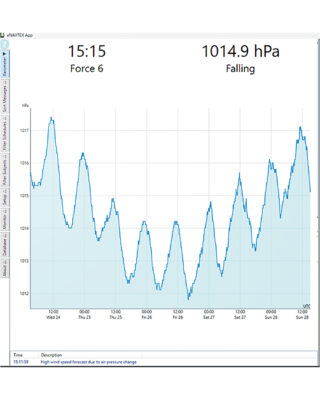
Electronic barometer trace over a 96-hour period in the Intertropical Convergence Zone
Dodging highs
This lesson was harshly taught to me when I was racing from Cape Town to Bahia de Salvador, Brazil some years ago. We left Cape Town with the plan of sailing round the top of the South Atlantic High, hitting the tradewinds and screaming into Brazil: simple, and after 36 hours we had a decent lead.
However, I hadn’t then twigged that, because Africa only goes down as far as about 35°S, there’s plenty of room for the highs to slide along from the Atlantic to the Indian Ocean. This means that unlike in the Northern Hemisphere, where the highs coming across the North Atlantic and the North Pacific often end up forming ridges just west of the main continental land masses, south of the Equator they just keep on going east.
I was making sure the log was kept up to date every hour, but I wasn’t paying attention other than checking to see that the barometer wasn’t changing quickly. I cut us too close to the centre of the high and didn’t notice the barometer rising too far then slowing down as we got over the synoptic gradient and into the flat bit in the middle.
We then made 16 miles in 48 hours as the rest of the fleet sailed around outside us. The high moved over us, and I missed the signs the barometer was giving. I learned my lesson though, and after that did very nicely sailing along isobars around the mid-ocean highs – it sounds a bit obscure, but if you’re looking to stay in the tradewinds it’s an effective method.
Valuable warnings
Recently I was assisting a yacht on its way from Europe to Uruguay, and the skipper gleefully sent in the trace from his barometer (see graph left) as he crossed the Intertropical Convergence Zone, the Doldrums, which is effectively the boundary between Northern and Southern Hemisphere weather.
This is over a four-day period, and the bottom dip of the mean pressure is the middle of the Doldrums. The twice daily rise and fall is diurnal variation, a normal tropical occurrence (which we’ll cover in a later article). Electronic barometers are very useful, they can keep a record of the pressure variation and you can zoom in and out. But they do, of course, need batteries.
Monitoring your barometer and thinking about what those readings mean in terms of system movement can give valuable warning of approaching systems, and is a vital part of every sailor’s navigational armoury, both immediate and medium term. And don’t tap it!
 If you enjoyed this….

Yachting World is the world’s leading magazine for bluewater cruisers and offshore sailors. Every month we have inspirational adventures and practical features to help you realise your sailing dreams.Build your knowledge with a subscription delivered to your door. See our latest offers and save at least 30% off the cover price.
Note: We may earn a commission when you buy through links on our site, at no extra cost to you. This doesn’t affect our editorial independence.