




Two-boat tuning is a huge part of any Olympic campaign, John Gimson shares some trade secrets with Andy Rice
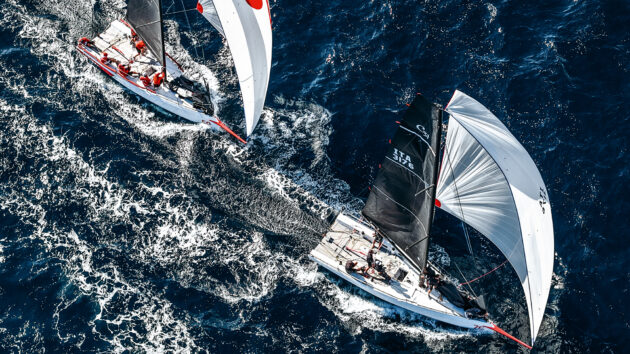
Before he specialised in foiling catamarans, John Gimson was long-time tuning partner to Iain Percy and the late Andrew ‘Bart’ Simpson in the Star keelboat, playing a key role in helping them win gold and silver medals at the Beijing and London Olympics. Two-boat tuning is a critical part of any serious Olympic campaign, a proven tool that is surprisingly underused outside of the very top echelons of the sport.
“Two-boat tuning massively speeds up your learning curve,” says Gimson. “You get much quicker feedback on your performance compared with just sailing by yourself.”
In an Olympic campaign in a highly technical boat like the Nacra 17, Gimson estimates they spend almost half their time engaged in tuning. The benefit comes not just in improving the technical speed of the boat.
“A big part of the benefit is getting used to living in a ‘thin lane’ and keeping the boat moving at optimum pace even when you’re struggling to live in an uncomfortable place next to another boat.”
The following are five of Gimson’s best tips for getting the most out of two-boat tuning.
Article continues below…
How to win at double handed sailing: Expert tips
The team dynamic in double-handed sailing is very different compared with fully crewed boats, says Pam Lee. “In your classic…
5 expert tips: How to make the best of crew dynamics
During the build-up to the 2024 America’s Cup, inside the INEOS Britannia team we came up with a set of…
Get a baseline
It’s good to keep one boat as the ‘baseline’ boat where you put everything on known, standard settings. That boat is effectively the ‘control’ in the test process. Then you start to change settings on the other boat to see how it affects relative performance. Once you get into a tuning run, you’re aiming to sail as hard as you can, trying to beat the other boat. It’s also good to use the same points of reference and calibration points, so you have a common language you can use on and off the water for understanding what adjustments are being made.
Be honest, be disciplined
You need to be honest with each other during the process. If you think you had an easier time because you benefited from a slight wind shift, for example, admit it. You’re not trying to kill each other. You’re looking to learn the lessons from the day and share those learnings with each other. If you discover something that works but don’t share it with your training partner, the process will break down. You need to have mutual trust to make the two-boat tuning programme work for everybody.
Start fair
When it’s flat water we’ll probably start three boat lengths apart, with the leeward boat half to one boat length ahead, so we’re effectively starting on equal terms. The more wavy it gets, the more separation we’ll start with, so the windward boat doesn’t get washed into the leeward boat.
Then we’ll keep swapping sides, from windward to leeward position and vice versa, testing on port and starboard tacks, making these changes for possibly an hour or more until we get a feeling of who’s going better and understanding the reasons why. But if the wind is really shifty there’s not much point in carrying on with a two-boat session. Use shifty days to work on other aspects of your sailing.

Emirates Team New Zealand training on one AC40 and one modified AC40 (officially a LEQ12). Photo: Ugo Fonollá / America’s Cup
Train against the extremes
When I was doing Star tuning against Percy and Bart, I’d sail with two different crews. One was really heavy, and one lighter, and we’d train against Percy and Bart with an inherent weight advantage; heavier than them in the strong, lighter than them in the lighter winds. It was a useful way of putting Percy and Bart under additional pressure.
Also, by nature I’m a bit of a pincher, which is probably because I grew up sailing on a lake, whereas other people tend to naturally foot off. Old habits die hard, I guess! Two-boat tuning can be a way of training on your least favourite mode and improving your weaknesses outside the pressure of a racing environment.
Rudder angles
Upwind, the keel provides the majority of the lift to stop the boat from sliding sideways. But a small amount of weather helm means the rudder is behaving like an extra lifting surface to minimise leeway. In a way, rudder angle is the ‘Holy Grail’ for any fast keelboat setup, the angle that minimises drag while ensuring you can still steer effectively.
The first thing you need to know is the optimum rudder angle for your particular type of boat. In the Star it’s between 1-2°. On hi-tech boats like TP52s you have electronic readouts for the rudder angle you’re operating at any given moment. If you’re not allowed to race with electronics, it’s good to train with them. At a minimum, your most basic reference point should be marks on the aft deck so you can glance at the tiller and get an immediate visual gauge on the number of degrees of deflection.
The same goes for adjustments to the backstay tension and jib lead position: all critical elements for finding the best all-round set-up for any given wind or wave condition.
This is where those commonly shared calibration marks can really help. There’s no substitute for hours on the water.
 If you enjoyed this….
Yachting World is the world’s leading magazine for bluewater cruisers and offshore sailors. Every month we have inspirational adventures and practical features to help you realise your sailing dreams.Build your knowledge with a subscription delivered to your door. See our latest offers and save at least 30% off the cover price.
Note: We may earn a commission when you buy through links on our site, at no extra cost to you. This doesn’t affect our editorial independence.