




Olympic campaigner Daisy Collingridge talks to Andy Rice about how to handle all types of sailing conditions

All of us sailors have a favourite set of conditions. Early in her career, coming up through the British youth ranks, Daisy Collingridge always leaned towards the windier stuff.
“Given the weather we get at home and the amount of domestic training we do, heavy air felt simple and rewarding: the more physical effort you put in, the faster the boat went. It was a direct, linear relationship based purely on wind strength,” she recalls.
However, as Daisy progressed to Olympic-level racing, her definition of ‘conditions’ had to evolve.
“You realise that wind speed is only one fraction of the equation. What truly dictates your success on the water is understanding the ‘day type’ (see Tip 1, opposite).”
Too often, sailors try to force the racecourse to fit the style of sailing they prefer, rather than adapting their play to what the environment is actually offering.
To perform consistently across a long regatta, campaign, or even an Olympic cycle, you cannot rely solely on a single ‘super strength’. You have to become a complete all-rounder. That process starts before you even launch: mentally priming yourself, categorising the day, and matching your starting and racecourse strategy to the reality of the wind.
Here are five of Daisy’s best tips for analysing the day and setting yourself up for success across a range of wind and wave conditions.
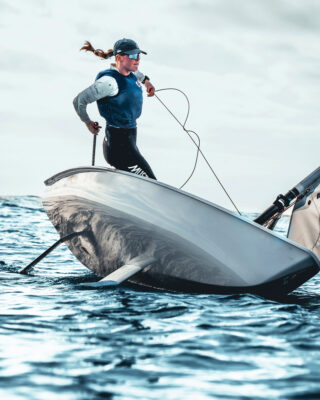
Very light airs can require strong mental resilience. Photo: Alice Callow/British Sailing Team
Build your own database of ‘day types’
Before you get on the water – possibly even the night before – you need to start thinking about what kind of day you’re going to be facing. Look at the meteorological profile, stability, and behavioural characteristics of the breeze. Is it going to be a shifty, oscillating type of day or a classic sea breeze day? For me this is a really important part of preparation for each race day – what I call ‘mental priming’.
There’s a lot you can do before hitting the water that sets you up for the day ahead. Some people are more instinctive sailors who prefer to go out and figure it out on the water, but over the years I’ve built up a venue-specific database.
After each day of training I log the conditions, along with notes on what worked strategically and technically in terms of how I set up the boat for those specific conditions. When race day comes, I can look at the venue, wind direction, and wind strength, and pull up key points from similar training days so I already know what to expect.
It’s not strictly prescriptive (I don’t say: “It’s unstable, so execute these exact behaviours”). Instead, those priorities come out during pre-start checks and conversations at the RIB with my coach. That said, you can easily characterise each day ‘type’ and develop simple rules of thumb.
Whether you are facing a steady, thermal sea breeze, a shifty, offshore land effect, or an unpredictable, oscillating afternoon, every day demands a distinct strategic mindset and a different way of attacking the day. For example, on a simple day with stable wind, no obvious pressure differences, and a small shift range, your go-to priorities are clean start execution, minimising manoeuvres, and raw boat speed.
It gets more complex when you’re on a start line with a hundred other boats, but having those fundamental rules outlined in your head before you even start gives you a clear baseline.
Match starting risks to shift range
One of the costliest errors on a shifty day is being lured to a biased end of the start line without a viable exit plan. If the pin end is favoured, ask yourself a critical pre-start question: is it biased enough that I’ll be able to tack and cross the fleet on the first left-hand shift? If the answer is yes, the pin offers maximum reward.
If the answer is no, starting at the pin traps you into holding a dead lane on a losing phase, forcing you off the front line early.
If the shift range or bias isn’t large enough to guarantee a cross, starting closer to the starboard end near the committee boat is often the safer, higher-probability play. It allows you to hold your lane or tack immediately onto the lifted shift without getting pinned by the fleet to leeward.
Always check the exact line bias with your compass during your pre-start routine, as a difference of just 10-15° completely alters your tactical options off the line.

Photo: British Sailing Team
Look to the compass on sea breeze days
Super-stable, classic sea breezes can be surprisingly tricky for sailors who rely on those opportunistic moves. A sea breeze day requires more patience, because the opportunities are fewer and farther between.
When there are no clear gusts, colour changes, or massive shifts to react to, it is easy to overcomplicate the course or force a move that isn’t there. When the racecourse offers no obvious visual clues, trust the numbers by paying ultra-strict attention to your compass heading. In stable air, the shifts may only be 3-5°, but they are often enough to allow you to take subtle crosses and pass a competitor.
Practice patience over panic by nailing your start, getting the boat moving at 100% speed, and waiting for the subtle shift to present itself, rather than trying to manufacture a tactical break.
Reframe ‘threat’ conditions
Waking up to a forecast you dislike can put your mental state in jeopardy. If you view challenging weather as a threat, you’re already on the back foot.
During a tough week in Palma, where we faced endless postponements and repeatedly abandoned races, I made a conscious effort to flip the narrative. Even if a race was called off while I was leading, I treated it as a win because I’d executed the right strategy, read the day type correctly, and gathered vital data for the next restart.
When facing conditions outside your comfort zone, reframe your internal monologue by replacing thoughts of, “I hate this shifty offshore breeze” with “Everyone is dealing with the same conditions, this is my chance to out-think them.” Shift your focus from the outcome on the scoreboard to the process of learning how the breeze behaves, which keeps your emotions neutral and allows you to adapt faster than competitors who let frustration take over.
These challenges are easier to handle when you’re sailing in a team, as long as you’ve got someone with the right personality on board to treat a challenging day positively.
Single-handed sailing can be a more isolating experience. When things go wrong on the water, the inner dialogue inside your head can quickly spiral into negativity.
To break a mental loop, vocalise your feelings. If you’re feeling nervous or frustrated by the day’s conditions, express it directly to a teammate, or trusted support person on the water.
Psychologists call this ‘name it to tame it’. Simply stating “I’m finding this breeze really hard to read today” out loud normalises the pressure and diffuses its power over you. A good coach or sailing partner can provide an instant reality check, bringing you back to a neutral, analytical baseline before the next starting sequence.
Compare notes
It is easy to get stuck in an echo chamber where you and your crew or training partners analyse conditions in the exact same way.
To accelerate your understanding of different day types, actively seek out advice from sailors and coaches with different backgrounds. Whether it’s asking a veteran big-boat sailor for a coffee to discuss downwind wave strategy or working with a coach from a different racing culture, exposure to alternative ways of thinking prevents tactical blind spots.
You don’t need to tackle complex weather scenarios alone – sailing possesses a vast depth of collective wisdom. Tap into it, test their solutions on the water, and integrate those lessons into your personal race-day playbook.
In association with Musto…
Rumour has it that when Grant Dalton turned up to race on board Flyer II in the 1981-82 Whitbread Round the World Race, he arrived with a suitcase! Things have come a long way since then and Musto has now launched a new collection of waterproof bags and luggage, purpose-built for sailors and adventurers.
The eight-piece range spans compact daypacks through to expedition-grade wheeled luggage, combining Musto’s decades of maritime engineering expertise with modern travel functionality, tried and tested by Musto ambassadors, who demand their kit stays dry and safe.
Adam May, Olympic chief technical officer of the British Sailing Team, put the new Musto 40L Waterproof Backpack through its paces on and off the water: “The best waterproof bag I’ve used, and I’ve gone through a few! Just the right size for a day on the water coaching, comfortable to wear, reassuringly robust construction, and a very satisfying external zip pouch.”