



With three enormous DynaRig projects in build, these distinctive square-rig offshoots may have come of age. Toby Hodges looks at the past, present and future of this potent big rig system

Some of the largest, boldest yachts of all time are currently in production, and what makes these massive yet radically different projects even feasible is the practical sailing ability provided by their revolutionary rigs.
Both the world’s largest sailing multihull (58m) and what is rumoured to be the largest ‘proper’ sailing monohull (as opposed to sail-assisted) at around 120m, are in fit-out today and will sport DynaRigs. First seen on the iconic Maltese Falcon over 20 years ago, these freestanding masts rotate so the yard arms and soft sails can be set to suit the wind angle.
Today, perhaps more than ever, DynaRigs herald a new era of practical sail handling – both for superyachts and shipping. These intelligible systems are increasingly sought by owners pursuing easier, more efficient sailing, while reducing fossil fuel reliance.
Furthermore, we can reveal that the third DynaRig project in build is for Greenpeace and its groundbreaking new 75m ship. Its two DynaRig masts will provide the primary means of propulsion aboard an innovative vessel designed to help set an example to the commercial industry.
With significant carbon and emissions reduction targets coming into force by 2030, shipping will increasingly have to turn to sail power and sailing technology to help offer it solutions.
Southern Spars asserts the well proven DynaRig solution is the answer for certain sizes and applications, especially with these three latest projects it has in production, each so different and on a scale we haven’t seen before.
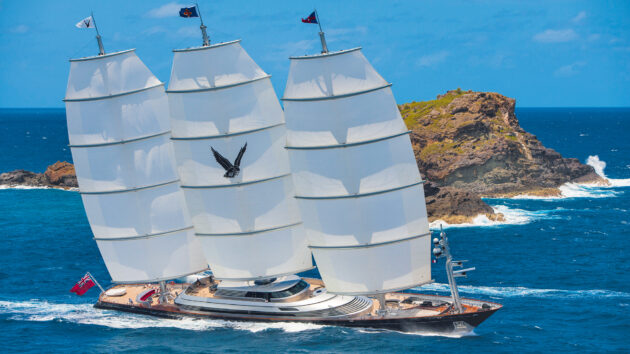
The 88m Maltese Falcon. Photo: Onne van der Wal
Full circle history
So who’s it for? The DynaRig heralds safety and reliability by removing the need for loaded sheets and standing rigging, to allow for clean, clear decks. In cost and practical terms, it makes much sense – for vessels over a certain size (around 65m+ LOA) and for offwind passagemaking, it is hard to match.
While aesthetically, the DynaRig may look more purposeful and industrial than ‘conventional’ Bermudan, ketch or schooner rigs, they do have that tangible historical connection to the age-old square rigger.
Square-rigged Clipper ships are famed for good reason and proved running with the wind is the most efficient way to ply the world’s oceans. The advent of steam and diesel power eclipsed our reliance on sail power on large vessels, yet in the late 1960s German engineer Wilhelm Prölß had the idea to redevelop the square rig style into a more automated and powerful design for shipping.
With the oil crisis of the early 1970s looming, his DynaSchiff design would be a solution that could be managed by the same short-handed crews of diesel ships, however it was never built as it lacked the material technology at the time.
Instead, the DynaRig was truly developed into what we know today when designer Gerard Dykstra suggested its potential for the groundbreaking three-masted 88m Maltese Falcon in 2001.
By then, armed with the carbon composite materials to make it feasible, the project team was able to develop rotating, self-supporting masts with curved yard arms that would allow the yacht to sail to windward and tack. Each mast would carry five sails, unleashing a 2,400m2 sailplan in minutes, all controllable by one person.
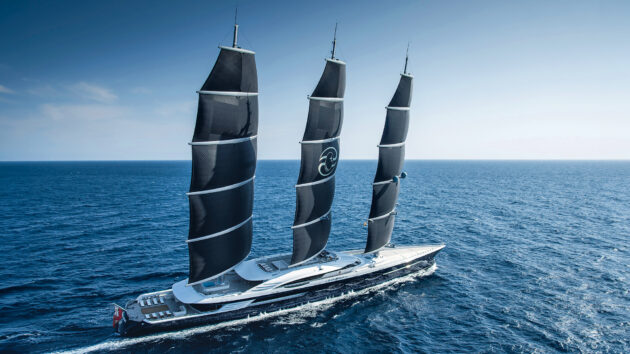
The 107m Black Pearl was launched from Oceanco with three 70m DynaRigs in 2016. Photo: Tom Van Oossanen
The brains trust assembled by visionary owner Tom Perkins included Dykstra Naval Architects and carbon mast guru Damon Roberts (both of whom continue working with DynaRig developments today), together with the furling systems technology know-how of Fabio Perini. This led to a fascinating multi-year development of Maltese Falcon’s rig, a story in itself (I recommend the biographical book on Perkins, Mine’s Bigger).
Yet it was seemingly still 20 years ahead of its time as, since then, DynaRig has been through several brand changes but has only been employed on one other yacht, the equally audacious 106.7m Oceanco Black Pearl.
Directly inspired by Maltese Falcon, and reuniting its same designers, Ken Freivokh and Dykstra, Black Pearl was developed to champion the potential of big DynaRigs, and represented the bleeding edge of alternative power for its day (2016). It was and still is championed for its ability to sail in the late teens and cross the Atlantic without relying on fuel.
So today’s DynaRig manufacturers have the decades of combined sailing data from these yachts, their systems proven across hundreds of thousands of miles and multiple ocean crossings. Now under the North Technology Group umbrella and Southern Spars leadership, and with a new dedicated factory, DynaRig looks set to realise more potential with its three latest commissions.
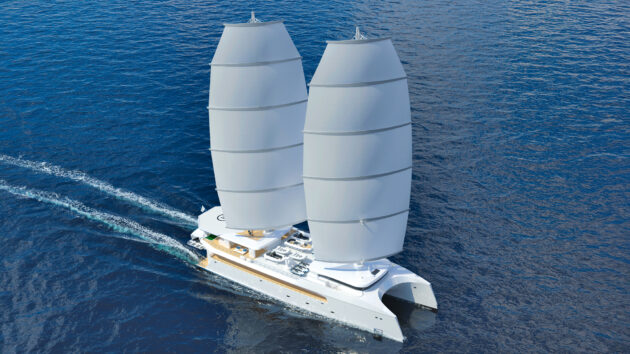
The 58m adventure Echo cat will feature two DynaRigs. Currently in build in Australia, this will be the world’s largest sailing multihull
In practice
The DynaRig is a solution for those after an intelligible, push-button system, which is easy to operate and therefore encourages maximum time under sail. Having worked on a superyacht where sails were rarely set because of the cost of potential sail damage, I understand this appeal. Black Pearl can up anchor and set its 3,000m2 of sail in eight minutes, for example. Then consider the army of crew needed to sail most large yachts, let alone 100m+ vessels.
During one of its many Transatlantic crossings, Black Pearl reported that it set 158 sail configurations – all controlled by one crewmember, and while employing hydrogeneration to avoid diesel generator use. Veteran Captain (of both Maltese Falcon and Black Pearl) Chris Gartner confirms one person can set, furl, tack, gybe and manoeuvre the yacht. (Should you wish to experience it yourself, Black Pearl is now available for charter for $850,000 a week).
DynaRigs are engineered for high load, general manager Andy Shaw explains, and equipped with fibre optics and load cells for strain data. The masts could be removed for painting or in the case of significant damage from impact or lightning strike, but that has not been necessary thus far. Indeed, the first time any significant maintenance was completed on Maltese Falcon’s rig was during Covid, “and these were sail handling equipment only – the rigs have never been off.”
Article continues below…
The 62m ketch proving Türkiye can build World-class custom sailing yachts
With the classic looks of a gentleman’s yacht and the gleam of expensive finishing, 62m Simena is the more-than-impressive debut…
Why the World’s fastest superyacht (Baltic 111 Raven) has a speed limit
On first glance, you might assume Raven is pure AI-generated fabrication. A fantastical superyacht with 7m canting foil arms? But…
Putting that into perspective, Shaw adds: “Over 20 years and that many miles, most other rigs would have been off numerous times.”
The performance of DynaRigs is also well verified. Unlike square rigs, there are no gaps in the sails and yards, so they capture all the force and are much more aerodynamic and efficient. With full sail set, each spar’s sail plan works as a single sail that can be trimmed to windward by rotating the mast.
Picture the iconic sailing shots of Maltese Falcon and it’s likely barrelling around the Bucket courses of St Barths at 20 knots. But the rigs mostly suit easy ocean voyaging rather than short tacking and regattas. That said, the existing yachts are both three-masted, while Dykstra’s CEO Thys Nikkels considers a two-masted DynaRig to have more pointing and upwind ability.
As maximum sailing time is promoted, the individual sails are used more. The sails are not reefed, but furled in sequence to reduce power. This leads to another big benefit: the choice of sailcloth. As the sail is supported over its full length, with pressure evenly distributed and there are no high clew loads, conventional Dacron is preferred over expensive laminates or exotic fibres. And as the sails are uniform sizes, minimal spare sails are needed – they don’t tend to flog, but UV is the enemy.
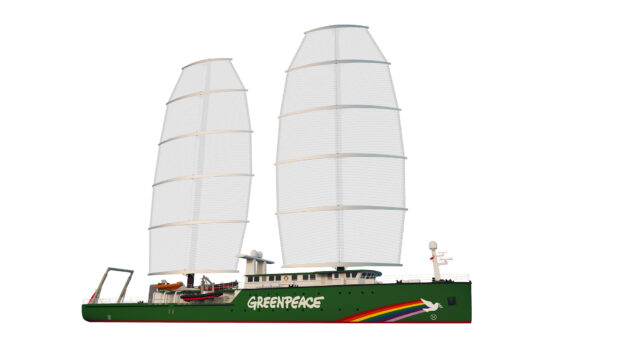
In 2024 the 75m Greenpeace ship was commissioned, the first vessel to be fitted with two commercial Dynarigs.
[And then there’s the square shape of the sails, which makes for an ideal outdoor projector screen, a feature both Maltese Falcon and Black Pearl (and any surrounding yachts in the anchorage) enjoy].
Building monster rigs
The big recent DynaRig orders helped warrant the opening of a new 5,500m2 factory complete with 90m-long oven in Southern Poland three years ago, where there is skilled labour.
DynaRig infuses its superyacht yards in full carbon, the masts built in prepreg carbon in a heated mould. A 14-tonne, 80m-long half-mast shell is cured in a single hit – “surely the biggest structure in the world to do this,” Shaw points out.
Shaw goes on to explain how Maltese Falcon and Black Pearl largely used similar technology in their rigs and how their mast sections taper as they extend up, which is hard to build. So they have redesigned new straighter mast sections, which have a slight weight detriment but are more buildable.
“It removes a lot of the complexity and eases maintenance and assembly. And this allowed us to redesign the hardware too,” he says. Every winch has a sensor and cable, so with four winches and a mandrel drive unit on each truss, there are a mass of internal conduits.

Black Pearl’s unstayed, rotating DynaRigs have long proven the supersized potential for these sail and rig solutions. Photo: Tom Van Oossanen
By flattening the side of the mast, DynaRig is now able to run the conduits down each side. “Previously, getting the trusses to stick on was another challenge composites-wise,” says Shaw. With the new constant shape of the mast sections, these trusses can be pinned on, which is easier to design and build. It’s more modular and repeatable.
“With all the sail handling equipment mounted on a common chassis unit on each truss, you can now undo four main bolts and drop it to the deck to expose and maintain all the furling mechanisms within.”
DynaRig’s current commercial tooling caters for 700-1,000m2 sailplans. And although Shaw admits that so far all orders have been customised, it means they can build big rigs on comparatively short lead times. “We can vary the tip length and camber of the yards to meet the needs.”
For commercial vessels, the yards are made in modular sections, currently in glassfibre and carbon. The trusses and struts are forged in stainless steel, while external tracks are bolted onto the straight masts.
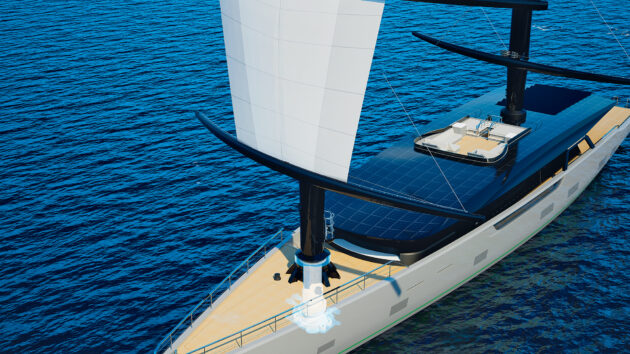
Four captive reel line winches are used on each yard truss, two for the sail above, two for the sail below, with one sail per yard arm. The sails unfurl from mandrels inside the hollow masts, less than a minute per sail, out of exi-feeders along the tapered yard arm
Trailblazers incoming
The secretive 120m+ project currently under construction at a southern European shipyard will sport two 82m DynaRigs. It will be twice as loaded as Black Pearl, its sail area double that of Maltese Falcon, hinting at the project’s complexity – but little more can be said at this time.
Alongside this, the DynaRig factory has also been building two 60m rigs for the new Greenpeace vessel (see following page), as well as twin 60m DynaRigs for a 58m adventure sailing catamaran, both Dykstra designs. The latter is currently in production at Echo Yachts in Australia. This all-aluminium craft will be the world’s largest multihull by some margin when it launches in March 2028, eclipsing the 46.5m Perini ArtExplorer.
The renderings illustrate the significant potential for DynaRigs on large vessels. This will be a real exploration craft, capable of long-distance zero emissions cruising, complete with a 12m dive cat tender and helideck aft – both made feasible as there’s no standing rigging.
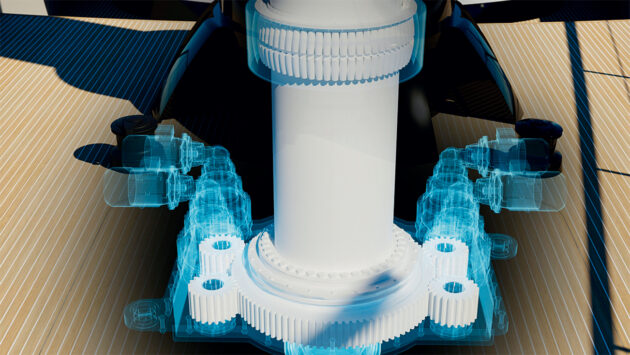
Heel and deck bearings for a modern rig
Looking ahead, the DynaRig team sees strong potential in the 60m Maverick and 106m Juno designs from Dixon, the latter targeting motoryacht converts seeking max volume. Meanwhile, Dykstra’s Nikkels thinks a 75m two-masted DynaRig project holds distinct appeal: “a real sailing machine for worldwide cruising. It’s a really good tool for making sure you have a very efficient, low-maintenance yacht.”
Arguably, however, the commercial/shipping sectors hold the most potential for DynaRig. Carrying the torch for this is a new 75m Greenpeace vessel in build. We were given some exclusive insight into this, along with these first images, and plan to report in more detail as the build progresses towards launch from Freire shipyard in Spain (it is due to leave dry dock in late 2026 for delivery in late 2027).
Leading a greener way
This groundbreaking Greenpeace project will provide a new floating laboratory for scientific research, amplifying its work and missions to protect the world’s oceans. It will also be the first vessel fitted with commercial DynaRigs. These will allow a considerably wider operating range by reducing reliance on large diesel tanks. Far from the luxury vessels shown on previous pages, the focus of this project is on setting an example for fossil fuel-free shipping.
And it will sail. In terms of performance, Thys Nikkels states that the percentage of sailing time will be comparable to Black Pearl’s. “This rig is a lot easier to use than the previous staysail schooner [of Greenpeace]. They will easily do 10-12 knots and start regenerating,” he explains. “Only in light airs will it need to start motoring.” And unlike flat-bottomed ships, which might go sideways under sail, this will have an 11m deep ballasted centreboard to aid pointing.
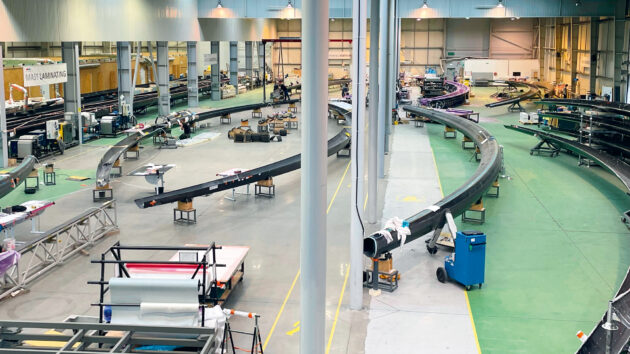
Lamination and assembly of yard arms in build this spring. Photo: DynaRig/Southern Spars
Shipping accounts for 3% of the world’s CO2 emissions. “This project shows what DynaRig is capable of for the commercial industry, and we see this as an example for a lot of different projects,” states DynaRig’s head of sales Rudy Jurg. He cites how the IMO has set a target to reduce the carbon intensity of international shipping by at least 40% by 2030, stats which helped encourage the North Group to establish North Windships for commercial shipping.
“We’re targeting a market where owners want to save 60-70% fuel costs,” which is increasingly relevant as oil barrel prices escalate. Jurg considers RORO ships, certain tankers and cargo vessels suitable for DynaRigs, but concedes that container ships are a lot more challenging, not least because of the loading and unloading practicalities.
Dykstra’s Nikkels was part of a Black Pearl panel which promoted the use of DynaRigs for more eco-friendly cargo ships eight years ago, but acknowledges this type of rig most applies to a niche sector of shipping – around 140m in length, and preferably on ocean/tradewind routes for a high level of efficiency, and with an aim to average over 30% sailing time, he calculates.
Arguably, there is more potential in cruise vessels. “Luxury cruise ships currently represent 4% of the tourism market, and a lot of these companies are fully booked till 2030 already,” says Jurg. “Yet these take 18 months to build versus five years of a superyacht.”
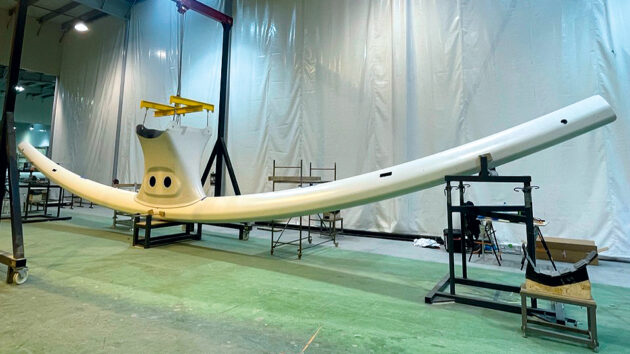
Yard arm with composite truss fitted. Photo: DynaRig/Southern Spars
There are many other types of rig in development from a long list of companies, plenty of which are already operational in shipping – from soft sails, wings and kites, to the many rigid wings, suction wings, solid sails and rotor masts. Each offer varying appeal for different applications, but the limitations are considerable, from leeway, heel, air draught, deck space and stability to cost, wind consistency, safety, hull integration, maintenance, and practical operation.
However, as we seemingly turn full circle and look to sail again for the answers of the future, there are many positives to take, including this proven pushbutton appeal of the square rig-inspired DynaRig.
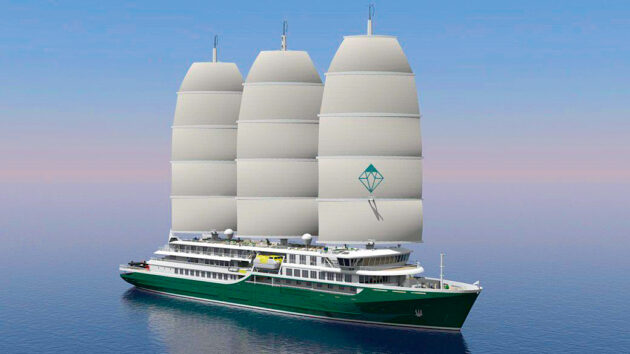
Cruise liners are thriving and make good DynaRig candidates
How it works
DynaRigs rotate +/- 180º around heel and deck bearings. Sails and masts are controllable from a remote device, the bridge or flybridge. To aid with sail attachment and removal or tender lifting one of the masts can rotate 270º.
Ideally, sails are set downwind, to make it more comfortable. The sails furl from the mast and set between the curved yards. Four captive reel line winches are used on each truss, two for the sail above, two for the sail below. Each sail peels out of a flexi-feeder, along the yard arms, with a sail stretcher pulling the sail apart so it furls neatly.
Sail power is reduced by setting fewer sails, rather than reefing individual ones. “The topsail represents 40% of the bending moment at deck level – so lose that and you’re pretty good,” says Shaw. The rigs can also be twisted very quickly to depower.
Each sail is furled one at a time. The yards are tapered so that as you start to furl, the sail is grabbed from the middle, removing the main loads immediately. The captive winches have always been electric. “You have to control four corners of the sail precisely,” Shaw explains. “With electric you get that control, where hydraulic may not do that – hence we spec electric for commercial boats too.”
Fibre optic cables in the mast communicate rig loads with the control system. The operator uses the main load input of the mast on the bearings to help establish optimum rig angle via an intuitive display. Graphs from Black Pearl reportedly show loading in its rigs when sailing in 60 knots apparent wind and heeling at 35º! “That data is one of the strongest things we have against anyone else,” Shaw adds.
 If you enjoyed this….
Yachting World is the world’s leading magazine for bluewater cruisers and offshore sailors. Every month we have inspirational adventures and practical features to help you realise your sailing dreams.Build your knowledge with a subscription delivered to your door. See our latest offers and save at least 30% off the cover price.
Note: We may earn a commission when you buy through links on our site, at no extra cost to you. This doesn’t affect our editorial independence.