




Radical, fast, and surprisingly spacious. These four innovative scow yacht launches are rewriting the design rules for cruising sailors
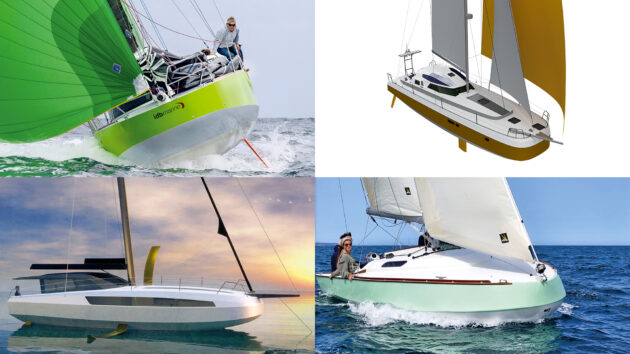
The blunt-bowed scow revolution is no longer confined to the frantic starting lines of the Mini Transat or Class 40s. This year, a new wave of innovative yacht designers and French shipyards are taking the unmistakable, high-volume scow form and steering it firmly toward the cruising market.
From high-tech, semi-foiling speed machines to rugged aluminium globe-trotters and pint-sized dayboats, these four new launches prove that you can have electrifying offshore pace without sacrificing the comforts of life on board.
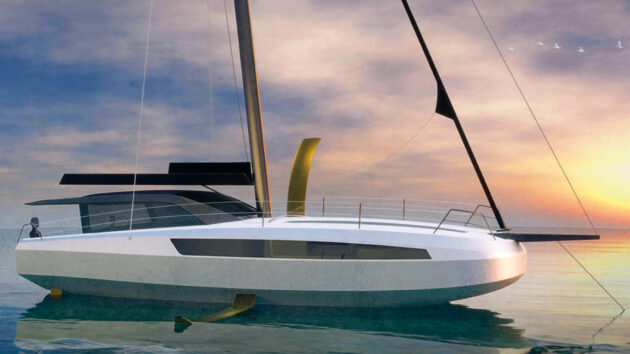
Skaw Paradise is designed to sail relatively level and maintain high average cruising speeds
Skaw Paradise
Two-and-a-half years ago, we reported on a bold new concept for a cruising scow called the Skaw Paradise, set for launch in late 2024. It would measure 11.3m (37ft) but borrowed heavily from the Mini 6.50 to offer electrifying semi-foiling performance. By the time you read this, the first hull should be in the water, its distinctively blunt-bowed form tearing up the brine off Brittany.
If there has been a delay, says Benoît Marie, the offshore racer and off-the-wall thinker behind the Skaw, it’s due to a client coming on board with a specific set of demands. It now measures 11.95m and has a fold-down bathing platform. “We have done things properly,” says Marie. “After starting the design work, we found a client who asked us to adapt the design to his wishes, so we’ve gone deep into optimising many systems.”
Built under contract by the Grand Large group (Outremer, Gunboat, RM etc), the hull is in glass-epoxy with carbon reinforcing where it is necessary around the foil and structure. “We didn’t want a full carbon boat for cost and acoustic reasons,” Marie adds. No expense has been spared where it counts, with carbon foils and keel, North 3Di carbon sails, ECsix carbon rigging with Sailmon load pins and a Hall Spars mast.
Manually operated C-shaped carbon foils provide powerful lift, doing the work of a heavy keel in terms of righting moment and keeping the boat unusually level. And by opting for a lighter lifting keel, it requires less sail (64m2 main and 184m2 spinnaker) and a shorter mast to accelerate. It will manage 25 knots in a blow, but the aim is to provide consistent passage speeds of 15 knots, says Marie.
Though he admits the very flat section of the bow makes for greater chances of pounding, Marie says the answer is simply to slow down in rougher conditions to ease the ride. He draws an analogy with supercars: “Your Ferrari might do 300kmh, but you still slow down for speedbumps,” he says phlegmatically. “It goes extremely fast when you crack the sheets a little. At 70° apparent, you won’t get wet but the boat goes twice as fast as close hauled.”
Unlike the race boat on which its design has drawn, the Skaw Paradise has simplified sail controls for a short-handed crew. There’s no running backstay, for instance, and the jib is a self-tacker. It has twin rudder blades with a tiller, although Marie says the design is flexible enough to accommodate almost anything – wheel steering included. When you head into port, winch the foils up inside the footprint of the boat, while the lifting keel reduces draught to 1.20m.
The Skaw also contains all the necessities of cruising life, from a decent galley to showers. The two principal double cabins are positioned aft, but the seating in that broad bow can also be converted into two further double cabins using a textile divider. “It’s a 40ft boat that offers the space of a 60ft monohull – the benefits of a multihull without the drawbacks,” Marie adds.
Skaw Paradise specifications
LOA: 11.95m 39ft 2in
Beam: 4.87m 16ft 0in
Draught (variable): 1.2-3.5m 3ft 11in-11ft 6in
Displacement (light): 5,500kg 12,125lb • Sail area (up/downwind) 109m2/248m2 1,173ft2/2,669ft2
Designer: Clément Bercault
Price: from €1.5m ex VAT
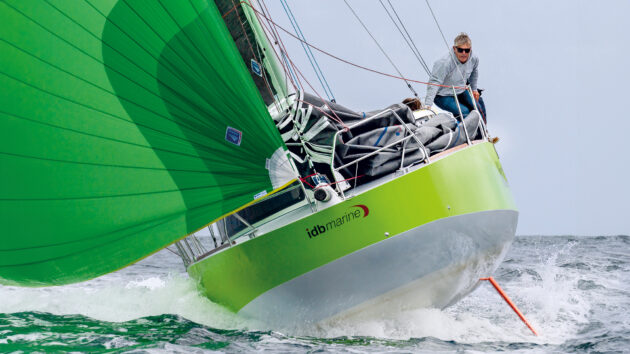
IDB Marine’s Mojito 32 is a fairly technical boat to sail well. Photo: Jakez Le Gall
Mojito 32
In a theme that comes up time and again when talking scows, the Mojito 32 is built by a small French yard to a concept inspired by the Mini 6.50. IDBMarine has carved out a niche building fast boats that offer a cruising taste of racing performance, freed from any restrictions imposed by class rules. And the new Mojito 32 has already proved a hit.
Designed by David Raison and Pierre Delion, it embraces the twin benefits of the scow form: exceptional speed and huge interior volume. It sets a big 33m2 genoa and a square-top main upwind, giving it ample power to accelerate a hull which is already light at under 4 tonnes. The lifting keel/centre plate is a more efficient solution than a bulb keel, permitting easier access to tidal waters and even the ability to dry out using the special beaching legs.
While the Mojito lacks the Skaw Paradise’s foils (see previous page), it remains a fairly technical boat to sail well. Running backstays are an option, and one you’d want for serious offshore cruising. There’s also a full three dimensions of trim for the jib sheets. In a recent sail trial the boat achieved high average speeds of around 15 knots, well reefed down in a 30-knot gale. “Contrary to received wisdom, the boat doesn’t slam on the waves,” says IDB founder Denis Bourbigot. “It passes over them.”
The five boats sold to date are in glass-epoxy, vacuum infused with a recycled PET foam core. Twin rudders are controlled by a classic offshore tiller, and there’s the option of electric propulsion. A huge lazarette to starboard would store a roll-up dinghy with ease, and the open transom is ideal for bathing. Standard layout includes a large double berth on the port quarter and a semi-open Breton double berth in the bow. It sports a raised pilothouse look, which gives panoramic views, standing headroom and brings natural light flooding in.
Mojito 32 specifications
LOA: 9.80m 32ft 2in
Beam: 3.45m 11ft 4in
Draught (variable): 1.00-2.73m 3ft 3in-8ft 11in
Displacement (light): 3,100kg 6,834lb
Sail area (up/downwind): 70m2/148m2 753ft2/1,593ft2
Designer: David Raison/Pierre Delion
Price: €191,038 ex VAT
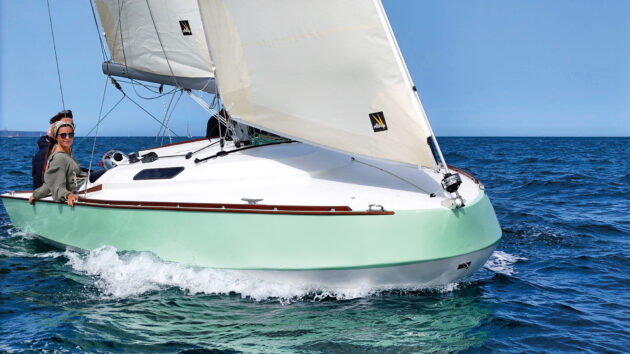
Z’TOON 5.50
Built by a traditional wooden-yacht boatyard in Saint-Briac, Brittany, the eccentrically named Z-Toon is at present a rather elaborate one-off for a determined client, although Grand Largue is hoping to build more. The boat follows the same logic of turning the scow form to cruising ends, but this time designer Guillaume Verdier has shrunk the concept to the scale of a dayboat.
He’s a man who understands racing sailing, having signed some of the most innovative designs of recent years, from Magic Carpet e to Gitana 18. But the challenge here was different: packing in a lifting keel, twin rudders and planing performance to a boat just 18ft long.
Grand Largue built the boat in cold-moulded plywood epoxy for a total weight of just 730kg – around 180kg of which is ballast.
Spars are in aluminium and the mast is reduced to 8.80m to suit the owner’s wishes, while running rigging is in Dyneema. The roller-furling jib is on a self-tacker, with the 10.8m2 mainsail small enough to go on a cam cleat.
The boat is designed to make the most of heavily tidal waters by drying out – either for a weekend away or simply on a mud berth. She has a very basic interior which allows two to sleep, and provides stowage for sails. Outboard powered, it is now for sale.
Z’TOON 5.50 specifications
LOA: 5.50m 18ft 1in
Beam: 2.63m 8ft 8in
Draught: 0.50m 1ft 8in
Displacement: 730kg 1,609lb
Sail area (up/downwind): 18.9m2 203ft2
Designer: Guillaume Verdier
Price: €36,000
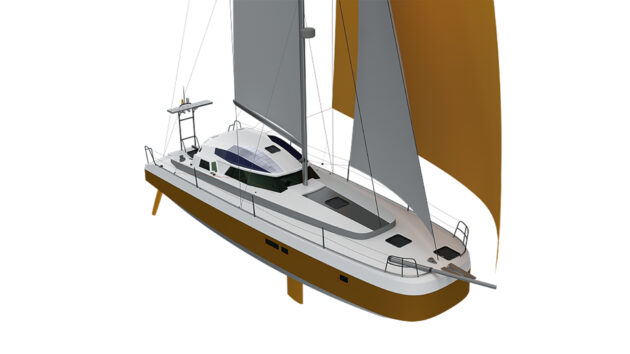
The Seascow is primarily aimed at cruising couples who want the go-anywhere capabilities of an aluminium build
Seascow
An interesting take on the scow is taking shape in aluminium at north Brittany yard Bord-à-Bord. The 32ft Seascow is designed to be a first, combining scow performance with the go-anywhere capabilities of aluminium for true bluewater cruisers.
Gildas Plessis is the designer behind the concept, and he has a string of scow projects behind him in various racing classes.
With the Seascow, there’s the option of a lifting keel, bilge keels or a fixed keel, and the transom-hung rudders can also be raised. High coamings make for a cosy cockpit with a central winch pedestal and a tiller. A large domed doghouse slightly reminiscent of an IMOCA contains a fantastic, raised navigation station, with a passage berth to port and a compact galley to starboard.
With the extra weight of the alloy construction, the Seascow has to pack a taller mast and larger sail area than some of the other boats mentioned in these pages. But performance is still punchy, and it should match other scow types from around 15 knots of true wind, according to co-owner of the yard Loïc Cheynet. A retractable bowsprit allows you to launch a big reaching or downwind sail, and there is a drop-down bathing platform aft.
Below decks, the design uses that broad scow bow for a good double berth, separated by a half frame from the saloon. This space can also be portioned off into two narrower doubles, encroaching a little on the saloon.
The seats here can also serve as convertible berths for four, but the concept is fundamentally for a cruising couple.
Seascow specifications
LOA: 9.99m 32ft 9in
Beam: 3.33m 10ft 11in
Draught: 0.6-2.2m 2ft 0in-7ft3in
Displacement: 6,000kg 13,228lb
Sail area (up/downwind): 69m2 743ft2
Designer: Gildas Plessis
Price: from €399,200 ex VAT
 If you enjoyed this….

Yachting World is the world’s leading magazine for bluewater cruisers and offshore sailors. Every month we have inspirational adventures and practical features to help you realise your sailing dreams.Build your knowledge with a subscription delivered to your door. See our latest offers and save at least 30% off the cover price.
Note: We may earn a commission when you buy through links on our site, at no extra cost to you. This doesn’t affect our editorial independence.