



The capsize of the Ultime foiling trimaran is the latest incident in a, so far, incident-packed Route du Rhum race. Helen Fretter reports.
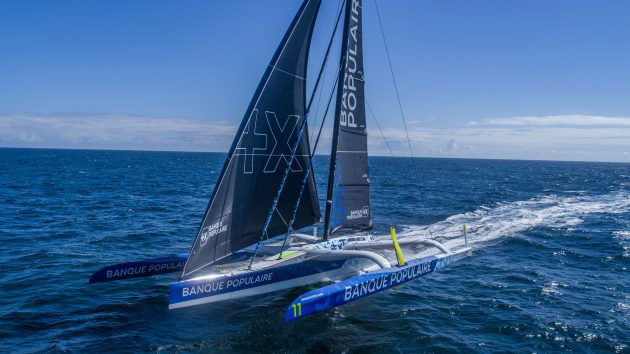
In another twist in this year’s eventful Route du Rhum – Guadaloupe, the giant trimaran Maxi Banque Populaire XI capsized this morning around 5:30 a.m. while sailing 550 nautical miles northwest of the Azores.
Race organisers have confirmed that skipper Armel Le Cléac’h is safe inside the boat and uninjured. He was able to activate his distress beacon and is in contact with his shore team.
The race statement continued: ‘A rescue operation, coordinated with race control, is underway by CROSS Jobourg and MRCC Boston. Everything is being done to quickly provide assistance to Armel.’
This is the latest incident in the solo transatlantic ocean race. While the fleet of solo skippers met benign conditions leaving the Bay of Biscay, high pressure systems in the North Atlantic have resulted in the fleet heading much further north west than usual, which puts Banque Populaire XI at around 42 deg N, meaning Le Cléac’h is likely to face colder sea temperatures than on a usual tradewinds trajectory.
The unusual conditions have resulted in other retirees being scattered across the North Atlantic. Charles Caudrelier’s Maxi Edmond de Rothschild / Gitana 18 is currently north of the Azores, after retiring his brand new Ultim following foil damage.
Meanwhile Anthony Marchand’s Actual Ultim 4 is in Galway on the west coast of Ireland, also having retired.
Other previous incidents include the capsize, and subsequent safe rescue, of ocean racing legend Francis Joyon from his ORMA trimaran, and a collision between the Initiatives Couer IMOCA and 75ft trimaran Use it Again shortly after the start.
IMOCA skipper Jérémie Beyou, one of the race favourites on Charal, has also retired for medical reasons.
Ultim race
At the time of the capsize, Le Cléac’h was in a strong position racing Tom Laperche on SVR-Lazartigue at the front of the Ultim fleet.
Before the incident, race leader Laperche spoke to race organisers, giving an indication of how challenging conditions were for the solo skippers on the 100ft foiling trimarans:
“Banque Populaire has closed the gap—they’re not far behind now!
“We’ve had some incredibly tough conditions on this leg, with highly unstable wind. At times, we were caught out by small low-pressure pockets, leaving us almost dead in the water—with the wind coming from behind, which was completely unexpected.
“And in the pitch-black night, it’s not easy to figure out what’s happening! We went from zero knots to 30 knots—with full sail up!
“We didn’t have much luck during that sequence, and we struggled to maintain a good average speed. Still, managing to stay slightly in the lead is a positive. Now, we’re approaching another weather transition, which will involve a tack within a low-pressure system. We need to get the boat and the maneuvers ready to cross this zone without too much trouble.
“After that, we should hit a stretch of high-speed sailing, with 20 to 30 knots of wind. It’ll likely remain quite volatile, but we should be able to keep the boat moving more consistently.
“And, of course, there’s still a long way to go—there are several more transitions to navigate before we reach the other side.”
Gitana: serious foil damage
Meanwhile the team behind Gitana 18 has confirmed that the innovative, newly launched trimaran has suffered serious damage to its port ‘Y’ foil.
According to the team, composite layers along the trailing edge of the foil shaft had been torn away, also ripping off the hydraulic hoses connected to the foil.
“From Charles’s account and the first photographs he sent us, we quickly realised that the damage was serious,” reported team manager Cyril Dardashti.
“Its extent and location, high up on the foil shaft, meant that there was absolutely no possibility of him carrying out repairs alone at sea, or of our technical team making a quick and effective repair along the course.
“What we can confirm at this stage is that the damage was not caused by a collision with an external object. These appendages are innovative, and the systems that accompany them are unprecedented on this type of offshore multihull. Sometimes that’s part of innovation.”
 If you enjoyed this….

Yachting World is the world’s leading magazine for bluewater cruisers and offshore sailors. Every month we have inspirational adventures and practical features to help you realise your sailing dreams.Build your knowledge with a subscription delivered to your door. See our latest offers and save at least 30% off the cover price.
Note: We may earn a commission when you buy through links on our site, at no extra cost to you. This doesn’t affect our editorial independence.