


French skipper Alexis Loison spent two decades chasing one elusive dream before securing a historic win in the Solitaire du Figaro
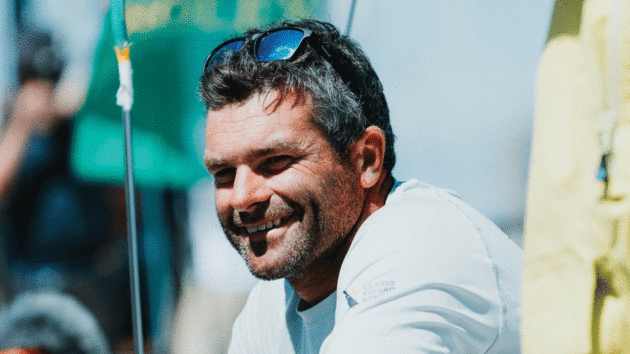
Most sailors would have simply given up, but Alexis Loison kept coming back. For 19 editions of La Solitaire du Figaro the Normandy skipper Alexis Loison held one dream, and an iron will.
The Solitaire du Figaro is, unquestionably, one of the most mentally gruelling races around. Solo, offshore, across enormously tidal and tactical waters, in a one-design fleet barely separated by minutes, the smallest slip of boat handling or lapse of concentration can see boats plummeting down the leaderboard. Or worse – slamming into rocks, beached on sands, races ended, dreams shattered.
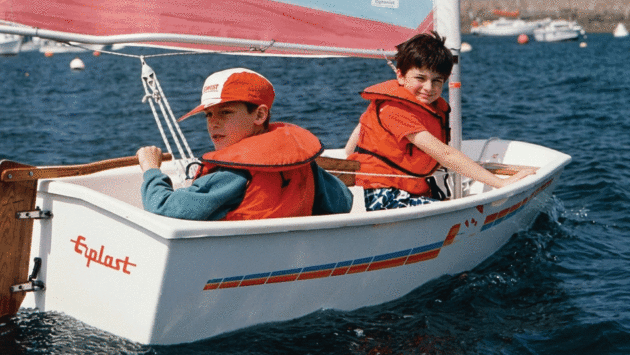
A young Alexis Loison skippering a homemade boat. Photo: Loison family
Over 20 years, Alexis Loison raced it again and again. Often he finished within touching distance of the podium, other years the race ended in disappointment.
Finally, in 2025, he won the race he had coveted since childhood. But that year he also claimed his second overall Rolex Fastnet Race and a ground-breaking Rolex Sydney Hobart win, confirming his place as one of the most complete offshore sailors of his generation. Now he has a new Class40 and eyes on this year’s solo Route du Rhum. So what makes him so competitive?
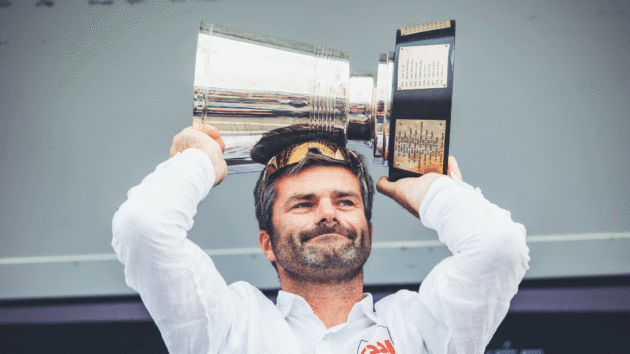
Emotional celebrations after winning the 2025 Solitaire du Figaro on his 19th attempt. Photo: Armel Vrac/Solitaire du Figaro Paprec
Sailing’s in the blood
Loison, now 42, grew up deeply immersed in the sailing world. “My father is a sailing enthusiast and a very knowledgeable amateur racer,” Loison says. “I was taken cruising from a very early age – I went to Scotland on a Gib’Sea 90 when I wasn’t even a year old. We often went on weekend trips to the Channel Islands, crossed the English Channel and visited Ireland. I was hooked straight away and I’ve never been seasick in my life!
“My father used to take part in RORC races with his boat Billy Bones, so I heard plenty of stories about the regattas. But from the age of 10, I wanted to do La Solitaire du Figaro. My grandmother would cut out pages from Le Figaro (newspaper) dedicated to the race for me – I still have them. It was my bedside book; I’d read the articles and look at the photos of the sailors who were completely exhausted on arrival, at the end of their tether.
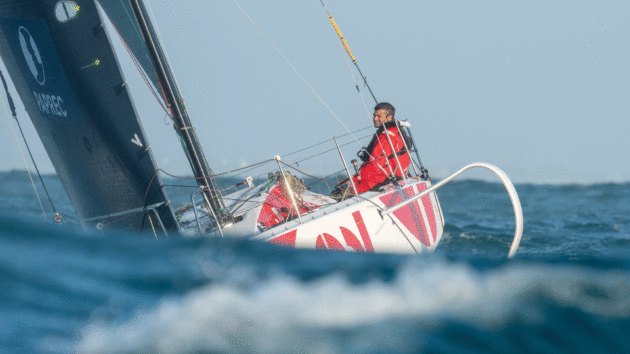
In his element: Loison starting Stage 2 of the 2025 Solitaire du Figaro Paprec. Photo: Mathieu Rivrin/Solitaire du Figaro Paprec
“And I’d say to myself, ‘that’s what I want to do’. I don’t know why, but it was like a revelation. Identical boats, four legs, always starting from scratch – or almost – for me, that was, and still is today, THE benchmark in racing.”
Like many top offshore racers, he had grown up around bigger boats, but his first move into keelboat racing highlighted some skills gaps.
“My first regatta was between high schools with a First Class 8 at La Trinité-sur-Mer. I realised I was good at handling the boat but wasn’t very good at the starts. I signed up for Laser training and improved. But I was starting from scratch because I didn’t have that feel for the tiller that the Optimist gives you; I learnt on the job.
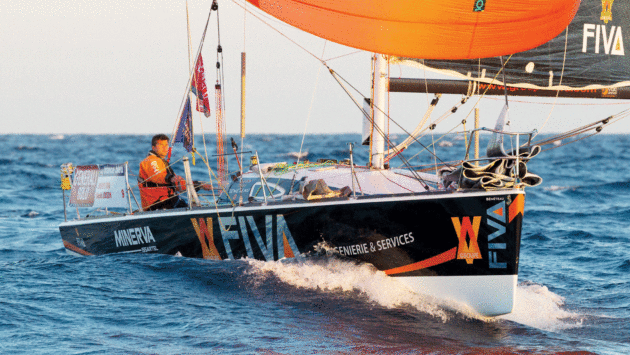
On Groupe Fiva winning the Generali Solo race in 2015. Photo: Alexis Courcoux/Generali Solo
“In Cherbourg, there’s a very strong sailing culture, particularly with the yacht club, which I’m still a member of. Back then, there were First Class 8s available. So we set up our own projects to compete in the French Espoirs Championship, the Spi Ouest France, and the Tour des Ports de la Manche. We were doing well, winning legs, and I was getting more and more into it.
“Then I met Alexandre Toulorge, who has since passed away. I went to give him a hand preparing his Figaro. He started trusting me with the delivery runs and, in 2005, he offered me the chance to do the Tour de Bretagne double-handed with him. That’s when I was really convinced I wanted to do the Figaro. In 2006, as if by fate, the Solitaire du Figaro started from Cherbourg. So I told myself it was now or never.”
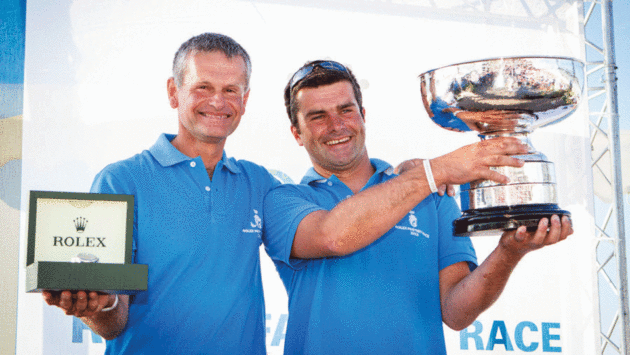
Prizegiving after winning the 2013 Rolex Fastnet Race overall with his father Pascal, the first double-handed team to do so. Photo: Tom Gruitt/RORC
Figaro dreams
His single-handed training was initially slightly covert. “My dad had owned a Figaro 1. He wasn’t really aware I was borrowing it, but turned a blind eye!
Then In 2006, I managed to hire a Figaro 2 and set off. My first race was the Concarneau Solo, where I made a brilliant weather call and finished 5th out of 25, so I was absolutely delighted.
“There was another race where things didn’t go so well, but I’d qualified and was at the start of La Solitaire, on a shoestring budget, thanks to the city of Cherbourg and the Normandy region.
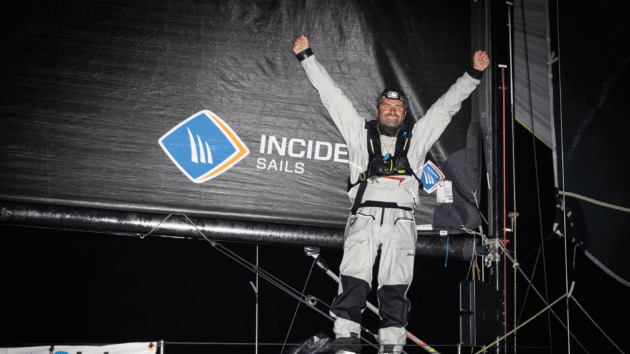
Loison winning the 2025 Solitaire du Figaro. Photo: Vincent Olivaud/Solitaire du Figaro Paprec
“With all the pressure, I think I had the worst start of my life! But in the end, I finished every leg and pulled off a few impressive moves that helped me make a name for myself. Above all I had a brilliant time; I’d realised my first dream, to sail La Solitaire. But then the dream evolves… you have to win it.
“It just took a bit of time,” he smiles.
More progress came in 2012, when he joined the Pôle Finistère Course au Large. “That really helped me step up my game. You find yourself racing against the best Figaro sailors. You get access to weather forecasts before the start, and Jean-Yves Bernot advises you on the best strategies.
“When I first joined the centre, I’d never had the budget to buy Adrena (routing software). There, everyone had it, so I had to buy it, and within a fortnight I knew exactly how it worked.
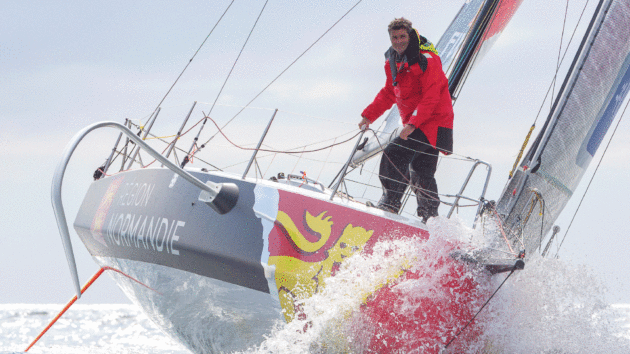
Training on board the then-new Figaro 3 class in 2019. Photo: Jean-Marie Liot/ALeA/Getty
“Throughout the winter of 2012, I shared a flat with Paul Meilhat, Yoann Richomme and Corentin Horeau. Over our plates of pasta after the day’s training, we’d go through the debriefs again. It really helped me take a big step forward. And then, as the results started coming in, I found sponsors – it’s a virtuous circle. In 2014, I won my first leg and started being mentioned among the favourites… but there are always more favourites than winners.”
That point was sorely reinforced in 2023.
“Finishing in Roscoff, I remember being in the lead with a comfortable advantage. Corentin Horeau, the eventual race winner, and Basile Bourgnon, the eventual leg winner, were 35 and 40 miles behind, which in the Figaro class is a massive gap. And in the end there was a huge wind shift at the finish line and I lost 15 hours!
“I admit it took me a while to get over that. It taught me to be wary, to push myself right to the end, and never to rest on my laurels. That helps me in lots of other sailing events, or even in life.”
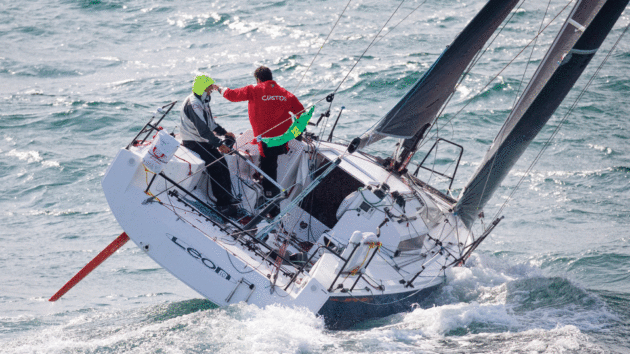
In the 2019 Fastnet with Jean-Pierre Kelbert on the JPK 10.30 Leon. Photo: Carlo Borlenghi/Rolex
History-maker
Outside of France, the Loisons came to wider attention when Alexis and his father Pascal won the Rolex Fastnet Race overall on IRC in 2013 – the first time in the race’s 88-year history that it was won by a two-handed crew. On the JPK 10.10 Night and Day, they finished in Plymouth in 3 days and 18 hours.
To those who’d been paying attention to the double-handed results, however, it was little surprise – the father-son duo had won the Fastnet two-handed fleet three times previously. In total Alexis has won the division eight of the 11 times since it was introduced in 2005.
In 2025 he made history again, becoming the first double-handed team to win the Rolex Sydney Hobart Race overall with Jiang Lin on Min River. His long list of crewed victories also include Sydney Hobart and Middle Sea Race class wins. How does Alexis compare the solo and double-handed disciplines?
“In solo racing, you have to be good at everything: manoeuvring, strategy, helming, tuning the sails, you can’t rely on anyone else. In double-handed racing, you learn a great deal from sailing with others, but it’s the same: you have to be able to do everything. I love solo, double-handed and crewed racing, and I’d find it hard to stick to just one of the three disciplines. That’s one of the strengths of ocean racing: the variety.
“In double-handed racing, it’s really important to complement each other. That’s why my best years in double-handed racing were with my father. In 2021
I teamed up with Guillaume Pirouelle. Apart from the 2025 Figaro, 2021 was my best race (4th overall) and that’s clearly down to him because he pushed me on so many things. He came from dinghy sailing, and he’s one of the best helmsmen I know.
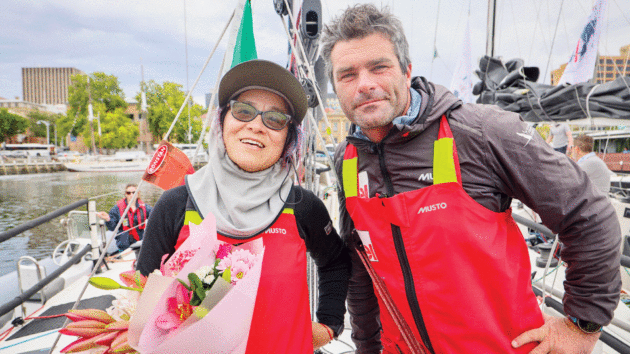
With Jiang Lin in 2025 as the first double-handed pair to win the Rolex Sydney Hobart Race. Photo: Salty Dingo/RSHR
“He drove the boat at 100% and I made sure it was set up properly, handling all the strategy.
“Then with Jiang Lin on the Sydney Hobart, in her role, she was top-notch. And she really knew her boat inside out. Those who are surprised by my results in double-handed races against crews wonder how I manage it. My answer is always the same: I come from the best ocean racing school in the world: the Figaro.”
Loison is also renowned for pushing his boats to a very high level of performance; how does he continually raise the bar? “I can’t stand it when the polar curve isn’t 100%. That, once again, is the Figaro way. We’re so used to thinking that every detail matters that we end up applying that mindset to other areas as well.
“Sometimes, when I’m sailing on foreign boats, there’s seaweed in the rudders, and it doesn’t bother the skippers too much, whereas it drives us mad. On a RORC race where you had to navigate through the rocks, only the French went for it, because every metre gained is important for what comes next.”
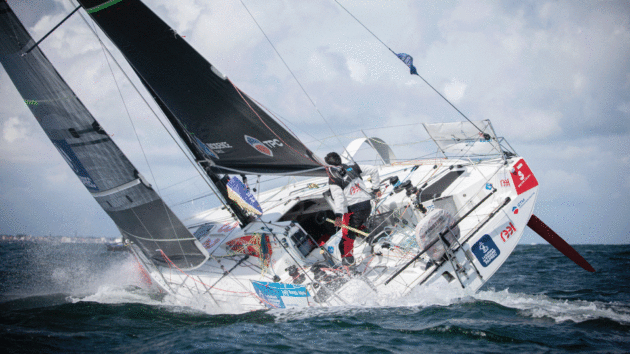
On Réel Groupe in the 2023 Solitaire du Figaro. Photo: Lou Benoist/AFP/Getty
Dream return
In 2025 Loison scored a hat-trick, with Figaro, Fastnet and Sydney-Hobart wins. The Fastnet was special – winning into the race’s new finish port of Cherbourg, his home town and region which had supported him for so many years. But the Figaro victory was the culmination of a life’s work – dominating to finish 1st, 2nd, and 1st in the three legs.
“I always had a little voice, every year, telling me to keep going, keep going, you’ll make it. Finally, I’m doing it,” said an emotional Loison at the finish.
Reflecting on last season, how does he explain his success? “You can never claim you’ll win the Fastnet overall, even with the best boat in the world, because the weather is the deciding factor. There are huge differences between a 100ft crewed yacht, a 9m double-handed boat, and, in between, the TP52s. Some boats will be comfortable running downwind, others upwind, and none will encounter the same weather.
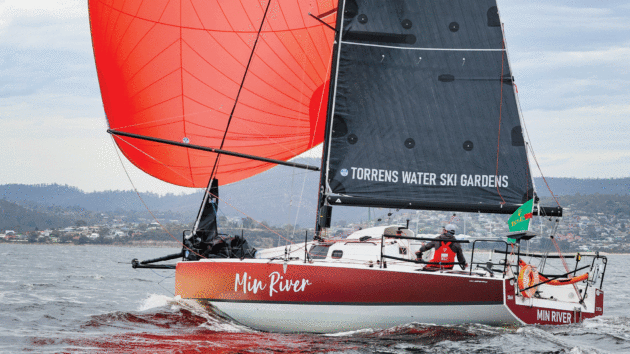
Photo: Salty Dingo/RSHR
“Our race went really well because the new JPK is a high-performance boat and Jean-Pierre Kelbert and I know each other well; we’d trained a lot and I’d been in charge of the whole sail development. And we pushed the boat to 100%. At the Fastnet [Rock], we were well placed, nothing more, but we were among the few to hoist the full spinnaker when it was 25 knots.
“After that, it was a run to the Raz Blanchard, where we arrived at the ideal time. It’s the same on the Sydney-Hobart; it’s all about the weather.
“On the Solitaire, it’s different; I think that with Corentin Horeau we finished every leg on the podium – we were really head and shoulders above the rest. It’s been years of hard work and it’s finally paid off. I had a good feeling about it; I’d trained hard, without overdoing it either, because I wanted to keep my enthusiasm. I was really calm in my decision-making; I didn’t look at what the others were doing.
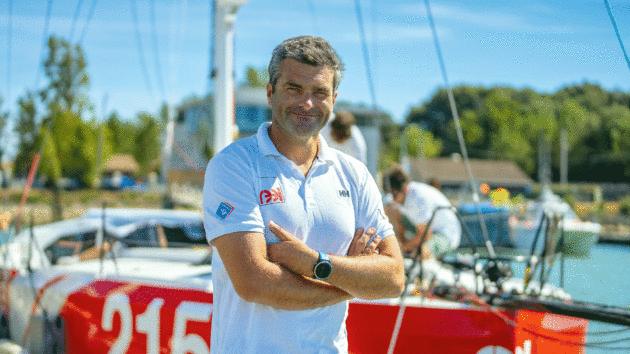
Loison at the launch of his new Lombard-design Lift 40 for the Route du Rhum. Photo: Laura Evrat/Groupe Réel
“You need a bit of luck, and the first leg went really well – the English Channel is really my playground. In the second leg, I [was OCS] set off last, and managed to catch up with everyone. At the finish, the wind dropped and Charlotte Yven, who was 0.3 miles behind me, lost 20 minutes. In the final leg, I could see that some people had lost faith.
“I’d worked out that you had to be in the lead after 24 hours. So I pushed myself hard on the first night; I came out of it exhausted, but I was in the lead. Thus, I extended the gap because I had better conditions. Towards the end, I was home; I wasn’t even looking at the chart anymore, I knew exactly where I wanted to go.”
Article continues below…

‘It’s completely crazy!’ Irish sailor Tom Dolan takes historic Solitaire du Figaro victory
Irish skipper Tom Dolan said that he wanted to cry with joy as he secured a historic win in La…
Inside Jazz Turner’s solo circumnavigation around Britain
On June 29 a lifeboat crew was attending a multicoloured little yacht that had run hard aground off Folkestone, on…
Ever-improving
In between racing, Loison now works as Incidence Sails. “I’ve always told myself that if I ever had to stop ocean racing, there’s one area that interests me: sailmaking – even though I’d never sewn a sail in my life. It’s the boat’s power, and I think a sail is magnificent to trim. There are so many variables; I don’t know how many photos of sails I have on my phone!
“In 2019, Fred Duthil [of Incidence] suggested we race double-handed together; we won the Tour Bretagne.
I don’t know a better sail trimmer than him; he taught me to get a better feel for the boat at the helm. My time at Incidence Sails has helped me improve tremendously in all aspects of sail trimming. Fred told me: ‘You’ll enjoy getting back to sailing so much that it’ll set you free’, and that’s exactly what happened.”
With Jean-Pierre Kelbert, finishing the 2025 Rolex Fastnet Race as overall winners. Photo: Armel Vrac/Rolex Fastnet Race
This year, his focus will be on the Route du Rhum, thanks to ongoing sponsorship from Groupe Réel. “It’s going to be a real battle on the Route du Rhum, but no risk, no reward!”
After that? “I’m also looking more and more at the IMOCAs. The boats look fabulous. Over the years, the Vendée Globe has become a sort of global Solitaire
du Figaro.
“And then there’s the Solitaire du Figaro… if I can go and win another one. I’ve always said I’d do at least 20.”
 If you enjoyed this….
Yachting World is the world’s leading magazine for bluewater cruisers and offshore sailors. Every month we have inspirational adventures and practical features to help you realise your sailing dreams.Build your knowledge with a subscription delivered to your door. See our latest offers and save at least 30% off the cover price.
Note: We may earn a commission when you buy through links on our site, at no extra cost to you. This doesn’t affect our editorial independence.