



Stu Bannatyne explains how to make the most of your sail crossovers and IRC rating to Andy Rice
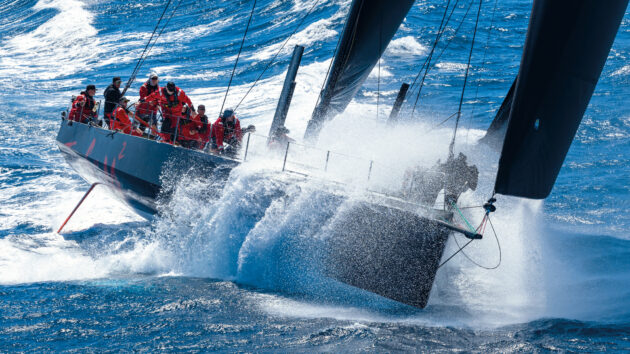
Maximising the benefits of your training time is one of Stu Bannatyne’s mantras. Drawing on his wealth of offshore racing experience, he likes to bring the highest level of preparation to any campaign that he’s involved with. “One of my recent programmes has been with the Volvo 70 Tschüss 2,” he says. “We ended up doing a couple of Transatlantics, a RORC Caribbean 600, a Gotland Runt, a Rolex Fastnet Race, and a few others in between.
“All of these were raced under the IRC rule. So we were looking for ways to optimise the boat’s performance under IRC, which is just a single number rating.
“One thing was to identify for each race what configuration made the most sense, and really leaning on the fact that the Volvo 70 has a very strong performance profile, both in real terms and in rating terms. As soon as the wind is over 15 knots it’s pretty competitive in all directions.
“We were looking to optimise the boat’s performance in those conditions that it’s going to do well in to make sure it does really well, and then just try to plug a few holes in the lighter airs.
“Making the most efficient use of the time you have is critical to achieving the best results. As always, you want to turn up to the start line of each race better prepared than anyone else, knowing your boat and your sail inventory and how all the crossovers work the best, having practised enough manoeuvres so you can do smooth and efficient sail changes.”
Identify rating wins
Whatever boat you’re racing, if you’re coming under IRC or a similar rating system, you’re always looking for your biggest gains from your performance versus rating perspective. In the case of faster boats like a Volvo 70, I was surprised that no one appeared to be doing much with flying headsails under IRC.
These specialist sails have tended to be more common on some of the 100-footers that didn’t care about rating and were just going for line honours. But after testing them we ended up with two on the Volvo 70: a masthead version and a fractional version. It’s basically a big masthead genoa that doesn’t come with a rating penalty of a typical masthead genoa, because it has a 60% mid-girth and is allowed by IRC.
Rate ‘down’
The fractional version of the flying headsails has quite a big sweet spot. When we did the Transatlantic Race it meant we could rate with no ‘headsails’ (as IRC defined headsails). So our rating was quite low and we ended up running the whole way.
The RORC Caribbean 600 was another: after looking at the forecast we chose to rate with no spinnakers because the use we’d get out of them wouldn’t justify the rating increase. Our big masthead flying headsail was our downwind sail. We didn’t go so great with it when it was VMG running in 12 knots, but for the low percentage of the overall race it was a penalty worth paying, and the overall result (winning) showed it was a good decision.

Heavy weather greets the reefed Palby Marine out of The Solent and past The Needles during the 2023 Rolex Fastnet Race. Photo: Paul Wyeth/RORC
Reef early
As a general rule, people probably carry too much mainsail before reefing – you want to reef earlier than you think, but it comes down to what you’re trying to achieve. Typically, if you’re trying to go VMG upwind, you’ll carry a full main for longer and put a smaller headsail on just so you try and keep some rudder angle and keep your upwind performance going. But as soon as you start reaching, take some area out of the main earlier to get the centre of effort down (and forward) and actually unload the rudder a bit.
Depending on the sails that are on the boat, some of the time we might be reefing the main in as little as 14 or 15 knots of wind if we have a big headsail and multiple staysails on at the front. As a general rule, it’s great to keep the power in the front of the boat.
Balance the rudder
We’ve talked about putting the power further forward in the sail plan, and the aim is to create balance in the rudder and make it easier to keep the boat in the groove. Twin-rudder boats are a lot easier to sail when pressed-up reaching, but single-rudder boats can be quite tricky. So the more load you can keep in the front, the less rudder angle is required to keep the boat under control.
Adding a staysail in there really helps settle things down and improves the balance. As soon as you start getting overpowered, just drop a reef in the main. It’s a great tool just for dealing with gusts and so on; full main, one reef, even two reefs, without changing anything on the front. It’s a way to avoid the downtime of more expensive sail changes up front.
Calibrate crossovers
You’re always up against it with training hours, so you’re looking to get maximum value out of that precious time. As a general rule, focus on the conditions you expect to see in the race. Before a big offshore race we’ll look at the forecast for the first couple of days of the race. Then we’ll aim to simulate those conditions in our first few testing days so we have confidence in doing the best we can on the first day or two of the race.
By having very recently sailed in those conditions and testing those crossovers, we know when we come off the start line exactly what sail is going to work and exactly when to change to the next one, and so on.
 If you enjoyed this….

Yachting World is the world’s leading magazine for bluewater cruisers and offshore sailors. Every month we have inspirational adventures and practical features to help you realise your sailing dreams.Build your knowledge with a subscription delivered to your door. See our latest offers and save at least 30% off the cover price.
Note: We may earn a commission when you buy through links on our site, at no extra cost to you. This doesn’t affect our editorial independence.