Cruising guru Jimmy Cornell transits the North West Passage in Aventura IV
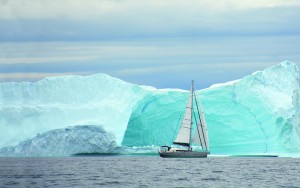
The North West Passage has been described as the Everest of sailing. Since Roald Amundsen’s successful transit in 1903-1906, a total of only 94 sailing boats have been able to follow his example. For every sailor who has sailed the North West Passage, 12 climbers have scaled the highest mountain in the world. In the history of maritime exploration no other part of the world has proved to be more difficult and has taken longer to conquer. The reason is quite simple: in spite of all the advances in boat design, technology and methods of navigation, the challenges faced by those sailing in the high Arctic have remained basically the same. Climate change, the effects of which are more obvious in the Arctic than anywhere else in the world, has certainly played a role in making conditions for a successful transit somewhat easier but, as I found out myself on my first attempt, however well prepared you might be, Mother Nature still has the last word. Compared with other high-latitude destinations where I have sailed in the past, the challenge posed by the North West Passage is entirely different. Whereas elsewhere the success of a voyage depends primarily on the experience of the skipper and crew, as well as the suitability of the vessel, in the North West Passage there is one major factor that is entirely out of your control: ice. Centuries of failed expeditions have resulted in a well-defined strategy for a transit, but sailors are still entirely at the mercy of ice conditions. During the short summer season, the sea ice, which has formed over the long winter, as well as the old ice left from previous winters, melts to a greater or lesser extent. East to west passage The ice normally retreats from west to east (Pacific to Atlantic), which means that in most years the eastern section of the North West Passage is the last to become ice-free. If planning an east to west passage, as I did in 2014, the way to deal with this is to arrive in July and wait until the ice has retreated to such an extent that a transit may be safely attempted. In recent years, the main hurdle has been Peel Sound, the symbolic exit for boats coming from the west, and the gateway to the Passage for those from the east. This potential choke-point has been entirely blocked by ice during the last two summers, although some boats have managed to bypass it by using the shortcut of Bellot Strait. Unfortunately, in 2014 Aventura was not among them, as I decided to abandon my attempt. The lateness of the season meant that, even if we could get through, we would have to overwinter somewhere in Arctic Canada or Alaska. The prospect of ten months of virtual imprisonment was something I was not prepared to accept. (See our feature on Jimmy Cornell’s boat Aventura, designed specially for this voyage.) The disappointment of having failed to reach the Pacific … Continue reading Cruising guru Jimmy Cornell transits the North West Passage in Aventura IV
